MENU
MENU
 Nasze ceny

 Przeczytaj fragment on-line

-
 nowość
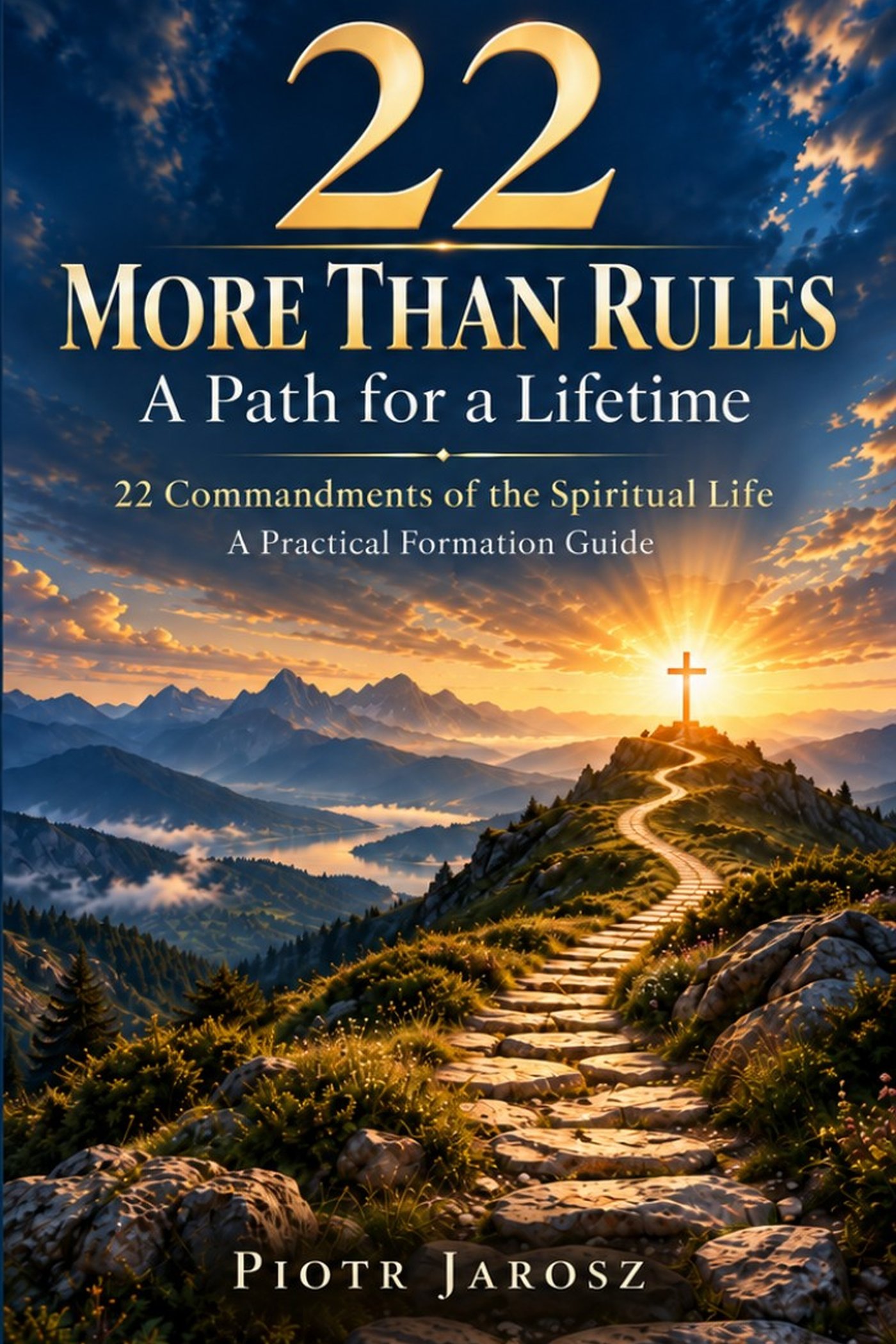
22. MORE THAN RULES. A Path for a Lifetime. - ebook
22. MORE THAN RULES. A Path for a Lifetime. - ebook
What if you do not lack faith—but simply need a path you can truly follow? “22. More Than Rules” is a practical guide for anyone seeking a deeper relationship with God, greater inner peace, and clear spiritual direction. Through biblical reflections, meaningful questions, exercises, and prayers, Piotr Jarosz explores 22 essential areas of Christian life—including forgiveness, humility, gratitude, discernment, hope, and love for others. You do not have to change everything at once. Begin with one honest step—and then take another.
Ta publikacja spełnia wymagania dostępności zgodnie z dyrektywą EAA.
| Kategoria: | Wiara i religia |
| Język: | Angielski |
| Zabezpieczenie: |
Watermark
|
| ISBN: | 9788398337731 |
| Rozmiar pliku: | 194 KB |
FRAGMENT KSIĄŻKI
AUTHOR’S PREFACE
TO YOU, WHO ARE HOLDING THIS BOOK
I don’t know who you are. You may be at the beginning of adult life, or at a stage where you’re asking, with new clarity, about meaning, direction, and what truly matters. You may work at home, at a school, in a hospital, in a shop, in an office, in a factory, at a university, or you may run your own business. You may live in a big city, a small town, in the countryside, or far from the place you call home.
You may be experiencing peace, gratitude, and strength today. Or you may be carrying tiredness, loss, loneliness, tension, uncertainty, or questions you have no one to share with. You may believe strongly, believe with difficulty, be returning after years away, or simply be searching for words to express the longing that there must be more to life.
I don’t know your story. But I know that you’re reaching for this book because you’re searching for a path. Perhaps you’re searching for God. Perhaps for peace, meaning, inner order, or the strength for another day. That is enough to begin.
The spiritual life is not reserved for people without problems, for the exceptionally disciplined, or for those who always know how to pray. It grows within ordinary life: between work and home, duties and rest, joy and crisis. It does not require perfection. It requires honesty and a readiness to return.
This book does not offer a quick fix. It offers a path: small steps, practices, questions, and prayers that can be integrated into real life. You can read it slowly, choose chapters according to your current need, and return to them whenever life becomes complicated.
If you have doubts, remember: doubts do not disqualify you from the path. If you are tired, you do not have to prove your strength. If you have fallen, you do not have to start from scratch. One more honest step is enough.
You are not alone. And this path doesn’t begin with a great achievement. It begins with a simple “yes”: I want to search, I want to listen, I want to return.
Piotr Jarosz
Sanok, September 8, 2026INTRODUCTION
WHY THIS BOOK?
I am writing this book because I myself needed a simple and honest guide to the spiritual life — one that doesn’t promise instant transformation, but helps bring order to daily life: prayer, relationships, forgiveness, rest, hope, and discernment.
Many people want to live closer to God but don’t know where to start. Others have started, but lost their rhythm along the way. Still others are returning after a long absence. This book is for each of them — not as a test to pass, but as a map to return to.
The title “More Than Rules” is a reminder that the spiritual life is not about ticking off practices. Rules can help, but they are not the goal. The goal is a relationship with God that transforms the way we live, love, work, rest, and make decisions.
This book guides you through 22 areas of formation. Each chapter contains a biblical foundation, a reflection, questions, exercises, and prayers. You do not need to use everything at once. Choose one small step and practice it faithfully. Over time, you can build your own realistic rule of life.
Read it in order if you need the foundations. Read it by topic if what you need most right now is help with prayer, relationships, forgiveness, or hope. Read it slowly — this is a book to be lived, not completed.
I don’t promise the path will always be easy. I promise concrete tools and one steady invitation: when you lose the rhythm, come back. Small steps, taken faithfully, matter.
HOW TO BEGIN?
Read one chapter and choose one exercise.
After a week, assess what helped you most.
After a month, put together a simple rule of life from two or three practices.
Return to the book depending on your stage of life and current needs.CHAPTER 1THE COMMANDMENT OF LOVING GOD
_“Love the Lord your God with all your heart, all your soul, all your mind, and all your strength.”
(Mark 12:30)_
1. INTRODUCING THE COMMANDMENT
Jesus points to this commandment as the FIRST AND GREATEST of all the commandments. It is not one among many, but the FOUNDATION on which the entire spiritual life rests. All other commandments, virtues, and good works flow from this fundamental relationship of love for God.
In this chapter, you are invited to reflect deeply on what it means to love God “with all your heart, with all your soul, with all your mind, and with all your strength.” This is not a call to perfect feelings or heroic sacrifice, but to ORIENTING THE WHOLE OF YOUR LIFE toward God.
2. SPIRITUAL REFLECTION
2.1. LOVE AS A RESPONSE
Love for God does not begin with our own effort. It is a RESPONSE to the love God first showed to humanity. God does not wait for you to become worthy of love. He himself comes out to meet you, revealing himself in the Word, in Jesus Christ, in the gift of the Holy Spirit.
When you say, “I love you, Lord,” deep within your soul you are confessing: “You loved me first. You created me. You redeemed me. You do not abandon me.” Love for God is therefore AN ACKNOWLEDGMENT OF HIS PRIMACY in your life.
2.2. “WITH ALL YOUR HEART” — DESIRES
In biblical language, the heart is not merely emotion. It is the CENTER OF DECISIONS, DESIRES, AND CHOICES. To love God with all your heart means directing your deepest desires toward him. It is not about having no other desires, but about God being your MOST IMPORTANT DESIRE, the source and goal of all the others.
A QUESTION FOR REFLECTION:
What is at the center of my desires today?
Is God the first place in my heart, or just one of many important points?
2.3. “WITH ALL YOUR MIND” — THOUGHTS
To love God with all your mind means DIRECTING YOUR THOUGHTS TOWARD GOD. In a world that constantly bombards you with stimuli, information, and images, this is an act of courage and fidelity. It means choosing what you allow to influence your mind.
It is not about never having bad thoughts, but about not letting them rule you. Loving God with all your mind is a decision: “Lord, you will shape my thinking. I will not let just anything take the wheel.”
A QUESTION FOR REFLECTION:
What most often occupies my mind during the day?
What content nourishes my mind, and what depletes it?
2.4. “WITH ALL YOUR SOUL” — INNER LIFE
In biblical language, the soul refers to THE WHOLE OF ONE’S INNER LIFE — the will, the depth of the person. To love God with all your soul means engaging your whole self in that love, not only your outward actions. It is a readiness to give God what is most precious: your freedom, your choices, your very self.
Loving with all your soul also means a readiness for sacrifice when God asks it. This is not a comfortable love, but a faithful one. It is consenting to let God lead you even through difficult roads, trusting that he knows the destination.
2.5. “WITH ALL YOUR STRENGTH” — ACTION
Love for God does not remain in the realm of thought and feeling. It BECOMES FLESH in deeds. “With all your strength” means: time, energy, talents, money, work, relationships. Everything you have and everything you are becomes a space for loving God.
You don’t have to do great things. It’s enough that whatever you do, you do WITH HIM AND FOR HIM. Ordinary work, daily duties, caring for loved ones — all of this can be an expression of love for God, if it is done in union with him.
A QUESTION FOR REFLECTION:
What do I spend my strength on (time, energy, money)?
Does my action express love for God, or does it serve other purposes?
3. THEOLOGICAL DEEPENING
3.1. THE SHEMA AND THE COMMANDMENT OF LOVE
This commandment, which Jesus cites, has its roots in the SHEMA ISRAEL from the Book of Deuteronomy:
“Hear, Israel: the Lord is our God, the Lord alone. Love the Lord your God with all your heart, all your soul, and all your strength” (Deuteronomy 6:4–5).
For a Jew in Jesus’s time, this was a profession of faith recited every morning and evening. By quoting these words, Jesus confirms their foundational importance and brings them to fulfillment in the light of the New Covenant.
3.2. JESUS AS THE REVELATION OF GOD’S LOVE
In the New Testament, love for God takes on a new dimension through THE PERSON OF JESUS CHRIST. God does not merely demand love — he himself reveals it in a perfect way. Jesus, who says, “You shall love…,” is himself THE FATHER’S LOVE given to the world.
To love God in the light of the New Testament therefore means not only fulfilling a commandment, but ENTERING INTO A RELATIONSHIP WITH JESUS, who reveals just how much God loves humanity.
3.3. LOVE AND THE OTHER VIRTUES
Love for God is THE FORM OF ALL THE VIRTUES. Faith, hope, patience, humility, obedience — all of these virtues draw their meaning and power from love. Without love they become empty, as St. Paul writes:
“If I speak in human and angelic tongues but do not have love, I am a resounding gong or a clashing cymbal” (1 Corinthians 13:1).
This is why the growth of the spiritual life always begins with deepening one’s love for God. The other virtues and good works are its fruit.
4. SPIRITUAL EXERCISES
4.1. DAILY OFFERING OF THE DAY TO GOD
PURPOSE: To make of each day an act of love for God. TIME: 2–3 minutes in the morning.
HOW TO DO IT:
In the morning, right after waking, sit for a moment in silence.
Say, in your mind or aloud:
“Lord, this day is yours. Receive my thoughts, words, actions, and omissions. I want to live today for you and with you.”
Close with the Sign of the Cross.
FREQUENCY: Every morning, for at least 30 days.
4.2. THE FIRST MINUTES WITH GOD
PURPOSE: To give God the first place in the day. TIME: 5–10 minutes in the morning.
HOW TO DO IT:
Turn off your phone and other distractions.
Slowly read a passage of Scripture (e.g., Mark 12:28–34 or Psalm 63).
Pause on one sentence that moves you. Repeat it in silence.
Speak to God simply, in your own words: give thanks, entrust the day to him, ask for light.
FREQUENCY: Every morning, for at least 30 days.
4.3. EXAMINATION OF CONSCIENCE ON LOVE FOR GOD
PURPOSE: To learn to recognize where you love God, and where you flee from him. TIME: 5 minutes in the evening.
HOW TO DO IT:
Sit in silence before going to sleep.
Recall the day just past.
Ask yourself three questions:
Where did I love God today (in thought, word, or deed)?
Where did I forget about God, or wound him?
What do I want to do differently tomorrow?
Close with a short prayer of thanksgiving and a request for forgiveness.
FREQUENCY: Every evening, for at least 30 days.
4.4. A WEEK WITH ONE SENTENCE OF LOVE
PURPOSE: To learn to turn your heart toward God throughout the day. TIME: A few seconds, many times a day.
HOW TO DO IT:
Choose one sentence, for example:
“Lord, you are my center.”
“Jesus, I love you.”
“Holy Spirit, guide me.”
Repeat it throughout the day: on the way to work, waiting in line, before a difficult task.
Let this sentence be an “anchor” that turns your heart back to God.
FREQUENCY: For 7 days, the same sentence. Then you may change it.
5. PRAYERS
5.1. PRAYER OF OFFERING THE DAY
“Lord God, almighty Father, I thank you for this new day. You are my beginning and my end. Receive my thoughts, words, actions, and omissions. I want to live today for you and with you. Guide me through every hour. When joy comes — teach me to give thanks. When difficulty comes — teach me to trust. When temptation comes — teach me to watch. Through Christ our Lord. Amen.”
5.2. PRAYER FOR LOVE OF GOD
“Jesus, Son of the Father, you revealed that God is Love. Pour into my heart the gift of love for the Father. Teach me to love him with all my heart, with all my mind, and with all my strength. When my desires wander in other directions, remind me that only God can fill my heart. When my mind chases a thousand things, stop me and turn me back to you. When my hands are at work, let me work for you and with you. Amen.”
5.3. EVENING PRAYER FROM THE EXAMINATION OF CONSCIENCE
“Lord, I thank you for this day. For everything good — I saw it thanks to you. For everything difficult — teach me to see your hand in it. Forgive me where I forgot you, and where I wounded you or my neighbor. Heal me where I am wounded. Guide me through the night. In the morning, I want to walk with you again. Amen.”
5.4. PRAYER IN A TIME OF SPIRITUAL DRYNESS
“Lord, I feel emptiness and dryness in my heart. I do not feel your closeness, but I believe that you are here. Accept this prayer, which flows from faith and not from feeling. Strengthen my love when it is weak. Remind me that you love me, even when I do not feel it. Amen.”
6. SUGGESTION FOR KEEPING A SPIRITUAL JOURNAL
For this chapter, it is worth keeping a simple spiritual journal. It can take the form of a notebook or a file on your computer.
SUGGESTED QUESTIONS FOR EACH DAY (OVER 7–14 DAYS):
How did I live out the commandment of loving God today?
Where did I feel that God was my center?
Where did I turn to other centers (work, others’ opinions, fears)?
What one sentence from this chapter do I want to remember?
My short prayer for tomorrow.CHAPTER 2THE COMMANDMENT OF FAITH AND CONVERSION
_“The time has come, and the kingdom of God has come near. Repent, and believe the good news.”
(Mark 1:15)_
“FROM THEN ON JESUS BEGAN TO PREACH AND SAY, ‘REPENT, FOR THE KINGDOM OF HEAVEN HAS COME NEAR.’” (Matthew 4:17)
1. INTRODUCING THE COMMANDMENT
This call of Jesus is the first word of his public teaching. Before Jesus begins to teach in parables, perform signs, and heal, he first speaks these foundational words: “Repent, and believe in the gospel.” This is no accidental opening to his mission — it is the key to understanding the whole message of Jesus.
In this chapter, you are invited to reflect on two realities that are inseparably joined: CONVERSION (_metanoia_) and FAITH in the Good News. These are not two separate acts, but two dimensions of a single movement of the heart toward God.
2. SPIRITUAL REFLECTION
2.1. “THE TIME IS FULFILLED” — GOD’S KAIROS
The words “the time is fulfilled” do not refer to the ordinary passage of time (_chronos_), but to AN APPOINTED MOMENT IN GOD’S PLAN (_kairos_). This is the time of grace, the time of salvation, the time in which God enters human history in a definitive way through the coming of Jesus Christ.
For you today, “the time is fulfilled” means: now is the moment of grace. God is not waiting for a “better time” in your life. He comes now, in this moment, in this situation, on this very day. Do not put off conversion until “later” — because “later” may never come.
A QUESTION FOR REFLECTION:
Do I live with the sense that “now is God’s time” in my life?
What am I putting off “for later” in my relationship with God?
2.2. “THE KINGDOM OF GOD IS AT HAND”
The Kingdom of God is not only a future heavenly reality. It is the reign of God in the present — in the heart, in relationships, in work, in daily life. When Jesus says “at hand,” it means that the Kingdom is already present in Jesus himself. Where Jesus is, there the Kingdom is.
“At hand” also means: AVAILABLE TO YOU. You don’t have to search far. The Kingdom is wherever you open your heart to God’s will. It is in your home, in your work, in your relationships — wherever you let God reign.
A QUESTION FOR REFLECTION:
Where in my life do I most need God to reign?
Do I believe that the Kingdom of God can be present in my everyday life?
2.3. “REPENT” — METANOIA
The word “repent” (Greek _metanoeite_) means A CHANGE OF MIND, A CHANGE IN THE DIRECTION OF ONE’S LIFE. This is not a one-time act but a continual process. Conversion involves not only great transformations, but also small returns to God in daily life.
Conversion has several dimensions:
INTELLECTUAL: a change in how one thinks about God, oneself, and the world.
MORAL: a change in concrete actions, habits, sins.
SPIRITUAL: a change in the direction of the heart — from self toward God.
A QUESTION FOR REFLECTION:
What in my thinking needs to change?
What concrete sins or habits are calling out for conversion?
Is my heart turned toward God, or toward myself?
2.4. “BELIEVE IN THE GOSPEL”
Faith in the Gospel is not merely acknowledging that God exists. It is trust that the way of Jesus is good, that his words are true, and that his promises are certain. Faith is a relationship of personal trust in Jesus Christ.
The Gospel is “Good News” — not a list of prohibitions, not a set of demands, but THE PROCLAMATION OF GOD’S LOVE FOR HUMANITY. To believe in the Gospel means to accept that love and let it transform your life.
A QUESTION FOR REFLECTION:
Do I treat the Gospel as good news, or as a burden?
Do I trust that Jesus’s way leads to life, even when it is difficult?
2.5. CONVERSION AND FAITH AS ONE
Conversion and faith are like two breaths of the same spirit. Conversion without faith becomes moralism, an effort driven by one’s own strength. Faith without conversion becomes an empty declaration, with no change in life. Jesus joins these two calls together because he knows that true faith always leads to conversion, and true conversion always flows from faith.
A QUESTION FOR REFLECTION:
Does my faith lead to a concrete change in my life?
Does my conversion flow from trust in God, or from a sense of obligation?
3. THEOLOGICAL DEEPENING
3.1. THE CONTEXT OF JESUS’S TEACHING
This call appears at the beginning of Jesus’s public ministry, immediately after his baptism in the Jordan and his temptation in the desert. Jesus comes out of the desert in the power of the Holy Spirit and begins to proclaim the Kingdom. This is no accidental opening — it sets the program for Jesus’s entire teaching.
In the Gospel of Matthew, Jesus begins with the words: “Repent, for the kingdom of heaven has come near” (Matthew 4:17). In the Gospel of Mark he adds: “Believe the good news” (Mark 1:15). Both versions emphasize the same truth: CONVERSION AND FAITH ARE THE GATEWAY TO THE KINGDOM.
3.2. METANOIA IN THE BIBLICAL TRADITION
In the New Testament, the word “_metanoia_” means A DEEP TRANSFORMATION OF MIND AND HEART. In the Old Testament, its counterpart is the Hebrew “_shuv_” — to turn back, to turn around. The prophets constantly called Israel to conversion: “Return to me, and I will return to you” (Malachi 3:7).
Jesus brings this call to fulfillment: conversion is no longer merely a return to the Law, but an entry into a relationship with him. He is the Kingdom. He is the Way. Conversion means following him.
3.3. FAITH IN JESUS’S TEACHING
Faith in the Gospel, according to Jesus, is not merely _assensus_ (assent to truths), but _FIDUCIA_ (personal trust). Jesus often praises the faith of those who trust him: the centurion (Matthew 8:10), the woman with the hemorrhage (Mark 5:34), blind Bartimaeus (Mark 10:52). Their faith was not perfect, but it was ALIVE AND TRUSTING.
Faith is also a gift of the Holy Spirit. You are not left to rely on your own strength. The Holy Spirit awakens faith in you and strengthens it. Your task is to cooperate with this gift: to listen to the Word, to pray, and to receive the sacraments.
3.4. CONVERSION IN THE LIFE OF THE CHURCH
The Church has proclaimed conversion from the beginning. St. Peter said on the day of Pentecost: “Repent and be baptized, every one of you, in the name of Jesus Christ for the forgiveness of your sins” (Acts 2:38). The whole Christian life is a continual conversion — from baptism until we meet God.
The sacrament of penance and reconciliation is a special place of conversion. Through this sacrament, God gives you the grace to return, even when you have fallen many times. Conversion is not a one-time event — it is A PATH FOR THE WHOLE OF LIFE.
4. SPIRITUAL EXERCISES
4.1. THE DAILY QUESTION OF CONVERSION
PURPOSE: To learn to recognize where you need conversion. TIME: 3–5 minutes in the evening.
HOW TO DO IT:
Sit in silence before going to sleep.
Recall the day just past.
Ask yourself: “WHERE DID I NEED CONVERSION TODAY?”
Write down one concrete situation (a thought, word, or deed).
Close with a short prayer: “Lord, help me turn back.”
FREQUENCY: Every evening, for at least 30 days.
4.2. A WEEKLY AREA OF CONVERSION
PURPOSE: To work on one specific sin or habit. TIME: 5 minutes in the morning + a review in the evening.
HOW TO DO IT:
At the start of the week, choose ONE AREA FOR CONVERSION (e.g., anger, complaining, impatience, laziness, dishonesty).
In the morning, say: “Lord, this week I want to turn away from this in my life: …”
In the evening, check in: “Where did I succeed today? Where did I fail?”
Do not judge yourself harshly — simply notice the direction you’re moving in.
FREQUENCY: A new area each week, for at least 7 weeks.
4.3. LECTIO DIVINA ON MARK 1:15 OR MATTHEW 4:17
PURPOSE: To listen closely to Jesus’s words about conversion and faith. TIME: 15–20 minutes.
HOW TO DO IT:
LECTIO (READING): Slowly read Mark 1:15 or Matthew 4:17 (2–3 times).
MEDITATIO (MEDITATION): Pause on one word or phrase that moves you. Repeat it in silence.
ORATIO (PRAYER): Speak to God about what you have heard. Give thanks, ask, entrust your conversion to him.
CONTEMPLATIO (SILENCE): Remain in silence with God. Let him speak to your heart.
FREQUENCY: Once a week, for at least 4 weeks.
4.4. AN EXAMINATION OF FAITH
PURPOSE: To recognize where your faith is growing, and where it is weakening. TIME: 5–10 minutes, once a week.
HOW TO DO IT:
Sit in silence.
Recall the past week.
ASK YOURSELF:
Where did my faith grow this week?
Where am I struggling with doubt or fear?
In whom or what do I trust the most (God, myself, others, money, work)?
Write down one resolution for the coming week.
FREQUENCY: Once a week, for at least 4 weeks.
“Lord Jesus, you came to proclaim the Good News and to call us to conversion. Pour into my heart the grace of metanoia — the transformation of my thinking and my life. Show me where I need to turn back. Give me the courage to admit my sins and to trust in your mercy. I do not want to put off conversion until later. I want to begin today. Amen.”
“Lord, I believe, but my faith is weak. Come to the help of my unbelief. Strengthen my faith in you and in your Good News. When doubts come, remind me that you are Faithful. When fear comes, remind me that you are my Protector. Lord, increase my faith. Amen.”
“Lord, I feel a temptation. You know what it is. Give me the strength not to act on impulse. Give me a pause. Give me a choice. Remind me who I am and to whom I belong. Jesus, I trust you. Help me. Amen.”
“Lord, you know those who have drifted from you. Some of them are dear to me. I believe that you love them more than I do. I ask you, touch their hearts. Restore to them the grace of conversion and faith. Use me too, that I may be a witness of your love. Amen.”
“Lord, I thank you for every grace of conversion you have given me in my life. Thank you for the moments when I turned back to you. Thank you for the people who helped me. Thank you for the sacraments that strengthen me. Do not stop leading me. Amen.”
TO YOU, WHO ARE HOLDING THIS BOOK
I don’t know who you are. You may be at the beginning of adult life, or at a stage where you’re asking, with new clarity, about meaning, direction, and what truly matters. You may work at home, at a school, in a hospital, in a shop, in an office, in a factory, at a university, or you may run your own business. You may live in a big city, a small town, in the countryside, or far from the place you call home.
You may be experiencing peace, gratitude, and strength today. Or you may be carrying tiredness, loss, loneliness, tension, uncertainty, or questions you have no one to share with. You may believe strongly, believe with difficulty, be returning after years away, or simply be searching for words to express the longing that there must be more to life.
I don’t know your story. But I know that you’re reaching for this book because you’re searching for a path. Perhaps you’re searching for God. Perhaps for peace, meaning, inner order, or the strength for another day. That is enough to begin.
The spiritual life is not reserved for people without problems, for the exceptionally disciplined, or for those who always know how to pray. It grows within ordinary life: between work and home, duties and rest, joy and crisis. It does not require perfection. It requires honesty and a readiness to return.
This book does not offer a quick fix. It offers a path: small steps, practices, questions, and prayers that can be integrated into real life. You can read it slowly, choose chapters according to your current need, and return to them whenever life becomes complicated.
If you have doubts, remember: doubts do not disqualify you from the path. If you are tired, you do not have to prove your strength. If you have fallen, you do not have to start from scratch. One more honest step is enough.
You are not alone. And this path doesn’t begin with a great achievement. It begins with a simple “yes”: I want to search, I want to listen, I want to return.
Piotr Jarosz
Sanok, September 8, 2026INTRODUCTION
WHY THIS BOOK?
I am writing this book because I myself needed a simple and honest guide to the spiritual life — one that doesn’t promise instant transformation, but helps bring order to daily life: prayer, relationships, forgiveness, rest, hope, and discernment.
Many people want to live closer to God but don’t know where to start. Others have started, but lost their rhythm along the way. Still others are returning after a long absence. This book is for each of them — not as a test to pass, but as a map to return to.
The title “More Than Rules” is a reminder that the spiritual life is not about ticking off practices. Rules can help, but they are not the goal. The goal is a relationship with God that transforms the way we live, love, work, rest, and make decisions.
This book guides you through 22 areas of formation. Each chapter contains a biblical foundation, a reflection, questions, exercises, and prayers. You do not need to use everything at once. Choose one small step and practice it faithfully. Over time, you can build your own realistic rule of life.
Read it in order if you need the foundations. Read it by topic if what you need most right now is help with prayer, relationships, forgiveness, or hope. Read it slowly — this is a book to be lived, not completed.
I don’t promise the path will always be easy. I promise concrete tools and one steady invitation: when you lose the rhythm, come back. Small steps, taken faithfully, matter.
HOW TO BEGIN?
Read one chapter and choose one exercise.
After a week, assess what helped you most.
After a month, put together a simple rule of life from two or three practices.
Return to the book depending on your stage of life and current needs.CHAPTER 1THE COMMANDMENT OF LOVING GOD
_“Love the Lord your God with all your heart, all your soul, all your mind, and all your strength.”
(Mark 12:30)_
1. INTRODUCING THE COMMANDMENT
Jesus points to this commandment as the FIRST AND GREATEST of all the commandments. It is not one among many, but the FOUNDATION on which the entire spiritual life rests. All other commandments, virtues, and good works flow from this fundamental relationship of love for God.
In this chapter, you are invited to reflect deeply on what it means to love God “with all your heart, with all your soul, with all your mind, and with all your strength.” This is not a call to perfect feelings or heroic sacrifice, but to ORIENTING THE WHOLE OF YOUR LIFE toward God.
2. SPIRITUAL REFLECTION
2.1. LOVE AS A RESPONSE
Love for God does not begin with our own effort. It is a RESPONSE to the love God first showed to humanity. God does not wait for you to become worthy of love. He himself comes out to meet you, revealing himself in the Word, in Jesus Christ, in the gift of the Holy Spirit.
When you say, “I love you, Lord,” deep within your soul you are confessing: “You loved me first. You created me. You redeemed me. You do not abandon me.” Love for God is therefore AN ACKNOWLEDGMENT OF HIS PRIMACY in your life.
2.2. “WITH ALL YOUR HEART” — DESIRES
In biblical language, the heart is not merely emotion. It is the CENTER OF DECISIONS, DESIRES, AND CHOICES. To love God with all your heart means directing your deepest desires toward him. It is not about having no other desires, but about God being your MOST IMPORTANT DESIRE, the source and goal of all the others.
A QUESTION FOR REFLECTION:
What is at the center of my desires today?
Is God the first place in my heart, or just one of many important points?
2.3. “WITH ALL YOUR MIND” — THOUGHTS
To love God with all your mind means DIRECTING YOUR THOUGHTS TOWARD GOD. In a world that constantly bombards you with stimuli, information, and images, this is an act of courage and fidelity. It means choosing what you allow to influence your mind.
It is not about never having bad thoughts, but about not letting them rule you. Loving God with all your mind is a decision: “Lord, you will shape my thinking. I will not let just anything take the wheel.”
A QUESTION FOR REFLECTION:
What most often occupies my mind during the day?
What content nourishes my mind, and what depletes it?
2.4. “WITH ALL YOUR SOUL” — INNER LIFE
In biblical language, the soul refers to THE WHOLE OF ONE’S INNER LIFE — the will, the depth of the person. To love God with all your soul means engaging your whole self in that love, not only your outward actions. It is a readiness to give God what is most precious: your freedom, your choices, your very self.
Loving with all your soul also means a readiness for sacrifice when God asks it. This is not a comfortable love, but a faithful one. It is consenting to let God lead you even through difficult roads, trusting that he knows the destination.
2.5. “WITH ALL YOUR STRENGTH” — ACTION
Love for God does not remain in the realm of thought and feeling. It BECOMES FLESH in deeds. “With all your strength” means: time, energy, talents, money, work, relationships. Everything you have and everything you are becomes a space for loving God.
You don’t have to do great things. It’s enough that whatever you do, you do WITH HIM AND FOR HIM. Ordinary work, daily duties, caring for loved ones — all of this can be an expression of love for God, if it is done in union with him.
A QUESTION FOR REFLECTION:
What do I spend my strength on (time, energy, money)?
Does my action express love for God, or does it serve other purposes?
3. THEOLOGICAL DEEPENING
3.1. THE SHEMA AND THE COMMANDMENT OF LOVE
This commandment, which Jesus cites, has its roots in the SHEMA ISRAEL from the Book of Deuteronomy:
“Hear, Israel: the Lord is our God, the Lord alone. Love the Lord your God with all your heart, all your soul, and all your strength” (Deuteronomy 6:4–5).
For a Jew in Jesus’s time, this was a profession of faith recited every morning and evening. By quoting these words, Jesus confirms their foundational importance and brings them to fulfillment in the light of the New Covenant.
3.2. JESUS AS THE REVELATION OF GOD’S LOVE
In the New Testament, love for God takes on a new dimension through THE PERSON OF JESUS CHRIST. God does not merely demand love — he himself reveals it in a perfect way. Jesus, who says, “You shall love…,” is himself THE FATHER’S LOVE given to the world.
To love God in the light of the New Testament therefore means not only fulfilling a commandment, but ENTERING INTO A RELATIONSHIP WITH JESUS, who reveals just how much God loves humanity.
3.3. LOVE AND THE OTHER VIRTUES
Love for God is THE FORM OF ALL THE VIRTUES. Faith, hope, patience, humility, obedience — all of these virtues draw their meaning and power from love. Without love they become empty, as St. Paul writes:
“If I speak in human and angelic tongues but do not have love, I am a resounding gong or a clashing cymbal” (1 Corinthians 13:1).
This is why the growth of the spiritual life always begins with deepening one’s love for God. The other virtues and good works are its fruit.
4. SPIRITUAL EXERCISES
4.1. DAILY OFFERING OF THE DAY TO GOD
PURPOSE: To make of each day an act of love for God. TIME: 2–3 minutes in the morning.
HOW TO DO IT:
In the morning, right after waking, sit for a moment in silence.
Say, in your mind or aloud:
“Lord, this day is yours. Receive my thoughts, words, actions, and omissions. I want to live today for you and with you.”
Close with the Sign of the Cross.
FREQUENCY: Every morning, for at least 30 days.
4.2. THE FIRST MINUTES WITH GOD
PURPOSE: To give God the first place in the day. TIME: 5–10 minutes in the morning.
HOW TO DO IT:
Turn off your phone and other distractions.
Slowly read a passage of Scripture (e.g., Mark 12:28–34 or Psalm 63).
Pause on one sentence that moves you. Repeat it in silence.
Speak to God simply, in your own words: give thanks, entrust the day to him, ask for light.
FREQUENCY: Every morning, for at least 30 days.
4.3. EXAMINATION OF CONSCIENCE ON LOVE FOR GOD
PURPOSE: To learn to recognize where you love God, and where you flee from him. TIME: 5 minutes in the evening.
HOW TO DO IT:
Sit in silence before going to sleep.
Recall the day just past.
Ask yourself three questions:
Where did I love God today (in thought, word, or deed)?
Where did I forget about God, or wound him?
What do I want to do differently tomorrow?
Close with a short prayer of thanksgiving and a request for forgiveness.
FREQUENCY: Every evening, for at least 30 days.
4.4. A WEEK WITH ONE SENTENCE OF LOVE
PURPOSE: To learn to turn your heart toward God throughout the day. TIME: A few seconds, many times a day.
HOW TO DO IT:
Choose one sentence, for example:
“Lord, you are my center.”
“Jesus, I love you.”
“Holy Spirit, guide me.”
Repeat it throughout the day: on the way to work, waiting in line, before a difficult task.
Let this sentence be an “anchor” that turns your heart back to God.
FREQUENCY: For 7 days, the same sentence. Then you may change it.
5. PRAYERS
5.1. PRAYER OF OFFERING THE DAY
“Lord God, almighty Father, I thank you for this new day. You are my beginning and my end. Receive my thoughts, words, actions, and omissions. I want to live today for you and with you. Guide me through every hour. When joy comes — teach me to give thanks. When difficulty comes — teach me to trust. When temptation comes — teach me to watch. Through Christ our Lord. Amen.”
5.2. PRAYER FOR LOVE OF GOD
“Jesus, Son of the Father, you revealed that God is Love. Pour into my heart the gift of love for the Father. Teach me to love him with all my heart, with all my mind, and with all my strength. When my desires wander in other directions, remind me that only God can fill my heart. When my mind chases a thousand things, stop me and turn me back to you. When my hands are at work, let me work for you and with you. Amen.”
5.3. EVENING PRAYER FROM THE EXAMINATION OF CONSCIENCE
“Lord, I thank you for this day. For everything good — I saw it thanks to you. For everything difficult — teach me to see your hand in it. Forgive me where I forgot you, and where I wounded you or my neighbor. Heal me where I am wounded. Guide me through the night. In the morning, I want to walk with you again. Amen.”
5.4. PRAYER IN A TIME OF SPIRITUAL DRYNESS
“Lord, I feel emptiness and dryness in my heart. I do not feel your closeness, but I believe that you are here. Accept this prayer, which flows from faith and not from feeling. Strengthen my love when it is weak. Remind me that you love me, even when I do not feel it. Amen.”
6. SUGGESTION FOR KEEPING A SPIRITUAL JOURNAL
For this chapter, it is worth keeping a simple spiritual journal. It can take the form of a notebook or a file on your computer.
SUGGESTED QUESTIONS FOR EACH DAY (OVER 7–14 DAYS):
How did I live out the commandment of loving God today?
Where did I feel that God was my center?
Where did I turn to other centers (work, others’ opinions, fears)?
What one sentence from this chapter do I want to remember?
My short prayer for tomorrow.CHAPTER 2THE COMMANDMENT OF FAITH AND CONVERSION
_“The time has come, and the kingdom of God has come near. Repent, and believe the good news.”
(Mark 1:15)_
“FROM THEN ON JESUS BEGAN TO PREACH AND SAY, ‘REPENT, FOR THE KINGDOM OF HEAVEN HAS COME NEAR.’” (Matthew 4:17)
1. INTRODUCING THE COMMANDMENT
This call of Jesus is the first word of his public teaching. Before Jesus begins to teach in parables, perform signs, and heal, he first speaks these foundational words: “Repent, and believe in the gospel.” This is no accidental opening to his mission — it is the key to understanding the whole message of Jesus.
In this chapter, you are invited to reflect on two realities that are inseparably joined: CONVERSION (_metanoia_) and FAITH in the Good News. These are not two separate acts, but two dimensions of a single movement of the heart toward God.
2. SPIRITUAL REFLECTION
2.1. “THE TIME IS FULFILLED” — GOD’S KAIROS
The words “the time is fulfilled” do not refer to the ordinary passage of time (_chronos_), but to AN APPOINTED MOMENT IN GOD’S PLAN (_kairos_). This is the time of grace, the time of salvation, the time in which God enters human history in a definitive way through the coming of Jesus Christ.
For you today, “the time is fulfilled” means: now is the moment of grace. God is not waiting for a “better time” in your life. He comes now, in this moment, in this situation, on this very day. Do not put off conversion until “later” — because “later” may never come.
A QUESTION FOR REFLECTION:
Do I live with the sense that “now is God’s time” in my life?
What am I putting off “for later” in my relationship with God?
2.2. “THE KINGDOM OF GOD IS AT HAND”
The Kingdom of God is not only a future heavenly reality. It is the reign of God in the present — in the heart, in relationships, in work, in daily life. When Jesus says “at hand,” it means that the Kingdom is already present in Jesus himself. Where Jesus is, there the Kingdom is.
“At hand” also means: AVAILABLE TO YOU. You don’t have to search far. The Kingdom is wherever you open your heart to God’s will. It is in your home, in your work, in your relationships — wherever you let God reign.
A QUESTION FOR REFLECTION:
Where in my life do I most need God to reign?
Do I believe that the Kingdom of God can be present in my everyday life?
2.3. “REPENT” — METANOIA
The word “repent” (Greek _metanoeite_) means A CHANGE OF MIND, A CHANGE IN THE DIRECTION OF ONE’S LIFE. This is not a one-time act but a continual process. Conversion involves not only great transformations, but also small returns to God in daily life.
Conversion has several dimensions:
INTELLECTUAL: a change in how one thinks about God, oneself, and the world.
MORAL: a change in concrete actions, habits, sins.
SPIRITUAL: a change in the direction of the heart — from self toward God.
A QUESTION FOR REFLECTION:
What in my thinking needs to change?
What concrete sins or habits are calling out for conversion?
Is my heart turned toward God, or toward myself?
2.4. “BELIEVE IN THE GOSPEL”
Faith in the Gospel is not merely acknowledging that God exists. It is trust that the way of Jesus is good, that his words are true, and that his promises are certain. Faith is a relationship of personal trust in Jesus Christ.
The Gospel is “Good News” — not a list of prohibitions, not a set of demands, but THE PROCLAMATION OF GOD’S LOVE FOR HUMANITY. To believe in the Gospel means to accept that love and let it transform your life.
A QUESTION FOR REFLECTION:
Do I treat the Gospel as good news, or as a burden?
Do I trust that Jesus’s way leads to life, even when it is difficult?
2.5. CONVERSION AND FAITH AS ONE
Conversion and faith are like two breaths of the same spirit. Conversion without faith becomes moralism, an effort driven by one’s own strength. Faith without conversion becomes an empty declaration, with no change in life. Jesus joins these two calls together because he knows that true faith always leads to conversion, and true conversion always flows from faith.
A QUESTION FOR REFLECTION:
Does my faith lead to a concrete change in my life?
Does my conversion flow from trust in God, or from a sense of obligation?
3. THEOLOGICAL DEEPENING
3.1. THE CONTEXT OF JESUS’S TEACHING
This call appears at the beginning of Jesus’s public ministry, immediately after his baptism in the Jordan and his temptation in the desert. Jesus comes out of the desert in the power of the Holy Spirit and begins to proclaim the Kingdom. This is no accidental opening — it sets the program for Jesus’s entire teaching.
In the Gospel of Matthew, Jesus begins with the words: “Repent, for the kingdom of heaven has come near” (Matthew 4:17). In the Gospel of Mark he adds: “Believe the good news” (Mark 1:15). Both versions emphasize the same truth: CONVERSION AND FAITH ARE THE GATEWAY TO THE KINGDOM.
3.2. METANOIA IN THE BIBLICAL TRADITION
In the New Testament, the word “_metanoia_” means A DEEP TRANSFORMATION OF MIND AND HEART. In the Old Testament, its counterpart is the Hebrew “_shuv_” — to turn back, to turn around. The prophets constantly called Israel to conversion: “Return to me, and I will return to you” (Malachi 3:7).
Jesus brings this call to fulfillment: conversion is no longer merely a return to the Law, but an entry into a relationship with him. He is the Kingdom. He is the Way. Conversion means following him.
3.3. FAITH IN JESUS’S TEACHING
Faith in the Gospel, according to Jesus, is not merely _assensus_ (assent to truths), but _FIDUCIA_ (personal trust). Jesus often praises the faith of those who trust him: the centurion (Matthew 8:10), the woman with the hemorrhage (Mark 5:34), blind Bartimaeus (Mark 10:52). Their faith was not perfect, but it was ALIVE AND TRUSTING.
Faith is also a gift of the Holy Spirit. You are not left to rely on your own strength. The Holy Spirit awakens faith in you and strengthens it. Your task is to cooperate with this gift: to listen to the Word, to pray, and to receive the sacraments.
3.4. CONVERSION IN THE LIFE OF THE CHURCH
The Church has proclaimed conversion from the beginning. St. Peter said on the day of Pentecost: “Repent and be baptized, every one of you, in the name of Jesus Christ for the forgiveness of your sins” (Acts 2:38). The whole Christian life is a continual conversion — from baptism until we meet God.
The sacrament of penance and reconciliation is a special place of conversion. Through this sacrament, God gives you the grace to return, even when you have fallen many times. Conversion is not a one-time event — it is A PATH FOR THE WHOLE OF LIFE.
4. SPIRITUAL EXERCISES
4.1. THE DAILY QUESTION OF CONVERSION
PURPOSE: To learn to recognize where you need conversion. TIME: 3–5 minutes in the evening.
HOW TO DO IT:
Sit in silence before going to sleep.
Recall the day just past.
Ask yourself: “WHERE DID I NEED CONVERSION TODAY?”
Write down one concrete situation (a thought, word, or deed).
Close with a short prayer: “Lord, help me turn back.”
FREQUENCY: Every evening, for at least 30 days.
4.2. A WEEKLY AREA OF CONVERSION
PURPOSE: To work on one specific sin or habit. TIME: 5 minutes in the morning + a review in the evening.
HOW TO DO IT:
At the start of the week, choose ONE AREA FOR CONVERSION (e.g., anger, complaining, impatience, laziness, dishonesty).
In the morning, say: “Lord, this week I want to turn away from this in my life: …”
In the evening, check in: “Where did I succeed today? Where did I fail?”
Do not judge yourself harshly — simply notice the direction you’re moving in.
FREQUENCY: A new area each week, for at least 7 weeks.
4.3. LECTIO DIVINA ON MARK 1:15 OR MATTHEW 4:17
PURPOSE: To listen closely to Jesus’s words about conversion and faith. TIME: 15–20 minutes.
HOW TO DO IT:
LECTIO (READING): Slowly read Mark 1:15 or Matthew 4:17 (2–3 times).
MEDITATIO (MEDITATION): Pause on one word or phrase that moves you. Repeat it in silence.
ORATIO (PRAYER): Speak to God about what you have heard. Give thanks, ask, entrust your conversion to him.
CONTEMPLATIO (SILENCE): Remain in silence with God. Let him speak to your heart.
FREQUENCY: Once a week, for at least 4 weeks.
4.4. AN EXAMINATION OF FAITH
PURPOSE: To recognize where your faith is growing, and where it is weakening. TIME: 5–10 minutes, once a week.
HOW TO DO IT:
Sit in silence.
Recall the past week.
ASK YOURSELF:
Where did my faith grow this week?
Where am I struggling with doubt or fear?
In whom or what do I trust the most (God, myself, others, money, work)?
Write down one resolution for the coming week.
FREQUENCY: Once a week, for at least 4 weeks.
“Lord Jesus, you came to proclaim the Good News and to call us to conversion. Pour into my heart the grace of metanoia — the transformation of my thinking and my life. Show me where I need to turn back. Give me the courage to admit my sins and to trust in your mercy. I do not want to put off conversion until later. I want to begin today. Amen.”
“Lord, I believe, but my faith is weak. Come to the help of my unbelief. Strengthen my faith in you and in your Good News. When doubts come, remind me that you are Faithful. When fear comes, remind me that you are my Protector. Lord, increase my faith. Amen.”
“Lord, I feel a temptation. You know what it is. Give me the strength not to act on impulse. Give me a pause. Give me a choice. Remind me who I am and to whom I belong. Jesus, I trust you. Help me. Amen.”
“Lord, you know those who have drifted from you. Some of them are dear to me. I believe that you love them more than I do. I ask you, touch their hearts. Restore to them the grace of conversion and faith. Use me too, that I may be a witness of your love. Amen.”
“Lord, I thank you for every grace of conversion you have given me in my life. Thank you for the moments when I turned back to you. Thank you for the people who helped me. Thank you for the sacraments that strengthen me. Do not stop leading me. Amen.”
więcej..