MENU
MENU
 Nasze ceny

 Przeczytaj fragment on-line

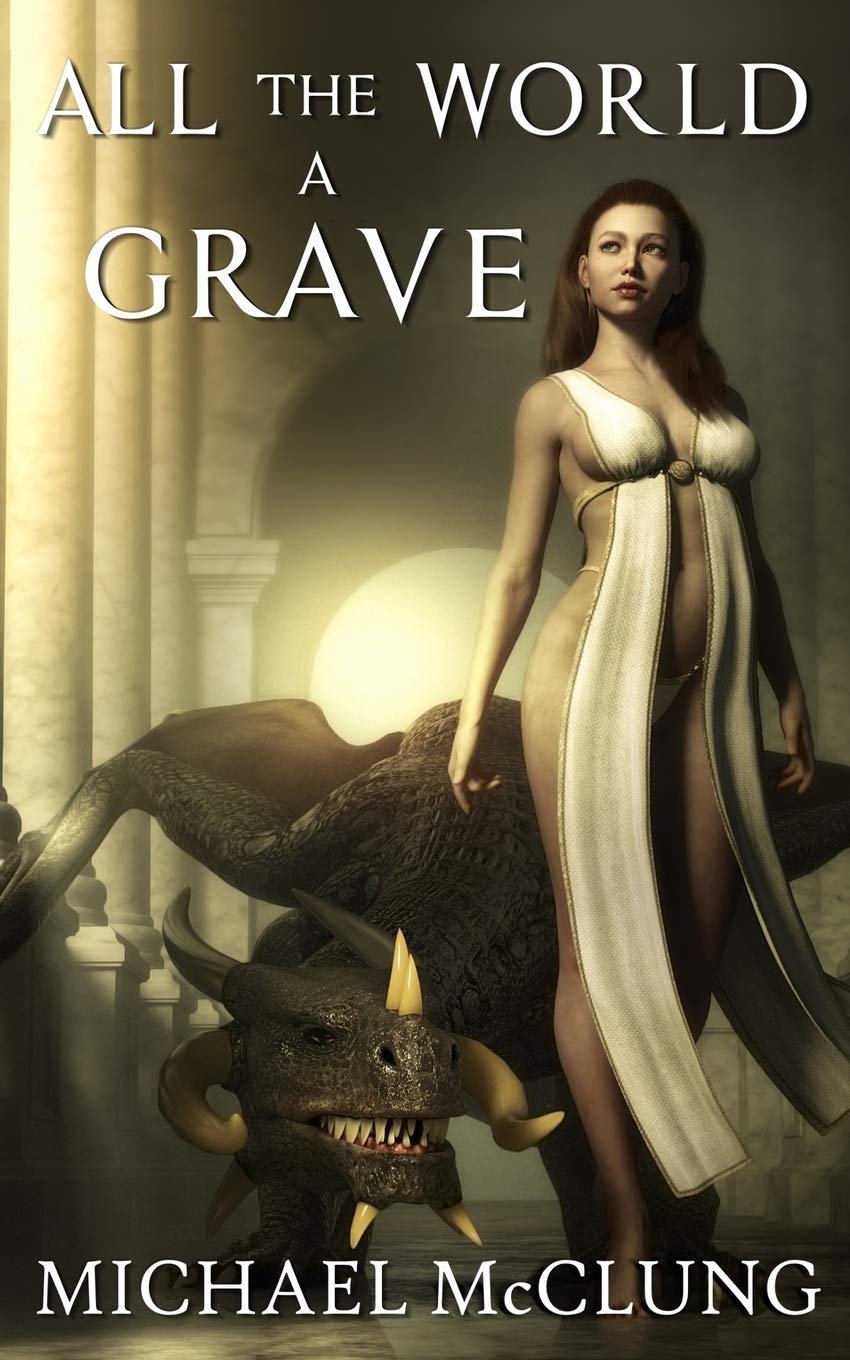
All the World a Grave - ebook
Thirteen dark, weird and wonderful tales of fantasy, science fiction and the paranormal tinged with horror from the author of the Amra Thetys series: From a boy who kills an entire world, to a mother who would give the entire world up for revenge, to a world that may actually be a god, these speculative fiction stories pull no punches. Try not to flinch. "McClung has an impressive ability to write compelling characters and a fast paced and action packed plot that never seems to let up." -Speculative Book Review
Ta publikacja spełnia wymagania dostępności zgodnie z dyrektywą EAA.
| Kategoria: | Fantasy |
| Język: | Angielski |
| Zabezpieczenie: |
Watermark
|
| Rozmiar pliku: | 266 KB |
FRAGMENT KSIĄŻKI
The Sorcerer’s Lament
The Lake of Dreams was where they dumped his body.
The creaking of leather-sleeved oars in their locks. The subtle _plash_ of blades biting water. The algae-ridden reek of lake water, of fish guts and his own blood was strong in his nose despite his inability to breathe. He’d stopped breathing hours before, but that meant little to a sorcerer.
His other senses informed him of much worse: splintered wood under his cheek; a garrote that seared a line of fire around his throat, more cuts than he could count, a belly full of poison that turned his own body traitor.
A chest with its heart hacked out.
He couldn’t move. He couldn’t open his eyes. But he could still _feel_. Agony, and rage.
When they’d taken his heart, he’d begun to worry. If they had taken his hands, he would have been finished. But they _hadn’t_ taken his hands, and so all the chains and fetishes and leaden ingots they’d secured to his ‘corpse’ wouldn’t do them any good when he came for them.
Came for them, and made them pay in blood, and terror.
Came for her.
“Far enough yet?” came a quiet, nervous voice from the stern. Abraxis, his apprentice.
“I suppose. How far have we gone?” Najib, his captain of the guard.
“I don’t know. Far.” Silence. “I still say we should have burned him.”
“Do you have any idea how hard it is to burn a body? Thoroughly, I mean? Not to mention the stench. No thank you.”
If only you had burned me, he thought. I was prepared for burning. But not for a watery grave.
The other, younger voice was quiet for a while. Then, “I’ll always know he’s down here.”
“And you’ll always know you helped put him here. You should be proud. For her sake, if nothing else.”
_All this for her? To take her from me? I will see you both in agony before I finally let you expire. You cannot have her. Ishabe is_ mine_._
“I’m glad we did it, and I’m glad he’s gone” said Abraxis. “But I’m not proud of anything that’s happened tonight.”
A sigh. “Maybe you have the better of it. But what’s done is done. C’mon, let’s get him over the side. Careful you don’t go tumbling after, now.”
Rough hands pulled him up. The boat pitched precariously. Slowly he was eased over the side, head-first, into the black waters. There was no splash to speak of. The cold embraced him.
He sank; the black waters of the lake embracing and then invading his battered, perforated body. All his other senses were starved. He concentrated on the same thing he’d been concentrating on for hours, since she’d passed him the poison cup and left him there for the others to butcher: The fingers of his right hand _– move, damn you._
But they wouldn’t. And a sorcerer who could not weave a spell, well, was severely limited in his options. There was very little he could do without the use of his hands.
Slowly he settled into the muck of the lakebed, on his side.
He realized, after a time, that without a heart to move his blood around, the poison would never be filtered out of his body, and he began to seriously worry. The worry slowly transformed itself to panic, and then an ever-greater rage.
~ ~ ~
After a time, a ghastly bluish light played against his eyelids. He realized it had been getting stronger, or nearer, for some time.
“What have we here, my pets? A visitor, or an interloper? A supplicant, or an offering?”
He knew who it must be. The Lady of the Lake. And if they Lady had deigned to notice him, he was faced with both grave danger and a desperate possibility.
“Open your eyes, Sorcerer.”
His eyes opened. He had nothing to do with it.
She floated above him; naked, and beautiful, and terrible. About her writhed the lake eels and golden pike that the city’s legends said were bad luck to even catch, much less eat. They caressed her blue-green flesh like jealous lovers.
“I would bow, Lady, if I could” he thought.
She smiled, revealing rows of needle-sharp teeth.
“It would seem your visit to my demesne was not of your own volition,” she said, taking in his chains. She surged forward, and her emotionless fish eyes searched his. “Still, you are not welcome here.”
“I beg forgiveness, and your indulgence,” he thought. “I have been betrayed. And so I seek your sympathy.”
“Sympathy? From me? You are wiser than that, Iskander. You are of the land; stay there. Your kind never ceases their plundering of my realm. I have no sympathy for humans.”
“But do you have sympathy for your own kind?”
“What is your meaning?”
“You rule beneath the Lake of Dreams, uncontested, and have for a thousand years and more. This is your right, and none would dare claim otherwise. Is this not so?”
“It is.”
“Though I am nothing beside your splendor and might, Lady, I too am a ruler. But tonight traitors have sought to upset the natural order, have sought to slay their better. They must be punished. And so I seek a boon from you.”
She deliberated for a time; eel and pike writhing around her fair limbs and suckling at her green-tipped breasts; her kelp-green green hair floating, cloud-like, about her inhuman face. Finally she smiled again, and it was not a pleasant smile. “What boon would you ask of me, Iskander?”
“Only this, fair Lady: Break my chains and cast me on the shore.”
“Very well. This much I will do for you. I will even see you put in some quiet place. You would want your resurrection to be a private affair, I am sure. But you must pay a price for your intrusion, human.” And she surged forward once more, and those needle teeth bit down on fragile flesh, and sheared through brittle bone. A bright flair of new pain, then nothing.
~ ~ ~
When he returned to life, it was in a midden just off Jalan Ru. It was not a flashy affair, this resurrection: One moment he was just another corpse in a bad part of a bad city perched on the edge of the Lake of Dreams, and then a horned, leathery-skinned little nightmare not much bigger than a cat scuttled through the refuse and shoved something wet, red and pulsing into the open wound that was his chest. It muttered a few words in a harsh language no human throat could have duplicated without damage, and scuttled back through the stinking mire, perched on a shattered carriage wheel, and waited.
Less than a minute later he drew breath; the breath he needed to fuel the scream that had been his existence for what seemed eternity.
Rage and pain made audible set a pack of stray dogs to howling- possibly in commiseration, more likely complaint. He sat up amongst the offal and rubbish and slime, and screamed again, like a man vomiting up tainted meat. Or a savaged heart. Between the first scream and the second, the wound in his chest became nothing more than an angry red scar. All the other wounds soon followed suit.
“Hurts some,” said the daemonette in that throat-ripping language.
“How long?” said the revived man, giving no indication he’d heard.
“Since you died? Day and a half, o master mine.” It sniggered.
“What—took you so long, Wurm?” He attempted to stand, fell back again, entire body trembling. His sharp-featured face, still ashen with death, was a homicidal mask. His eyes blazed. He clambered up again, a husk transforming itself back into a man through force of will. In the distance, the sounds of revelry; drum, fife, hurdy-gurdy, a full-throated, boisterous crowd.
Wurm merely smiled, exposing black, jagged teeth. “Looks like the dogs have had a go at you, Master. Or maybe rats. They get big down here.”
The man looked down at himself for the first time. He took in the ruined finery and the body underneath, black with blood and the sludge of the midden and the lake and the murder; ripped, ruined, some of it missing entirely, like his left slipper—and the last three fingers of his right hand. He stared at the angry red scar tissue that capped each of the three stumps.
He howled again, and again the dogs joined in.
“I followed your command to the letter, Master. Your death eventuated, and so I’ve brought you back to life. New heart, new life, and a fine heart it is. Not my fault I cannot swim. I had to wait upon the shore, with no assurance you’d return. And not my fault you’re now a sorcerer that can’t make a Grand Pass.” It chuckled, hissed. “I’ll be on my way now. Unless you want to try Compelling me to another task?”
“No. But I would ask a question of you.”
“The mighty Iskander asks lowly Wurm? Very well, ask. I will answer if I can.”
“What is that noise?”
“Which noise?”
“The noise. The music, the crowd. Tell me. Please.” That last word, more painful than all the others he’d spoken that night.
“Why that is the city, celebrating your death, Master. That is the sound of a tyrant’s demise.” Wurm sniggered a final time, then turned and loped away into the night.
Iskander watched the daemonette depart, and his whole world was hate.
He found a rotting gunny sack, draped it over his head as a cowl, and started off towards the Hill of Johorh, where his manse stood, dark and, hopefully, as yet undefiled.
~ ~ ~
The homunculus tried to kill him when he entered his garden.
It burst from the topiary and leapt at his throat like some feral beast, bared teeth and wicked dagger flashing in the moonlight.
“Stop!” he managed to command it, just before it plunged the blade into his neck, and the dagger veered away at the last instant. The homunculus kicked off from his chest and landed in the dewy grass, malevolent eyes looking up at, but not quite meeting his own.
“You dare attack your master?”
“My master is dead.”
“Was. No more. You know this, else you would already be gone, cur.”
“My master is dead,” it said stubbornly, “and so I have no master anymore.”
“Really?” Leave, then, though your master bids you stay.” This was no daemonette, with sorcery in its veins. Compulsion held it fast to its duties.
The homunculus shuffled its feet, and stared at the ground.
“Disobey me again and I will punish you, cur. Do you understand me?”
“Aye,” the little man-like creature said, grudgingly.
“Now tell me who is in my house.”
“No-one is in your house.”
He kicked the creature. “No-one is in your house, Master.”
“No-one is in your house, Master.”
“The guards? The servants?”
“Fled. Master.”
“Intruders?”
“A few townsfolk came. I scared them off. Master.”
“You should have killed them.”
The homunculus said nothing to that.
“Her?” Iskander said the word unwillingly. It came out despite the bile in his soul.
“Gone. Master.” The homunculus’s evil little face was stone, but its eyes glinted.
Iskander stared at it, until it turned its eyes away, and then he walked up towards the manse. It was almost dawn.
~ ~ ~
The dining hall: Scattered, toppled chairs. The poison cup. Blood, blood and more blood. In the cold ashes of the great hearth, a charred and blackened lump that had been his heart.
~ ~ ~
His sanctum: Unchanged, save for the bare wood and broken chains of the pedestal that had held his grimoire.
~ ~ ~
His strong-room: Still ensorcelled, still untouched. The dogs had not dared that puissant magic. Of course, without all of his own fingers with which to make the subtle gestures his art demanded, he could not dispel the death magics he himself had laid down to keep his treasures safe.
~ ~ ~
The servants’ quarters: Abandoned in obvious haste. Unpleasant comments regarding him were scribbled on the whitewashed walls.
~ ~ ~
He did not have to inventory the rest of the manse to know that portable valuables had been removed, or to know that no serious looting had yet occurred. He didn’t care. It could all burn and crumble to dust as far as he was concerned. All of it was defiled, now. He stalked the halls and smashed statuary, ripped priceless paintings, pissed on and spat at ancient tapestries and carpets.
It was with a certain amount of surprise that he realized, and admitted to himself, that he was avoiding her chambers. It was with a deeply bitter reluctance that, in turn, engendered a bilious rage, that he stalked to her chambers and threw open the doors.
She had taken nothing. Priceless treasures that he had acquired for her, items rare and exquisite, the products of genius craftsmen and -women from near and very, very far were scattered about her rooms.
A queen’s ransom: Toys desultorily played with, and quickly, thoughtlessly abandoned.
On her balcony, wind chimes rang out the purest, liquid notes. Something was wrong. Something was missing. He went, and saw.
On the stone balustrade a row of gilded cages, their inmates freed and flown away.
With one mangled fist and one whole, he smashed their delicate wireworks until they more closely resembled his soul.
No-one could have been more surprised than he himself was, when the hot tears stung his cheeks.
Beyond the balcony and down the hill, the city finally slumbered, sated; the revelry engendered by the demise of its erstwhile ruler having spent itself with the sun rising over the vast Lake of Dreams.
Iskander went to find Najib, stopping only to collect a cleaver from the cavernous kitchen.
~ ~ ~
He hid his face with a stolen scarf; other than that, he made no effort to conceal himself. It just wasn’t in him yet to skulk, and most of the city was spent and slumbering. He went from tavern to wine shop to bawdy house, checking each drunken, snoring and stuporous patron before moving on.
Najib was in the fifth one he came to.
He was not drunken, snoring or stuporous, though he was surrounded by such. He recognized Iskander at once.
“I thought it was too easy,” he said with a wry smile. Then, “Let’s go outside. No need to burn the place down, my lord.”
“You dare call me your lord?” Iskander hissed.
“Well. It’s better than ‘petty, murdering, piss-pot tyrant’. Which is what I was really thinking.”
“Tell me where she is and I will let you live,” said Iskander, and was surprised to realize he almost meant it.
Najib laughed. It was a laugh with a lot of emotion in it. None of that emotion was humor. “Just let me come outside. No-one else needs to die.”
“So be it,” said Iskander, and backed out of the doorway and out of Najib’s line of sight.
Of course Najib didn’t know Iskander’s deadliest weapon was no longer sorcery, but a kitchen implement tucked into his frayed, filthy sash. And so he was taken by surprise when, as he walked through the doorway of the wine shop, the cleaver whistled down on his unprotected head.
~ ~ ~
Abraxis was much more difficult to ferret out.
Iskander couldn’t sleep. He couldn’t eat. The hate and the rage ate away at him, night and day. He scoured the city for days, questioning those he dared to speak to about what had happened to the tyrant’s apprentice. No-one had a clue, and few had the time or inclination to speak to the addled, stinking vagrant who covered his face and compulsively stroked the hilt of a cleaver sticking out of his sash.
Being a furtive fugitive in his own land had unhinged him far more, and far more quickly, than he had ever been capable of imagining.
Just two more traitors to find and deal with, he promised himself, and then all will be well. All will be well. All manner of things will be well.
He’d almost given up hope, believing Abraxis had fled the city, when he found his wayward apprentice.
Iskander had squatted down in the shade of a gnarled lammas tree across from the cemetery, mind dull with fatigue and the dregs of hate, when he saw a blonde head bobbing amongst the high, skewed tombstones and between the ruined mausoleums. Blondes were very rare in the City by the Lake. Abraxis had come from some cold, far-off land to apprentice under Iskander.
Iskander, suddenly energized, rose from his haunches and followed the blonde at a careful distance. The fingers of the hand that was still whole stroked the handle of his cleaver, still gore-streaked with Najib’s dried blood and brains and hair.
He followed Abraxis – and it was definitely he – up a slight incline to the small, shattered temple of a forgotten godling whose name had been lost to time. The youth disappeared inside.
Iskander crawled towards the temple on his belly, cleaver clutched in his good hand, mind working feverishly.
Made of some delicate white stone that no local quarry produced, what remained of the temple glowed in the late afternoon sun. The columns and the portion of the roof that still stood faced Iskander. He decided to approach from the rear, among the rubble.
You hide here from me, traitor, you hide and cower. But I have found you, now. I have found you and I am as patient as a spider, and when you lay your wretched bones down to sleep, I will surprise you. I will surprise you with my hate, and my sharp intent.
With infinite patience, Iskander worked his careful and silent way around to the rear of the temple and insinuated himself among the scattered blocks of stone. He could hear Abraxis moving around inside, and as night fell, the former apprentice lit a fire. Iskander steeled himself to wait until the fire died low and Abraxis fell asleep. He waited to spring his surprise. But Abraxis surprised him first.
“Would you like to share my fire, Master?” Abraxis called. “The nights are growing chill, now.”
Iskander froze, dared not breathe. A chill crept up his spine, and he could no longer deny the feeling down at the bottom of his soul, beneath the hate and the rage that grew more ragged every day. The emotion that had stolen up on him, remorselessly, since the Lady of the Lake had taken his fingers, and his power, in her devil’s bargain.
Fear.
“Come sit beside me at my fire, Master. I have a lovely haunch of mutton here, and a little wine.”
Iskander was frozen. But some fragment of the sorcerer’s haughty pride remained, for he forced himself to unfold from his crouch, and walk down the jumbled rubble to Abraxis. His hands trembled, but he caressed the cleaver still.
“I have come to kill you, traitor,” said Iskander, a ghost of his old sneer on his unshaven face.
Abraxis nodded, gestured to the fire. “First have some wine, and some food. There is time enough.”
Iskander laughed. “You think I would eat or drink anything you offered me? You think I don’t know whence the poison came that Ishabe handed me? It could only have been you, apprentice.”
Abraxis nodded again. “Indeed. You taught me well. But I have no cause to poison you a second time.”
“You wanted me dead. You tried your best. Do you honestly think I’d believe you won’t try again, knowing that I will kill you?”
“No, Master. You won’t kill me. You can’t now. And I don’t want to kill you. I didn’t want to the first time. It just had to be done.”
“So you could steal my magic and my woman!” Iskander screamed, foamy specks of spittle flying from his lips.
Abraxis said nothing. Iskander took two steps towards him, gauging the distance, fingers writhing around the cleaver’s handle much as the eels and pike had writhed around the Lady of the Lake. He forced his voice to assume a reasonable tone.
“Keep the grimoire,” he said. “I have no further use for it. Only tell me where she is, and we will part unblooded. I will forgive your treachery. Only tell me where Ishabe is.”
Abraxis looked at him, first with disbelief and then with pity in his eyes. “You don’t know, do you?”
“Know what?”
“Ishabe is dead, master.”
Iskander’s face grew pale. He trembled. “No. You lie.”
Abraxis merely shook his head.
“No. She was mine. Mine to kill. Or not. She was MINE!”
“Well, in a very real sense, it was you that killed her, master.”
“What do you mean? What nonsense is this?”
Abraxis stood. Iskander took an involuntary step back.
“The daemonette you had Compelled to bring you a new heart. Did you never wonder where – who – he got it from?”
Iskander’s hands flew to his chest. Felt the heart thudding there, so fast.
“No,” he whispered.
Abraxis made a complicated writhing gesture with his fingers, and Iskander’s cleaver flew into the younger man’s palm, hilt-first.
“No,” he agreed, smiling. “That was a lie. I just wanted to see your face when I said it.”
Iskander turned and tried to run, but he found himself lying on the dusty stone floor, unable to move. The paralysis charm was of course one he’d taught Abraxis.
Abraxis knelt down and whispered in his ear. “This would have been much less unpleasant if you’d just drunk the wine, Iskander.” Abraxis stood, and called out to the night. And she came.
From his position, he could only see her sandaled feet and a bit of the silken robe she wore.
She kicked him in the face. Hard. Again.
“I am not yours,” she hissed, “and I never was. I am no-one’s possession. And now, with you out of the way, this city is mine.” And she leaned down and made a precise cut in his jugular.
And then she walked away, into the night.
As Iskander’s life-blood poured away, Abraxis leaned down and patted him on the shoulder.
“Don’t worry, master,” he whispered, “I’ll soon have her in hand.” The smile in his voice was audible.
“I am your apprentice, after all.”Mandrake’s Children
"There’s a fine line between revenge and justice," she said, while repeatedly plunging a paring knife into the prone corpse of our father. “The killing stroke was justice. This is revenge. But you know what? I don’t really care."
I shrugged, and stepped back off the fine woven rug that was fast soaking with blood. I said nothing. I couldn’t, possessing neither tongue nor mouth. After father had made Lyssa, he’d decided children should be seen and not heard.
Lyssa looked at me with one brow arched and offered me the knife, hilt-first. I shook my head and, in the finger talk we had devised, said _He is dead. It is enough_.
"Suit yourself, Moloch." Lyssa sighed, and tossed the dagger onto his rent and bloody chest. "I guess I’ve had enough, at that."
_We must go,_ I signed to her, _far, now. Servants will come. They will burn us._
Lyssa snorted. "Oh, they’ll be up in arms for a while, but I don’t think they’ll be all that hot to avenge him. He wasn’t any nicer to the fleshborn than he was to us."
I shrugged, tilted my head towards the door. _Time flies_, I signed again. Trying to tell her they’d hunt us down because we were homunculi, made creatures, was pointless. She wouldn’t accept that everyone who served our father hated and feared us. Perhaps because she wanted so badly to be ordinary herself. Even when she looked at me and saw the blank flesh where a mouth should be, she pretended that we were the same as anyone else.
"All right, Moloch. All right." Lyssa stood up, spat in father’s pale, slack face and walked over to the open casement. It was a beautiful night on which she’d chosen to slay our father, our creator. High, thin clouds scudded across the face of a nearly full moon. She stood in the moonlight, naked and surprisingly free of blood, considering—save for a few spatters between her small, firm breasts, only her hands were red. I thought her beautiful. So had father. But then, he’d intended her to be.
She looked at me, long black hair shining in the moonlight. I swear sometimes she could read my thoughts.
"Do you think I’m pretty, Moloch?" I nodded. Funny how someone without lips can still have the urge to smile.
Lyssa grinned and looked down at her body. She was a perfect woman in miniature – four feet tall. Perfect, except that where her vulva should have been, there was only a blank swelling of hairless flesh. My own clothes hid the same smooth blankness.
We were born of mandrake roots and alchemy, not of man and woman. We would never procreate. Nor for that matter did we need to eat, or excrete. That had puzzled father to no end. He would periodically try to force Lyssa to ingest various substances, to no effect. She couldn’t swallow. At least I’d been spared that indignity. More than once he’d sworn he was going to cut one of us open just to see what was inside. Perhaps someday he would have. Most likely it would have been me, considering father’s relationship with Lyssa. He wasn’t one to waste a favored plaything on idle curiosity.
"Moloch, where have you gone to?" Lyssa called me back from my thoughts. She stood framed by the moonlight, hand on hip, head tilted. She was beautiful. The most beautiful thing I’d ever seen. She reached out a bloody hand to touch my lank brown hair. I backed away a little.
_Nowhere. Let’s go_. I walked to father’s desk. He kept a small cache of coin there, in an ivory box. I took what was there and walked across his dark, expensively appointed study toward the door to the hallway. I knew she would follow, after a second or two. And she did, picking her night robe up off the floor along the way and belting it loosely. I stopped at the door and gave her my most serious look.
Hide your hands. Wash when we get back to your rooms.
She _tssked_. “Do you think I’m a half-wit?”
Father kept Lyssa near him, on the same level of the tower as his own private chambers. I had a room just off the kennels on the ground floor. It wasn’t that he thought of me as a beast, I don’t think. He simply didn’t think of me much at all. For which I had been grateful most of the time.
I loosened the black cloth from around my face. Normally I used it to conceal my more obvious ‘deformity’. I stepped out into the hall. The servants tended to look down at the floor when I passed them this way. I wanted to lessen the chance of anyone noticing Lyssa’s guilty hands.
As it happened, we met no one in the darkened corridors. Once inside her bedroom, Lyssa washed her hands in the basin on the dresser, and then began to go through her wardrobe. She pulled out a dress, then another, laying both on the bed, trying to decide which one to take. "Oh, I do so love the green," she said, "but I don’t know when I would have call to wear a formal evening gown again...." She cut her eyes to me and I signed frantically_, Time! Time!_
Lyssa laughed. "I know. I was just teasing, Moloch. I’m already packed. I have been for a month." She pulled out a pack from under the bed and put one foot atop it, like a conqueror. I rolled my eyes. _Please hurry and get dressed._
She stuck her tongue out at me, then must have felt a twinge of shame considering my inability to respond in kind, for she began to dress immediately. In a relatively short time she was ready to go.
I stopped at the door, listening for any sign of activity. It would be much harder to explain why we were leaving her rooms at night as opposed to leaving father’s. The servants were used to father summoning us at all hours. Especially Lyssa.
Hearing nothing, I stepped out into the dark hallway, motioning Lyssa to wait. I walked silently to the stairs and, seeing no one, waved her to follow.
We wound our way down. At the second floor landing, the floor where father kept his laboratory, Lyssa stopped. I put a hand to her arm and tugged at her, but she shook her head. "No," she hissed. "There’s something I want." And she walked down the corridor to father’s workroom, our delivery room.
Half a dozen slate-topped work benches occupied most of the floor space of the wide, cold room. Shelves of books lined every wall. Lyssa walked up and down the rows, muttering "Where is it? I saw it not two days ago...." I stood by the door, listening for footsteps and looking at the fine glass retorts and coiled copper tubing that had somehow birthed me.
She took so long I was fairly dancing with anxiety, but finally I heard her murmur "aha!" as she scanned a row of books. She pulled down a heavy tome and carried it to me, cradling it in her arms.
"Do you want to see what we came from?"
_Not now_, I signed, but she was Lyssa and would have her way. She cracked open the leather covers and flipped rapidly through several pages until she came upon a pair of woodcuts.
"See there on the left? When they hang a man, he loses all control of his bodily functions, and it all runs out of him. Feces, urine, sperm." She then pointed to the woodcut on the right. "If he’s hanged on the right day, or maybe in the right spot, a mandrake root will grow where his fluids fall. See how it kind of looks like a person, with the fork for legs and those knobs that look a bit like arms?" She closed the book and looked at me. "Father discovered a way turn a mandrake root into us. He was a smart bastard, I’ll give him that."
I would have sighed if I could have. I cared less about where we came from than where we were going. And we wouldn’t be going anywhere except into the fire if we didn’t leave immediately. I stared at Lyssa, then jerked my head toward the door.
"Fine. We’ll go now. But carry this for me, all right? I can’t manage it and my pack." I nodded and took the book from her. Anything to get moving.
~ ~ ~
I’d heard father called a sorcerer, but I don’t think he possessed any kind of magic. He called himself a scholar and an alchemist. Lyssa called him a monster.
He held his manor at the edge of the kingdom and lorded it over his servants and the peasants and merchants in the village below. I know he was some sort of minor nobility, but whether of the old nobility or new was never discussed within my hearing. I did know we were his only family.
As we walked away, I looked back over my shoulder at the haphazard bulk of the manse, the outline of its single black tower rising up from the rest to spear the star-filled sky. Now that he was dead, I wondered if anyone would come to claim that tower high on the rim of the valley. Perhaps the peasants would tear it down and use the stones to build sheep pens. Perhaps it would stand until it tumbled on its own. In any case, I took one last look at my place of birth, the only home I had ever known, and knew that I would not miss it.
"Well, Moloch, we’re free now. What do you think about that?" Lyssa skipped down the rutted road beside me.
_Not free yet_. It’s harder to read finger sign in the dark. I tried to keep my words simple.
Lyssa laughed. "This is as free as we’ve ever been! We can do whatever we want, be whoever we want. We can go anywhere!"
But I knew she was wrong. We would always be what we were, and because of it we could only live on the periphery of human life, or abandon it altogether. But I didn’t want to spoil her joy, so I just nodded.
"We could go to the Capital, and dance at the Imperial Ball, and watch the sun rise over the palace gardens...." She bubbled on all that night as we trudged out of the valley, inventing possible futures for us. I loved her for it, though I knew it was just so much mist and wishing. She was what I was not; light where I was dark, action where I was hesitation, a dreamer where I was bothersome practicality. As we walked on toward our future, I had the strangest thought that together we were a whole person.
~ ~ ~
We were together for exactly four more days.
It happened in a village on the King’s Road called Koenningsbourg. I will never forget the name or the town. I’ll never forget the way she screamed at me to run. I’ll never be rid of my shame for doing so.
Lyssa was tired of walking. We had both developed blisters on our feet, hers especially. I wanted to skirt the town, but she would have none of it.
The Lake of Dreams was where they dumped his body.
The creaking of leather-sleeved oars in their locks. The subtle _plash_ of blades biting water. The algae-ridden reek of lake water, of fish guts and his own blood was strong in his nose despite his inability to breathe. He’d stopped breathing hours before, but that meant little to a sorcerer.
His other senses informed him of much worse: splintered wood under his cheek; a garrote that seared a line of fire around his throat, more cuts than he could count, a belly full of poison that turned his own body traitor.
A chest with its heart hacked out.
He couldn’t move. He couldn’t open his eyes. But he could still _feel_. Agony, and rage.
When they’d taken his heart, he’d begun to worry. If they had taken his hands, he would have been finished. But they _hadn’t_ taken his hands, and so all the chains and fetishes and leaden ingots they’d secured to his ‘corpse’ wouldn’t do them any good when he came for them.
Came for them, and made them pay in blood, and terror.
Came for her.
“Far enough yet?” came a quiet, nervous voice from the stern. Abraxis, his apprentice.
“I suppose. How far have we gone?” Najib, his captain of the guard.
“I don’t know. Far.” Silence. “I still say we should have burned him.”
“Do you have any idea how hard it is to burn a body? Thoroughly, I mean? Not to mention the stench. No thank you.”
If only you had burned me, he thought. I was prepared for burning. But not for a watery grave.
The other, younger voice was quiet for a while. Then, “I’ll always know he’s down here.”
“And you’ll always know you helped put him here. You should be proud. For her sake, if nothing else.”
_All this for her? To take her from me? I will see you both in agony before I finally let you expire. You cannot have her. Ishabe is_ mine_._
“I’m glad we did it, and I’m glad he’s gone” said Abraxis. “But I’m not proud of anything that’s happened tonight.”
A sigh. “Maybe you have the better of it. But what’s done is done. C’mon, let’s get him over the side. Careful you don’t go tumbling after, now.”
Rough hands pulled him up. The boat pitched precariously. Slowly he was eased over the side, head-first, into the black waters. There was no splash to speak of. The cold embraced him.
He sank; the black waters of the lake embracing and then invading his battered, perforated body. All his other senses were starved. He concentrated on the same thing he’d been concentrating on for hours, since she’d passed him the poison cup and left him there for the others to butcher: The fingers of his right hand _– move, damn you._
But they wouldn’t. And a sorcerer who could not weave a spell, well, was severely limited in his options. There was very little he could do without the use of his hands.
Slowly he settled into the muck of the lakebed, on his side.
He realized, after a time, that without a heart to move his blood around, the poison would never be filtered out of his body, and he began to seriously worry. The worry slowly transformed itself to panic, and then an ever-greater rage.
~ ~ ~
After a time, a ghastly bluish light played against his eyelids. He realized it had been getting stronger, or nearer, for some time.
“What have we here, my pets? A visitor, or an interloper? A supplicant, or an offering?”
He knew who it must be. The Lady of the Lake. And if they Lady had deigned to notice him, he was faced with both grave danger and a desperate possibility.
“Open your eyes, Sorcerer.”
His eyes opened. He had nothing to do with it.
She floated above him; naked, and beautiful, and terrible. About her writhed the lake eels and golden pike that the city’s legends said were bad luck to even catch, much less eat. They caressed her blue-green flesh like jealous lovers.
“I would bow, Lady, if I could” he thought.
She smiled, revealing rows of needle-sharp teeth.
“It would seem your visit to my demesne was not of your own volition,” she said, taking in his chains. She surged forward, and her emotionless fish eyes searched his. “Still, you are not welcome here.”
“I beg forgiveness, and your indulgence,” he thought. “I have been betrayed. And so I seek your sympathy.”
“Sympathy? From me? You are wiser than that, Iskander. You are of the land; stay there. Your kind never ceases their plundering of my realm. I have no sympathy for humans.”
“But do you have sympathy for your own kind?”
“What is your meaning?”
“You rule beneath the Lake of Dreams, uncontested, and have for a thousand years and more. This is your right, and none would dare claim otherwise. Is this not so?”
“It is.”
“Though I am nothing beside your splendor and might, Lady, I too am a ruler. But tonight traitors have sought to upset the natural order, have sought to slay their better. They must be punished. And so I seek a boon from you.”
She deliberated for a time; eel and pike writhing around her fair limbs and suckling at her green-tipped breasts; her kelp-green green hair floating, cloud-like, about her inhuman face. Finally she smiled again, and it was not a pleasant smile. “What boon would you ask of me, Iskander?”
“Only this, fair Lady: Break my chains and cast me on the shore.”
“Very well. This much I will do for you. I will even see you put in some quiet place. You would want your resurrection to be a private affair, I am sure. But you must pay a price for your intrusion, human.” And she surged forward once more, and those needle teeth bit down on fragile flesh, and sheared through brittle bone. A bright flair of new pain, then nothing.
~ ~ ~
When he returned to life, it was in a midden just off Jalan Ru. It was not a flashy affair, this resurrection: One moment he was just another corpse in a bad part of a bad city perched on the edge of the Lake of Dreams, and then a horned, leathery-skinned little nightmare not much bigger than a cat scuttled through the refuse and shoved something wet, red and pulsing into the open wound that was his chest. It muttered a few words in a harsh language no human throat could have duplicated without damage, and scuttled back through the stinking mire, perched on a shattered carriage wheel, and waited.
Less than a minute later he drew breath; the breath he needed to fuel the scream that had been his existence for what seemed eternity.
Rage and pain made audible set a pack of stray dogs to howling- possibly in commiseration, more likely complaint. He sat up amongst the offal and rubbish and slime, and screamed again, like a man vomiting up tainted meat. Or a savaged heart. Between the first scream and the second, the wound in his chest became nothing more than an angry red scar. All the other wounds soon followed suit.
“Hurts some,” said the daemonette in that throat-ripping language.
“How long?” said the revived man, giving no indication he’d heard.
“Since you died? Day and a half, o master mine.” It sniggered.
“What—took you so long, Wurm?” He attempted to stand, fell back again, entire body trembling. His sharp-featured face, still ashen with death, was a homicidal mask. His eyes blazed. He clambered up again, a husk transforming itself back into a man through force of will. In the distance, the sounds of revelry; drum, fife, hurdy-gurdy, a full-throated, boisterous crowd.
Wurm merely smiled, exposing black, jagged teeth. “Looks like the dogs have had a go at you, Master. Or maybe rats. They get big down here.”
The man looked down at himself for the first time. He took in the ruined finery and the body underneath, black with blood and the sludge of the midden and the lake and the murder; ripped, ruined, some of it missing entirely, like his left slipper—and the last three fingers of his right hand. He stared at the angry red scar tissue that capped each of the three stumps.
He howled again, and again the dogs joined in.
“I followed your command to the letter, Master. Your death eventuated, and so I’ve brought you back to life. New heart, new life, and a fine heart it is. Not my fault I cannot swim. I had to wait upon the shore, with no assurance you’d return. And not my fault you’re now a sorcerer that can’t make a Grand Pass.” It chuckled, hissed. “I’ll be on my way now. Unless you want to try Compelling me to another task?”
“No. But I would ask a question of you.”
“The mighty Iskander asks lowly Wurm? Very well, ask. I will answer if I can.”
“What is that noise?”
“Which noise?”
“The noise. The music, the crowd. Tell me. Please.” That last word, more painful than all the others he’d spoken that night.
“Why that is the city, celebrating your death, Master. That is the sound of a tyrant’s demise.” Wurm sniggered a final time, then turned and loped away into the night.
Iskander watched the daemonette depart, and his whole world was hate.
He found a rotting gunny sack, draped it over his head as a cowl, and started off towards the Hill of Johorh, where his manse stood, dark and, hopefully, as yet undefiled.
~ ~ ~
The homunculus tried to kill him when he entered his garden.
It burst from the topiary and leapt at his throat like some feral beast, bared teeth and wicked dagger flashing in the moonlight.
“Stop!” he managed to command it, just before it plunged the blade into his neck, and the dagger veered away at the last instant. The homunculus kicked off from his chest and landed in the dewy grass, malevolent eyes looking up at, but not quite meeting his own.
“You dare attack your master?”
“My master is dead.”
“Was. No more. You know this, else you would already be gone, cur.”
“My master is dead,” it said stubbornly, “and so I have no master anymore.”
“Really?” Leave, then, though your master bids you stay.” This was no daemonette, with sorcery in its veins. Compulsion held it fast to its duties.
The homunculus shuffled its feet, and stared at the ground.
“Disobey me again and I will punish you, cur. Do you understand me?”
“Aye,” the little man-like creature said, grudgingly.
“Now tell me who is in my house.”
“No-one is in your house.”
He kicked the creature. “No-one is in your house, Master.”
“No-one is in your house, Master.”
“The guards? The servants?”
“Fled. Master.”
“Intruders?”
“A few townsfolk came. I scared them off. Master.”
“You should have killed them.”
The homunculus said nothing to that.
“Her?” Iskander said the word unwillingly. It came out despite the bile in his soul.
“Gone. Master.” The homunculus’s evil little face was stone, but its eyes glinted.
Iskander stared at it, until it turned its eyes away, and then he walked up towards the manse. It was almost dawn.
~ ~ ~
The dining hall: Scattered, toppled chairs. The poison cup. Blood, blood and more blood. In the cold ashes of the great hearth, a charred and blackened lump that had been his heart.
~ ~ ~
His sanctum: Unchanged, save for the bare wood and broken chains of the pedestal that had held his grimoire.
~ ~ ~
His strong-room: Still ensorcelled, still untouched. The dogs had not dared that puissant magic. Of course, without all of his own fingers with which to make the subtle gestures his art demanded, he could not dispel the death magics he himself had laid down to keep his treasures safe.
~ ~ ~
The servants’ quarters: Abandoned in obvious haste. Unpleasant comments regarding him were scribbled on the whitewashed walls.
~ ~ ~
He did not have to inventory the rest of the manse to know that portable valuables had been removed, or to know that no serious looting had yet occurred. He didn’t care. It could all burn and crumble to dust as far as he was concerned. All of it was defiled, now. He stalked the halls and smashed statuary, ripped priceless paintings, pissed on and spat at ancient tapestries and carpets.
It was with a certain amount of surprise that he realized, and admitted to himself, that he was avoiding her chambers. It was with a deeply bitter reluctance that, in turn, engendered a bilious rage, that he stalked to her chambers and threw open the doors.
She had taken nothing. Priceless treasures that he had acquired for her, items rare and exquisite, the products of genius craftsmen and -women from near and very, very far were scattered about her rooms.
A queen’s ransom: Toys desultorily played with, and quickly, thoughtlessly abandoned.
On her balcony, wind chimes rang out the purest, liquid notes. Something was wrong. Something was missing. He went, and saw.
On the stone balustrade a row of gilded cages, their inmates freed and flown away.
With one mangled fist and one whole, he smashed their delicate wireworks until they more closely resembled his soul.
No-one could have been more surprised than he himself was, when the hot tears stung his cheeks.
Beyond the balcony and down the hill, the city finally slumbered, sated; the revelry engendered by the demise of its erstwhile ruler having spent itself with the sun rising over the vast Lake of Dreams.
Iskander went to find Najib, stopping only to collect a cleaver from the cavernous kitchen.
~ ~ ~
He hid his face with a stolen scarf; other than that, he made no effort to conceal himself. It just wasn’t in him yet to skulk, and most of the city was spent and slumbering. He went from tavern to wine shop to bawdy house, checking each drunken, snoring and stuporous patron before moving on.
Najib was in the fifth one he came to.
He was not drunken, snoring or stuporous, though he was surrounded by such. He recognized Iskander at once.
“I thought it was too easy,” he said with a wry smile. Then, “Let’s go outside. No need to burn the place down, my lord.”
“You dare call me your lord?” Iskander hissed.
“Well. It’s better than ‘petty, murdering, piss-pot tyrant’. Which is what I was really thinking.”
“Tell me where she is and I will let you live,” said Iskander, and was surprised to realize he almost meant it.
Najib laughed. It was a laugh with a lot of emotion in it. None of that emotion was humor. “Just let me come outside. No-one else needs to die.”
“So be it,” said Iskander, and backed out of the doorway and out of Najib’s line of sight.
Of course Najib didn’t know Iskander’s deadliest weapon was no longer sorcery, but a kitchen implement tucked into his frayed, filthy sash. And so he was taken by surprise when, as he walked through the doorway of the wine shop, the cleaver whistled down on his unprotected head.
~ ~ ~
Abraxis was much more difficult to ferret out.
Iskander couldn’t sleep. He couldn’t eat. The hate and the rage ate away at him, night and day. He scoured the city for days, questioning those he dared to speak to about what had happened to the tyrant’s apprentice. No-one had a clue, and few had the time or inclination to speak to the addled, stinking vagrant who covered his face and compulsively stroked the hilt of a cleaver sticking out of his sash.
Being a furtive fugitive in his own land had unhinged him far more, and far more quickly, than he had ever been capable of imagining.
Just two more traitors to find and deal with, he promised himself, and then all will be well. All will be well. All manner of things will be well.
He’d almost given up hope, believing Abraxis had fled the city, when he found his wayward apprentice.
Iskander had squatted down in the shade of a gnarled lammas tree across from the cemetery, mind dull with fatigue and the dregs of hate, when he saw a blonde head bobbing amongst the high, skewed tombstones and between the ruined mausoleums. Blondes were very rare in the City by the Lake. Abraxis had come from some cold, far-off land to apprentice under Iskander.
Iskander, suddenly energized, rose from his haunches and followed the blonde at a careful distance. The fingers of the hand that was still whole stroked the handle of his cleaver, still gore-streaked with Najib’s dried blood and brains and hair.
He followed Abraxis – and it was definitely he – up a slight incline to the small, shattered temple of a forgotten godling whose name had been lost to time. The youth disappeared inside.
Iskander crawled towards the temple on his belly, cleaver clutched in his good hand, mind working feverishly.
Made of some delicate white stone that no local quarry produced, what remained of the temple glowed in the late afternoon sun. The columns and the portion of the roof that still stood faced Iskander. He decided to approach from the rear, among the rubble.
You hide here from me, traitor, you hide and cower. But I have found you, now. I have found you and I am as patient as a spider, and when you lay your wretched bones down to sleep, I will surprise you. I will surprise you with my hate, and my sharp intent.
With infinite patience, Iskander worked his careful and silent way around to the rear of the temple and insinuated himself among the scattered blocks of stone. He could hear Abraxis moving around inside, and as night fell, the former apprentice lit a fire. Iskander steeled himself to wait until the fire died low and Abraxis fell asleep. He waited to spring his surprise. But Abraxis surprised him first.
“Would you like to share my fire, Master?” Abraxis called. “The nights are growing chill, now.”
Iskander froze, dared not breathe. A chill crept up his spine, and he could no longer deny the feeling down at the bottom of his soul, beneath the hate and the rage that grew more ragged every day. The emotion that had stolen up on him, remorselessly, since the Lady of the Lake had taken his fingers, and his power, in her devil’s bargain.
Fear.
“Come sit beside me at my fire, Master. I have a lovely haunch of mutton here, and a little wine.”
Iskander was frozen. But some fragment of the sorcerer’s haughty pride remained, for he forced himself to unfold from his crouch, and walk down the jumbled rubble to Abraxis. His hands trembled, but he caressed the cleaver still.
“I have come to kill you, traitor,” said Iskander, a ghost of his old sneer on his unshaven face.
Abraxis nodded, gestured to the fire. “First have some wine, and some food. There is time enough.”
Iskander laughed. “You think I would eat or drink anything you offered me? You think I don’t know whence the poison came that Ishabe handed me? It could only have been you, apprentice.”
Abraxis nodded again. “Indeed. You taught me well. But I have no cause to poison you a second time.”
“You wanted me dead. You tried your best. Do you honestly think I’d believe you won’t try again, knowing that I will kill you?”
“No, Master. You won’t kill me. You can’t now. And I don’t want to kill you. I didn’t want to the first time. It just had to be done.”
“So you could steal my magic and my woman!” Iskander screamed, foamy specks of spittle flying from his lips.
Abraxis said nothing. Iskander took two steps towards him, gauging the distance, fingers writhing around the cleaver’s handle much as the eels and pike had writhed around the Lady of the Lake. He forced his voice to assume a reasonable tone.
“Keep the grimoire,” he said. “I have no further use for it. Only tell me where she is, and we will part unblooded. I will forgive your treachery. Only tell me where Ishabe is.”
Abraxis looked at him, first with disbelief and then with pity in his eyes. “You don’t know, do you?”
“Know what?”
“Ishabe is dead, master.”
Iskander’s face grew pale. He trembled. “No. You lie.”
Abraxis merely shook his head.
“No. She was mine. Mine to kill. Or not. She was MINE!”
“Well, in a very real sense, it was you that killed her, master.”
“What do you mean? What nonsense is this?”
Abraxis stood. Iskander took an involuntary step back.
“The daemonette you had Compelled to bring you a new heart. Did you never wonder where – who – he got it from?”
Iskander’s hands flew to his chest. Felt the heart thudding there, so fast.
“No,” he whispered.
Abraxis made a complicated writhing gesture with his fingers, and Iskander’s cleaver flew into the younger man’s palm, hilt-first.
“No,” he agreed, smiling. “That was a lie. I just wanted to see your face when I said it.”
Iskander turned and tried to run, but he found himself lying on the dusty stone floor, unable to move. The paralysis charm was of course one he’d taught Abraxis.
Abraxis knelt down and whispered in his ear. “This would have been much less unpleasant if you’d just drunk the wine, Iskander.” Abraxis stood, and called out to the night. And she came.
From his position, he could only see her sandaled feet and a bit of the silken robe she wore.
She kicked him in the face. Hard. Again.
“I am not yours,” she hissed, “and I never was. I am no-one’s possession. And now, with you out of the way, this city is mine.” And she leaned down and made a precise cut in his jugular.
And then she walked away, into the night.
As Iskander’s life-blood poured away, Abraxis leaned down and patted him on the shoulder.
“Don’t worry, master,” he whispered, “I’ll soon have her in hand.” The smile in his voice was audible.
“I am your apprentice, after all.”Mandrake’s Children
"There’s a fine line between revenge and justice," she said, while repeatedly plunging a paring knife into the prone corpse of our father. “The killing stroke was justice. This is revenge. But you know what? I don’t really care."
I shrugged, and stepped back off the fine woven rug that was fast soaking with blood. I said nothing. I couldn’t, possessing neither tongue nor mouth. After father had made Lyssa, he’d decided children should be seen and not heard.
Lyssa looked at me with one brow arched and offered me the knife, hilt-first. I shook my head and, in the finger talk we had devised, said _He is dead. It is enough_.
"Suit yourself, Moloch." Lyssa sighed, and tossed the dagger onto his rent and bloody chest. "I guess I’ve had enough, at that."
_We must go,_ I signed to her, _far, now. Servants will come. They will burn us._
Lyssa snorted. "Oh, they’ll be up in arms for a while, but I don’t think they’ll be all that hot to avenge him. He wasn’t any nicer to the fleshborn than he was to us."
I shrugged, tilted my head towards the door. _Time flies_, I signed again. Trying to tell her they’d hunt us down because we were homunculi, made creatures, was pointless. She wouldn’t accept that everyone who served our father hated and feared us. Perhaps because she wanted so badly to be ordinary herself. Even when she looked at me and saw the blank flesh where a mouth should be, she pretended that we were the same as anyone else.
"All right, Moloch. All right." Lyssa stood up, spat in father’s pale, slack face and walked over to the open casement. It was a beautiful night on which she’d chosen to slay our father, our creator. High, thin clouds scudded across the face of a nearly full moon. She stood in the moonlight, naked and surprisingly free of blood, considering—save for a few spatters between her small, firm breasts, only her hands were red. I thought her beautiful. So had father. But then, he’d intended her to be.
She looked at me, long black hair shining in the moonlight. I swear sometimes she could read my thoughts.
"Do you think I’m pretty, Moloch?" I nodded. Funny how someone without lips can still have the urge to smile.
Lyssa grinned and looked down at her body. She was a perfect woman in miniature – four feet tall. Perfect, except that where her vulva should have been, there was only a blank swelling of hairless flesh. My own clothes hid the same smooth blankness.
We were born of mandrake roots and alchemy, not of man and woman. We would never procreate. Nor for that matter did we need to eat, or excrete. That had puzzled father to no end. He would periodically try to force Lyssa to ingest various substances, to no effect. She couldn’t swallow. At least I’d been spared that indignity. More than once he’d sworn he was going to cut one of us open just to see what was inside. Perhaps someday he would have. Most likely it would have been me, considering father’s relationship with Lyssa. He wasn’t one to waste a favored plaything on idle curiosity.
"Moloch, where have you gone to?" Lyssa called me back from my thoughts. She stood framed by the moonlight, hand on hip, head tilted. She was beautiful. The most beautiful thing I’d ever seen. She reached out a bloody hand to touch my lank brown hair. I backed away a little.
_Nowhere. Let’s go_. I walked to father’s desk. He kept a small cache of coin there, in an ivory box. I took what was there and walked across his dark, expensively appointed study toward the door to the hallway. I knew she would follow, after a second or two. And she did, picking her night robe up off the floor along the way and belting it loosely. I stopped at the door and gave her my most serious look.
Hide your hands. Wash when we get back to your rooms.
She _tssked_. “Do you think I’m a half-wit?”
Father kept Lyssa near him, on the same level of the tower as his own private chambers. I had a room just off the kennels on the ground floor. It wasn’t that he thought of me as a beast, I don’t think. He simply didn’t think of me much at all. For which I had been grateful most of the time.
I loosened the black cloth from around my face. Normally I used it to conceal my more obvious ‘deformity’. I stepped out into the hall. The servants tended to look down at the floor when I passed them this way. I wanted to lessen the chance of anyone noticing Lyssa’s guilty hands.
As it happened, we met no one in the darkened corridors. Once inside her bedroom, Lyssa washed her hands in the basin on the dresser, and then began to go through her wardrobe. She pulled out a dress, then another, laying both on the bed, trying to decide which one to take. "Oh, I do so love the green," she said, "but I don’t know when I would have call to wear a formal evening gown again...." She cut her eyes to me and I signed frantically_, Time! Time!_
Lyssa laughed. "I know. I was just teasing, Moloch. I’m already packed. I have been for a month." She pulled out a pack from under the bed and put one foot atop it, like a conqueror. I rolled my eyes. _Please hurry and get dressed._
She stuck her tongue out at me, then must have felt a twinge of shame considering my inability to respond in kind, for she began to dress immediately. In a relatively short time she was ready to go.
I stopped at the door, listening for any sign of activity. It would be much harder to explain why we were leaving her rooms at night as opposed to leaving father’s. The servants were used to father summoning us at all hours. Especially Lyssa.
Hearing nothing, I stepped out into the dark hallway, motioning Lyssa to wait. I walked silently to the stairs and, seeing no one, waved her to follow.
We wound our way down. At the second floor landing, the floor where father kept his laboratory, Lyssa stopped. I put a hand to her arm and tugged at her, but she shook her head. "No," she hissed. "There’s something I want." And she walked down the corridor to father’s workroom, our delivery room.
Half a dozen slate-topped work benches occupied most of the floor space of the wide, cold room. Shelves of books lined every wall. Lyssa walked up and down the rows, muttering "Where is it? I saw it not two days ago...." I stood by the door, listening for footsteps and looking at the fine glass retorts and coiled copper tubing that had somehow birthed me.
She took so long I was fairly dancing with anxiety, but finally I heard her murmur "aha!" as she scanned a row of books. She pulled down a heavy tome and carried it to me, cradling it in her arms.
"Do you want to see what we came from?"
_Not now_, I signed, but she was Lyssa and would have her way. She cracked open the leather covers and flipped rapidly through several pages until she came upon a pair of woodcuts.
"See there on the left? When they hang a man, he loses all control of his bodily functions, and it all runs out of him. Feces, urine, sperm." She then pointed to the woodcut on the right. "If he’s hanged on the right day, or maybe in the right spot, a mandrake root will grow where his fluids fall. See how it kind of looks like a person, with the fork for legs and those knobs that look a bit like arms?" She closed the book and looked at me. "Father discovered a way turn a mandrake root into us. He was a smart bastard, I’ll give him that."
I would have sighed if I could have. I cared less about where we came from than where we were going. And we wouldn’t be going anywhere except into the fire if we didn’t leave immediately. I stared at Lyssa, then jerked my head toward the door.
"Fine. We’ll go now. But carry this for me, all right? I can’t manage it and my pack." I nodded and took the book from her. Anything to get moving.
~ ~ ~
I’d heard father called a sorcerer, but I don’t think he possessed any kind of magic. He called himself a scholar and an alchemist. Lyssa called him a monster.
He held his manor at the edge of the kingdom and lorded it over his servants and the peasants and merchants in the village below. I know he was some sort of minor nobility, but whether of the old nobility or new was never discussed within my hearing. I did know we were his only family.
As we walked away, I looked back over my shoulder at the haphazard bulk of the manse, the outline of its single black tower rising up from the rest to spear the star-filled sky. Now that he was dead, I wondered if anyone would come to claim that tower high on the rim of the valley. Perhaps the peasants would tear it down and use the stones to build sheep pens. Perhaps it would stand until it tumbled on its own. In any case, I took one last look at my place of birth, the only home I had ever known, and knew that I would not miss it.
"Well, Moloch, we’re free now. What do you think about that?" Lyssa skipped down the rutted road beside me.
_Not free yet_. It’s harder to read finger sign in the dark. I tried to keep my words simple.
Lyssa laughed. "This is as free as we’ve ever been! We can do whatever we want, be whoever we want. We can go anywhere!"
But I knew she was wrong. We would always be what we were, and because of it we could only live on the periphery of human life, or abandon it altogether. But I didn’t want to spoil her joy, so I just nodded.
"We could go to the Capital, and dance at the Imperial Ball, and watch the sun rise over the palace gardens...." She bubbled on all that night as we trudged out of the valley, inventing possible futures for us. I loved her for it, though I knew it was just so much mist and wishing. She was what I was not; light where I was dark, action where I was hesitation, a dreamer where I was bothersome practicality. As we walked on toward our future, I had the strangest thought that together we were a whole person.
~ ~ ~
We were together for exactly four more days.
It happened in a village on the King’s Road called Koenningsbourg. I will never forget the name or the town. I’ll never forget the way she screamed at me to run. I’ll never be rid of my shame for doing so.
Lyssa was tired of walking. We had both developed blisters on our feet, hers especially. I wanted to skirt the town, but she would have none of it.
więcej..