MENU
MENU
 Nasze ceny

 Przeczytaj fragment on-line

-
 nowość
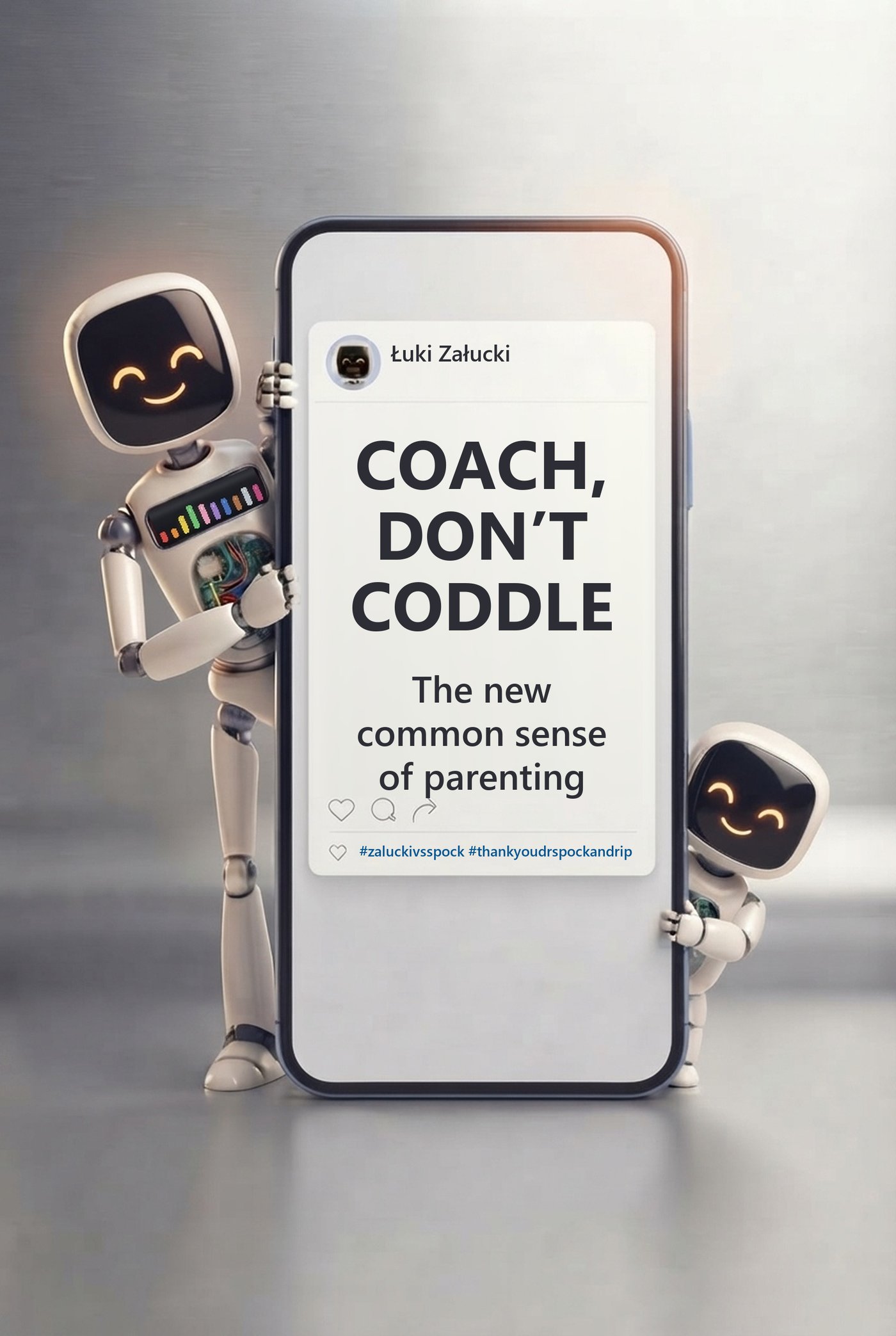
Coach, Don't Coddle. The new common sense of parenting - ebook
Coach, Don't Coddle. The new common sense of parenting - ebook
Your child will leave home one day. That is the only exam that really counts. Parenting guides teach you how to adapt to your child so that it wants to cooperate. It works — inside a flat with two people and one child in it. The trouble is that the rest of the world has not read the book and does not intend to adapt to anyone. This book goes the other way: how to prepare a child for the world it will actually live in — and have a calmer home while you do it, not a harder one. Twenty chapters on what to do, and in the middle the Golden 14: fourteen sentences that stay with you when you have forgotten everything else, and one that stands above them all. No sugar-coating, and not a single sentence that sounds clever while meaning nothing.
Ta publikacja spełnia wymagania dostępności zgodnie z dyrektywą EAA.
| Kategoria: | Poradniki |
| Język: | Angielski |
| Zabezpieczenie: |
Watermark
|
| ISBN: | 9788398324212 |
| Rozmiar pliku: | 2,5 MB |
FRAGMENT KSIĄŻKI
Thank you to my friend Kasia Z. for the pressure. For pushing me for so long to start a YouTube channel with this material. I never did start the channel. I wrote this book instead. The pressure landed somewhere other than where it was aimed, but it landed. Sometimes the best thing somebody can do for us is not leave us alone.
Thank you to my parents, Edzinek and Lidziuchna, meaning Edward and Lidzia. And especially to my mother, because she probably had the hardest time of it with me. Dad is Dad, he was always a strong player. But it was my mother who twice had to shut the front door on me so I’d pull myself together. And it was the best thing she could have done at the time. Because me, a sixteen-year-old living in a mate’s cellar or in another mate’s house, instead of snapping like a matchstick, sorted my life out a level up and started thinking about opening a garage.
At least that’s what I thought… only me.
Or maybe I wasn’t thinking, only feeling? In the sense that I couldn’t.
If I’d been wrapped in cotton wool I’d probably have been dead long ago, because the suicide statistics don’t lie and my teenage years weren’t easy. And it’s thanks to them that I made it at all.
Dad was always there, but he didn’t always have to be. But whenever he had to be, he always was.
And being stubborn, I did my best to make sure he had to as rarely as possible. Because I can do it myself. I can do it myself. Apparently at six I used to rinse the shampoo out of my hair in the toilet bowl, saying: it doesn’t sting, it doesn’t sting, I can do it myself, I can do it myself.
I’m a tough nut, my dears. And it’s thanks to them.
Right behind my parents, my godparents. Basia and Byniu, meaning Zbyszek.
Thank you for always helping me and my parents. Auntie showed a seven-year-old that women can drive brilliantly. And Byniu is written into my motoring history forever.
Wiesia, mother-in-law from my first marriage, you’re the one who let me set out into independent life at nineteen. But most of all, thank you for Gosia. We’re still friends to this day. We got exactly what we wanted, it’s just that fate showed us we needed more players on the board of life. And that’s all.
And Mama Mysia is Mama Mysia. A saint. But most of all I thank her for WuWu, because without her none of this would exist.
I love you all.
Thank you to my Scottish brother Kamcio. You were the only one who, when I was holding forth about parenting without having any hominid mammal children of my own, only three Dobermanns, agreed with me and said: Łuki, you have to have children, because you’ve got a great approach. Everybody else said: Łuki, what could you possibly know, you haven’t got children. It turns out I knew more than all of them put together.
And you know what, Kamcio? They were right. Just not in the way they thought.
If you haven’t had it, you can’t speak. If you don’t know, you can’t speak.
At the time it infuriated me. Today I use it myself and I’ll go on using it to the end of this book. The conversations we had about Gabryś: you’ve got this problem or that one and you’re thinking of doing this or that. And you, my dear friend, are our shared certificate of quality. You won the fight for your son during your separation and I don’t think we could be prouder of what you achieved. Gabryś, you’re the best, my young friend. I love you, my birthday twin.
And Kamcio, there’s one more thing I want to thank you for. For a sentence from 2021: Łuki, you do too many things at once and that’s why you’ve always got some problem or other. Do one thing and do it well, and only then take on something else.
And that’s exactly what I intend to do, my friend.
And in the same breath, thank you to Gabryś’s mum. Because all of this is thanks to her. She’s the one who agreed to Gabryś living with his dad and having the flexibility of two homes. She trusted herself when it was hardest, and because of that Gabryś has both parents to hand at all times, and can get on with becoming a man.
Was that you, Doctor Spock?
YES. It was you, and that’s what I love you for most. Thank you for helping to give Gabryś a happy adult life. His mother trusted herself. And we combined you with a new approach, the one that fits the twenty-first century.
Ania, Ksenija, thank you for giving Kamcio a family. And for being the easier part of it.
Hang on, let me be precise, because in the plural that sentence wouldn’t be true. Ksenija is the calmer one as a child and gave everyone more peace throughout the whole process. Ania not so much, but then she does a great deal more. And that’s all I have to say on the matter.
Ania, my dear, huge kudos for everything you do. But above all for being able to put up with Kamcio. Because he isn’t easy. Definitely not.
And while I’m with the Scottish family and sticking to the Polish speakers, I’d also like to thank Agusia, Monej and Hofik.
I could write at length here. So, briefly: thank you for everything.
And it was through them that I met Patras.
Patras, I wasn’t your friend, I wasn’t even a good mate of yours, you barely knew me really, and you still saved my life twice. I’ve thanked you for it many times and I’ll thank you many more.
And finally, how could I not mention my WuWu. It was hard. More than once what I was doing hurt you, because you were emotionally invested on the side where it did harm instead of good. But every year you saw that it worked. And on balance you let me bring in the new, the better, the best, and now we’re flying through life like the fastest drones.
And I’d also like to thank Szwederowo in Bydgoszcz. Poland, twentieth century. The University of Life, no question. That’s where I did most of my training, at home and outside it.
Szwederowo is safe. You go out in a jacket, you come back in a jumper.
Back then things were so hard that now we’ve got it far easier.
It’s all of those elements that gave me a perfect childhood and a perfect adolescence.
Which is to say, it wasn’t hard. It was perfect.
Greetings to everyone from those days. And the ones who had the best start, we all know who they are. And they made it anyway.
Greetings, and I’ll say one thing. You really did make it.INTRODUCTION. HOW THIS BOOK DIFFERS FROM THE REST
I’ve seen a fair number of parenting books.
Seen, not read. And I’m not going to pretend otherwise: I’d pick one up, skim it, put it down. Every time, after a few minutes, I already knew what would be on page two hundred. Rubbish. One after another.
The four books I genuinely go back to are at the end of this one. Not one of them is about parenting, and that probably tells you something in itself.
All the rest, and there are a lot of them, do one and the same thing.
THEY TEACH YOU HOW TO ADAPT TO YOUR CHILD SO THAT IT WILL WANT TO LISTEN TO YOU.
Not how to prepare it for the world it’s going to live in. How you should change the way you speak, your tone, your expectations and your rules, so that the child takes an interest in cooperating.
And it works. It genuinely works. The house gets calmer, you argue less, the evenings are bearable.
Except there’s a catch in it that you can’t see for the first eighteen years.
The world you built has two inhabitants
On the day your child leaves home, it turns out the two of you were the only people on the planet playing by those rules.
Nobody else is going to adapt to its pace. Nobody will repeat something a third time in a gentler tone. Nobody will check whether it might be hungry or tired before making a demand of it. A boss won’t do that. A university won’t do that. A landlord, a clerk, a partner or a client won’t do that.
You taught it to live in a world made of one flat and two people.
AND THAT WORLD HAS JUST ENDED.
The Bill
Your life was easier for those eighteen years. That’s true and there’s nothing wrong with it, every parent takes the path of least resistance and I took it too.
But instead of a person who copes, you raised an adult who can’t cope with anything. Because he lived in a world that was artificial, wonderful and cut to fit him. He had a marvellous childhood.
AND HE’LL BE A CHILD FOR THE REST OF HIS LIFE.
The world won’t spare him. Not because it’s cruel, but because it’s indifferent. It won’t notice that this particular one was brought up differently.
Instead of watching your children cope with adulthood, you’ll be nannying them for the rest of your own life. And there’s a fair chance that at forty they’ll still be living with you, because Mum and Dad will always help.
Read: Mum and Dad will always do everything for them.
And no, this isn’t exclusively a mothers’ problem. It’s a problem for whichever parent does most of the caring, and if you’re doing it together, then it’s a problem for both of you. A father who takes over the main role falls into it exactly as fast.
Raise a man, not a boy
I saw a whole shelf of books in a bookshop about how to raise a boy.
And that, in my view, is a mistake written into the title itself. Because if you raise a boy, what you end up with is a fifty-year-old boy.
THE GOAL ISN’T A BOY. THE GOAL IS A MAN.
It’s worth looking at the numbers here, because they’re very specific. In 2025 in Poland, 4,776 people died by suicide. 3,975 of them were men, roughly 83 per cent. That’s about five men to every woman, and Poland has one of the highest such disparities in Europe.
And to be clear this isn’t a Polish speciality, I checked how it looks elsewhere.
In the United States in 2024, 48,824 people took their own lives. 38,977 of them were men, eight in ten. The rate among men there is close to four times higher than among women.
In the European Union, more than three quarters of all suicides are men. Year after year.
In Australia in 2024, 3,307 people died this way, of whom 2,529 were men, 76 per cent. And that proportion has stayed above three quarters for decades.
Three continents, different cultures, different healthcare systems, different levels of wealth. And the same proportion.
This isn’t a Polish problem. It’s a male problem. Poland just has a sharper version of it than the rest.
Sources: Komenda Główna Policji, Poland, 2025. Centers for Disease Control and Prevention, USA, 2024. Eurostat, European Union. Australian Bureau of Statistics, Australia, 2024.
And now I have to say something that mustn’t be left unsaid, or I’d be exactly the kind of author I’m criticising a few paragraphs above.
These numbers don’t mean that spoiling children kills. Suicide has many causes: illness, addiction, loneliness, crisis, pain nobody outside can see. No parenting book has any business pointing to a single one, and I’m not going to.
But these numbers do say something else, something that is within our reach. Men ask for help less often. And they do it later.
So if I’m to say what raising a man rather than a boy means, it means two things at once, and they don’t contradict each other at all:
First, that he can cope.
Second, that he can say when he can’t.
These aren’t opposites. They’re two halves of the same capability. A man who can do everything except ask for help isn’t strong. He’s simply alone.
Once, a man hunted, went where it was dangerous, and took the risk on himself so the family had something to eat. Today a boy sits at his mum’s and can’t ring the surgery.
Not on my watch.
And I wish exactly the same approach on all of you.
If you or somebody close to you is in crisis, support is available around the clock, wherever you are reading this.
In the United States: 988, the Suicide and Crisis Lifeline.
In the United Kingdom: 116 123, the Samaritans. In Australia: 13 11 14, Lifeline.
If there is immediate danger to life, call your local emergency number: 112 across Europe, 911 in the United States, 000 in Australia.
Anywhere else, go to findahelpline.com. Vetted crisis lines in more than a hundred and seventy countries, in your own language.
You don’t have to be certain it’s bad enough. That is exactly what they are there for.
And now the thing I mustn’t leave unsaid
I promise you.
If you go to a psychiatrist and you’re given medication, the SSRIs, the standard for depression and anxiety disorders, it doesn’t mean you’ll turn into a zombie incapable of looking after your own child. You won’t. That’s a myth, and that myth keeps people out of the consulting room for years.
Sometimes it’s exactly the opposite: the one thing that was flooding everything else stops flooding it, and the rest comes back. Patience comes back. Sleep comes back. Evenings come back where you can sit with your child and not want to run.
I’m not a doctor and I’m not going to explain to you how the medication works. I’ll say one thing, the simplest one, that nobody tells people.
You don’t have to know anything about it. You don’t have to know what you need. It’s enough to say who you are and what you have to be able to do tomorrow morning.
I’ve got a small child. I don’t want to be a zombie. I have to be functioning by seven.
Those exact words. They hear it every day and that’s what they’re there for. They know their medications, there are a lot of them and they work very differently from one another. Your job ends at telling the truth, they’ll handle the rest.
And if something doesn’t suit you, you go back and say so. Switching is an ordinary procedure, not a defeat.
But before you decide you’re broken, check the wiring. Not figuratively. In a lab.
The silver cable you’ll read about in Chapter One, the thyroid, can imitate all the others. An underactive thyroid, Hashimoto’s for instance, looks exactly like depression: nothing to get up on, everything heavy, thinking as if through cotton wool. An overactive one looks like anxiety: heart pounding, can’t sit still, blowing up over nothing. Blood sugar swinging about looks like moodiness. And low ferritin, meaning not enough iron, an everyday matter for women with heavy periods, looks like burnout: fog, exhaustion after ten hours’ sleep, irritability for no reason.
All of it shows up in an ordinary blood test. Don’t diagnose yourself off the internet, just get the tests done and show the results to a doctor.
Even a Toyota only lasts twenty years because somebody changes the oil in it once a year.
So get yourself serviced. Once a year, blood. And if the blood is fine and things are still bad, there’s the other thing, the harder one. Asking for help.
Try trusting this book the way you’d trust a psychiatrist. And then see what else might help you.
All the way through this book I keep telling you: check for yourself, don’t believe declarations, look at performance. Here, for the first and last time, I’m asking for the opposite.
And one hunch, and I’m saying clearly that it’s mine. Our children will have it extremely differently from us, and their children more so again. The last chapter of this book is about that. I wouldn’t be surprised if they needed outside help more often than we do.
But one thing I know for certain, and that isn’t a hunch:
A CHILD WOULD RATHER HAVE A PARENT WHO TOOK HELP THAN A PARENT WHO WAS BRAVE TO THE END.