MENU
MENU
 Nasze ceny

 Przeczytaj fragment on-line

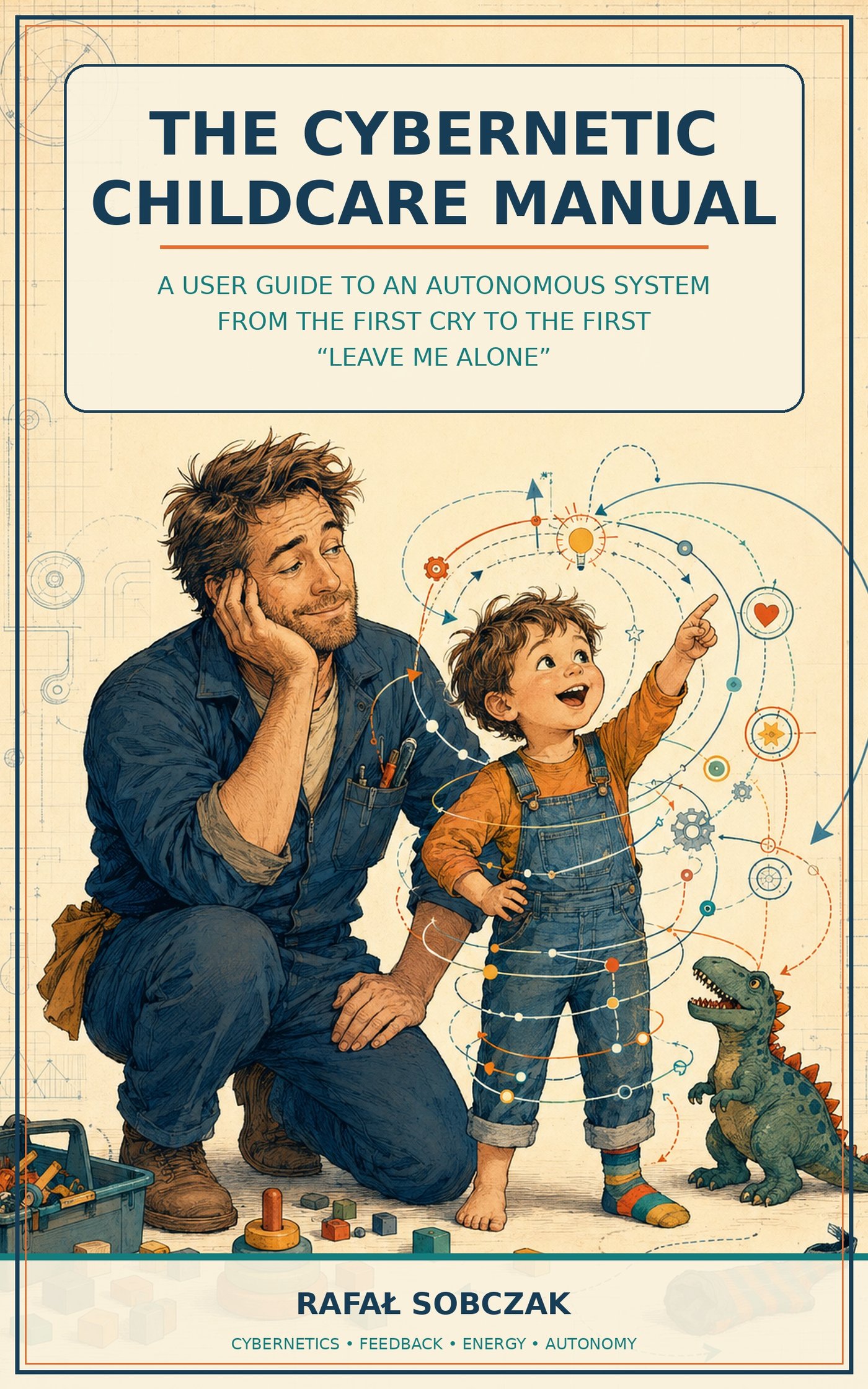
Cybernetic Childcare Manual - ebook

Cybernetic Childcare Manual - ebook
A child arrives in the home without an instruction manual, an administrator password or a customer-support number. System updates usually install at night, without asking for permission. The Cybernetic Childcare Manual is a practical and humorous guide based on the concepts of Marian Mazur’s Polish school of cybernetics. It presents the child as an autonomous system that receives information, manages energy, makes decisions and protects its capacity to act. The book explains how to understand children’s behavior, communicate more effectively, set boundaries without undermining independence, and respond to anger, overload, sleep difficulties, screens, school and sibling conflicts. It guides parents from infancy through adolescence. This is not a manual for programming an obedient child. It is a guide for parents who want to understand, observe and respond appropriately—before the next family “malfunction” is handled simply by increasing the volume.
Ta publikacja spełnia wymagania dostępności zgodnie z dyrektywą EAA.
| Kategoria: | Family & Relationships |
| Język: | Angielski |
| Zabezpieczenie: |
Watermark
|
| Rozmiar pliku: | 5,3 MB |
FRAGMENT KSIĄŻKI
This is a popular-science and humorous guide to relationships with children, viewed through the lens of cybernetics. It is not a medical textbook and does not replace consultation with a pediatrician, psychologist, psychiatrist, dietitian or any other qualified professional. When health, safety or child development is involved, a joke may release tension, but diagnosis still belongs to a properly trained human being.
The cybernetic model is not meant to turn a child into a machine. Quite the opposite: it helps explain why a child is not a television remote. Pressing the correct button is not enough. Sometimes there is no button. Sometimes the remote is in the refrigerator, and the child insists that this is an experiment.INTRODUCTION. THE MANUAL THAT WAS NOT INCLUDED IN THE BOX
A child arrives in the home without an instruction manual, an administrator password or a customer-support number. The manufacturer remains silent. Updates arrive at night, usually without warning, and can completely replace the interface. The “sleeps through the night” function, which worked beautifully for three days, suddenly disappears. In its place, the system installs “me do it,” “no,” “why?” and a module capable of detecting a chocolate wrapper from two rooms away.
Parents therefore begin writing their own manuals very quickly. Some use family documentation: “That is how I was raised, and I survived.” True, although from a process-quality perspective, this is rather weak evidence. A man who drove for thirty years without wearing a seat belt also survived. That does not make seat belts a conspiracy run by upholsterers.
Other parents read guidebooks. The third tells them that a child needs routine. The fourth says flexibility. The fifth announces that unconditional closeness is the key. The sixth insists that a parent must set firm boundaries. By the seventh, what the parent needs most is sleep and someone willing to take the child for a two-hour walk.
Cybernetics proposes a different question. Instead of asking only, “What should I do to make my child behave the way I want?” it asks:
- What kind of system am I dealing with?
- What information is reaching that system?
- How much usable energy does it have right now?
- What is disrupting its equilibrium?
- What response am I getting after my own action?
- Did I actually check the response, or did I simply repeat the command more loudly?
That final question matters. In many homes, communication looks like this:
“Put your shoes on.”
No response.
“Put your shoes on!”
No response.
“HOW MANY TIMES DO I HAVE TO TELL YOU?!”
The answer is: until you change something other than the volume. Cybernetics teaches a merciless rule: if a system does not produce the expected result, increasing the power of the same intervention may produce little more than a louder malfunction.
In the Polish school of cybernetics developed by Marian Mazur, a human being is described as an autonomous system: a system capable of controlling itself and counteracting the loss of that capacity. This sentence is the foundation of the entire book. A child is not passive educational material. A child has needs, receives and processes information, stores energy, makes decisions, affects the environment and protects internal equilibrium. In other words, from the beginning, the child is a participant in the system, not a product waiting for final quality inspection.
This does not mean that a three-year-old should independently set bedtime, plan the menu and determine the family budget for excavators. Autonomy is not the same thing as competence. A driver may steer independently, but before receiving the keys, that driver should learn which side of the road to use and why a roundabout is not a drifting circuit.
This book combines several languages. Cybernetics provides a model of control, information, energy, feedback loops and functional equilibrium. Contemporary child-development knowledge sets the limits of what can honestly be recommended. Everyday family life provides the field-test data, during which the research system regularly spills cocoa over the documentation.
The book covers the period from infancy to adolescence. Not because a seventeen-year-old should be handled like a seven-month-old baby. Precisely the opposite. With every passing year, a child becomes more capable of self-direction, while the parent’s role shifts from direct protection and regulation toward designing conditions, teaching the recognition of consequences and gradually transferring control. A well-run project called “child” ends when the system no longer needs a project manager. It is the only promotion after which the boss should celebrate losing the position.
MESSAGE FROM CONTROL: The goal of parenting is not a child who always obeys commands. The goal is a person who can accurately recognize a situation, make decisions, anticipate consequences, cooperate and regain equilibrium after a disruption.