MENU
MENU
 Nasze ceny

 Przeczytaj fragment on-line

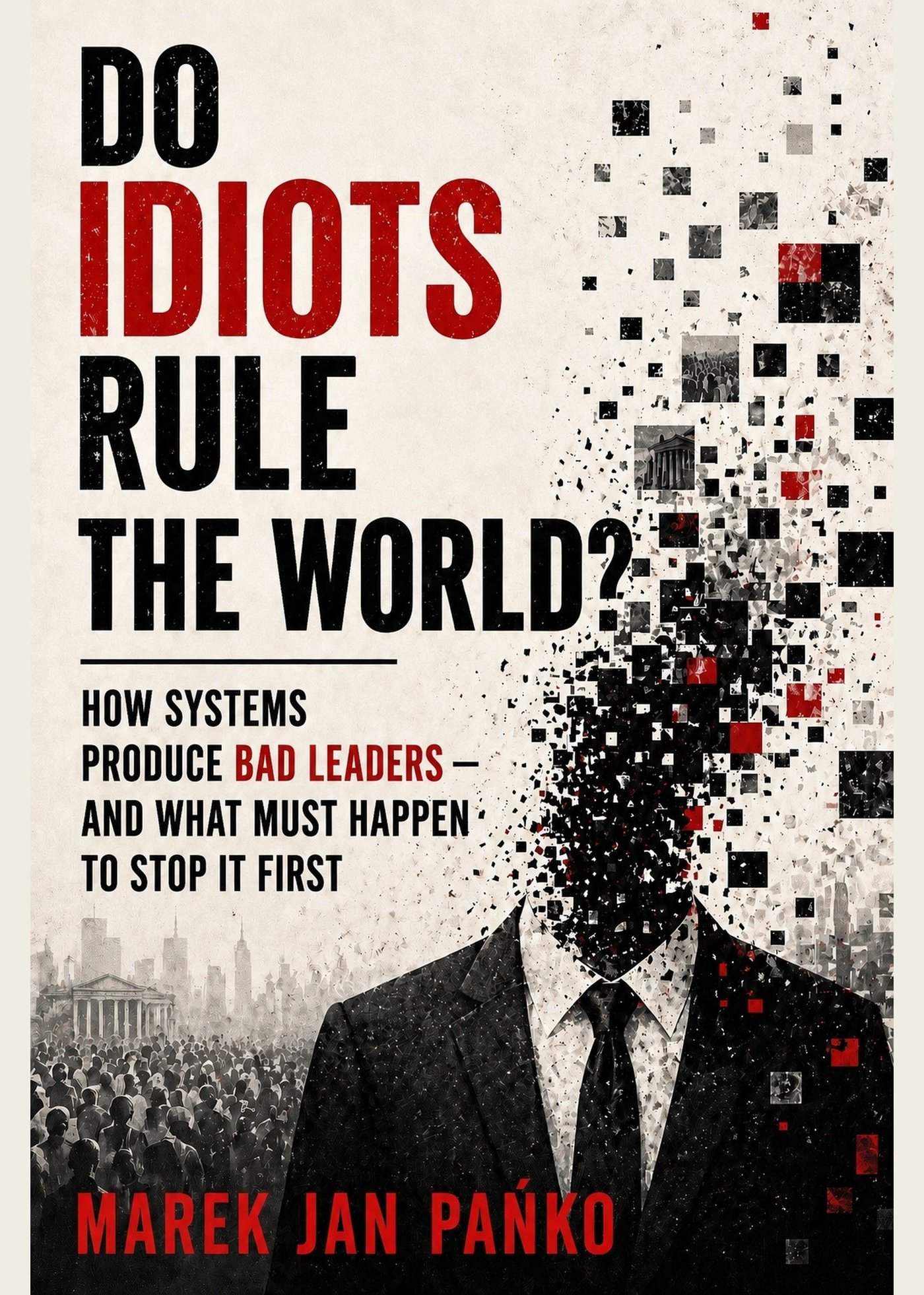
DO IDIOTS RULE THE WORLD? - ebook
DO IDIOTS RULE THE WORLD? - ebook
IS THE PROBLEM THAT IDIOTS RULE — OR THE SYSTEM THAT PRODUCES THEM? On election night, November 8, 2016, the world froze. Then came Brexit, Hungary, Brazil, Poland. Each time the same disbelief: “something is wrong here — but what?” The author offers a thesis that changes the perspective: bad leaders are not simply produced by bad people. They emerge from specific conditions — and once those conditions exist, the system begins to select exactly this kind of leader. This book explains the mechanism. It shows how the collapse of shared reality, disinformation, and social-media algorithms prepare the ground for populism, and how power operates when institutions lose public trust. It is a study of the crisis of democracy written from the perspective of a witness who watched political change up close. For readers interested in politics, history, and the nature of power — and anyone who wants to understand the crisis of democracy beyond the daily headlines.
Ta publikacja spełnia wymagania dostępności zgodnie z dyrektywą EAA.
| Kategoria: | Literatura faktu |
| Język: | Angielski |
| Zabezpieczenie: |
Watermark
|
| ISBN: | 9788398292924 |
| Rozmiar pliku: | 3,5 MB |
FRAGMENT KSIĄŻKI
It was the evening of November 8, 2016. In the newsrooms of the world’s largest papers, journalists sat in front of their screens waiting for results that were meant to confirm the prevailing expectations. The polls gave Hillary Clinton a clear lead, and the betting markets rated her chances as decidedly better too. Clinton was supposed to win the presidential election in the United States, and everything was supposed to go back to normal.
It didn’t.
At three in the morning, as one state after another began turning from blue to red on the television maps, the studios and newsrooms fell into a silence of a different kind from the one that usually accompanies surprise. It was the silence of people who had suddenly realized they did not understand the world they were living in.
That night, in the studios and newsrooms, you could hear a sentence that had been hard to imagine before. Not a comment on the result, not a ready-made analysis — rather an admission of helplessness: something here doesn’t add up, we don’t know what, but something doesn’t add up.
That sentence could have been uttered many times before and many times after. At the results of the Brexit referendum, a few months before that night, when the British voted to leave the European Union against the forecasts, against the recommendations of their own government, and against what most economists considered sensible. At the elections in Italy, Hungary, Poland, France, Brazil — when parties and politicians who a decade earlier had not existed or had operated on the margins suddenly began to seize power. At the speeches that contained things plainly untrue — and nothing happened. At the sight of crowds that clapped and believed.
Something doesn’t add up. But what?
An explanation that reassures — and doesn’t work
The answer that comes fastest is also the most human. We say that specific people are to blame. That the politicians who come to power this way are irresponsible, dangerous, crude. That the voters let themselves be deceived, that they lost their reason, that they gave in to emotion. That we live in an age which, for some reason, produces more stupidity than the ones before it.
This explanation is understandable. It is also, to some degree, reassuring — because if the problem lies in specific people, then all we have to do is wait for them to leave. Or vote differently. Or explain to the voters more clearly how the world works. The problem is defined, the solution is within reach, and the world as a whole remains a place we understand.
The trouble is that this explanation doesn’t hold up against reality.
Because if the problem lies in specific people — why does it recur in so many different places at once? Why do we observe similar phenomena in countries with entirely different histories, cultures, and levels of wealth? Why does the same pattern — a simple message, confidence without foundation, a division into the good and the bad, the erosion of institutions — appear in democratic America, post-communist Hungary, ancient Athens, and pre-war Germany?
Coincidence happens once. What happens dozens of times in dozens of places across the centuries is not coincidence. It is a mechanism. And it is precisely this mechanism that this book is about.
Changing the question
To understand it, we have to begin by changing the question.
We usually ask: why did this person come to power? What is it about him that made people follow him? What traits, talents, and flaws does he have — and what does that say about those who chose him?
These are questions about the effect. Interesting, but not enough.
The question that leads deeper sounds different: what had to change beforehand for such a person to have any chance at all? What conditions had to arise before he stepped onto the stage? What broke — in the system, in the institutions, in the way people understand reality — for his way of speaking and acting to suddenly start working?
This shift is crucial. Instead of looking at the individual, we begin to look at the environment that brought that individual forth. Instead of judging, we begin to understand. And understanding is always more useful than judgment — because judgment closes the conversation, while understanding opens it.
This book is built around a single thesis that can be expressed in a single sentence:
Bad leaders are not produced by bad people. They are produced by particular conditions — and once those conditions arise, the system begins to bring forth exactly this kind of leader, as if it had been designed to do so.
This sentence has several consequences that may not be obvious.
The first: the problem does not disappear when a particular politician disappears. If the conditions that produced him remain unchanged, the system will simply produce the next one. Perhaps less charismatic, perhaps more, perhaps with different rhetoric — but with the same set of traits that prove effective under those conditions.
The second: the voters who vote for such politicians are neither more stupid nor worse than those who do not. They are doing something that, in their situation, is entirely rational — looking for their bearings in a world that has stopped being comprehensible. That they look for them in the wrong place is a symptom of the problem, not its cause.
The third, and perhaps the most important: responsibility for what is happening is broader than we usually think. It does not lie only with the politicians who lie, or with the voters who believe them. It lies in the conditions that both sides create together — conditions whose change requires more than another round of elections.
The mechanism I describe has several stages — and each of them is the subject of a separate chapter.
It begins with something that might be called the disintegration of shared reality. By this term I mean the minimal set of facts that is accepted by the participants in a given system regardless of their political views — something you can start a conversation from, because both sides agree at least on what the facts are. When that point disappears, each side lives in its own version of the world, convinced that its version is the only true one.
In such a world, the hunger for simplicity grows. Complex explanations demand effort, time, and a willingness to doubt. Simple explanations are instant, certain, and give the feeling that at last someone is saying what everyone feels. They do not win because they are true. They win because they are useful — they provide bearings where bearings were missing.
Then the institutions — the courts, the media, the parliaments, the public offices — begin to lose their ability to settle disputes. They do not vanish; they still exist and still function. But they stop being seen as neutral. They become one of the parties to the conflict, and their decisions cease to be treated as final.
And at that moment — when reality is divided, simplicity triumphs, and the institutions are powerless — a vacuum appears. Someone has to fill it. And someone always does.
We will look at this mechanism from several sides.
We will see what psychology has to say about it — why the human brain, in conditions of chaos, reaches for simplifications, and how this leads to decisions that look irrational from the outside, even though, on the inside, they are perfectly logical.
We will see what history has to say — because this mechanism is not an invention of the twenty-first century. It was at work in ancient Athens, in pre-war Germany, in Rwanda in 1994. Each time it looked a little different, but its core was the same.
And we will see what follows from all this — what conditions hold this mechanism back, and why stability is not a natural state but something that requires constant upkeep.
What this book is, and what it is not
One more thing before we begin.
This book is not political in the sense in which that word is usually used. It does not take the side of any part of the political spectrum. It does not claim that one party is better than another, or that one economic system is more just than another. The thesis it advances concerns a mechanism — and that mechanism has been and still is used by people of different convictions, in different countries, on different occasions.
It is, however, a book that asks uncomfortable questions. Not only about politicians and systems — but about all of us. About how we react to uncertainty. About what we look for when the world stops being comprehensible. About the role each of us plays in creating the very conditions it describes.
Because the ultimate answer to the question in the title is not: yes, idiots rule the world.
It is: the world creates the conditions in which idiots can rule. And for those conditions we are all responsible — to different degrees, in different ways, but responsible nonetheless.
That is the thought worth starting from.
This book is not a scholarly work. It is an attempt at understanding. It draws on the available sources, data, and literature — but its ambition is not to create a new theory, but rather to capture the mechanisms that recur across those materials. The conclusions are the product of their interpretation, and also of my own experience, which allows me to see them as a whole.PART I
THE ILLUSION OF THE OBVIOUS
CHAPTER 1 — A label instead of an answer
“Idiot” — the word that comes on its own
There is something deeply satisfying about the word “idiot.”
When we look at a politician who says things that are plainly untrue, when we watch a leader make decisions that defy elementary logic, when we listen to a speech full of contradictions and open lies — the word appears almost reflexively. You don’t have to search for it. It comes on its own, ready-made, precise, satisfying. For a moment everything fits. The world makes sense. The problem is identified. The guilty party named.
And it is precisely at that moment — in that instant of satisfaction — that we make a mistake which will follow us through this entire book if we don’t recognize it now.
Because the word “idiot” is not an answer. It is a substitute for one. It is a label that looks like an explanation but is in fact the end of one. To see this, all you have to do is ask a single simple question. If the problem lies in this particular man — in his stupidity, ignorance, irresponsibility — then how do we explain that similar people appear in so many different places and at such different moments in history? How do we explain that the same pattern — a simple message, absolute certainty, a division into the good and the bad, contempt for experts and institutions — appears simultaneously in wealthy democracies and poor developing countries, in Europe and in Latin America, in the twenty-first century and two and a half thousand years ago in ancient Athens?
Behind every recurring pattern there is a mechanism. And it is the mechanism — not the particular person — that is the real subject of this book.
I think it is worth stating right away how I use the word “populism” in this book. I do not mean a specific political program, nor the left or the right. By populism I mean a style of leadership and rhetoric: self-assurance unsupported by facts, a simple narrative explaining complex problems, a sharp division between “the people” and “the elites,” and a readiness to undermine the institutions that stand in the way. This style appears on both sides of the political spectrum — and that is precisely why the mechanism that produces it is a systemic phenomenon, not an ideological one.
Let us also settle one thing: the hunger for power is not idiocy. A person can be intelligent, competent, and perfectly aware of his own actions, and still pursue power at any cost.
A shortcut that replaces thinking
We cannot do without labels. Without them we could not function.
Every day we process enormous amounts of information — about people, situations, events. If we analyzed everything from scratch each time, we would be unable to make a single decision. So the brain uses shortcuts. It classifies, simplifies, assigns labels. This is not a flaw — it is a necessity. Evolution designed us in exactly this way, because in most situations a quick, approximate answer is better than a slow, precise one.
The problem arises when a label replaces thinking instead of setting it in motion.
When we call someone an “idiot,” we do several things at once. We describe — we attribute certain traits to that person. We explain — we say why he does what he does. And we close the subject. The label works like a latch. Once we’ve fastened it, the question is finished. There is no need to go any further.
And it is exactly where the label ends that the real question begins.
The case of Farage
Take a concrete example. In 2016 Nigel Farage, one of the most recognizable spokesmen for the campaign to take Britain out of the European Union, stood before the cameras and announced that the United Kingdom had regained its independence. He said things that experts immediately dismantled as untrue or greatly exaggerated. He ignored the economic data. He reduced complicated trade relationships to a few catchy slogans. From the perspective of someone who understood the complexity of the issue, it looked like a spectacle of ignorance.
An idiot — said many observers.
But Farage won the referendum. He convinced millions of people. He changed the course of history of one of the largest countries in the world. Can an idiot accomplish that? Can a man devoid of competence and reason spend years building a political movement, recognize the moment when society is ready to embrace it, and put it to effective use?
Farage may have made mistakes of substance. His vision of the world may have been simplistic. But calling him an idiot does not explain his success — it hides it. It replaces the question “why did he succeed” with the answer “because the others were stupider.” And that is an answer that explains nothing.
The same goes for Trump, Orbán, Bolsonaro, Le Pen, and dozens of other politicians whose careers over the past decades have left commentators dumbfounded. Each of them had his obvious weaknesses, mistakes, and oversimplifications. Each of them was regularly described by part of the media as unserious and incompetent. And each of them, in spite of that — or perhaps precisely because of it — gained real influence and real power.
The label “idiot” does not explain this phenomenon. It masks it.
The guilty man, the innocent system
Worse still, the masking has consequences. If we believe that the problem lies in a particular man, we stop looking deeper. We stop asking about the conditions that produced that man. We wait for him to leave — and we are surprised when someone else takes his place, someone similar, perhaps even worse. Because the conditions remained. And the conditions produce people who fit them.
There is one more problem with the label, less often noticed but just as serious. The label shifts all the responsibility onto the individual and lifts it off the system. If a particular man is guilty, then the system is innocent. And if the system is innocent, there is no need to change it. It is enough to change the man.
History shows clearly, however, that changing the man without changing the system rarely solves the problem. The new man steps into the old system and either adapts to it or is rejected by it. The system endures. The conditions endure. And after a while another politician appears who surprises and unsettles us, and who hears, once again, the same word.
Idiot.
And the circle closes.
To break that circle, we have to learn to look differently. Not at the man, but at the environment in which the man operates. Not at the effect, but at the process that leads to it. Not at who won, but at what had to change for such a person to be able to win.
It is a shift of perspective that seems small but leads to an entirely different place.
The garden and the gardener
Imagine a garden. In the garden grow many different plants — some strong and healthy, others weak, vegetating in the shade, almost invisible. For years the garden looks much the same. The strong plants dominate, the weak ones cling to the edges. Then comes a drought. Or the composition of the soil changes. Or someone stops tending the garden. And suddenly it turns out that the plants which for years had no chance at all begin to dominate. They take up space, they spread, they crowd out the former dominants.
A gardener who looks only at the plants will say: these weeds have grown stronger. A gardener who looks at the whole garden will say: the conditions in which the plants compete have changed.
In politics we usually look like the first gardener. We see a man growing in strength, and we focus on him — on his traits, talents, flaws. Less often do we ask about the soil. About the conditions. About what changed in the whole environment so that his strategy suddenly began to bear fruit.
This book is an attempt to look like the second gardener.
Here it is worth pausing over a certain misunderstanding that arises almost every time someone proposes such a shift of perspective.
This shift is sometimes understood as a defense of the politicians we are talking about. As if saying “the problem lies in the system, not the individual” meant “this man bears no responsibility at all.” That conclusion is false, but common enough that it is worth disarming right away.
Understanding a mechanism is not the same as excusing those who take part in it.
A politician who lies is responsible for his lies — regardless of whether the system created fertile ground for them. A politician who attacks institutions bears responsibility for those attacks — regardless of whether the institutions had already been weakened by others. The agency of the individual does not vanish when we notice the influence of the system.
But noticing the influence of the system adds a dimension to the picture that is missing without it. And it is precisely this dimension that is crucial — because without it we can judge, but we cannot understand. We can condemn, but we cannot prevent. And prevention, after all, is the goal.
This is about us too
There is one more reason the label is dangerous — and this reason concerns us directly, not the politicians.
When we say “idiot,” we assume that we ourselves are on the right side. That we are not taken in, not manipulated, that we think critically and see what others do not. This is a comfortable and entirely understandable assumption. It is also an assumption that psychology has undermined, repeatedly and mercilessly.
Every one of us is susceptible to the mechanisms this book describes. Every one of us has a need for meaning, order, and belonging. Every one of us, under conditions of chaos and uncertainty, reaches for simpler explanations. Every one of us is inclined to reject information that threatens our picture of the world and to accept information that confirms it.
This is not a matter of intelligence. It is a matter of being human.
Education is not a shield. History knows too many examples of superbly educated people who, under certain conditions, adopted beliefs that from the outside — and from a distance in time — look like obvious errors or outright madness. Professors, lawyers, doctors, engineers — all of them, at various moments in history, supported or tolerated things that are unacceptable today. Education was not a shield. Intellect was not a shield.
This means that the word “idiot” has one more flaw beyond those we have already named. It is too comfortable. It gives us a sense of security we do not deserve. It suggests that the problem concerns others — the less intelligent, the less educated, the less critical. And it is precisely this sense of security that is especially dangerous, because it lulls our vigilance exactly where it is most needed.
It is an interweaving of several processes that together create conditions favorable to a particular type of leadership. These processes are neither mysterious nor invisible — on the contrary, they are present in everyday life and we can observe them, if we know what to look for. I described them briefly in the Introduction. Each of these processes deserves a separate chapter — and each will get one. Together they create an environment in which a particular type of leader becomes not only possible but virtually inevitable.
The mechanisms we will be discussing are not irreversible. They are not destiny. They do not operate like the laws of physics, which cannot be resisted. They operate under specific conditions — and when those conditions change, the mechanisms lose their force. That sounds optimistic. And it is optimistic. But it is also demanding. Because changing the conditions is not simple and does not happen on its own. It requires understanding what is going on. It requires seeing the mechanism before it grows to a size that is hard to control. It requires acting at the right moment — and not after the fact, when all that is left is to assess the damage.
That is why this book begins with a label. With the word “idiot” and the satisfaction it gives. Because the first step toward understanding the mechanism is giving up that satisfaction.
I set the label aside and begin to ask.
Who really are these people who win? What distinguishes the moments when they win from the moments when they lose? What has to change in the system for their strategies to start working?
The answer to the first of these questions is less obvious than it seems.
Because, contrary to appearances, these people — these politicians we call idiots — are not idiots at all. They are something more complicated.CHAPTER 2 — The same man, different times
A ranter from the beer hall
In 1930 a certain Austrian painter, who for years had vegetated on the margins of politics, delivered a speech in a Munich beer hall. It was not his first speech — he had been speaking in public for more than a decade. For most of that time no one beyond a handful of ardent supporters took him seriously. He was seen as a ranter, as a man too extreme, too emotional, too unpredictable to play any serious political role. Mainstream German politicians looked at him with a mixture of contempt and amusement.
Three years later he was Chancellor of Germany.
What changed over those three years was not the man himself. He said similar things, in a similar way, with a similar intensity. His views did not evolve in any meaningful direction. His methods were the same — a simple message, a clear enemy, absolute self-assurance, contempt for compromise.
What changed was Germany.
The Great Depression struck the country with a force no one had expected. Unemployment rose sharply and by 1932 reached roughly thirty percent. The life savings of millions of people evaporated within months. The institutions of the Weimar Republic, young and weak, were unable to cope with the scale of the catastrophe. The mainstream parties quarreled over details while the country was sinking. People who only five years earlier had a job, a home, and a sense that they knew how the world worked suddenly found themselves in a reality they did not understand and were afraid of.
And then someone appeared who spoke simply. Who knew who was to blame. Who promised order.
The rest of the story we all know — and we live with its consequences to this day.
A pattern, not a person
The story of Adolf Hitler is extreme and exceptional in many respects. But the mechanism it illustrates is neither extreme nor exceptional. It is repeatable. And it is precisely this repetition — across centuries, across continents, across political systems — that is worth examining.
Because if a similar pattern appears again and again, in different places and different eras, then it is not the result of chance or of the exceptional traits of an individual. It is the result of something deeper. Something bound up with how societies work — and how they break down.
To see this, we have to stop for a moment looking at particular figures and start looking at the pattern.
The pattern looks like this: in every era, in every culture, there are people with extreme views. Certain they are right, intolerant of doubt, dividing the world into the good and the bad, offering simple explanations for complicated problems. Most of the time these people remain on the margins. They are present, they may be loud, but they do not rule. The system does not reward them.
Then something changes.
And suddenly — though this “suddenly” is, as we shall see, an illusion — people who for years were ignored or ridiculed begin to gain influence. Their message, which earlier seemed too extreme, too simplistic, too irresponsible, begins to reach an ever wider audience. The system that had previously constrained them stops doing so.
The question is: why?
Trait and context
The answer we are looking for requires a distinction between two things that are easy to confuse.
The first is a person’s character — his personality traits, his beliefs, his style of action. The second is the effectiveness of those traits in a given environment.
This distinction is crucial, because traits in themselves do not determine success or failure. Whether a given trait is an asset or a flaw depends on the context in which it is applied.
Take self-assurance. In a stable, well-functioning system, excessive self-assurance is usually a flaw. A man who never has doubts, who does not listen to others, who is convinced he is always right — such a man makes mistakes and cannot correct them. A system that works well has mechanisms that catch and correct such mistakes. The media, the opposition, oversight institutions, voters who judge the effectiveness of governments — all of this together ensures that excessive self-assurance sooner or later loses out to competence and caution.
But in an unstable system, in conditions of chaos and uncertainty, the same trait works differently.
When people do not know what is true, when institutions lose trust, when reality becomes hard to understand — self-assurance ceases to be a flaw. It becomes a signal. A signal that someone understands the situation, that someone knows what to do, that someone is able to restore order.
This is not logic — it is psychology. But it is a psychology that works. And it works regardless of whether the self-assurance is justified or not.
Chávez, Mussolini, and others
To see this mechanism in action, I will give a few concrete examples, and we will look at the common pattern.
Venezuela, the turn of the nineteen-nineties and two-thousands. Hugo Chávez was a military man who in 1992 attempted a coup and ended up in prison. Venezuela was then a country in deep crisis: a political system controlled by two corrupt parties, growing inequality, millions of people in poverty despite the oil. Trust in institutions and in the political class was at historic lows.
In such an environment Chávez, released from prison in 1994, began to build a political movement. He spoke simply, pointed to the guilty, promised revolution. In 1998 he won the presidential election with more than fifty-six percent of the vote.
Was Chávez an exceptional man? In certain respects, yes. But his traits did not change between 1992 and 1998. What changed was the context. Venezuela became a country in which his strategy — simple, emotional, anti-establishment — found fertile ground.
Italy, 1919. Benito Mussolini — a newspaper editor and political agitator of relatively small reach. Italy after the First World War was a deeply wounded country: humiliation at the peace conference, runaway inflation, unemployment, street fighting between left and right, the instability of one cabinet after another. The political class seemed incapable of governing.
In this environment Mussolini built a movement that seized power in 1922. He had talents — rhetorical, organizational, political. But such talents were not in short supply in the Italy of that time. What Mussolini had, and others did not, was a perfect fit to the moment.
In calmer times the same key would not have found a lock it fit.
One could cite dozens of similar examples: Perón in Argentina, McCarthy in the America of the nineteen-fifties, Fujimori in Peru, Lukashenko in Belarus. Each of these cases has its own specifics and its own local history. But they are all bound by a single pattern.
A man of a particular style — self-assured, simplifying, pointing to the guilty, anti-establishment — appears at the moment when the system is weakened. And suddenly, in precisely these conditions, his style ceases to be a flaw and becomes an asset.
This is not coincidence. It is a mechanism.
And to understand it, we have to answer the question: what exactly must change in the system for this mechanism to start working?
A bridge that collapses from within
Imagine a bridge.
The bridge is built from materials that from the outside look solid and durable. For years, perhaps for decades, people walk across this bridge, drive their cars over it, without thinking that it could collapse. The bridge is such an obvious part of the landscape that it stops being noticed. It is simply there.
Meanwhile, inside, invisible to the passers-by, processes of corrosion are at work. Moisture seeps into micro-cracks. The metal rusts. The concrete crumbles from within. Each of these changes is minimal — none of them in itself poses a threat. But together, accumulating over the years, they weaken the structure.
Then comes one day. One moment. Perhaps an unusually strong wind, perhaps a truck a little heavier than usual. And the bridge collapses.
The people who see it say: the bridge collapsed suddenly. In reality the bridge had been collapsing for years. What happened suddenly was only that it became visible.
Social and political systems break down in exactly this way. There is no single dramatic moment in which everything changes. There is a long process of erosion that for most of the time remains invisible. And then there is a moment when something snaps — and everyone says it happened suddenly.
Hitler did not appear suddenly. The Weimar Republic had been decaying throughout its existence — through its inability to build coalitions, through economic crises, through the absence of a culture of compromise, through the fact that too many of its citizens never truly accepted it. When the Great Depression dealt the final blow, the bridge had long been eaten away from within.
Mussolini did not appear suddenly. Italy after the First World War was a country in which the institutional bridge had never been particularly solid — too young, too weak, too little rooted in society.
Chávez did not appear suddenly. For decades Venezuela had been building up the corruption and inequality that eventually caused the bridge of trust in institutions and in the political class to collapse completely.
Every time: a long erosion, then a tipping point, then a man who fits the moment.
Blind selection
Here we arrive at an observation that is perhaps the most important.
When systems are stable and functioning well, they select leaders by the criterion of competence in the broad sense — the ability to solve problems, build coalitions, take different perspectives into account, correct mistakes. It is not a perfect selection. But it favors a certain type of action and a certain type of person.
When systems break down, the criterion of selection changes.
Not abruptly, not all at once. Gradually, as one element of the system after another loses its effectiveness. As institutions stop settling disputes, as the media stop creating a shared point of reference, as people lose trust in those who were supposed to represent them.
And in this changed environment a different type of person begins to be effective. Not the one who can manage complexity — but the one who can reduce it to a simple picture. Not the one who has doubts and reveals them — but the one who speaks with absolute certainty. Not the one who seeks compromise — but the one who points to an enemy.
This is systemic selection. And it is blind — no one plans it, no one directs it. It is the result of many elements acting at once, each of them slightly, all of them together powerfully.
Why does the same man achieve a different outcome in different times?
The answer is: because it is not about the man. It is about the fit between the man and the conditions.
A man inclined to simplify reality, to absolute self-assurance, to pointing at the guilty — such a man exists in every society and every era. When the system works well, his strategy is ineffective. It may attract followers on the fringes, but it does not win power, because the system has mechanisms that constrain him.
This is a conclusion that may seem discouraging. For it suggests that the problem cannot be solved by swapping particular people in particular offices. It suggests that until the conditions change, the system will keep producing similar leaders — one leaves, another appears.
But there is also something in this conclusion that ought to mobilize us rather than discourage us. Because if the problem lies in the conditions, then changing the conditions is possible. Conditions are not given once and for all. They can be shaped. What has been damaged can be rebuilt. The mechanisms that protect the system can be strengthened.
This is harder than changing a single politician. But it is a change that has a chance of outlasting a single term of office.
A similar mechanism, different effects
Someone usually asks: does this mean that all the politicians we are talking about are really the same? That between Hitler and Farage, between Mussolini and Chávez, between Orbán and Bolsonaro there is no difference at all?
Of course there are differences. Enormous differences. Differences in the scale of the harm they did. Differences in the methods they used. Hitler was a mass murderer. Farage is a populist politician. To place them in one sentence without enormous qualifications would be a serious error.
But the mechanism that brought them forth is similar. And it is precisely this similarity that matters — not in order to equate the consequences, but in order to understand the causes.
If we understand how the system produces a Farage, we are closer to understanding how the system — in other, more extreme conditions — produces someone far more dangerous. And we are closer to being able to recognize the moment when the mild version of the mechanism begins to move toward the more dangerous one.
At the beginning of this chapter I described a certain Austrian painter who for years vegetated on the margins and then, within a few years, became Chancellor of Germany.
I would now like to describe him differently.
Not as an exceptional man with exceptional traits who in some mysterious way managed to master a great country. But as a man with a particular style of action who for years found no environment for himself. And then the environment changed — and the style that earlier had been worthless became the most valuable political currency in Germany.
This is a cooler and perhaps less dramatic way of telling this story. But it is closer to the truth. And — more importantly — it is more useful. Because if we understand that it was the environment that created the conditions for his success, then we can ask: what in that environment had to change? And are similar changes taking place somewhere today?CHAPTER 3 — Competence versus fit
The Churchill paradox
In 1940 Winston Churchill became Prime Minister of Great Britain. He was then sixty-five years old, with a political career behind him that most observers would have judged spectacularly unsuccessful. He was responsible for the Gallipoli disaster in the First World War, which cost the lives of tens of thousands of soldiers. He spent the nineteen-thirties in the political wilderness, warning against Hitler when no one wanted to listen. He was seen as a man of terrible judgment, unpredictable, difficult to work with, prone to exaggeration and drama.
When he took office as Prime Minister in May 1940, Germany was just marching into France. The British army was surrounded at Dunkirk. Most of his cabinet believed they should seek an accommodation with Hitler. The situation was, objectively speaking, hopeless.
Churchill said no. He said they would fight on the beaches, on the landing grounds, in the fields and in the streets, that they would never surrender. He said it with an absolute self-assurance that no facts justified.
And he won.
Not because he was right in a military sense — the situation really was hopeless, and only a series of lucky circumstances and Hitler’s mistakes allowed Great Britain to survive. He won because his style — self-assured, unyielding, dramatic, refusing to acknowledge the possibility of defeat — was exactly what Great Britain needed at that particular moment.
That same Churchill, in the calm of peacetime, was a difficult and problematic politician. He lost the election in 1945 — right after victory in the war, at the peak of his fame — because the British decided his style suited war but not reconstruction. They were right.
Churchill is a paradoxical example — because in his case the fit to the moment produced effects that most of us regard as positive. But the mechanism is the same as in the cases that trouble us. A style that would be a flaw in normal times became, in extreme circumstances, an asset.
And that is the heart of this chapter.
What political competence is
To understand why fit beats competence under certain conditions, we first have to understand what competence in politics actually is, and why its definition is not as simple as it seems.
Political competence is not the same as academic knowledge. Not the same as intelligence in the sense of IQ. Not the same as professional experience in the sense of years worked in a given field.
Political competence is the ability to act effectively within a political system — to build coalitions, to negotiate compromises, to manage complex organizations, to understand which decisions are possible under which conditions, and to implement them in a way that does not destroy the foundations of the system.
This definition matters, because it shows that political competence is always a systemic competence. It operates within a particular system and assumes that this system functions. It assumes that there are rules of the game respected by all participants. That institutions work. That the media perform their function. That voters judge politicians by certain criteria that bear some relation to reality.
When these assumptions are met, competence is rewarded. A politician who understands the complexity of problems, who builds lasting coalitions, who corrects his mistakes, who does not promise the impossible — such a politician has an advantage over one who simplifies, shouts, and points to the guilty.
When these assumptions cease to be met — when the system destabilizes, when institutions lose credibility, when the rules of the game stop being respected — competence ceases to be rewarded. Because competence assumes a game played by rules, and the rules have stopped working.
When fit comes into play
And then fit comes into play.
Fit is a broader and less precise concept than competence. It is not about someone being good at what he does. It is about what he does answering what his surroundings need at a given moment.
That need is not necessarily conscious. Often it is emotional, intuitive, hard to put into words. Voters do not sit down at a table and logically analyze what they need. They feel — and that feeling leads them to particular choices.
In conditions of stability and relative prosperity, people need politicians who will manage affairs well and predictably. Their needs are relatively satisfied — they are not looking for a revolution, they are looking for competent management of what they have.
In conditions of crisis, chaos, and a sense of threat, the needs are different and far more urgent. Above all, people need three things — meaning, order, and the sense that someone is on their side. They need someone to explain what is happening. Who will point out who is to blame. Who will say that he knows how to fix it.
A politician competent in the traditional sense has a problem with these needs. Because the honest answer to the question “what is happening” is usually: it’s complicated, many factors are affecting the situation, there is no simple solution, we will act gradually and correct our mistakes. That is an honest answer, and probably the best one from a long-term point of view. But it is an answer that, in conditions of acute crisis and a sense of threat, does not fulfill its psychological function.
A politician fitted to a moment of crisis gives a different answer. He says: I know what is happening. I know who is to blame. I have a plan. I will act decisively. Everything will change.
This answer may be false in substance. Often it is. But it fulfills a psychological function that the other answer does not. It gives the feeling that reality makes sense again. That someone is in control of the situation. That there is a direction.
And that is precisely why it is chosen.