MENU
MENU
 Nasze ceny

 Przeczytaj fragment on-line

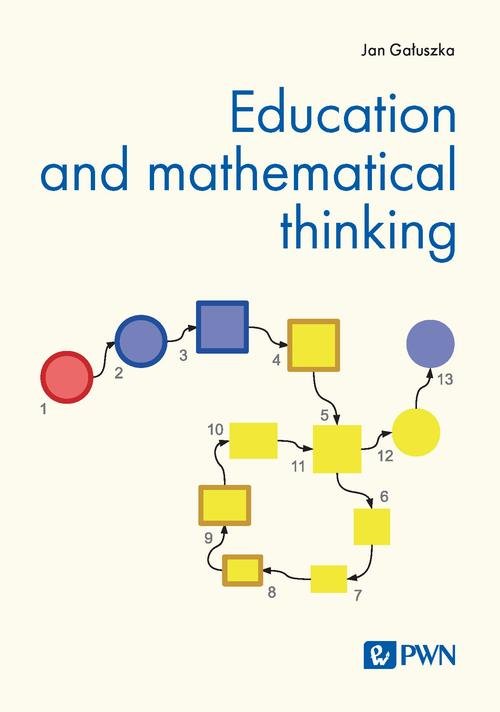
Education and mathematical thinking - ebook

Education and mathematical thinking - ebook
Książka zapełnia lukę między podejściami w opracowaniach dotyczących edukacji matematycznej. Wskazuje, co w edukacji matematycznej jest najistotniejsze oraz, co powinno być uwzględnione w każdym realizowanym podejściu, tak aby edukacja matematyczna była w pełni prawidłowa i zgodna z aktualną wiedzą oraz wartościowa poznawczo.
| Kategoria: | Mathematics |
| Język: | Angielski |
| Zabezpieczenie: |
Watermark
|
| ISBN: | 978-83-01-24202-2 |
| Rozmiar pliku: | 3,3 MB |
FRAGMENT KSIĄŻKI
INTRODUCTION
Mathematics appears as art;
Mathematical objects are its matter;
Mathematical thinking is its tool;
Experiencing harmony and logical aesthetics is its finial.
Mathematics is difficult to define. Depending on the adopted philosophical concept, mathematics can be defined as a method of describing or structuring the reality around us, and in particular a method of modelling processes that man observes. The special role of mathematics follows on from its effectiveness, which stems, on the one hand, from a strict connection of mathematics with the human cognitive system, and, on the other, from the extremely precise in-built language of mathematics. No other branch of science or knowledge requires such discipline of thinking and precision of statement as mathematics does. It is the only science in which a correctly proved theorem will never be falsified.
The problem of the foundations of mathematics and, consequently, mathematical thinking and mathematical imagination has long been piquing the interest of researchers representing various branches of academia, including, apart from mathematicians themselves, philosophers and psychologists. It should be noted that undertaking research in this field requires special competences. The researcher should have cognitive access to the object/subject being described. Hence it is necessary that a person researching mathematical thinking be a mathematician with their own creative experience in mathematics. The researcher should also be adequately competent in psychology, to be able to properly analyse the process of thinking, as well as in philosophy, to be able to perform a deepened analysis and synthesis set in a philosophical system. Given the enormous knowledge gathered in these fields to date, it is practically impossible for a single person to master all of those competences. Thus, it would be advisable that a properly selected team carry out such research. Important observations concerning mathematical thinking were made by Jacques Hadamard (An Essay on the Psychology of Invention in the Mathematical Field, Princeton University Press, 1945), who, himself being an outstanding mathematician, came to know the problem through self-reflection. However, he did underline that he was not a psychologist and his observations had been made from a mathematician’s perspective.
A material element of research into mathematical thinking is analysis of the foundation and development of arithmetic competences, which can to some extent be studied empirically, including with the use of non-invasive medical techniques. Authors who have made significant observations in this area include Stanislas Dehaene (The Number Sense: How the Mind Creates Mathematics, Oxford University Press, 1997 ()). Research into this matter has encouraged attempts at early analysis of mathematical skills in children.
While mathematical intuition is an integral part of mathematical thinking, it is hard to describe and difficult to conduct research on, all the more so because in the various stages of mathematical activity it manifests in various ways. In a child, mathematical intuition is in the initial stage of forming (it is known as “proto-intuition”); if it is subsequently properly stimulated and developed in the generally understood educational process, it may prove a hard-to-overestimate tool in tackling mathematical problems.
The development of mathematics has rendered it necessary to make ways of mathematical thinking and the expression of mathematics more precise. It included the need to codify the existing logic systems and develop new ones. A logic system is connected with the relevant axiomatic system, symbolic notation and specified rules of inference (of proving theorems). Logical semiotics has evolved. Among major contributors to this field was Charles Peirce (Collected papers. Vols. 1–6 edited by Charles Hartshorne and Paul Weiss; vols. 7–8 edited by A. W. Burks. Cambridge: Belknap Press of Harvard University Press, 1958–1966).
The need emerged to structure the mosaic of mathematical matter into a conceptual entity, which was achieved by a group of mathematicians working under the collective pseudonym of Nicolas Bourbaki; they prepared a number of monographs published under the title of Éléments de mathématique. The group performed immense work on building a logically and conceptually coherent entity from apparently different branches of mathematics. The Bourbaki group have given mathematics a new quality, which also enabled a broader view of mathematical thinking. A precise logic method has been brought to fore as the fabric of mathematical thinking. At the same time, developmental psychology advanced, as seen in particular in works by Bärbel Inhelder and Jean Piaget (cf. ), which enabled a new concept of mathematical education to be created, wherein the main objective was no longer memorising mathematical statements and mastering technical skills, but developing mathematical thinking, understanding the structure of mathematics, interrelation occurring in the structure and, consequently, perceiving mathematics as a method of structuring the process of thinking, learning and thus the mathematics itself. New methodological concepts were developed. The new educational approach adapting the precision of Nicolas Bourbaki’s ideas to elementary education was presented in Georges Papy’s monograph Mathématique moderne (). Georges Papy’s publication and its importance is discussed in Dirk De Bock, Michel Roelens and Geert Vanpaemel’s, Mathématique moderne: A pioneering Belgian textbook series shaping the New Math reform of the 1960s ().
To cater to the needs of developing knowledge, including exact sciences, computer science, social and biological sciences and other branches of knowledge, multiple new branches of mathematics have emerged, which has materially affected mathematical thinking. The emergence of new branches of mathematics requiring differentiated mathematical tools has diversified mathematical thinking.
The development of computer science has blazed a new trail for mathematical thinking known as computational thinking, and enabled support of mathematical activity with computer-science methods. Should computer generated proofs be recognised as acceptable, it may in the extreme case lead to the forking of mathematics into orthodox mathematics and statistical mathematics (which approves reasoning of a statistical nature as fully acceptable).
These developments pose special challenges to the process of mathematical education. Mathematical thinking, mathematical imagination, mathematical intuition and the mathematical knowledge based thereon are strictly connected by feedback with mathematical education. For mathematics teaching to be effective, it should start early and proceed consistently, taking into consideration a pupil’s abilities depending on their age and knowledge. It is of major importance, too, that people responsible for mathematical education should have appropriate training in mathematics and its teaching methodology, with a special emphasis on the early stage of education.
Mathematical abilities are often erroneously equated with computational skills. The following opinion is too often voiced about a child: “He/she has great mathematical abilities because he/she proficiently operates numbers, even big ones”. It should be clearly stressed that computational skills are not directly connected with mathematical abilities. People have been described who have quickly mentally performed highly complicated arithmetic operations, but never showed any broadly meant mathematical abilities. And, conversely, history tells us of outstanding mathematicians who computed slowly and rather reluctantly. Mathematical abilities should rather be included in a certain thinking disposition called mathematical thinking.
The development of mathematical, properly logically founded, thinking and mathematical imagination in a pupil is much more important than the pupil mastering mathematical technical skills. Hence, in the process of teaching mathematics, special emphasis should be put on the development of such mathematical thinking and not on computational proficiency. Pupils, especially in the early stage of education, often find it difficult to solve word problems or to relate a mathematical description to a real-life situation; and it is the difficulty with building a mathematical micro-model of the real-life situation or the situation described in the word problem that makes the relating difficult. The ability to independently build a correct micro-model depends on the pupil having a sufficiently rich mathematical imagination.
Education focused on the development of mathematical thinking requires carefully chosen steps to be taken. In various stages of education, these steps take various forms: starting from modelling elementary mathematical objects with real-life objects in the pre-school and early school stages to formulating/building mature problems as part of MSc mathematics programmes. In the current education model, mathematics is not consistent. Its treatment in early school education differs from that applied in later school years. Nor is it consistent in later school years, where stress is often put on computational proficiency and efficiency in solving more or less typical problems. It should be strongly emphasised that there is just one mathematics, and its only educational methods that require adaptation to the pupils’ perceptive abilities. Developing mathematical thinking and mathematical imagination in a pupil is much more important than the pupil acquiring mathematical technical skills.
Research into the subject areas outlined above and drawing constructive conclusions requires the multilateral cooperation of specialists representing various branches of knowledge, including mathematicians, logicians, computer scientists, mathematical education methodologists, mathematics teachers, philosophers, psychologists, cognitivists and pedagogues.
It is of fundamental importance to mathematical education that it is mathematically correct from the very beginning, and adapted to the pupil’s age, while being mathematically correct and consistent with the body of mathematical knowledge. Therefore, special attention should be given to early school mathematical education addressed to pupils aged seven to eleven.
This study summarises the author’s multi-year research into both primary and secondary school education, and university education in Poland; however, given the universal nature of mathematical education, the author’s reflections have a global application.
For basic number sets, the following standard symbols will be used:
ℕ – stands for the set of natural numbers (non-negative integers),
ℕ₁ – stands for the set of positive integers (ℕ₁ = ℕ – {0}),
ℤ – stands for the set of integers,
ℚ – stands for the set of rational numbers.
This text is a material development of the text included in the materials of the conference “Mathematical thinking: foundations – development – education”, held in 2019 (cf. ).
The conference website is accessible at https://ma-th-1.syskonf.pl/.
Jan Gałuszka
Institute of Pedagogy
Jagiellonian University Kraków,
Poland 20241. MATHEMATICAL THINKING – CONCEPT OUTLINE
There is only one mathematics,
but each stage of education
follows its own path to access it.
Mathematics is not numbers and operations thereon, not computational fluency, not commonly understood arithmetic (referred to as naïve arithmetic). Mathematics is a way of thinking consisting in the creation and structuring of abstract objects and structured handling and processing thereof. In mathematics, the language of mathematics, inseparably integrated therein, plays a key role. This language is a means of mathematical expression and communication. It is also a metalanguage for specific theories developed within mathematics and a tool in creating mathematical objects in those theories. It should be stressed that the semantic range of the notion of the mathematical object is wide. Mathematical objects are not only those typically intended to be ones, such as number sets or geometric shapes (figures), but also, for instance, a formal language, logic formulae, theorems, proofs, algebraic structures and theories. Thus a multi-tiered structure emerges, bonded together by intertwined links and relations. Both the creation of mathematical objects and the structuring process thereof (including in the context of modelling) are autonomous continuous processes in feedback with the perceived reality and subsequently stacked tiers.
1.1 Levels of mathematical thinking
The process of creating and structuring abstract objects depends on the stage in which a given person’s cognitive (intellectual) development is and on their knowledge of mathematics. Jean Piaget proposed the following five stages of a human being’s cognitive development (cf. , Piaget’s concept has been developed since):
–sensorimotor stage (up to two years of age),
–preoperational stage (two to seven years of age),
–concrete operational stage (seven to twelve years of age),
–formal operational stage (over 12 years of age),
–post-formal operational stage (over 18 years of age).
It should be stressed that both the timespans of the individual stages and the areas covered by those stages may vary from person to person.
The cognitive development concept outlined above may serve as a basis for working out a concept of mathematical thinking development in a human being and, consequently, for laying a mathematical development pathway, that is a process during which a moderator-teacher is a conscious guide in the process of learning mathematics.
Herein below, to ensure a precise presentation of the mathematics learning process in a pupil, the following notions will have the following respective meanings:
• Abstract from (something) – based on sensorily accessible and mentally processed content, create a general concept, omitting (abstracting from) what is immaterial for that concept.
• Reification of a mathematical object (concrete interpretation, concretisation) – a physical object (physical educational tool), stimulating the learning (creating), by a perceiving pupil, of an abstract mathematical object (reification is a mathematical stimulator of that object (cf. p. 66)). A reification is a physical object. Thus, apart from the features required for the creation (separation/abstraction) of the expected mathematical object, it as a rule also has unwanted features. In order to achieve the expected educational result, a teacher should use filtering techniques; that is, skilfully apply various reifications which would mutually strengthen the expected features, while weakening the unwanted features.
Note. One should distinguish between a mathematical object reification created for educational purposes and a physical interpretation of that object, where such interpretation serves other purposes. The objective of a reification is its educational role, and key features of a reification should include its clarity and interpretational accessibility, correctly stimulating mathematical thinking. A physical interpretation of a mathematical object is a technical tool created to physically emulate abstracts. For instance, HDD domain re-magnetisation, voltage differences in electronic systems or deformations in a CD/DVD medium are physical interpretations of binary digits used to physically interpret numbers and operations thereon in computer processes. Soroban beads and their arrangement form a physical interpretation of numbers. The rules of bead manipulation are physical interpretations of relevant arithmetic algorithms.
Physical interpretations of mathematical objects may to some extent play roles of reifications, but their origin and purposes are different. Depending on the manner of application and form of mathematical expression, reifications can be passive or active, and enactive or iconic.
–Passive reification – a physical object, not necessarily intended for educational purposes, but, given some of its features, useful in perceiving the mathematical object created. Examples of passive reification include: playing ball as a reification of the geometric ball, a soap bubble as a reification of the sphere, an exercise hoop as a reification of the circle or an oblong table countertop as a reification of the rectangle.
–Active (purposeful) reification – a physical object which has been designed and made to support perception of specified mathematical objects. Active reifications include: a ball abacus, Cuisenaire rods, Dienes blocks, models and nets of solid bodies.
–Enactive reification (enactive interpretation) – a reification connected with expression based on active, physical use of real objects, including operating those objects, with a view to developing the intuition of certain features of abstract mathematical objects.
–Iconic reification (iconic interpretation, iconisation) – a presentation of a mathematical object with the use of a diagram, drawing or graphic chart, including with the use of computer graphics. In an iconic representation, mathematical expression is of a visual nature, based on a shape or colour of the objects presented.
–Thematic (e.g. logic, set-theoretical, algebraic, geometric or combinatorics) reification – a targeted reification intended to specifically stimulate the perceiving person’s recognition/perception of some specific mathematical objects, e.g. logic, set-theoretical, algebraic, geometric or combinatorial objects, respectively.
• Symbolic interpretation, (symbolisation) – assigning a symbol of the language to the abstracted mathematical object. In the context of extreme logicism, it is the identification of a mathematical object with the equivalence class of symbols denoting the object.
Referring to Jerome S. Bruner’s concept (), the process of mathematical cognition, seen from a pupil’s perspective, may, rather generally, be presented as follows:
(A₁) I abstract from what I am experiencing.
(Process connected with enactive perception)
The process of abstraction is ingrained in enactive cognition and connected with perception founded on manipulation of mathematical object reifications, both passive and active. This type of abstraction is most clearly seen in the early school stage; however, it may play an auxiliary role in later stages, when, during enactive operations, reifications of mathematical objects are replaced with iconisations or even symbolisations of those objects.
(A₂) I abstract from what I am observing and what I imagine.
(Process connected with perception of an iconic nature)
This is the process of abstraction of mathematical objects based on the perception of those object features which are accessible to sight and serve as iconisations of selected individual features of the reifications considered; or, in the case of a back step from the higher level, of presumed features of (abstract) mathematical objects (including through the related symbolisations).
(A₃) I abstract from what I know and understand.
(Process connected with perception of symbolic nature)
Occurring on the level of full abstraction, it is the construction of new mathematical objects based on the perception of already existing abstract objects. Auxiliary back references connected with iconisations of selected abstract objects may occur.
The process is outlined in Figure 1.1. Boundaries between individual stages may be blurred; loops and the back references mentioned above may also occur.
Figure 1.1: Diagram illustrating the development of abstraction process.
1.2 Development considerations for mathematical thinking
Adequately developed mathematical imagination and mathematical intuition help achieve a higher level of mathematical cognition in mathematical thinking; a level matching a pupil’s development level. Adapting Lev S. Vygotsky’s ideas (), we may say that the role of a teacher-moderator overseeing mathematical education is to organise the zone of mathematical proximal development so that mathematical imagination and mathematical intuition can be properly founded and developed. This applies to each stage of mathematical education, and, in each stage, it is necessary for the teacher-moderator to have full relevant knowledge of mathematics, enabling the teacher to properly create and organise the zone of proximal development. Moreover, in each educational stage, the teacher-moderator is required to have relevant methodological and didactic competences.
The mathematical education process, including in particular the process of creating and structuring abstract mathematical objects, includes the following two inseparable and interpenetrating layers:
1. Layer of natural perception of mathematical objects
(Which includes the cultural zone of proximal development.)
The layer of natural perception of mathematical objects is a layer built in interaction with the cultural environment. In this layer, a human being, and in particular a child, influenced by the stimuli perceived, adequate to their capabilities and progress in intellectual development, absorbs (creates) quasi-ideas and then preideas of mathematical objects, including interrelations among those objects, a manner of operating them and, consequently, their quasi-structuring and, in the next step, pre-structuring.
In the natural perception layer, quasi-ideas of mathematical objects emerge and exist. From those quasi-ideas, preideas of mathematical objects are separated; for instance, preideas of set-theoretical objects, numbers, geometric objects, etc. including preideas of mathematical reasoning executed based on the adopted prelogic system. As a superstructure of this layer, a conceptual and linguistic metalayer is developed, including, in particular, a not yet fully perceived image of mathematics, including logic. This metalayer also includes the psychological aspect of mathematics, and in particular a positive or negative attitude to mathematics.
The natural perception layer and the related metalayer form an integral part of the man-made cultural environment. The progress in development of those layers may vary from person to person, depending on the stimuli from the environment. It applies to both entire societies and, to a lesser extent, subcultures of a given society. In an extreme case, if there is no mathematical thinking stimulus in a given culture, the development of those layers can remain in the embryo state. The culture of the South-American Pirahã tribe studied by Daniel Everett (cf. ) may serve as an example of such a situation.
In the natural perception layer, no institutional moderators act; that is, no teacher-guides or tutors who would implement some developed educational programme. The role of the discussed layer and meta-layer in mathematical education consists in building a superstructure based on logic competences (or just dispositions for those competences) within the meaning of the concept developed by John Macnamara ().
2. Layer of targeted mathematical education
(Which includes the educational zone of proximal development, moderated according to a programme.)
The layer of targeted mathematical education is developed within an existing educational system. It includes in particular a set of actions undertaken in accordance with the current (as at a given time) knowledge of mathematics itself and its methodology, and in line with the adopted curriculum concept. In this layer, depending on the educational system, various institutional educational moderators (teachers, tutors, lecturers, etc.) act.
Targeted mathematical education can indicatively be divided into the following six stages:
(a) Pre-school stage (pupils aged 2–6) – premathematical: mathematical education is part of pre-school education (moderators: pre-school teachers; most often they are not professional mathematicians and have no solid mathematical background),
(b) Early school stage (pupils aged 7–10) – mathematical education is part of early school education (moderators: early school teachers; most often they are not professional mathematicians and have no solid mathematical background),
(c) Primary school stage (pupils aged 11–15) (moderators: mathematics teachers),
(d) Secondary school stage (pupils aged 16–18) (moderators: mathematics teachers and tutors),
(e) University stage (students aged over 18) (moderators: mathematicians – university lecturers, tutors, thesis promoters),
(f) Development based on one’s own research (moderators: influence mathematicians, PhD thesis promoters).
Also for this layer, a superstructure is built in the form of a conceptual and linguistic metalayer. The paralogic and conceptual correctness of this metalayer, its adaptation to a given stage, to a pupil’s knowledge and conceptual capabilities, as well as to the stage of a pupil’s intellectual development in each of the educational stages listed are of especial importance to correct and effective mathematics learning.
It should be noted that in the pre-school and early school stages (items 2a and 2b) the people responsible for mathematical education are most often teachers who are neither mathematicians nor mathematics teachers; they even lack any solid mathematical background, and yet it is in these stages that frameworks of mathematical thinking are formed. This issue may lie behind specific problems or even give rise to substantive mathematical errors, which might hinder if not prevent correct development of abstract mathematical objects.
In the school stages (items 2c and 2d), mathematical education is assumed to be guided by teachers with a solid mathematical background, while not always with their own experience in mathematics and not always with an MSc in mathematics; an consequently, not always with appropriately founded both mathematical apparatus and mathematical imagination and intuition.
In the university stage (item 2e), depending on the higher education institution, mathematical education is guided and supervised by mathematicians specialising in various branches of mathematics; it is in this stage that students are introduced into their own mature comprehension of mathematics, as well as to independent research in the field. Mathematics is currently a very rich and differentiated branch of knowledge. For this reason, some misassignments of moderators to courses (which do occur at higher education institutions) can narrow the scope of or even adversely affect students’ mathematical development.
The path of mathematical education followed by a given pupil/student depends on their choice of overall educational path. Thus, not every student will go through all of the mathematical education stages referred to above. Under the current educational system, the stages covering all pupils are those referred to in items 2a–2d.FOOTNOTES
The problem of whether intuition is (and if it is, to what extent) part of “core competence” should be researched by a team composed of a psychologist and a mathematician.
Naïve arithmetic – computational fluency, mostly in mental computing, not founded in mathematics, but based on common, naïve reasoning.
For a more detailed analysis of the language of mathematics, see Section 2.1 on page 23.
A quasi-idea is a notion inspired by the abstract object idea, but, given the scarce conceptual apparatus, its boundaries are blurred.
A preidea is the starting point on the conscious way to the idea proper of a given abstract object; however, given the poor conceptual system, it does not have such features of the idea which would suffice to develop a clearly outlined concept of a mathematical object.
Quasi-structuring is a structuring action based on quasi-ideas.
Prestructuring is a structuring action based on preideas. It has some features of the final structuring.
A prelogic system is a non-formalised, subjective system validating the process of reasoning. This system is often rooted in what is called common-sense reasoning, precedes the logic system proper, has some features of the latter, but can include logical contradictions and inconsistencies.
Most probably, no mathematical thinking stimulus exists in the Pirahã culture.
For a given mathematician, an influence mathematician is a person who materially influences the work of the former through the latter’s research, scientific publications or personal contact.
We must distinguish prelogic reasoning from paralogic reasoning. Paralogic reasoning occuring within the metalayer is reasoning performed at the natural language level, thus constructively and conceptually immersed in natural language; it does not, however, contradict formal, logic models of such reasoning.
Mathematics appears as art;
Mathematical objects are its matter;
Mathematical thinking is its tool;
Experiencing harmony and logical aesthetics is its finial.
Mathematics is difficult to define. Depending on the adopted philosophical concept, mathematics can be defined as a method of describing or structuring the reality around us, and in particular a method of modelling processes that man observes. The special role of mathematics follows on from its effectiveness, which stems, on the one hand, from a strict connection of mathematics with the human cognitive system, and, on the other, from the extremely precise in-built language of mathematics. No other branch of science or knowledge requires such discipline of thinking and precision of statement as mathematics does. It is the only science in which a correctly proved theorem will never be falsified.
The problem of the foundations of mathematics and, consequently, mathematical thinking and mathematical imagination has long been piquing the interest of researchers representing various branches of academia, including, apart from mathematicians themselves, philosophers and psychologists. It should be noted that undertaking research in this field requires special competences. The researcher should have cognitive access to the object/subject being described. Hence it is necessary that a person researching mathematical thinking be a mathematician with their own creative experience in mathematics. The researcher should also be adequately competent in psychology, to be able to properly analyse the process of thinking, as well as in philosophy, to be able to perform a deepened analysis and synthesis set in a philosophical system. Given the enormous knowledge gathered in these fields to date, it is practically impossible for a single person to master all of those competences. Thus, it would be advisable that a properly selected team carry out such research. Important observations concerning mathematical thinking were made by Jacques Hadamard (An Essay on the Psychology of Invention in the Mathematical Field, Princeton University Press, 1945), who, himself being an outstanding mathematician, came to know the problem through self-reflection. However, he did underline that he was not a psychologist and his observations had been made from a mathematician’s perspective.
A material element of research into mathematical thinking is analysis of the foundation and development of arithmetic competences, which can to some extent be studied empirically, including with the use of non-invasive medical techniques. Authors who have made significant observations in this area include Stanislas Dehaene (The Number Sense: How the Mind Creates Mathematics, Oxford University Press, 1997 ()). Research into this matter has encouraged attempts at early analysis of mathematical skills in children.
While mathematical intuition is an integral part of mathematical thinking, it is hard to describe and difficult to conduct research on, all the more so because in the various stages of mathematical activity it manifests in various ways. In a child, mathematical intuition is in the initial stage of forming (it is known as “proto-intuition”); if it is subsequently properly stimulated and developed in the generally understood educational process, it may prove a hard-to-overestimate tool in tackling mathematical problems.
The development of mathematics has rendered it necessary to make ways of mathematical thinking and the expression of mathematics more precise. It included the need to codify the existing logic systems and develop new ones. A logic system is connected with the relevant axiomatic system, symbolic notation and specified rules of inference (of proving theorems). Logical semiotics has evolved. Among major contributors to this field was Charles Peirce (Collected papers. Vols. 1–6 edited by Charles Hartshorne and Paul Weiss; vols. 7–8 edited by A. W. Burks. Cambridge: Belknap Press of Harvard University Press, 1958–1966).
The need emerged to structure the mosaic of mathematical matter into a conceptual entity, which was achieved by a group of mathematicians working under the collective pseudonym of Nicolas Bourbaki; they prepared a number of monographs published under the title of Éléments de mathématique. The group performed immense work on building a logically and conceptually coherent entity from apparently different branches of mathematics. The Bourbaki group have given mathematics a new quality, which also enabled a broader view of mathematical thinking. A precise logic method has been brought to fore as the fabric of mathematical thinking. At the same time, developmental psychology advanced, as seen in particular in works by Bärbel Inhelder and Jean Piaget (cf. ), which enabled a new concept of mathematical education to be created, wherein the main objective was no longer memorising mathematical statements and mastering technical skills, but developing mathematical thinking, understanding the structure of mathematics, interrelation occurring in the structure and, consequently, perceiving mathematics as a method of structuring the process of thinking, learning and thus the mathematics itself. New methodological concepts were developed. The new educational approach adapting the precision of Nicolas Bourbaki’s ideas to elementary education was presented in Georges Papy’s monograph Mathématique moderne (). Georges Papy’s publication and its importance is discussed in Dirk De Bock, Michel Roelens and Geert Vanpaemel’s, Mathématique moderne: A pioneering Belgian textbook series shaping the New Math reform of the 1960s ().
To cater to the needs of developing knowledge, including exact sciences, computer science, social and biological sciences and other branches of knowledge, multiple new branches of mathematics have emerged, which has materially affected mathematical thinking. The emergence of new branches of mathematics requiring differentiated mathematical tools has diversified mathematical thinking.
The development of computer science has blazed a new trail for mathematical thinking known as computational thinking, and enabled support of mathematical activity with computer-science methods. Should computer generated proofs be recognised as acceptable, it may in the extreme case lead to the forking of mathematics into orthodox mathematics and statistical mathematics (which approves reasoning of a statistical nature as fully acceptable).
These developments pose special challenges to the process of mathematical education. Mathematical thinking, mathematical imagination, mathematical intuition and the mathematical knowledge based thereon are strictly connected by feedback with mathematical education. For mathematics teaching to be effective, it should start early and proceed consistently, taking into consideration a pupil’s abilities depending on their age and knowledge. It is of major importance, too, that people responsible for mathematical education should have appropriate training in mathematics and its teaching methodology, with a special emphasis on the early stage of education.
Mathematical abilities are often erroneously equated with computational skills. The following opinion is too often voiced about a child: “He/she has great mathematical abilities because he/she proficiently operates numbers, even big ones”. It should be clearly stressed that computational skills are not directly connected with mathematical abilities. People have been described who have quickly mentally performed highly complicated arithmetic operations, but never showed any broadly meant mathematical abilities. And, conversely, history tells us of outstanding mathematicians who computed slowly and rather reluctantly. Mathematical abilities should rather be included in a certain thinking disposition called mathematical thinking.
The development of mathematical, properly logically founded, thinking and mathematical imagination in a pupil is much more important than the pupil mastering mathematical technical skills. Hence, in the process of teaching mathematics, special emphasis should be put on the development of such mathematical thinking and not on computational proficiency. Pupils, especially in the early stage of education, often find it difficult to solve word problems or to relate a mathematical description to a real-life situation; and it is the difficulty with building a mathematical micro-model of the real-life situation or the situation described in the word problem that makes the relating difficult. The ability to independently build a correct micro-model depends on the pupil having a sufficiently rich mathematical imagination.
Education focused on the development of mathematical thinking requires carefully chosen steps to be taken. In various stages of education, these steps take various forms: starting from modelling elementary mathematical objects with real-life objects in the pre-school and early school stages to formulating/building mature problems as part of MSc mathematics programmes. In the current education model, mathematics is not consistent. Its treatment in early school education differs from that applied in later school years. Nor is it consistent in later school years, where stress is often put on computational proficiency and efficiency in solving more or less typical problems. It should be strongly emphasised that there is just one mathematics, and its only educational methods that require adaptation to the pupils’ perceptive abilities. Developing mathematical thinking and mathematical imagination in a pupil is much more important than the pupil acquiring mathematical technical skills.
Research into the subject areas outlined above and drawing constructive conclusions requires the multilateral cooperation of specialists representing various branches of knowledge, including mathematicians, logicians, computer scientists, mathematical education methodologists, mathematics teachers, philosophers, psychologists, cognitivists and pedagogues.
It is of fundamental importance to mathematical education that it is mathematically correct from the very beginning, and adapted to the pupil’s age, while being mathematically correct and consistent with the body of mathematical knowledge. Therefore, special attention should be given to early school mathematical education addressed to pupils aged seven to eleven.
This study summarises the author’s multi-year research into both primary and secondary school education, and university education in Poland; however, given the universal nature of mathematical education, the author’s reflections have a global application.
For basic number sets, the following standard symbols will be used:
ℕ – stands for the set of natural numbers (non-negative integers),
ℕ₁ – stands for the set of positive integers (ℕ₁ = ℕ – {0}),
ℤ – stands for the set of integers,
ℚ – stands for the set of rational numbers.
This text is a material development of the text included in the materials of the conference “Mathematical thinking: foundations – development – education”, held in 2019 (cf. ).
The conference website is accessible at https://ma-th-1.syskonf.pl/.
Jan Gałuszka
Institute of Pedagogy
Jagiellonian University Kraków,
Poland 20241. MATHEMATICAL THINKING – CONCEPT OUTLINE
There is only one mathematics,
but each stage of education
follows its own path to access it.
Mathematics is not numbers and operations thereon, not computational fluency, not commonly understood arithmetic (referred to as naïve arithmetic). Mathematics is a way of thinking consisting in the creation and structuring of abstract objects and structured handling and processing thereof. In mathematics, the language of mathematics, inseparably integrated therein, plays a key role. This language is a means of mathematical expression and communication. It is also a metalanguage for specific theories developed within mathematics and a tool in creating mathematical objects in those theories. It should be stressed that the semantic range of the notion of the mathematical object is wide. Mathematical objects are not only those typically intended to be ones, such as number sets or geometric shapes (figures), but also, for instance, a formal language, logic formulae, theorems, proofs, algebraic structures and theories. Thus a multi-tiered structure emerges, bonded together by intertwined links and relations. Both the creation of mathematical objects and the structuring process thereof (including in the context of modelling) are autonomous continuous processes in feedback with the perceived reality and subsequently stacked tiers.
1.1 Levels of mathematical thinking
The process of creating and structuring abstract objects depends on the stage in which a given person’s cognitive (intellectual) development is and on their knowledge of mathematics. Jean Piaget proposed the following five stages of a human being’s cognitive development (cf. , Piaget’s concept has been developed since):
–sensorimotor stage (up to two years of age),
–preoperational stage (two to seven years of age),
–concrete operational stage (seven to twelve years of age),
–formal operational stage (over 12 years of age),
–post-formal operational stage (over 18 years of age).
It should be stressed that both the timespans of the individual stages and the areas covered by those stages may vary from person to person.
The cognitive development concept outlined above may serve as a basis for working out a concept of mathematical thinking development in a human being and, consequently, for laying a mathematical development pathway, that is a process during which a moderator-teacher is a conscious guide in the process of learning mathematics.
Herein below, to ensure a precise presentation of the mathematics learning process in a pupil, the following notions will have the following respective meanings:
• Abstract from (something) – based on sensorily accessible and mentally processed content, create a general concept, omitting (abstracting from) what is immaterial for that concept.
• Reification of a mathematical object (concrete interpretation, concretisation) – a physical object (physical educational tool), stimulating the learning (creating), by a perceiving pupil, of an abstract mathematical object (reification is a mathematical stimulator of that object (cf. p. 66)). A reification is a physical object. Thus, apart from the features required for the creation (separation/abstraction) of the expected mathematical object, it as a rule also has unwanted features. In order to achieve the expected educational result, a teacher should use filtering techniques; that is, skilfully apply various reifications which would mutually strengthen the expected features, while weakening the unwanted features.
Note. One should distinguish between a mathematical object reification created for educational purposes and a physical interpretation of that object, where such interpretation serves other purposes. The objective of a reification is its educational role, and key features of a reification should include its clarity and interpretational accessibility, correctly stimulating mathematical thinking. A physical interpretation of a mathematical object is a technical tool created to physically emulate abstracts. For instance, HDD domain re-magnetisation, voltage differences in electronic systems or deformations in a CD/DVD medium are physical interpretations of binary digits used to physically interpret numbers and operations thereon in computer processes. Soroban beads and their arrangement form a physical interpretation of numbers. The rules of bead manipulation are physical interpretations of relevant arithmetic algorithms.
Physical interpretations of mathematical objects may to some extent play roles of reifications, but their origin and purposes are different. Depending on the manner of application and form of mathematical expression, reifications can be passive or active, and enactive or iconic.
–Passive reification – a physical object, not necessarily intended for educational purposes, but, given some of its features, useful in perceiving the mathematical object created. Examples of passive reification include: playing ball as a reification of the geometric ball, a soap bubble as a reification of the sphere, an exercise hoop as a reification of the circle or an oblong table countertop as a reification of the rectangle.
–Active (purposeful) reification – a physical object which has been designed and made to support perception of specified mathematical objects. Active reifications include: a ball abacus, Cuisenaire rods, Dienes blocks, models and nets of solid bodies.
–Enactive reification (enactive interpretation) – a reification connected with expression based on active, physical use of real objects, including operating those objects, with a view to developing the intuition of certain features of abstract mathematical objects.
–Iconic reification (iconic interpretation, iconisation) – a presentation of a mathematical object with the use of a diagram, drawing or graphic chart, including with the use of computer graphics. In an iconic representation, mathematical expression is of a visual nature, based on a shape or colour of the objects presented.
–Thematic (e.g. logic, set-theoretical, algebraic, geometric or combinatorics) reification – a targeted reification intended to specifically stimulate the perceiving person’s recognition/perception of some specific mathematical objects, e.g. logic, set-theoretical, algebraic, geometric or combinatorial objects, respectively.
• Symbolic interpretation, (symbolisation) – assigning a symbol of the language to the abstracted mathematical object. In the context of extreme logicism, it is the identification of a mathematical object with the equivalence class of symbols denoting the object.
Referring to Jerome S. Bruner’s concept (), the process of mathematical cognition, seen from a pupil’s perspective, may, rather generally, be presented as follows:
(A₁) I abstract from what I am experiencing.
(Process connected with enactive perception)
The process of abstraction is ingrained in enactive cognition and connected with perception founded on manipulation of mathematical object reifications, both passive and active. This type of abstraction is most clearly seen in the early school stage; however, it may play an auxiliary role in later stages, when, during enactive operations, reifications of mathematical objects are replaced with iconisations or even symbolisations of those objects.
(A₂) I abstract from what I am observing and what I imagine.
(Process connected with perception of an iconic nature)
This is the process of abstraction of mathematical objects based on the perception of those object features which are accessible to sight and serve as iconisations of selected individual features of the reifications considered; or, in the case of a back step from the higher level, of presumed features of (abstract) mathematical objects (including through the related symbolisations).
(A₃) I abstract from what I know and understand.
(Process connected with perception of symbolic nature)
Occurring on the level of full abstraction, it is the construction of new mathematical objects based on the perception of already existing abstract objects. Auxiliary back references connected with iconisations of selected abstract objects may occur.
The process is outlined in Figure 1.1. Boundaries between individual stages may be blurred; loops and the back references mentioned above may also occur.
Figure 1.1: Diagram illustrating the development of abstraction process.
1.2 Development considerations for mathematical thinking
Adequately developed mathematical imagination and mathematical intuition help achieve a higher level of mathematical cognition in mathematical thinking; a level matching a pupil’s development level. Adapting Lev S. Vygotsky’s ideas (), we may say that the role of a teacher-moderator overseeing mathematical education is to organise the zone of mathematical proximal development so that mathematical imagination and mathematical intuition can be properly founded and developed. This applies to each stage of mathematical education, and, in each stage, it is necessary for the teacher-moderator to have full relevant knowledge of mathematics, enabling the teacher to properly create and organise the zone of proximal development. Moreover, in each educational stage, the teacher-moderator is required to have relevant methodological and didactic competences.
The mathematical education process, including in particular the process of creating and structuring abstract mathematical objects, includes the following two inseparable and interpenetrating layers:
1. Layer of natural perception of mathematical objects
(Which includes the cultural zone of proximal development.)
The layer of natural perception of mathematical objects is a layer built in interaction with the cultural environment. In this layer, a human being, and in particular a child, influenced by the stimuli perceived, adequate to their capabilities and progress in intellectual development, absorbs (creates) quasi-ideas and then preideas of mathematical objects, including interrelations among those objects, a manner of operating them and, consequently, their quasi-structuring and, in the next step, pre-structuring.
In the natural perception layer, quasi-ideas of mathematical objects emerge and exist. From those quasi-ideas, preideas of mathematical objects are separated; for instance, preideas of set-theoretical objects, numbers, geometric objects, etc. including preideas of mathematical reasoning executed based on the adopted prelogic system. As a superstructure of this layer, a conceptual and linguistic metalayer is developed, including, in particular, a not yet fully perceived image of mathematics, including logic. This metalayer also includes the psychological aspect of mathematics, and in particular a positive or negative attitude to mathematics.
The natural perception layer and the related metalayer form an integral part of the man-made cultural environment. The progress in development of those layers may vary from person to person, depending on the stimuli from the environment. It applies to both entire societies and, to a lesser extent, subcultures of a given society. In an extreme case, if there is no mathematical thinking stimulus in a given culture, the development of those layers can remain in the embryo state. The culture of the South-American Pirahã tribe studied by Daniel Everett (cf. ) may serve as an example of such a situation.
In the natural perception layer, no institutional moderators act; that is, no teacher-guides or tutors who would implement some developed educational programme. The role of the discussed layer and meta-layer in mathematical education consists in building a superstructure based on logic competences (or just dispositions for those competences) within the meaning of the concept developed by John Macnamara ().
2. Layer of targeted mathematical education
(Which includes the educational zone of proximal development, moderated according to a programme.)
The layer of targeted mathematical education is developed within an existing educational system. It includes in particular a set of actions undertaken in accordance with the current (as at a given time) knowledge of mathematics itself and its methodology, and in line with the adopted curriculum concept. In this layer, depending on the educational system, various institutional educational moderators (teachers, tutors, lecturers, etc.) act.
Targeted mathematical education can indicatively be divided into the following six stages:
(a) Pre-school stage (pupils aged 2–6) – premathematical: mathematical education is part of pre-school education (moderators: pre-school teachers; most often they are not professional mathematicians and have no solid mathematical background),
(b) Early school stage (pupils aged 7–10) – mathematical education is part of early school education (moderators: early school teachers; most often they are not professional mathematicians and have no solid mathematical background),
(c) Primary school stage (pupils aged 11–15) (moderators: mathematics teachers),
(d) Secondary school stage (pupils aged 16–18) (moderators: mathematics teachers and tutors),
(e) University stage (students aged over 18) (moderators: mathematicians – university lecturers, tutors, thesis promoters),
(f) Development based on one’s own research (moderators: influence mathematicians, PhD thesis promoters).
Also for this layer, a superstructure is built in the form of a conceptual and linguistic metalayer. The paralogic and conceptual correctness of this metalayer, its adaptation to a given stage, to a pupil’s knowledge and conceptual capabilities, as well as to the stage of a pupil’s intellectual development in each of the educational stages listed are of especial importance to correct and effective mathematics learning.
It should be noted that in the pre-school and early school stages (items 2a and 2b) the people responsible for mathematical education are most often teachers who are neither mathematicians nor mathematics teachers; they even lack any solid mathematical background, and yet it is in these stages that frameworks of mathematical thinking are formed. This issue may lie behind specific problems or even give rise to substantive mathematical errors, which might hinder if not prevent correct development of abstract mathematical objects.
In the school stages (items 2c and 2d), mathematical education is assumed to be guided by teachers with a solid mathematical background, while not always with their own experience in mathematics and not always with an MSc in mathematics; an consequently, not always with appropriately founded both mathematical apparatus and mathematical imagination and intuition.
In the university stage (item 2e), depending on the higher education institution, mathematical education is guided and supervised by mathematicians specialising in various branches of mathematics; it is in this stage that students are introduced into their own mature comprehension of mathematics, as well as to independent research in the field. Mathematics is currently a very rich and differentiated branch of knowledge. For this reason, some misassignments of moderators to courses (which do occur at higher education institutions) can narrow the scope of or even adversely affect students’ mathematical development.
The path of mathematical education followed by a given pupil/student depends on their choice of overall educational path. Thus, not every student will go through all of the mathematical education stages referred to above. Under the current educational system, the stages covering all pupils are those referred to in items 2a–2d.FOOTNOTES
The problem of whether intuition is (and if it is, to what extent) part of “core competence” should be researched by a team composed of a psychologist and a mathematician.
Naïve arithmetic – computational fluency, mostly in mental computing, not founded in mathematics, but based on common, naïve reasoning.
For a more detailed analysis of the language of mathematics, see Section 2.1 on page 23.
A quasi-idea is a notion inspired by the abstract object idea, but, given the scarce conceptual apparatus, its boundaries are blurred.
A preidea is the starting point on the conscious way to the idea proper of a given abstract object; however, given the poor conceptual system, it does not have such features of the idea which would suffice to develop a clearly outlined concept of a mathematical object.
Quasi-structuring is a structuring action based on quasi-ideas.
Prestructuring is a structuring action based on preideas. It has some features of the final structuring.
A prelogic system is a non-formalised, subjective system validating the process of reasoning. This system is often rooted in what is called common-sense reasoning, precedes the logic system proper, has some features of the latter, but can include logical contradictions and inconsistencies.
Most probably, no mathematical thinking stimulus exists in the Pirahã culture.
For a given mathematician, an influence mathematician is a person who materially influences the work of the former through the latter’s research, scientific publications or personal contact.
We must distinguish prelogic reasoning from paralogic reasoning. Paralogic reasoning occuring within the metalayer is reasoning performed at the natural language level, thus constructively and conceptually immersed in natural language; it does not, however, contradict formal, logic models of such reasoning.
więcej..