MENU
MENU
 Nasze ceny

 Przeczytaj fragment on-line

From the real gas state equations theory yo their practical applications - ebook

From the real gas state equations theory yo their practical applications - ebook
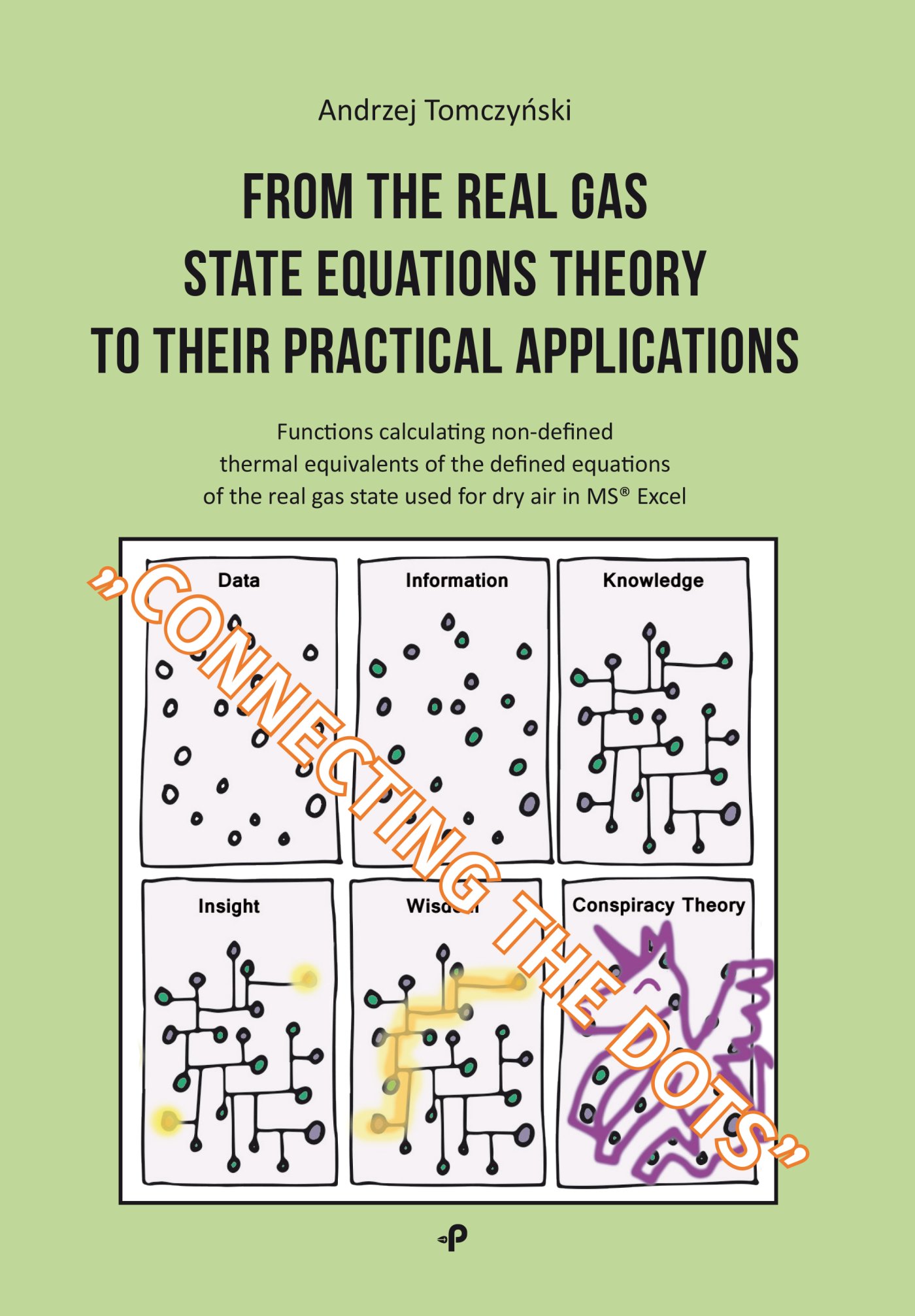
The cover features a drawing composed of six separate images, which depict potential stages of human thinking development. In Western culture, this process is called “connecting the dots,” and, in short, according to the author, it can be described as follows:
The image titled "Data" refers to the fact that each of us has some information stored in our minds. We are also constantly learning new things, so let’s call these new pieces of information “data.” People treat this data differently or make various uses of it.
The image titled "Information" shows that some of this data is connected by people, as they believe doing so broadens their understanding or knowledge about something—meaning they have a better grasp of a particular topic.
The "Knowledge" image pertains to a smaller group of people who believe they now have a better understanding of certain subjects. They start connecting this knowledge intuitively, thinking that doing so gives them better insight or perspective on other things.
The "Insight" image involves an even smaller number of people—those who don’t stop at just connecting data or knowledge. Instead, they try to figure out what theory (“wisdom”) is behind it, what philosophy or ideology it relates to, and so on.
The "Wisdom" image is about a few individuals from that group who have determined that they can add value or new insights to the theories (“wisdom”), philosophies, or ideologies they’ve identified. They then share this with others so they can learn and evaluate it.
The "Conspiracy Theory" image shows that there are also people who intentionally do not try to figure out what theory (“wisdom”) or related philosophy or ideology is behind the data. Instead, they believe that certain data (information) is spread deliberately to shape a specific “image” or to contribute to the creation of “conspiracy theories.” These individuals might claim that these theories are their own opinions or judgments.
It’s also important to note that when someone makes use of data (information)—that is, “connects the dots”—the outcome can vary depending on how much effort they put into it. Some people put in no effort at all. Therefore, everyone can assess themselves in this process—how they “connect the dots”—which indicates self-awareness.
Ta publikacja spełnia wymagania dostępności zgodnie z dyrektywą EAA.
| Kategoria: | Physics |
| Język: | Angielski |
| Zabezpieczenie: |
Watermark
|
| ISBN: | 978-83-8308-937-9 |
| Rozmiar pliku: | 7,0 MB |
FRAGMENT KSIĄŻKI
So, my Mom said to me, that if I understand what I am taught in the science classes, that it is good and I should feel good about it, but if I don’t understand something, then I need to try to remember something of these, or maybe even learn it by rote and then patiently wait until it is eventually clarified sometime during my education or life in general.
So whenever I had an opportunity, I have been talking, with my Friends, now with Women, and also with my daughter Izabela since she was born, about various theoretical and practical issues, including the topics I covered in this book, because such conversations can be inspirations, and also can solve some conundrums, exactly like my mother told me.INTRODUCTION
From the Prof. W.R. Gundlach’s book _Z_ _Wysp Brytyjskich przez Turbinową Dolinę Szwajcarską w_ _dwudziesty pierwszy wiek: szkic rozwoju cieplnych maszyn energetycznych od czasów Herona z_ _Aleksandrii_ , I learned that when the Stirling engine has been patented (in 1816), it was impossible to perform calculations of the thermodynamic process happening in this endige, and that in 21st century many afficionados will still be working on the scientific and technical analysis of the achievements and construction intricacies of this peculiar engine.
Thus, as one of the aforementioned afficionados, I decided to perform calculation of the Stirling’s thermodynamic circuit, implementing them in a specific calculation model that consisted in the imitation of Stirling’s engine. I have quickly determined that these need to be iterative calculations what requires entropic functions of a gaseous medium ‘filling’ this computational model.
Looking for necessary literature, I haven’t found any that would consider entropic functions of some gaseous medium, being able to find only books showing, e.g. theoretical basics of the s-i plot (an entropy-enthalpy chart) for the dry air, with an attached printout of said chart on a A1 format sheet. Namely, it is a book _Wykresy entropowe dla powietrza i_ _spalin_ by B. Kaczan, W.R. Gundlach and S. Czarnecki .
So I performed entropic functions for the dry air, consulted them with the aforementioned chart, and then made thermodynamic calculations for Stirling circuit. The results of this work, collected in the book _Obliczenia pól pracy i_ _pól ciepła silnika Stirlinga z_ _napędem rombowym_ , was published by the Łódź Technical University Publishing House in September 2022 .
I am aware that it would be better if I ‘filled’ the computational model of this engine by helium. Sure, I could have also made entropic functions for helium, but with the assumption that for helium I will use the real gas state equation formulated by Berthelot as ‘B2’. This is because in the book , all the information necessary to perform specific entropic and enthalpic functions are available only for the Berthelot’s ‘B2’ real gas state equation.
I would add that not only could I not know about some of this information at the time, but also explain why it is related to this equation.
Thus, I have presented the reasons why I wrote this book. I am a Stirling engine enthusiast, as I have already written about, but also an egocentric, what in this specific case means that I have been spending a lot of time to answer the following questions for myself, in order to later pass on the findings to others:
- Why are there so many authors of the real gas state equations, and due to what specific merit have they became the ‘classics’ of thermodynamic books?
- Why is it that no one used the real gas state equations by these authors to create thermal engineering tools, which could then be made available for enthusiasts who want to perform various thermal calculations?
I was to answer the first of the above questions by a well-known saying, or more precisely, its version immortalized by Honoré de Balzac 160 years ago, that the synonyms of beauty or ideals of perfect beauty are: a beautiful dancing woman, a thoroughbred horse at a gallop, and a frigate under full sail. To these, I would add also ‘graphs of equations’, including the graphs of the real gas state equations established by the authors cited above.
Of course, I will want to show this in this book, and I also think that I have already answered the second question above with this statement. I will also point out that the subtitle of this book (_Functions calculating_...) also relates to the answer to this second question.
Naturally, making such assumptions is associated with the need to do much more work than just that of analysing the real gas state equations and describing this process. Additionally, in a widely available application in MS® Excel, thermal functions of the real gas state equations will be created, which functions, as modern thermal engineering tools, will be applied to perform engineering calculations. The results of these engineering calculations will then be demonstrated as graphs throughout this book, and the buyers of this book will also be able to use them for other thermal calculations of dry air or as reference for performing thermal functions of other gases. It is worth noting that paper printouts, e.g. of thermal functions of gas equations of state, are similar thermal engineering tools, just more at home in the previous century.
With the above in mind, I’d like to inform you that in this book I will be using the ‘philosophical’ terms possibly concerning ‘theory’, namely, perhaps a bit oddly, ‘theory as such’ (usually omitting ‘as such’) and ‘theory concerning practice’. What is most significant about what I have written above is that I have chosen to identify specific thermal concrete issues by describing the successive equations of the real gas state and show them in diagrams, that is, to write and show a thermic ‘crime story’. I have chosen to use such a comparison because all the mysteries will be explained only at the end of the book.
I am aware that not everyone likes crime stories and such an approach to scientific theories. Hence, I apologize in advance to scientists and those readers who do not like detective literature – they can, if they wish, use only the _Functions calculating_..., which I made not only for the purpose of this book. This said, I wish remaining readers good intellectual and engineering ‘fun’.
At the same time, I must add that, just as the best real gas state equations were not established immediately, so certainly this book should also be corrected, supplemented and modified, and it would be good for this to be influenced by its readers, including users of thermal functions of real gas state equations. In other words, by enthusiast-theorists like me. This is because what I will be describing, is effectively a historical reconstruction of the thinking of the creators of the real gas state equations from the 19th and 20th centuries, and that in this reconstruction I am using my own and hopefully already 21st century thinking.
At this point, I will admit that I was also inspired to write this book J.C. Lennox’s _God’s Undertaker: Has Science Buried God?_ , which among other things, includes two questions starting with ‘Why...?’ – a crucial question and a common one. This key question is: ‘Why does the Universe exist and why did Life, including mine, arise in it?’, and the common one is ‘Why did Aunt Matilda bake a cake?’. The author states that these are questions of intention, and for this reason science only plays a supporting role here; in the case of the first question, such a role is also played by philosophy. So it can be said that people have or support one of the two world-views and answer the first question like this: ‘Because that’s the way God wanted it, and he told us a little about it by revealing it to us’ or that ‘It was caused by Eternal Matter, because it has a nature of randomness and necessity, and this led to the creation of Life, including humans’.
Since I mentioned the philosophy that advises us to think, I will quote below a statement by the philosopher from Königsberg, Immanuel Kant (from the end of the _Critique of Pure Reason_), because it appeals to me and because I live in Elbląg, located not far from Königsberg, today called Królewiec. The quote is: ‘Two things fill my mind with ever-new and intensifying admiration and reverence the more often and permanently I reflect on them: the starry sky above me and the moral law within me’.
Returning to the question about Aunt Matilda, it can be said that science is only able to determine the ingredients of this cake or its caloric content, in order to assume that it is an occasional cake, i.e. one that is better than a cake baked every day. We will know the truth if Aunt Matilda tells us why she baked this cake, and this truth may also include a condition that we do not include in our assumptions, because, for example, Aunt Matilda could tell us ‘I baked the cake for my fourth grandson’s birthday, but my birthday is a day earlier, and he will get this cake when he visits to wish me a happy birthday’. With this in mind, I am aware that I have chosen to write a difficult and problematic book – to guess the intentions of the authors of the real gas state equations. In order to reduce the threat of criticism, I derive the formulas, reconstruct the 19th and 20th century establishment of physical quantities (taking into account the possibilities regarding these periods, and perhaps the ‘scientific fashions’ promoted at the time), make and describe graphs, and make available the thermal functions of dry air, so that all this can be quickly verified.¹
The error I found in the literature shows and describes its effects – for one can come to a false conclusion without knowing that they reference to the error. Anyway, I have to admit that one of the diagrams I made showed a beautiful justification of why the author of the real gas state equations, which is the reference to this diagram, deserved to become a ‘classic’ of thermodynamic books, but I had to completely change this justification because, double-checking my work, I discovered that I had made a mistake in deriving the equation of a certain function.
After this brief introduction, we can move on to identifying specific thermic specifics, as I promised before.
The following is a table from the book , as it compiles the real gas state equations, the theory and practical application of which I will present in this lecture.
, where the rows list gas state equations: – van der Waals' (VdW), – Dieterici's (D), – Berthelot's (B1), – Berthelot's (B2), – Clausius (C), – Redlich and Kwong's (R&K), and the coefficients a and b relating to the equation in question, which are the products of the numbers, which may be fractions, and the physical quantities of the gas: crp, crT, crv and, in the case of the Dieterici's equation, also the gas constant R.]
Fig. I.1. Basic real gas state equations_
Source_: .
Some information necessary to recognize the theory of the real gas state equations present in the table in Fig. I.1 are present in the specific references that is also shown in this book.
, containing references used in this book that were published, e.g. Berlin, Springer: 1961, 1956; Łódź, PŁ: 1954; New York, 1955; Moscow, 1963 etc.]
Fig. I.2. References_
Source_: .
However, after determining this literature, I came to conclusion that it would be very difficult to reach its specific books, so I decided to refer to the Internet. After checking available sources, I found that the books and papers made available here and dealing with the subject of the real gas state equations provide information that is missing from the book or that is the book that contains data absent in these online publications. In addition, graphs are published without showing the scale on the axes or information about the gas involved, and containing inaccurate technical descriptions. Thus for me these are more thermal artistic works, not thermal (thermodynamic) engineering works. This is because the latter need to reference specific engineering calculations, in the performance of which specific mathematical methods are applied and specific engineering tools are used.
Therefore, for the time being, I am attaching the ‘artistic’ diagrams, just to determine what phase of the gaseous dry air state I will address in this book. I also attach diagrams that were already so corrected by me to show this.
, showing, in the three-dimensional p-V-T system, the van der Waals' equation isotherms on the gas surface and the boundary lines of the surfaces: liquid, liquid + gas, solid, solid + gas, along with these surfaces.]
Fig. I.3. Family of van der Waals’ isotherms on the p-V-T diagram_
Source_: __ .
Fig. I.4. Family of van der Waals’ isotherms on the p-V-T diagram_
Source_: __ with own correction.
Technically refining Fig. I.3 into Fig. I.4 with my own correction, I extracted the so-called ‘vapour’ phase from the vapour phase of some agent (substance) and called it ‘vapour (gas)’. In the case of water, its state in the vapour phase is called ‘dry (superheated) steam’. Under the thermal conditions (p, T) of the atmosphere that surrounds us, various substances are in solid, liquid or gas phase and can, mainly under the influence of temperature, change this phase state. Hence, for water, the nomenclature given above has been adopted.
For a substance such as air, we are surrounded by its ‘gaseous’ phase state, and it cannot be liquefied using any sort of pressure, unless its temperature is lowered below the critical temperature – for air it is crT_air = 132.5 (crt_air = –140.65 ), i.e. it is not brought to the ‘vapour (gas)’ gaseous state. Because of this, I have singled out this ‘vapour (gas)’ gas state and shown it in Fig. I.4, so that it is already clear at this stage that in the book I will not deal with this gas state of gases, i.e. with ‘vapour (gas)’, including dry air.
Thus, the word ‘gas’ used in the book means the vapour phase of a substance (dry air) temperature of which is equal to or greater than its critical temperature. Consequently, I also corrected Fig. I.5.
, showing the isotherms of the van der Waals' equation in the v-p system, i.e. the critical isotherm and isotherms with temperatures above and below the critical temperature. On an isotherm with a temperature below the critical temperature, the horizontal G-P line shows the liquid-gas phase transition.]
Fig. I.6. Van der Waals’ isotherms.
C – critical point, GP – phase transformation liquid-gas at a constant pressure_
Source_: __ with own correction.
Fig. I.5. Van der Waals’ isotherms.
Cr – critical point, GP – phase transformation liquid-steam (of gas) at a constant pressure_
Source_: __ .
I also need to point out that in this book, the descriptions will not replace diagrams, as is practised in, e.g. Wikipedia – see Fig. I.7 and Fig. 3.1.
, which is a form of description of the van der Waals' equation and gives the numerical value of the critical coefficient relating to this equation. I would also add that these are incomplete data to draw the isotherms of this state equation in the v-p system. In this book, descriptions will not replace diagrams.]
Fig. I.7. Table row related to van der Waals’ equation_
Source_: __ .
And also for the fact that in Fig. I.7 the real gas state equation is presented in molar form, while in engineering practice such equations are used in mass form. Because of this and in order to have everything at hand, I begin this book with the PERFECT GAS STATE EQUATION – the ‘BC’ equation of Benoît Clapeyron (1834) .
------------------------------------------------------------------------
¹ In addition to the sentence followed by this reference, it should be stated that in this book formulas and numbers have been copied from MS® Excel specific calculation sheets or macro sheets. In these worksheets, requirements for signs used in writing negative and decimal numbers had to be applied, and this applies to forms of ordinary numbers and forms of scientific numbers, and that requirements for the use of spaces in the formulas before or after the signs of mathematical operations used had to be applied.
In contrast, in the book, editorial formatting of the text is used, and this sometimes made it look strange when it was used without intrusive copying of numbers, formulas, and names of physical quantities in which the signs of mathematical operations are used.
Hence, in some cases, the comma was replaced with a dot in numbers, in formulas and in the titers of physical quantities the space was eliminated, etc.
Such interferences were made as little as possible, because in order to make the text in the book look pleasant, it was also decided that it could also be used, almost unchanged, in the above-mentioned MS® Excel sheets, in the case of verification of the author’s calculations or to perform analogous calculations relating to a medium other than air.
Therefore, it is noted that differences in notation, especially in decimal numbers, formulas, are not errors or lack of consistency, but that they are indications that in the same spreadsheets in MS® Excel different characters are used in the notation of numbers, and in formulas spaces are used or not used.INDEX OF IMPORTANT INDICATIONS
USED IN CHAPTER 0
+--------------------------+--------------------------+--------------------------+
| 1 | m_sg; m_a | mass of the specific |
| | | gas; air |
+--------------------------+--------------------------+--------------------------+
| 2 | M_sg; M_air | mole mass of the |
| | | specific gas; air |
| | | |
+--------------------------+--------------------------+--------------------------+
| 3 | n = m_sg / M_sg; | number of moles of the |
| | | specific gas; air |
| | n = m_air / M_air | |
+--------------------------+--------------------------+--------------------------+
| 4 | R | universal gas constant |
| | | |
+--------------------------+--------------------------+--------------------------+
| 5 | R_sg = R / M_sg; | gas constant of specific |
| | | gas; air |
| | R_air = R / M_air | |
+--------------------------+--------------------------+--------------------------+
| 6 | V, V_sg; V_air | gas volume, specific |
| | | gas; air |
+--------------------------+--------------------------+--------------------------+
| 7 | v_sg = V_sg / m_sg; | gas specific volume, |
| | | specific gas; air |
| | v_air = V_air / m_air | |
+--------------------------+--------------------------+--------------------------+
| 8 | v, v_sg; | specific volume, |
| | | specific volume of the |
| | v_air | specific gas; air |
| | | – applied |
| | | technical parameter |
+--------------------------+--------------------------+--------------------------+
| 9 | T, T_sg, t_sg; | gas temperature, |
| | | temperature of the |
| | T_air, t_air | specific gas; air , |
| | | (t) – applied |
| | | technical parameter |
+--------------------------+--------------------------+--------------------------+
| 10 | p, p_sg; | gas pressure, pressure |
| | | of the specific gas; air |
| | p_air | , – applied |
| | | technical parameter |
+--------------------------+--------------------------+--------------------------+
| 11 | V_sgexp, V_sgexp, | respectively: specific |
| | m_sgexp; v_airexp, | volume, volume, mass of |
| | | the specific gas; air |
| | V_airexp, m_airexp | determined in an |
| | | experiment (cylinder |
| | | with piston) |
+--------------------------+--------------------------+--------------------------+
| 12 | v_sgBC, m_sgBC; | respectively: specific |
| | v_ airBC, | volume, mass of the |
| | | specific gas, volume of |
| | m_airBC | air calculated as not |
| | | provided thermal |
| | | equivalent, i.e. Benoît |
| | | Clapeyron ‘BC’ state |
| | | equation is satisfied |
+--------------------------+--------------------------+--------------------------+
| 13 | p_sgBC, T_sgBC; | respectively: pressure, |
| | | temperature of the |
| | p_ airBC, T_airBC | specific gas; air |
| | | calculated as |
| | | unspecified thermal |
| | | equivalent satisfying |
| | | Benoît Clapeyron’s ‘BC’ |
| | | state equation |
+--------------------------+--------------------------+--------------------------+
| 14 | crT_sg, crt_sg; | critical temperature of |
| | | the specific gas; air |
| | crT_air, crt_air | , |
| | | |
| | | |
+--------------------------+--------------------------+--------------------------+
| 15 | crp_sg; crp_air | critical pressure of the |
| | | specific gas; air |
| | | , |
+--------------------------+--------------------------+--------------------------+
| 16 | t_N.C. | gas temperature in |
| | | normal conditions |
+--------------------------+--------------------------+--------------------------+
| 17 | p_N.C. | gas pressure in normal |
| | | conditions |
+--------------------------+--------------------------+--------------------------+
| 18 | VM_air | volume 1 |
| | | mole of air , |
| | | (= ), regardless |
| | | of equation it has been |
| | | calculated with |
+--------------------------+--------------------------+--------------------------+
| 19 | compf_cpBC | compression factor in |
| | | the critical point of |
| | | the ‘BC’ Benoît |
| | | Clapeyron’s equation – |
| | | RN (rational number), |
| | | quotient with ‘x = 1’ in |
| | | the dividend and natural |
| | | number ‘y = 1’ in the |
| | | divisor |
+--------------------------+--------------------------+--------------------------+
| 20 | crv_sgBC; | critical volume of the |
| | | specific gas; air in the |
| | crv_airBC | critical point of the |
| | | ‘BC’ Benoît |
| | | Clapeyron’s equation |
+--------------------------+--------------------------+--------------------------+
USED IN CHAPTER 1
+--------------------------+--------------------------+--------------------------+
| 21 | a_sgVDW; | coefficient in the |
| | | correction increasing |
| | a_airVDW | pressure of the specific |
| | | gas; air in the ‘VDW’ |
| | | van der Waals’ equation |
+--------------------------+--------------------------+--------------------------+
| 22 | Dep_sgVDW; | correction increasing |
| | | pressure of the specific |
| | Dep_ airVDW | gas; air in the ‘VDW’ |
| | | van der Waals’ equation |
+--------------------------+--------------------------+--------------------------+
| 23 | b_sgVDW; | coefficient reducing the |
| | | volume of the specific |
| | b_airVDW | gas; air in the ‘VDW’ |
| | | van der Waals’ equation |
+--------------------------+--------------------------+--------------------------+
| 24 | Dev_sgVDW; | reduced specific volume |
| | | of the specific gas; air |
| | Dev_ airVDW | in the ‘VDW’ van der |
| | | Waals’ equation, by the |
| | | coefficient above (23) |
+--------------------------+--------------------------+--------------------------+
| 25 | p_sgVDW; | pressure of the specific |
| | | gas; air calculated as |
| | p_airVDW | unspecified thermal |
| | | equivalent fulfilling |
| | | the ‘VDW’ van der Waals’ |
| | | equation |
+--------------------------+--------------------------+--------------------------+
| 26 | crv_sgVDW; | specific volume for the |
| | | specific gas; air in the |
| | crv_airVDW | critical point of ‘VDW’ |
| | | van der Waals’ equation |
+--------------------------+--------------------------+--------------------------+
| 27 | d(cp_sgWDW) / | derivate of the function |
| | | cp_sgVDW = |
| | d(crT_ sg, crv_sg) | |
| | | = f (crT_sg, crv_sg) by |
| | | crv_sg (25) |
+--------------------------+--------------------------+--------------------------+
| 28 | compf_VDW | compression factor in |
| | | the critical point of |
| | | the ‘VDW’ van der Waals’ |
| | | equation – RN (rational |
| | | number), quotient with |
| | | ‘x = 3’ in the dividend |
| | | and natural number ‘y = |
| | | 8’ in the divisor |
+--------------------------+--------------------------+--------------------------+
| 29 | T_sgVDW; | temperature of the |
| | | specific gas; air |
| | T_airVDW | calculated as |
| | | unspecified thermal |
| | | equivalent fulfilling |
| | | the ‘VDW’ van der Waals’ |
| | | equation |
+--------------------------+--------------------------+--------------------------+
| 30 | v_sgVDW; | specific volume of the |
| | | specific gas; air, |
| | v_airVDW | calculated as |
| | | unspecified thermal |
| | | equivalent fulfilling |
| | | the ‘VDW’ van der Waals’ |
| | | equation (final result |
| | | of the iterative |
| | | calculations) |
+--------------------------+--------------------------+--------------------------+
| 31 | Cv_sgVDW2; | coefficients of the |
| | | specific volume of the |
| | Cv_ airVDW2; | specific gas; air; for |
| | | the specific volume in |
| | Cv_sgVDW1; | second and third power |
| | | and free expression, in |
| | Cv_ airVDW1; | the third degree |
| | | polynomial equation used |
| | Cv_sgVDW0; | to calculate the |
| | | unspecified thermal |
| | Cv_ airVDW0 | equivalent satisfying |
| | | the ‘VDW’ van der Waals’ |
| | | equation |
+--------------------------+--------------------------+--------------------------+
| 32 | LSEv_VDWit | left side of the |
| | | polynomial equation used |
| | | to calculate specific |
| | | volume of the specific |
| | | gas, air as |
| | | a unspecified thermal |
| | | equivalent satisfying |
| | | the ‘VDW’ van der Waals’ |
| | | equation |
+--------------------------+--------------------------+--------------------------+
| 33 | v_sgVDWit0; | specific volume of the |
| | | specific gas; air, |
| | v_airVDWit0 | assumed in the iteration |
| | | 0 in the iterative |
| | | calculations, where this |
| | | value is calculated as |
| | | a unspecified thermal |
| | | equivalent fulfilling |
| | | the ‘VDW’ van der Waals’ |
| | | equation |
+--------------------------+--------------------------+--------------------------+
| 34 | RSEv_VDWit | right side of the |
| | | polynomial equation used |
| | | to calculate specific |
| | | volume of the specific |
| | | gas, air as |
| | | a unspecified thermal |
| | | equivalent fulfilling |
| | | the ‘VDW’ van der Waals’ |
| | | equation |
+--------------------------+--------------------------+--------------------------+
| 35 | Ul_ v_sgVDWit; | upper limit of the |
| | | iterated specific volume |
| | Ul_ v_airVDWit | of the specific gas; |
| | | air, calculated as |
| | | a unspecified thermal |
| | | equivalent fulfilling |
| | | the ‘VDW’ van der Waals’ |
| | | state equation |
+--------------------------+--------------------------+--------------------------+
| 36 | Ll_ v_sgVDWit; | lower limit of the |
| | | iterated specific volume |
| | Ll_ v_airVDWit | of the specific gas; |
| | | air, calculated as |
| | | a unspecified thermal |
| | | equivalent fulfilling |
| | | the ‘VDW’ van der Waals’ |
| | | state equation |
+--------------------------+--------------------------+--------------------------+
| 37 | v_sgVDWit1; | specific volume of the |
| | | specific gas; air, |
| | v_airVDWit1 | calculated in the |
| | | iteration 1 (and |
| | | subsequent ones) to |
| | | determine whether it is |
| | | an upper or lower limit |
| | | of the calculated |
| | | unspecified thermal |
| | | equivalent fulfilling |
| | | the ‘VDW’ van der Waals’ |
| | | state equation, when |
| | | upper and lower limit of |
| | | this iterated value is |
| | | calculated (determined) |
| | | (35) and (36) |
+--------------------------+--------------------------+--------------------------+
| 38 | Mov_sgVDWit1_0| | module of difference of |
| | | the specific volumes |
| | | calculated in the |
| | | subsequent iterations as |
| | | a not provided thermal |
| | | equivalents fulfilling |
| | | the ‘VDW’ van der Waals’ |
| | | state equation; written |
| | | this way it applies to |
| | | iteration 1 and |
| | | iteration 0 |
+--------------------------+--------------------------+--------------------------+
USED IN CHAPTER 2
+--------------------------+--------------------------+--------------------------+
| 39 | a_sgD; | coefficient in the |
| | | exponent of the |
| | a_airD | factor-correction, |
| | | Euler’s number ‘e’, of |
| | | the specific gas; air in |
| | | the Dieterici’s ‘D’ |
| | | equation |
+--------------------------+--------------------------+--------------------------+
| 40 | b_sgD; | coefficient decreasing |
| | | specific volume of the |
| | b_airD | specific gas; air in the |
| | | Dieterici’s ‘D’ equation |
+--------------------------+--------------------------+--------------------------+
| 41 | crv_sgD; | specific volume of the |
| | | specific gas; air in the |
| | crv_airD | critical point of |
| | | Dieterici’s ‘D’ equation |
+--------------------------+--------------------------+--------------------------+
| 42 | compf_cpD | compression coefficient |
| | | in the critical point of |
| | | the ‘D’ |
| | | Dieterici’s equation – |
| | | IN (irrational number), |
| | | quotient with ‘x = 2’ in |
| | | the dividend and number |
| | | |
| | | ‘y = e^2’ in the divisor |
+--------------------------+--------------------------+--------------------------+
| 43 | p_sgD; | pressure of the specific |
| | | gas; air, calculated as |
| | p_airD | a not provided thermal |
| | | equivalents fulfilling |
| | | the ‘D’ |
| | | Dieterici’s state |
| | | equation |
+--------------------------+--------------------------+--------------------------+
| 44 | T_sgD; t_sgD; | temperature of the |
| | | specific gas; air , |
| | T_airD; t_airD | , calculated as |
| | | a unspecified thermal |
| | | equivalent fulfilling |
| | | the ‘D’ |
| | | Dieterici’s state |
| | | equation (final result |
| | | of the iterative |
| | | calculations) |
+--------------------------+--------------------------+--------------------------+
| 45 | v_sgD; | specific volume of the |
| | | specific gas; air, |
| | v_airD | calculated as |
| | | a unspecified thermal |
| | | equivalent fulfilling |
| | | the ‘D’ |
| | | Dieterici’s state |
| | | equation (final result |
| | | of the iterative |
| | | calculations) |
+--------------------------+--------------------------+--------------------------+
| 46 | T_sgLitLlmin; | lower limit – minimal |
| | | temperature assumed for |
| | T_airLitLlmin | the iterative |
| | | calculations of the |
| | | temperature of the |
| | | specific gas; air as |
| | | a unspecified thermal |
| | | equivalent fulfilling |
| | | the ‘D’ |
| | | Dieterici’s state |
| | | equation (final result |
| | | of the iterative |
| | | calculations) |
+--------------------------+--------------------------+--------------------------+
| 47 | T_sgUitULst; | temperature assumed to |
| | | determine at the |
| | T_airUitULst | beginning of the |
| | | iterative calculations |
| | | whether it is an upper |
| | | or lower limit of the |
| | | iterated temperature of |
| | | the specific gas; air, |
| | | calculated as |
| | | a unspecified thermal |
| | | equivalent fulfilling |
| | | the ‘D’ |
| | | Dieterici’s state |
| | | equation (final result |
| | | of the iterative |
| | | calculations) |
+--------------------------+--------------------------+--------------------------+
| 48 | v_sgLitUlmin; | lower limit – minimal |
| | | specific volume assumed |
| | v_ airLitUlmin | for the iterative |
| | | calculations of the |
| | | specific volume of the |
| | | specific gas; air, as |
| | | a unspecified thermal |
| | | equivalent fulfilling |
| | | the ‘D’ |
| | | Dieterici’s state |
| | | equation (final result |
| | | of the iterative |
| | | calculations) |
+--------------------------+--------------------------+--------------------------+
| 49 | v_sgLitULst; | specific volume assumed |
| | | to determine at the |
| | v_ airLitULst | beginning of the |
| | | iterative calculations |
| | | whether it is an upper |
| | | or lower limit of the |
| | | iterated specific volume |
| | | of the specific gas; |
| | | air, calculated as |
| | | a unspecified thermal |
| | | equivalent fulfilling |
| | | the ‘D’ |
| | | Dieterici’s state |
| | | equation (final result |
| | | of the iterative |
| | | calculations) |
+--------------------------+--------------------------+--------------------------+
| 50 | Ul_TStit; | upper; lower start limit |
| | | of the iterated |
| | Ll_TStit | temperature, refers to |
| | | the specific gas, |
| | | including air, |
| | | calculated as |
| | | a unspecified thermal |
| | | equivalent fulfilling |
| | | a specific equation when |
| | | they are used for that |
| | | purpose (e.g. they can |
| | | relate to |
| | | Dieterici’s ‘D’ state |
| | | equation) |
+--------------------------+--------------------------+--------------------------+
| 51 | Ul_vStit; | upper; lower start limit |
| | | of the iterated specific |
| | Ll_vStit | volume, refers to the |
| | | specific gas, including |
| | | air, calculated as |
| | | a unspecified thermal |
| | | equivalent fulfilling |
| | | a specific equation when |
| | | they are used for that |
| | | purpose (e.g. they can |
| | | relate to |
| | | Dieterici’s ‘D’ state |
| | | equation) |
+--------------------------+--------------------------+--------------------------+
| 52 | DeVarUl_Tit | minimal difference of |
| | | temperatures assumed to |
| | | establish either upper |
| | | or lower limit described |
| | | in (49) |
+--------------------------+--------------------------+--------------------------+
| 53 | DeVarUl_vit | minimal difference of |
| | | specific volume assumed |
| | | to establish either |
| | | upper or lower limit |
| | | described in (50) |
+--------------------------+--------------------------+--------------------------+
| 54 | MultDeVar | multiplier of minimal |
| | | difference of |
| | | temperatures of specific |
| | | volume assumed to |
| | | establish either upper |
| | | or lower starting limit |
| | | described in (49) or |
| | | (50) |
+--------------------------+--------------------------+--------------------------+
| 55 | Ul / Ll_TStit | formula for establishing |
| | | either upper or lower |
| | | starting limit after |
| | | using one of the limits |
| | | (49) and (51), (53) |
+--------------------------+--------------------------+--------------------------+
| 56 | Ul / Ll_vStit | formula for establishing |
| | | either upper or lower |
| | | starting limit after |
| | | using one of the limits |
| | | (50) and (52), (53) |
+--------------------------+--------------------------+--------------------------+
| 57 | Ul_Tit / Ll_it | temperature of the |
| | | specific gas; air |
| | | calculated in the |
| | | iteration 1 (and |
| | | subsequent ones) to |
| | | check whether it is |
| | | a new upper or lower |
| | | limit of the calculated |
| | | unspecified thermal |
| | | equivalent satisfying |
| | | state equation, e.g. |
| | | Dieterici’s ‘D’ |
| | | equation, when upper and |
| | | lower limit of this |
| | | iterated value is |
| | | already determined |
| | | (calculated), e.g. in |
| | | (49), (54) |
+--------------------------+--------------------------+--------------------------+
| 58 | Ul_vit / Ll_vit | specific volume of the |
| | | specific gas; air |
| | | calculated in the |
| | | iteration 1 (and |
| | | subsequent ones) to |
| | | check whether it is |
| | | a new upper or lower |
| | | limit of the calculated |
| | | unspecified thermal |
| | | equivalent satisfying |
| | | state equation, e.g. |
| | | Dieterici’s ‘D’ |
| | | equation, when upper and |
| | | lower limit of this |
| | | iterated value is |
| | | already determined |
| | | (calculated), e.g. in |
| | | (50), (55) |
+--------------------------+--------------------------+--------------------------+
| 59 | Avl_Titb; | arithmetic average of |
| | | the upper and lower |
| | Avl_Tite | limit of the iterated |
| | | temperature, calculated |
| | | as unspecified thermal |
| | | equivalent satisfying |
| | | state equation, e.g. |
| | | Dieterici’s ‘D’ |
| | | equation, at the |
| | | beginning and end of |
| | | every iteration step |
+--------------------------+--------------------------+--------------------------+
| 60 | Avl_vitb; | arithmetic average of |
| | | the upper and lower |
| | Avl_vite | limit of the iterated |
| | | specific volume, |
| | | calculated as |
| | | unspecified thermal |
| | | equivalent satisfying |
| | | state equation, e.g. |
| | | Dieterici’s ‘D’ |
| | | equation, at the |
| | | beginning and end of |
| | | every iteration step |
+--------------------------+--------------------------+--------------------------+
USED IN CHAPTER 3
+--------------------------+--------------------------+--------------------------+
| 61 | a_sgB1; | coefficient in the |
| | | correction increasing |
| | a_airB1 | the pressure of the |
| | | specific gas; air in the |
| | | ‘B1’ |
| | | Berthelot’s equation |
+--------------------------+--------------------------+--------------------------+
| 62 | b_sgB1; | coefficient decreasing |
| | | the specific volume of |
| | b_airB1 | the specific gas; air in |
| | | the ‘B1’ |
| | | Berthelot’s equation |
+--------------------------+--------------------------+--------------------------+
| 63 | crv_sgB1; | specific volume of the |
| | | specific gas; air in the |
| | crv_airB1 | critical point of the |
| | | ‘B1’ |
| | | Berthelot’s equation |
+--------------------------+--------------------------+--------------------------+
| 64 | crpcalc_airB1a | auxiliary critical point |
| | | on the critical crt_sg |
| | | (crt_air) – hyperbole |
| | | line that is not |
| | | a hyperbole, i.e. a line |
| | | with monotonic descent |
| | | bisected by line of |
| | | calculated critical |
| | | pressure, e.g. |
| | | crprcalc_airB1 = 13.95 |
| | | ) |
+--------------------------+--------------------------+--------------------------+
| 65 | compf_crpB1 | compression coefficient |
| | | in the critical point of |
| | | the ‘B1’ |
| | | Berthelot’s equation – |
| | | RN (rational number), |
| | | quotient with natural |
| | | number ‘x = 4’ in the |
| | | dividend and natural |
| | | number ‘y = 9’ in the |
| | | divisor |
+--------------------------+--------------------------+--------------------------+
| 66 | p_sgB1; | pressure of the specific |
| | | gas; air, calculated as |
| | p_airB1 | unspecified thermal |
| | | equivalent satisfying |
| | | the ‘B1’ |
| | | Berthelot’s state |
| | | equation |
+--------------------------+--------------------------+--------------------------+
| 67 | WT_sg1B1; | temperature coefficients |
| | | of the specific gas; air |
| | WT_ pow1B1; | at the temperature to |
| | | the first power and an |
| | WT_sg0B1; | absolute term in the |
| | | polynomial quadratic |
| | WT_ pow0B1 | equation from which the |
| | | unspecified thermal |
| | | equivalent satisfying |
| | | ‘B1’ Berthelot’s state |
| | | equation is calculated |
+--------------------------+--------------------------+--------------------------+
| 68 | Ll_T_sgB1; | lower limit (minimum) of |
| | | the temperature of the |
| | Ll_t_sgB1; | specific gas; air |
| | | assumed to exclude one |
| | Ll_T_airB1; | of the roots of the |
| | | polynomial quadratic |
| | Ll_t_ powB1 | equation from which the |
| | | unspecified thermal |
| | | equivalent satisfying |
| | | ‘B1’ Berthelot’s state |
| | | equation is calculated |
+--------------------------+--------------------------+--------------------------+
| 69 | Ul_T_sgB1; | upper limit (minimum) of |
| | | the temperature of the |
| | Ul_t_sgB1; | specific gas; air |
| | | assumed to exclude one |
| | Ul_T_airB1; | of the roots of the |
| | | polynomial quadratic |
| | Ul_t_ powB1 | equation from which the |
| | | unspecified thermal |
| | | equivalent satisfying |
| | | ‘B1’ Berthelot’s state |
| | | equation is calculated |
+--------------------------+--------------------------+--------------------------+
| 70 | T_sgB1; t_sgB1; | temperature of the |
| | | specific gas; air , |
| | T_airB1; t_airB1 | , calculated as |
| | | the unspecified thermal |
| | | equivalent satisfying |
| | | ‘B1’ Berthelot’s state |
| | | equation – the result of |
| | | calculations is one of |
| | | the roots of the |
| | | polynomial quadratic |
| | | equation taking into |
| | | account the temperatures |
| | | provided in (68), (69) |
+--------------------------+--------------------------+--------------------------+
| 71 | crTcalc_sgB1, | critical calculational |
| | | isotherm – , , parameters |
| | | calculated as the |
| | crtcalc_sgB1, | unspecified thermal |
| | | equivalent satisfying |
| | crtcalc_airB1 | ‘B1’ Berthelot’s state |
| | | equation and playing the |
| | | same role as the |
| | | critical isotherm in the |
| | | van der |
| | | |
| | | Waals’ ‘VDW’ state |
| | | equation |
+--------------------------+--------------------------+--------------------------+
| 72 | v_sgB1; | specific volume of the |
| | | specific gas; air, |
| | v_airB1 | calculated as the |
| | | unspecified thermal |
| | | equivalent satisfying |
| | | ‘B1’ Berthelot’s state |
| | | equation (final result |
| | | of the iterative |
| | | calculations as in |
| | | (31)–(38)) |
+--------------------------+--------------------------+--------------------------+
| 73 | Wv_sg2B1; | specific volume |
| | | coefficients of the |
| | Wv_air2B1; | specific gas; air at the |
| | | volume to the second and |
| | Wv_sg1B1; | third power and an |
| | | absolute term in the |
| | Wv_air1B1; | third-level polynomial |
| | | equation from which the |
| | Wv_sg0B1; | unspecified thermal |
| | | equivalent satisfying |
| | Wv_air0B1 | ‘B1’ Berthelot’s state |
| | | equation is iteratively |
| | | calculated |
+--------------------------+--------------------------+--------------------------+
USED IN CHAPTER 4
+--------------------------+--------------------------+--------------------------+
| 74 | a_sgB2; | coefficient in the |
| | | amendment increasing the |
| | a_airB2 | pressure of the specific |
| | | gas; air in the ‘B2’ |
| | | Berthelot’s equation |
+--------------------------+--------------------------+--------------------------+
| 75 | b_sgB2; | coefficient decreasing |
| | | the specific volume of |
| | b_airB2 | the specific gas; air in |
| | | the ‘B2’ |
| | | Berthelot’s equation |
+--------------------------+--------------------------+--------------------------+
| 76 | crv_sgB2; | specific volume of the |
| | | specific gas; air in the |
| | crv_airB2 | critical point of the |
| | | ‘B2’ |
| | | Berthelot’s equation |
+--------------------------+--------------------------+--------------------------+
| 77 | crpcalc_airB2a | auxiliary critical point |
| | | on the critical isotherm |
| | | crt_sg (crt_air) – |
| | | a hyperbole line that is |
| | | not a hyperbole, i.e. |
| | | a line with monotonic |
| | | descent (bisected in |
| | | point crpB2a by the |
| | | non-natural (negative) |
| | | line of the critical |
| | | calculational pressure |
| | | crprcalc_airB2 = –22.04 |
| | | ) |
+--------------------------+--------------------------+--------------------------+
| 78 | compf_crpB2 | compressibility factor |
| | | in the critical point of |
| | | the ‘B2’ |
| | | Berthelot’s equation – |
| | | RN (rational number), |
| | | quotient with natural |
| | | number ‘x = 9’ in the |
| | | dividend and natural |
| | | number ‘y = 32’ in the |
| | | divisor |
+--------------------------+--------------------------+--------------------------+
| 79 | p_sgB2; | pressure of the specific |
| | | gas; air, calculated as |
| | p_airB2 | unspecified thermal |
| | | equivalent satisfying |
| | | the ‘B2’ |
| | | Berthelot’s state |
| | | equation |
+--------------------------+--------------------------+--------------------------+
| 80 | WT_sg1B2; | temperature coefficients |
| | | of the specific gas; air |
| | WT_ pow1B2; | at the temperature to |
| | | the first power and an |
| | WT_sg0B2; | absolute term in the |
| | | polynomial quadratic |
| | WT_air0B2 | equation from which the |
| | | unspecified thermal |
| | | equivalent satisfying |
| | | ‘B2’ Berthelot’s state |
| | | equation is calculated |
+--------------------------+--------------------------+--------------------------+
| 81 | T_sgB2; | temperature of the |
| | | specific gas; air , |
| | t_sgB2; | , calculated as |
| | | the unspecified thermal |
| | T_airB2; | equivalent satisfying |
| | | ‘B2’ Berthelot’s state |
| | t_airB2 | equation – the result of |
| | | calculations is one of |
| | | the roots of the |
| | | polynomial quadratic |
| | | equation taking into |
| | | account the temperatures |
| | | provided in (68), (69) |
+--------------------------+--------------------------+--------------------------+
| 82 | v_sgB2; | specific volume of the |
| | | specific gas; air |
| | v_airB2 | calculated as |
| | | unspecified thermal |
| | | equivalent satisfying |
| | | ‘B2’ Berthelot’s state |
| | | equation (final results |
| | | of the iterative |
| | | calculations as in |
| | | (31)–(38)) |
+--------------------------+--------------------------+--------------------------+
| 83 | Wv_sg2B2; | specific volume |
| | | coefficients of the |
| | Wv_air2B2; | specific gas; air at the |
| | | specific volume to the |
| | Wv_sg1B2; | second and first power |
| | | and an absolute term in |
| | Wv_air1B2; | the third-level |
| | | polynomial equation from |
| | Wv_sg0B2; | which the unspecified |
| | | thermal equivalent |
| | Wv_air0B2 | satisfying ‘B2’ |
| | | Berthelot’s state |
| | | equation is iteratively |
| | | calculated |
+--------------------------+--------------------------+--------------------------+
| 84 | v_sgB2min; | quadratic function of |
| | | the specific gas; air |
| | v_airB2min | related to the |
| | | temperature, v_airB2min |
| | | = f(a2 * t^2 + a1 * t + |
| | | a0), setting the limit |
| | | of the specific volume |
| | | from which the ‘B2’ |
| | | Berthelot’s state |
| | | equation can be applied |
+--------------------------+--------------------------+--------------------------+
| 85 | B_sgWB2; | specific gas factor that |
| | | is a function of |
| | B_airWB2 | temperature for ‘p’ in |
| | | the virial equation that |
| | | is an expansion of the |
| | | ‘B2’ |
| | | Berthelot’s equation |
| | | into an exponential |
| | | order |
+--------------------------+--------------------------+--------------------------+
| 86 | C_sgWB2; | specific gas factor that |
| | | is a function of |
| | C_airWB2 | temperature for ‘p^2’ in |
| | | the virial equation that |
| | | is an expansion of the |
| | | ‘B2’ |
| | | Berthelot’s equation |
| | | into an exponentialorder |
+--------------------------+--------------------------+--------------------------+