MENU
MENU
 Nasze ceny

 Przeczytaj fragment on-line

-
 nowość
How To Be A Good Person Without Losing Yourself - ebook
How To Be A Good Person Without Losing Yourself - ebook
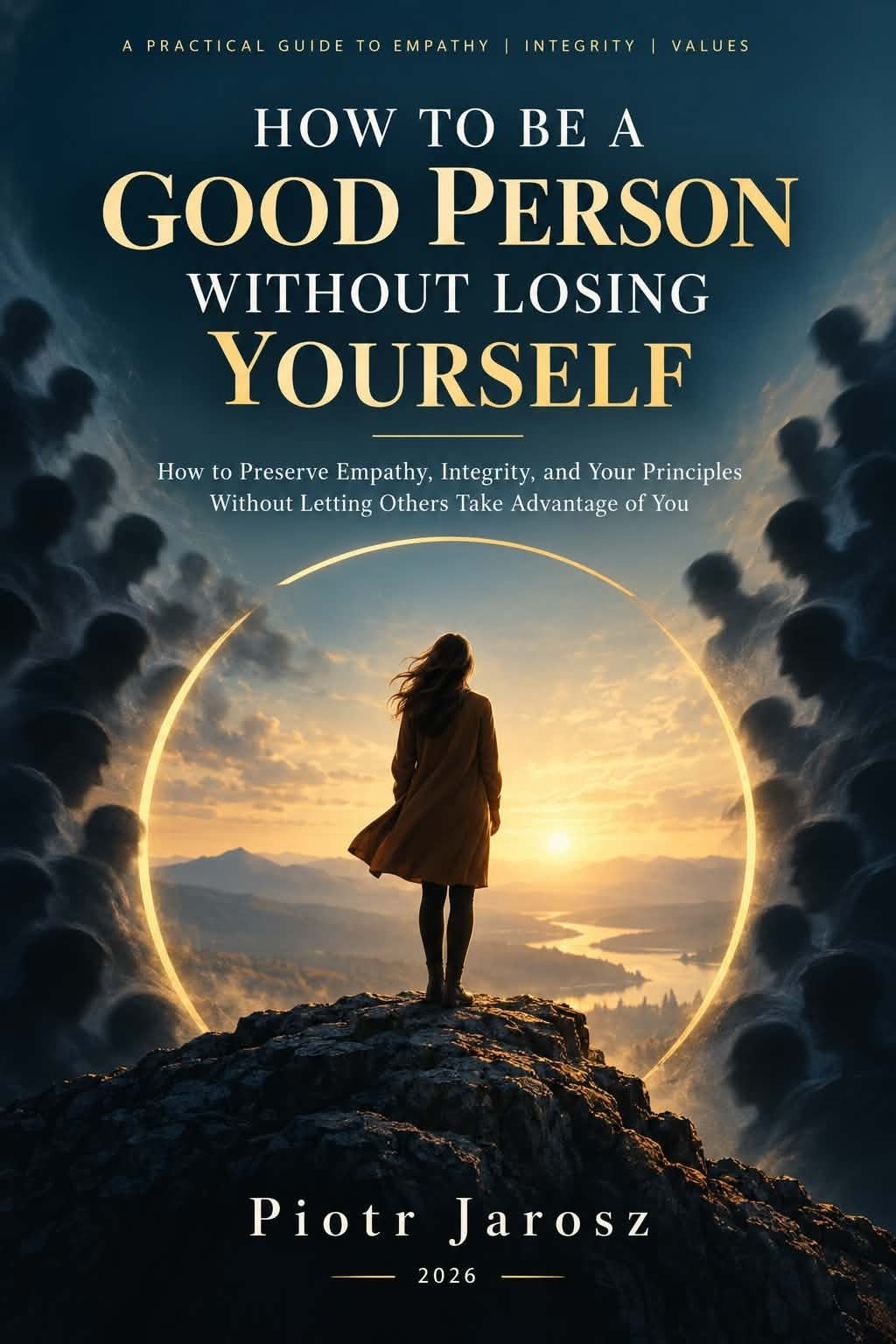
Can you be a good person without letting others take advantage of you? Sometimes we try so hard to understand others that we stop listening to ourselves. We say yes at the expense of our own needs, avoid difficult conversations, and confuse kindness with an obligation to meet everyone else’s expectations. “How to Be a Good Person Without Losing Yourself” by Piotr Jarosz invites you to cultivate kindness rooted in empathy, self-respect, and a commitment to your values. It explores how to remain compassionate while protecting your boundaries—in your relationships and everyday choices. For anyone who wants to help without losing themselves, say no without feeling they are letting others down, and stay true to their principles despite pressure from those around them. Your kindness matters. So do you. This e-book is in English.
Ta publikacja spełnia wymagania dostępności zgodnie z dyrektywą EAA.
| Kategoria: | Poradniki |
| Język: | Angielski |
| Zabezpieczenie: |
Watermark
|
| ISBN: | 9788398337786 |
| Rozmiar pliku: | 7,8 MB |
FRAGMENT KSIĄŻKI
GOODNESS NEEDS WISDOM
Being a good person seems simple until life begins to put our principles to the test. It is easy to be honest when honesty costs us nothing. It is easy to be patient with someone who treats us with respect. It is easy to talk about forgiveness when we have not been deeply hurt. It is easy to believe in people when no one has seriously taken advantage of our trust. The real questions begin later.
What should we do when our kindness has been exploited?
Should we continue helping someone who has repeatedly let us down?
Does forgiveness mean we are obliged to let that person back into our life?
Can a good person be firm?
Do we have the right to be angry?
Is it acceptable to leave a toxic relationship?
Should we always tell the truth?
Can we seek consequences for someone we have also forgiven?
Does loving our neighbor mean that we must tolerate every kind of behavior?
And finally: can we remain good people without allowing others to take advantage of us?
Yes. But it takes more than good intentions. Goodness needs wisdom, boundaries, and courage. It requires the ability to recognize our own emotions. It also needs humility, because people who see themselves as entirely good and infallible can easily stop noticing their own mistakes. That is why this book does not present goodness as a permanent smile, endless yielding, or unconditional compliance with other people’s expectations. Mature goodness looks different. Sometimes it means helping. Sometimes it means refusing. Sometimes it means forgiving. Sometimes it means leaving. Sometimes it means remaining silent.
And sometimes it means having the courage to tell someone: “What you are doing is wrong, and I will not take part in it.”
FOUR QUESTIONS THIS BOOK ASKS
The question of how to live well can be viewed from several perspectives.
Morality asks: What is good, and what is evil?
Ethics asks: Why should I act this way?
Psychology asks: Why does a person who knows the rules sometimes act against them?
Religion asks: How should I live in light of faith and my responsibility before God?
These four questions do not have to compete with one another. On the contrary, together they can give us a much fuller picture of the human person. Psychology can help us understand why someone manipulates, but understanding the mechanism does not mean we must accept the manipulation. Ethics can help us build principles, but a principle by itself will not always tell us how to deal with the pain of betrayal. Religion may speak about forgiveness, but forgiveness also requires a mature understanding of boundaries and responsibility. Morality reminds us that life is not made up of theory alone.
In the end, a decision still has to be made: tell the truth or lie; help or look away; apologize or make excuses; set a boundary or once again allow it to be crossed.
GOODNESS DOES NOT MEAN WEAKNESS
Many problems arise from the mistaken belief that a good person should be gentle in every situation. No. A person can be good and very firm. You can oppose injustice. You can end a relationship. You can refuse to lend money. You can report a crime. You can defend your family. You can stop trusting someone who has repeatedly betrayed your trust. Goodness does not mean consenting to evil. In the Christian tradition, love of neighbor has never meant declaring every action of another person to be good.
You can love a person and at the same time firmly oppose what that person is doing. That distinction matters. Respect for a person does not require acceptance of every behavior.
GOODNESS DOES NOT MEAN PERFECTION EITHER
A book about being a good person can unintentionally suggest that there is some perfect model of a human being who never gets angry, never feels envy, always makes the right decision, and responds to every injury with a calm smile. That image is not only unrealistic; it can also be harmful. People experience anger. They feel envy. Sometimes they behave selfishly. They make bad decisions. They say things they later regret.
So the goal is not moral perfection. The goal is direction: the ability to notice our mistakes and the willingness to admit, “I was wrong,” without immediately adding, “but the other person did worse,” “everyone does it,” or “it wasn’t my fault.”
Maturity begins when we can recognize our own responsibility without destroying our dignity.
A GOOD HEART. A COOL HEAD. A STRONG BACKBONE.
These three elements will return throughout this book. A good heart means the capacity for compassion, kindness, helpfulness, and seeing value in another person. A cool head means sound judgment, attention to facts, and the ability not to fall into every emotional trap. A strong backbone means principles and boundaries.
A good heart by itself can lead to naivety. A cool head without empathy can lead to cynicism. A strong backbone without compassion can become harshness. Maturity lies in bringing all three together.