MENU
MENU
 Nasze ceny

 Przeczytaj fragment on-line

-
 nowość
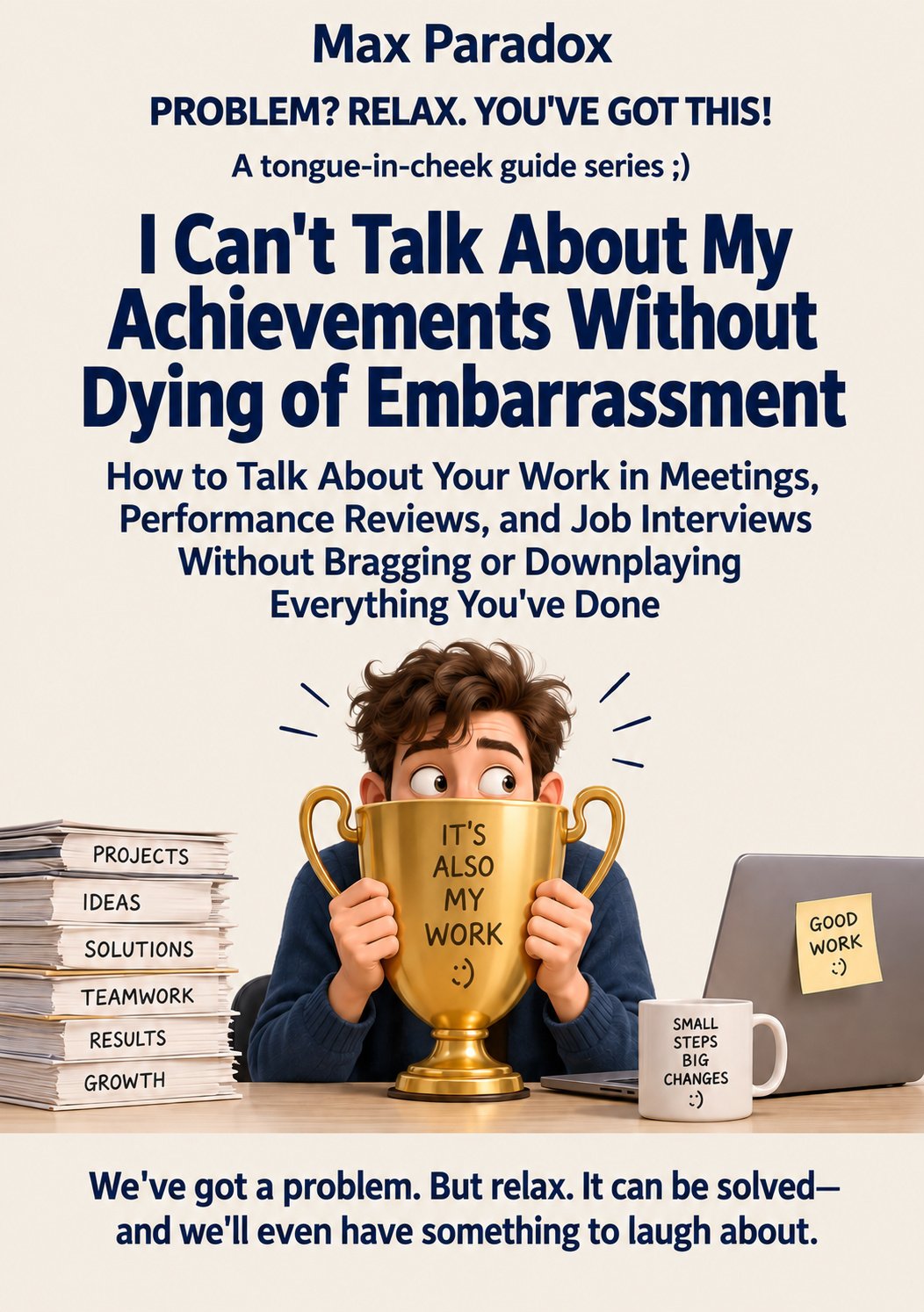
I Can't Talk About My Achievements Without Dying of Embarrassment - ebook
I Can't Talk About My Achievements Without Dying of Embarrassment - ebook
You do good work. You solve problems, keep projects moving, help people, make decisions, and quietly prevent chaos. Then someone asks, "What have you achieved?" and your brain offers: "Well... nothing special." This book shows you how to talk about your work clearly in meetings, performance reviews, and job interviews without bragging, shrinking your contribution, or sounding like your own corporate brochure. Learn to show evidence, explain impact, accept credit, handle awkward questions, and stay visible without turning visibility into a second job.
Ta publikacja spełnia wymagania dostępności zgodnie z dyrektywą EAA.
| Kategoria: | Careers |
| Język: | Angielski |
| Zabezpieczenie: |
Watermark
|
| Rozmiar pliku: | 2,6 MB |
FRAGMENT KSIĄŻKI
INTRO
You are sitting in a performance review, and your manager asks a question that should be almost embarrassingly easy: "What are you most proud of this year?" You have answers. Plenty of them. You fixed the project that had been wobbling toward disaster for six weeks. You spotted a problem before it became expensive. You trained a new colleague who now works independently. You handled a client conversation nobody was particularly eager to volunteer for. You built something, improved something, prevented something, delivered something. Your brain opens the filing cabinet containing all of this evidence, looks directly at it, and says, "Hmm. Nothing comes to mind." So you smile awkwardly and answer, "I mean... I was just doing my job." Twelve months of work have now been compressed into a sentence suitable for someone who occasionally refills the office printer. Your manager nods. You nod. Somewhere inside you, several perfectly respectable achievements quietly put on their coats and leave.
The strange part is that you may be excellent at talking about almost anything except your own contribution. Ask you to explain the project, and you can describe the dependencies, risks, timelines, customer concerns, technical limitations, and why the spreadsheet has seventeen tabs even though nobody remembers approving tab fourteen. Ask what you personally did, and suddenly language becomes dangerous. "Well, we all worked on it." True. "I only helped with one part." Possibly. "Anyone could have done it." An interesting claim, especially considering that several people had the opportunity and somehow you were the one doing it. The moment your own competence enters the conversation, an internal legal department appears and begins reviewing every sentence for excessive self-importance. "You said you led the project. Do we have sufficient evidence for the word led? Could we perhaps replace it with stood near the project while things happened?"
This problem is often mistaken for modesty, but modesty is only part of it. The deeper issue is that many capable people have learned to treat accurate self-description as socially suspicious. Saying "I did this well" feels dangerously close to saying "I am extraordinary, please form an orderly line for autographs." So they protect themselves by shrinking the facts. They turn "I redesigned the process and reduced repeated errors" into "I helped a bit." They turn "I took responsibility when the original owner left" into "We managed somehow." They turn a measurable result into "It worked out." The achievement remains real, but the language becomes so cautious that the listener would need forensic training to find it. Then, months later, the same person wonders why somebody else seems more visible. Usually that somebody else has not discovered secret executive magic. They simply used a subject and a verb.
There is another reason this problem survives: your own skills become ordinary to you. If you are good at organizing messy work, the mess stops looking impressive once you have organized it. If you are good at calming difficult conversations, you remember that the conversation ended calmly, not that your judgment helped it get there. If you notice risks quickly, you may assume everyone noticed them. Familiar competence has a camouflage effect. The things you do well start feeling like basic human functions, somewhere between breathing and remembering where the meeting room is. Meanwhile, somebody watching from the outside may be thinking, "How did they untangle that in twenty minutes?" You are thinking, "I don't know, it was obvious." This is how expertise quietly disguises itself as Tuesday.
Workplaces make this even more complicated because good work is not always visible at the moment it happens. A manager may see the final result but not the six decisions that prevented trouble. A recruiter sees your résumé, not the evening when you rebuilt the analysis because the original assumptions collapsed. A senior leader may know that a project launched on time without knowing who noticed the schedule conflict early enough to fix it. Even colleagues often see only their part of the machinery. This does not mean everyone is careless or unfair. It means people are busy, information is incomplete, and your work does not come with a small narrator walking behind it saying, "For context, this bit was actually quite difficult." If you rely entirely on other people to reconstruct your contribution, you are outsourcing an important part of your career to collective memory, which is brave in the same way leaving your airport arrival time to group chat consensus is brave.
The solution is not to become louder. It is not to turn every meeting into a press conference about your recent accomplishments, update your professional profile because you successfully ran a Tuesday call, or develop the conversational habit of introducing yourself with quarterly results. That would solve one problem by creating a much more exhausting one. The useful skill is far less dramatic: learning to describe your work accurately, proportionately, and at the right moment. Sometimes that means one sentence. Sometimes it means a clear example in a job interview. Sometimes it means being able to explain during a performance review what changed because of your contribution. And sometimes it simply means accepting "Great job" with "Thank you" instead of immediately producing a five-minute argument for why the compliment has been issued to the wrong person.
That requires a different relationship with evidence. Instead of asking, "Does this sound impressive enough?" you learn to ask better questions. What was actually happening? What did I personally contribute? What changed afterward? What part belonged to other people? What does this example demonstrate about how I work? Those questions are useful because they move attention away from personality theater. You do not need to feel like a confident person before you can answer them. You do not need to experience a warm glow of self-belief while saying, "I led the analysis." You only need the statement to be true. Confidence is helpful, but facts are wonderfully low-maintenance. They do not require affirmations before breakfast.
You will also need to get comfortable with an inconvenient truth: good self-description can still feel embarrassing at first. That feeling is not reliable proof that you have crossed into bragging. Sometimes it is simply the sensation of using muscles you normally avoid. If you have spent years answering praise with "It was nothing," then saying "Thanks, I put a lot of work into that" may feel as if you have just ordered a bronze statue of yourself for the lobby. You have not. You have completed a normal conversational exchange. The discomfort may arrive anyway. Let it. The goal is not to eliminate every awkward sensation before you speak. If you wait for complete emotional comfort, you may reach retirement with an excellent record of achievements that nobody, including you, has ever heard described properly.
This book is about building a more useful middle ground between two bad options: disappearing from your own work and inflating it until it no longer resembles reality. You will learn how to notice achievements that have become invisible through familiarity, separate your contribution from the team's without stealing credit, choose examples that prove competence instead of merely sounding grand, and talk about results even when there is no glamorous percentage attached. You will learn how to prepare for meetings, performance reviews, and interviews without memorizing corporate monologues that make you sound like you swallowed a leadership brochure. You will also learn what to do when the result was imperfect, when somebody else did something more impressive, when praise makes you uncomfortable, or when you explain your contribution perfectly and the other person reacts with all the enthusiasm of someone approving an expense report.
Most importantly, none of this requires becoming a different kind of person. You do not need a louder voice, a bigger ego, or a mysterious new ability to enjoy talking about yourself. You need a clearer way to recognize what happened and a less self-destructive way to describe it. Your work does not become less collaborative because you name your part. Your mistakes do not disappear because you acknowledge your strengths, and your strengths do not disappear because you made mistakes. You are allowed to describe both without turning either into a personality verdict. That is the whole point: less performance, more accuracy.
Because when someone eventually asks, "What did you achieve?" the answer should not require a spiritual crisis, a forensic search through twelve months of calendar entries, and an emergency meeting of your internal modesty committee. You did the work. You can learn to say what the work was.
And then, mercifully, you can stop talking.CHAPTER 1 - IT WAS JUST MY JOB
The meeting is almost over when your manager says, "Before we wrap up, I want to call out the work you did on the renewal issue. That could have become a serious mess, and you handled it really well." You know exactly what happened. The account had contradictory terms in three places, two teams had different assumptions about the deadline, and the client had already sent an email containing the phrase "deeply concerned," which in corporate language is roughly the stage before furniture starts moving. You pulled the documents together, found the contradiction, got the right people into one conversation, proposed a workable fix, and kept the customer from spending another week wondering whether anyone in your company owned a calendar. Your response? "Oh, it was just part of the job." Your manager pauses, says, "Well, still - good work," and moves on. Congratulations. You have just taken a perfectly accurate description of competent performance and reduced it to something that sounds like you changed the toner cartridge without being asked.
"It was just my job" feels responsible because, technically, it often is true. Many of your achievements happen inside the boundaries of your role. You were hired to solve problems, complete projects, serve customers, analyze information, make decisions, coordinate work, or keep some complicated part of civilization from falling into a shared inbox. You are not volunteering heroically every morning. There is a salary involved. This fact, however, does not mean every possible way of performing the job is equivalent. A responsibility describes what needed to happen. An achievement describes what you did with that responsibility. "Manage the launch" might be the job. Spotting a dependency nobody had planned for, restructuring the timeline, getting four teams aligned, and launching without missing the commercial date describes how you performed it. The first belongs in a job description. The second tells someone what you can actually do.
This distinction matters because capable people often become blind to the difference between assigned work and valuable execution. If you spend years doing something, the skill involved starts to feel ordinary from the inside. You can scan a complicated document and notice the clause that will cause trouble, so after a while you assume that clause was glowing fluorescent orange and wearing a tiny hat. You can walk into a chaotic meeting and identify the real disagreement within ten minutes, so you tell yourself, "I just asked a few questions." You can turn vague instructions into a workable plan, so you think, "Well, someone had to organize it." Familiarity makes competence look cheap. The smoother you become at something, the less dramatic it feels while you are doing it, which is a wonderfully inconvenient feature of professional growth.
One reason people fall into this trap is that they use difficulty as the main test of whether something counts. If a task exhausted you, kept you awake, and forced you to whisper "why" at a spreadsheet at 11:47 p.m., then perhaps it qualifies as an achievement. If you handled it calmly because you have become good at it, apparently it gets demoted to "nothing special." That logic rewards struggle and discounts mastery. A senior engineer who diagnoses a production problem in twenty minutes has not contributed less because the same problem would have taken a junior employee four hours. An experienced account manager who prevents a client escalation with one well-timed conversation has not done "less" because nobody needed to arrange an emergency call afterward. Competence often looks boring from the outside and even more boring from the inside. That is not evidence that it has no value. It may be evidence that you have stopped noticing the machinery.
A more useful way to look at your work is to separate three things: the assignment, the contribution, and the consequence. The assignment is what the role or situation required. The contribution is what you specifically brought to the situation - judgment, initiative, expertise, coordination, a decision, a method, a conversation, a correction. The consequence is what changed because of it. Suppose your assignment was to prepare a quarterly planning session. That alone tells us almost nothing. Your contribution might have been discovering that the teams were using different demand assumptions, creating one shared model, and resolving the disagreement before the meeting. The consequence might have been that leadership could make a decision in one session instead of scheduling another round of clarification. You did not invent planning. You did not personally rescue capitalism. You did something useful and identifiable within your job.
The fastest practical exercise is to take one recent task and write those three layers without trying to make any of them impressive. For example: "Assignment: prepare the supplier review. Contribution: noticed the cost comparison ignored minimum-order requirements, rebuilt the comparison, and challenged the original recommendation. Consequence: we selected a different supplier and avoided committing to inventory we did not need." Notice how little drama is required. There is no sentence beginning "Through exceptional leadership..." because nobody needs that sentence except perhaps a brochure suffering from low self-esteem. The facts already contain the interesting part. This is also why specificity tends to feel less embarrassing than self-praise. Saying "I'm commercially brilliant" requires you to become your own awards committee. Saying "I caught an assumption that would have doubled the minimum commitment" requires you to remember what happened.
You should also stop using "anyone could have done it" as an automatic discount code. Maybe someone else could have done it. That is frequently true. Another surgeon could have performed the operation, another teacher could have taught the class, another analyst could have built the model, another manager could have led the conversation. The existence of hypothetical alternative humans does not erase the human who actually did the work. If a colleague says, "Thanks for catching that error," answering "Anyone would have caught it" is not humility so much as a strange philosophical experiment. Would they? When? Before or after the report went out? With the same information? You do not need to prove that you were the only person on Earth capable of the action. Professional value is not an exclusivity patent.
At the same time, identifying your contribution does not give you permission to expand it until it occupies the entire project. If you made the analysis but another person negotiated the final agreement, say so. If you led the client conversation but the technical team designed the solution, your achievement is not "I solved the whole problem." Accuracy works in both directions. A reliable sentence might be, "The team developed the technical fix, and I led the client side - explaining the options, negotiating the timeline, and getting agreement on the revised plan." This is stronger than "we all helped," because it explains your role, and more credible than "I saved the account," because it does not behave as if the rest of the company had gone for lunch. Learning to talk about achievements well means resisting both inflation and disappearance.
There is another category people routinely erase: preventative work. If you solve a visible crisis, at least there is a dramatic before-and-after. If you prevent the crisis, all you get is a suspiciously normal Tuesday. You review a contract early, catch a renewal clause, and change the date. Nothing happens. You notice that two teams are building from different specifications and reconcile them before development starts. Nothing happens. You flag that an order quantity looks wrong and correct it before purchase. Again, nothing happens. Good. Sometimes "nothing happened" is the result. The trick is to describe the intervention rather than inventing a giant disaster you supposedly prevented. "I identified a renewal condition before the deadline and renegotiated it" is grounded. "I saved the company from catastrophic financial exposure" may be true, but if your evidence is mainly a strong feeling and a slightly dramatic imagination, perhaps leave the trumpets in storage.
Another overlooked achievement is increased responsibility. Your outcomes may look similar from year to year while your level of ownership changes substantially. Last year, you contributed analysis while someone else set the direction. This year, you designed the analysis, presented the options, and recommended the decision. Last year, you attended customer meetings. This year, you lead them. Last year, you completed a recurring process with supervision. This year, other people come to you when the process breaks. If you look only for bigger numbers, you may miss the fact that your actual development has been from execution toward judgment. That matters in performance reviews, promotion conversations, and job interviews because seniority is often visible in the decisions you own, not merely in the volume of work you produce.
A good reality check is to imagine the same contribution performed by a colleague you respect. Would you describe their work as "nothing special"? If a teammate took over a failing project, rebuilt the plan, handled a difficult stakeholder, and got it delivered, would you say, "Yes, but technically they were employed at the time"? Probably not. You would recognize the quality of execution. We often apply a bizarre double standard to ourselves because we remember every hesitation, false start, awkward email, and moment when we stared at the screen hoping a solution might emerge through intimidation. We see the messy backstage of our own performance and the finished scene of everyone else's. Of course ours looks less polished. We have seen the cables.
For the minimum version, do not build a system, a tracker, or a personal Hall of Excellence. Pick one piece of work from the last seven days and finish this sentence: "The part that depended on me was..." Keep it factual. "The part that depended on me was turning three competing requests into one agreed priority list." "The part that depended on me was noticing the pricing assumption and checking it before submission." "The part that depended on me was getting the customer and operations team to agree on the revised date." One sentence is enough to begin retraining your attention. You are not trying to convince yourself that everything you touch is remarkable. You are simply learning to notice where your judgment, effort, or skill actually entered the picture.
If even that feels uncomfortable, use Plan B: write the sentence as though you were describing someone else. "Jordan identified the source of the mismatch and coordinated the correction across two teams." Then replace the name with "I." If the sentence suddenly feels boastful even though no facts changed, you have found the problem. The language is not excessive. Your tolerance for being the subject of an accurate sentence is simply underdeveloped. That can improve.
Your job is supposed to contain opportunities to do good work. That does not make the good work meaningless. "It was my job" can be true at exactly the same time as "I handled it well." You do not need to choose between professional responsibility and personal contribution, because the second often exists inside the first. The useful habit is not asking whether you deserve applause. It is asking whether your description matches reality.
Sometimes the most accurate sentence is simply: "Yes, that was my responsibility, and I did it well."
You are allowed to leave the sentence there.CHAPTER 2 - MODESTY WITH A DELETE BUTTON
Someone compliments your presentation after a meeting. "That was really clear. The comparison between the options made the decision much easier." Your internal response arrives before the other person has finished breathing: "Oh, it wasn't really me. Priya gave me some of the numbers, and honestly I threw most of it together yesterday." The colleague looks mildly confused because they were not conducting an audit. They were saying the presentation was good. You continue anyway. "And the second slide was too crowded." Excellent. A compliment has entered the building, security has identified it as a threat, and you are personally escorting it back outside. Within ten seconds, you have credited someone else, disclosed a weakness nobody asked about, and provided evidence that the work was completed under less-than-ideal circumstances. Somewhere, a publicist has felt a sudden disturbance in the universe.
This reflex can look like modesty, but it behaves more like deletion. Healthy modesty keeps your claims proportionate. It reminds you that other people contributed, circumstances helped, and success does not automatically make you the most fascinating person in the room. Self-erasure does something different. It systematically removes relevant information about your own contribution. The difference matters because modesty is compatible with truth, while self-erasure often distorts it. If you built the argument, structured the recommendation, and delivered the presentation, saying "I really just put the slides together" is not more morally pure. It is less accurate. You have taken a three-dimensional piece of work and described the nearest visible object.
The language of self-erasure has recognizable fingerprints. "Just" is one of the most efficient. "I just coordinated it." "I just suggested the change." "I just handled the customer side." The sentence may describe work involving judgment, influence, or responsibility, but "just" arrives like a tiny office intern with a red pen and reduces the significance before anyone else gets a chance to evaluate it. "A little" performs similar work: "I helped a little with the restructuring," said the person who spent six weeks rebuilding the workflow. Then there is "kind of," a phrase capable of making even formal responsibility sound temporary and mysterious. "I kind of led the implementation." Did you lead it, or did you occasionally walk near it carrying coffee?
You are sitting in a performance review, and your manager asks a question that should be almost embarrassingly easy: "What are you most proud of this year?" You have answers. Plenty of them. You fixed the project that had been wobbling toward disaster for six weeks. You spotted a problem before it became expensive. You trained a new colleague who now works independently. You handled a client conversation nobody was particularly eager to volunteer for. You built something, improved something, prevented something, delivered something. Your brain opens the filing cabinet containing all of this evidence, looks directly at it, and says, "Hmm. Nothing comes to mind." So you smile awkwardly and answer, "I mean... I was just doing my job." Twelve months of work have now been compressed into a sentence suitable for someone who occasionally refills the office printer. Your manager nods. You nod. Somewhere inside you, several perfectly respectable achievements quietly put on their coats and leave.
The strange part is that you may be excellent at talking about almost anything except your own contribution. Ask you to explain the project, and you can describe the dependencies, risks, timelines, customer concerns, technical limitations, and why the spreadsheet has seventeen tabs even though nobody remembers approving tab fourteen. Ask what you personally did, and suddenly language becomes dangerous. "Well, we all worked on it." True. "I only helped with one part." Possibly. "Anyone could have done it." An interesting claim, especially considering that several people had the opportunity and somehow you were the one doing it. The moment your own competence enters the conversation, an internal legal department appears and begins reviewing every sentence for excessive self-importance. "You said you led the project. Do we have sufficient evidence for the word led? Could we perhaps replace it with stood near the project while things happened?"
This problem is often mistaken for modesty, but modesty is only part of it. The deeper issue is that many capable people have learned to treat accurate self-description as socially suspicious. Saying "I did this well" feels dangerously close to saying "I am extraordinary, please form an orderly line for autographs." So they protect themselves by shrinking the facts. They turn "I redesigned the process and reduced repeated errors" into "I helped a bit." They turn "I took responsibility when the original owner left" into "We managed somehow." They turn a measurable result into "It worked out." The achievement remains real, but the language becomes so cautious that the listener would need forensic training to find it. Then, months later, the same person wonders why somebody else seems more visible. Usually that somebody else has not discovered secret executive magic. They simply used a subject and a verb.
There is another reason this problem survives: your own skills become ordinary to you. If you are good at organizing messy work, the mess stops looking impressive once you have organized it. If you are good at calming difficult conversations, you remember that the conversation ended calmly, not that your judgment helped it get there. If you notice risks quickly, you may assume everyone noticed them. Familiar competence has a camouflage effect. The things you do well start feeling like basic human functions, somewhere between breathing and remembering where the meeting room is. Meanwhile, somebody watching from the outside may be thinking, "How did they untangle that in twenty minutes?" You are thinking, "I don't know, it was obvious." This is how expertise quietly disguises itself as Tuesday.
Workplaces make this even more complicated because good work is not always visible at the moment it happens. A manager may see the final result but not the six decisions that prevented trouble. A recruiter sees your résumé, not the evening when you rebuilt the analysis because the original assumptions collapsed. A senior leader may know that a project launched on time without knowing who noticed the schedule conflict early enough to fix it. Even colleagues often see only their part of the machinery. This does not mean everyone is careless or unfair. It means people are busy, information is incomplete, and your work does not come with a small narrator walking behind it saying, "For context, this bit was actually quite difficult." If you rely entirely on other people to reconstruct your contribution, you are outsourcing an important part of your career to collective memory, which is brave in the same way leaving your airport arrival time to group chat consensus is brave.
The solution is not to become louder. It is not to turn every meeting into a press conference about your recent accomplishments, update your professional profile because you successfully ran a Tuesday call, or develop the conversational habit of introducing yourself with quarterly results. That would solve one problem by creating a much more exhausting one. The useful skill is far less dramatic: learning to describe your work accurately, proportionately, and at the right moment. Sometimes that means one sentence. Sometimes it means a clear example in a job interview. Sometimes it means being able to explain during a performance review what changed because of your contribution. And sometimes it simply means accepting "Great job" with "Thank you" instead of immediately producing a five-minute argument for why the compliment has been issued to the wrong person.
That requires a different relationship with evidence. Instead of asking, "Does this sound impressive enough?" you learn to ask better questions. What was actually happening? What did I personally contribute? What changed afterward? What part belonged to other people? What does this example demonstrate about how I work? Those questions are useful because they move attention away from personality theater. You do not need to feel like a confident person before you can answer them. You do not need to experience a warm glow of self-belief while saying, "I led the analysis." You only need the statement to be true. Confidence is helpful, but facts are wonderfully low-maintenance. They do not require affirmations before breakfast.
You will also need to get comfortable with an inconvenient truth: good self-description can still feel embarrassing at first. That feeling is not reliable proof that you have crossed into bragging. Sometimes it is simply the sensation of using muscles you normally avoid. If you have spent years answering praise with "It was nothing," then saying "Thanks, I put a lot of work into that" may feel as if you have just ordered a bronze statue of yourself for the lobby. You have not. You have completed a normal conversational exchange. The discomfort may arrive anyway. Let it. The goal is not to eliminate every awkward sensation before you speak. If you wait for complete emotional comfort, you may reach retirement with an excellent record of achievements that nobody, including you, has ever heard described properly.
This book is about building a more useful middle ground between two bad options: disappearing from your own work and inflating it until it no longer resembles reality. You will learn how to notice achievements that have become invisible through familiarity, separate your contribution from the team's without stealing credit, choose examples that prove competence instead of merely sounding grand, and talk about results even when there is no glamorous percentage attached. You will learn how to prepare for meetings, performance reviews, and interviews without memorizing corporate monologues that make you sound like you swallowed a leadership brochure. You will also learn what to do when the result was imperfect, when somebody else did something more impressive, when praise makes you uncomfortable, or when you explain your contribution perfectly and the other person reacts with all the enthusiasm of someone approving an expense report.
Most importantly, none of this requires becoming a different kind of person. You do not need a louder voice, a bigger ego, or a mysterious new ability to enjoy talking about yourself. You need a clearer way to recognize what happened and a less self-destructive way to describe it. Your work does not become less collaborative because you name your part. Your mistakes do not disappear because you acknowledge your strengths, and your strengths do not disappear because you made mistakes. You are allowed to describe both without turning either into a personality verdict. That is the whole point: less performance, more accuracy.
Because when someone eventually asks, "What did you achieve?" the answer should not require a spiritual crisis, a forensic search through twelve months of calendar entries, and an emergency meeting of your internal modesty committee. You did the work. You can learn to say what the work was.
And then, mercifully, you can stop talking.CHAPTER 1 - IT WAS JUST MY JOB
The meeting is almost over when your manager says, "Before we wrap up, I want to call out the work you did on the renewal issue. That could have become a serious mess, and you handled it really well." You know exactly what happened. The account had contradictory terms in three places, two teams had different assumptions about the deadline, and the client had already sent an email containing the phrase "deeply concerned," which in corporate language is roughly the stage before furniture starts moving. You pulled the documents together, found the contradiction, got the right people into one conversation, proposed a workable fix, and kept the customer from spending another week wondering whether anyone in your company owned a calendar. Your response? "Oh, it was just part of the job." Your manager pauses, says, "Well, still - good work," and moves on. Congratulations. You have just taken a perfectly accurate description of competent performance and reduced it to something that sounds like you changed the toner cartridge without being asked.
"It was just my job" feels responsible because, technically, it often is true. Many of your achievements happen inside the boundaries of your role. You were hired to solve problems, complete projects, serve customers, analyze information, make decisions, coordinate work, or keep some complicated part of civilization from falling into a shared inbox. You are not volunteering heroically every morning. There is a salary involved. This fact, however, does not mean every possible way of performing the job is equivalent. A responsibility describes what needed to happen. An achievement describes what you did with that responsibility. "Manage the launch" might be the job. Spotting a dependency nobody had planned for, restructuring the timeline, getting four teams aligned, and launching without missing the commercial date describes how you performed it. The first belongs in a job description. The second tells someone what you can actually do.
This distinction matters because capable people often become blind to the difference between assigned work and valuable execution. If you spend years doing something, the skill involved starts to feel ordinary from the inside. You can scan a complicated document and notice the clause that will cause trouble, so after a while you assume that clause was glowing fluorescent orange and wearing a tiny hat. You can walk into a chaotic meeting and identify the real disagreement within ten minutes, so you tell yourself, "I just asked a few questions." You can turn vague instructions into a workable plan, so you think, "Well, someone had to organize it." Familiarity makes competence look cheap. The smoother you become at something, the less dramatic it feels while you are doing it, which is a wonderfully inconvenient feature of professional growth.
One reason people fall into this trap is that they use difficulty as the main test of whether something counts. If a task exhausted you, kept you awake, and forced you to whisper "why" at a spreadsheet at 11:47 p.m., then perhaps it qualifies as an achievement. If you handled it calmly because you have become good at it, apparently it gets demoted to "nothing special." That logic rewards struggle and discounts mastery. A senior engineer who diagnoses a production problem in twenty minutes has not contributed less because the same problem would have taken a junior employee four hours. An experienced account manager who prevents a client escalation with one well-timed conversation has not done "less" because nobody needed to arrange an emergency call afterward. Competence often looks boring from the outside and even more boring from the inside. That is not evidence that it has no value. It may be evidence that you have stopped noticing the machinery.
A more useful way to look at your work is to separate three things: the assignment, the contribution, and the consequence. The assignment is what the role or situation required. The contribution is what you specifically brought to the situation - judgment, initiative, expertise, coordination, a decision, a method, a conversation, a correction. The consequence is what changed because of it. Suppose your assignment was to prepare a quarterly planning session. That alone tells us almost nothing. Your contribution might have been discovering that the teams were using different demand assumptions, creating one shared model, and resolving the disagreement before the meeting. The consequence might have been that leadership could make a decision in one session instead of scheduling another round of clarification. You did not invent planning. You did not personally rescue capitalism. You did something useful and identifiable within your job.
The fastest practical exercise is to take one recent task and write those three layers without trying to make any of them impressive. For example: "Assignment: prepare the supplier review. Contribution: noticed the cost comparison ignored minimum-order requirements, rebuilt the comparison, and challenged the original recommendation. Consequence: we selected a different supplier and avoided committing to inventory we did not need." Notice how little drama is required. There is no sentence beginning "Through exceptional leadership..." because nobody needs that sentence except perhaps a brochure suffering from low self-esteem. The facts already contain the interesting part. This is also why specificity tends to feel less embarrassing than self-praise. Saying "I'm commercially brilliant" requires you to become your own awards committee. Saying "I caught an assumption that would have doubled the minimum commitment" requires you to remember what happened.
You should also stop using "anyone could have done it" as an automatic discount code. Maybe someone else could have done it. That is frequently true. Another surgeon could have performed the operation, another teacher could have taught the class, another analyst could have built the model, another manager could have led the conversation. The existence of hypothetical alternative humans does not erase the human who actually did the work. If a colleague says, "Thanks for catching that error," answering "Anyone would have caught it" is not humility so much as a strange philosophical experiment. Would they? When? Before or after the report went out? With the same information? You do not need to prove that you were the only person on Earth capable of the action. Professional value is not an exclusivity patent.
At the same time, identifying your contribution does not give you permission to expand it until it occupies the entire project. If you made the analysis but another person negotiated the final agreement, say so. If you led the client conversation but the technical team designed the solution, your achievement is not "I solved the whole problem." Accuracy works in both directions. A reliable sentence might be, "The team developed the technical fix, and I led the client side - explaining the options, negotiating the timeline, and getting agreement on the revised plan." This is stronger than "we all helped," because it explains your role, and more credible than "I saved the account," because it does not behave as if the rest of the company had gone for lunch. Learning to talk about achievements well means resisting both inflation and disappearance.
There is another category people routinely erase: preventative work. If you solve a visible crisis, at least there is a dramatic before-and-after. If you prevent the crisis, all you get is a suspiciously normal Tuesday. You review a contract early, catch a renewal clause, and change the date. Nothing happens. You notice that two teams are building from different specifications and reconcile them before development starts. Nothing happens. You flag that an order quantity looks wrong and correct it before purchase. Again, nothing happens. Good. Sometimes "nothing happened" is the result. The trick is to describe the intervention rather than inventing a giant disaster you supposedly prevented. "I identified a renewal condition before the deadline and renegotiated it" is grounded. "I saved the company from catastrophic financial exposure" may be true, but if your evidence is mainly a strong feeling and a slightly dramatic imagination, perhaps leave the trumpets in storage.
Another overlooked achievement is increased responsibility. Your outcomes may look similar from year to year while your level of ownership changes substantially. Last year, you contributed analysis while someone else set the direction. This year, you designed the analysis, presented the options, and recommended the decision. Last year, you attended customer meetings. This year, you lead them. Last year, you completed a recurring process with supervision. This year, other people come to you when the process breaks. If you look only for bigger numbers, you may miss the fact that your actual development has been from execution toward judgment. That matters in performance reviews, promotion conversations, and job interviews because seniority is often visible in the decisions you own, not merely in the volume of work you produce.
A good reality check is to imagine the same contribution performed by a colleague you respect. Would you describe their work as "nothing special"? If a teammate took over a failing project, rebuilt the plan, handled a difficult stakeholder, and got it delivered, would you say, "Yes, but technically they were employed at the time"? Probably not. You would recognize the quality of execution. We often apply a bizarre double standard to ourselves because we remember every hesitation, false start, awkward email, and moment when we stared at the screen hoping a solution might emerge through intimidation. We see the messy backstage of our own performance and the finished scene of everyone else's. Of course ours looks less polished. We have seen the cables.
For the minimum version, do not build a system, a tracker, or a personal Hall of Excellence. Pick one piece of work from the last seven days and finish this sentence: "The part that depended on me was..." Keep it factual. "The part that depended on me was turning three competing requests into one agreed priority list." "The part that depended on me was noticing the pricing assumption and checking it before submission." "The part that depended on me was getting the customer and operations team to agree on the revised date." One sentence is enough to begin retraining your attention. You are not trying to convince yourself that everything you touch is remarkable. You are simply learning to notice where your judgment, effort, or skill actually entered the picture.
If even that feels uncomfortable, use Plan B: write the sentence as though you were describing someone else. "Jordan identified the source of the mismatch and coordinated the correction across two teams." Then replace the name with "I." If the sentence suddenly feels boastful even though no facts changed, you have found the problem. The language is not excessive. Your tolerance for being the subject of an accurate sentence is simply underdeveloped. That can improve.
Your job is supposed to contain opportunities to do good work. That does not make the good work meaningless. "It was my job" can be true at exactly the same time as "I handled it well." You do not need to choose between professional responsibility and personal contribution, because the second often exists inside the first. The useful habit is not asking whether you deserve applause. It is asking whether your description matches reality.
Sometimes the most accurate sentence is simply: "Yes, that was my responsibility, and I did it well."
You are allowed to leave the sentence there.CHAPTER 2 - MODESTY WITH A DELETE BUTTON
Someone compliments your presentation after a meeting. "That was really clear. The comparison between the options made the decision much easier." Your internal response arrives before the other person has finished breathing: "Oh, it wasn't really me. Priya gave me some of the numbers, and honestly I threw most of it together yesterday." The colleague looks mildly confused because they were not conducting an audit. They were saying the presentation was good. You continue anyway. "And the second slide was too crowded." Excellent. A compliment has entered the building, security has identified it as a threat, and you are personally escorting it back outside. Within ten seconds, you have credited someone else, disclosed a weakness nobody asked about, and provided evidence that the work was completed under less-than-ideal circumstances. Somewhere, a publicist has felt a sudden disturbance in the universe.
This reflex can look like modesty, but it behaves more like deletion. Healthy modesty keeps your claims proportionate. It reminds you that other people contributed, circumstances helped, and success does not automatically make you the most fascinating person in the room. Self-erasure does something different. It systematically removes relevant information about your own contribution. The difference matters because modesty is compatible with truth, while self-erasure often distorts it. If you built the argument, structured the recommendation, and delivered the presentation, saying "I really just put the slides together" is not more morally pure. It is less accurate. You have taken a three-dimensional piece of work and described the nearest visible object.
The language of self-erasure has recognizable fingerprints. "Just" is one of the most efficient. "I just coordinated it." "I just suggested the change." "I just handled the customer side." The sentence may describe work involving judgment, influence, or responsibility, but "just" arrives like a tiny office intern with a red pen and reduces the significance before anyone else gets a chance to evaluate it. "A little" performs similar work: "I helped a little with the restructuring," said the person who spent six weeks rebuilding the workflow. Then there is "kind of," a phrase capable of making even formal responsibility sound temporary and mysterious. "I kind of led the implementation." Did you lead it, or did you occasionally walk near it carrying coffee?
więcej..