MENU
MENU
 Nasze ceny

 Przeczytaj fragment on-line

Mieszko and Poland’s conversion - ebook

Mieszko and Poland’s conversion - ebook
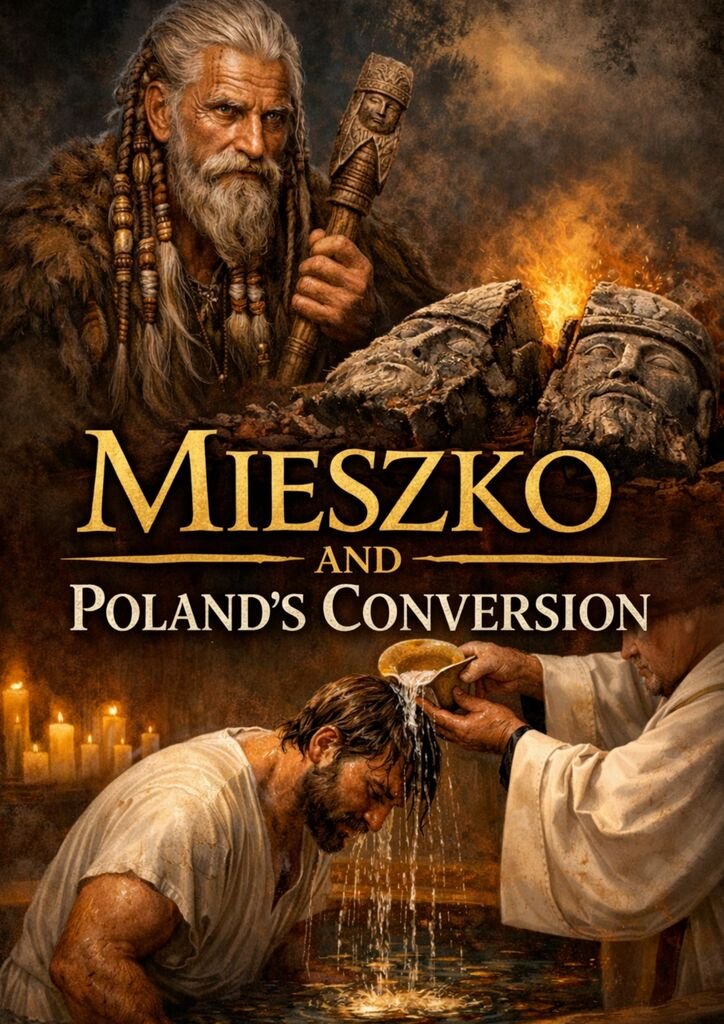
Vivid historical novel giving Mieszko I’s conversion to Christianity to secure Poland against Saxon and imperial threats. Blends 10th-C politics, faith struggles, & supernatural tension. follows Mieszko’s shift from paganism, Dobrawa’s gentle evangelization, and shaman’s tragic resistance — led by demon Veles — across four parts: alliance & baptism, early conflicts & battles (Mt. Ślęża, Cedynia), transformation, and final victories. Immersive tale of Poland’s birth as a Christian nation.
Ta publikacja spełnia wymagania dostępności zgodnie z dyrektywą EAA.
| Kategoria: | Nonfiction |
| Język: | Angielski |
| Zabezpieczenie: |
Watermark
|
| ISBN: | 978-83-8440-985-5 |
| Rozmiar pliku: | 1,3 MB |
FRAGMENT KSIĄŻKI
This book is licensed for your personal enjoyment only. It may not be re-sold or given away to other people. If you would like to share this book with another person, please purchase an additional copy for each recipient. If you’re re-reading this book and did not purchase it, or it was not purchased for your use only, then please return to your favorite book retailer and purchase your own copy. Thank you for respecting the hard work of this author.
It would add to your enjoyment to have a map of Poland at about the time 965—992 AD.Prolog The Price of Alliance
Vyšehrad, Prague, Czechia — Autumn 964. The stone walls of Vyšehrad held the day’s last warmth, but the chamber itself had grown cold. Duke Boleslav I of Czechia stood near the narrow window slit, hands clasped behind his back, watching the Vltava River slide dark and steady below the cliff. He did not turn when the guards announced the Polanian envoy.
“Bring him in,” Boleslav said.
Czcibor entered without hesitation. He wore no Christian token, no cross, no attempt at disguise. His cloak smelled faintly of smoke and horse sweat, and the bronze clasp at his shoulder bore an old Slavic design — older than any church in Prague. Behind him came another man — lean, sharp-eyed — who carried himself like one accustomed to listening more than speaking.
Boleslav turned at last. His expression was openly hostile. “Mieszko sends a pagan to negotiate with Christians?” he said. “That alone tells me how this meeting will end.”
Czcibor inclined his head slightly. “My prince sends the man who speaks his thoughts most clearly. If that offends you, Duke, we can return north before nightfall.”
Boleslav’s jaw tightened. At his side, Father Přemislav — his assistant in all matters spiritual and political — shifted his weight, fingers tightening around the edge of his woolen mantle.
“You come because you need us,” Boleslav said. “The Saxons press you from the west. And Otto presses them, you and _me_.”
Czcibor met his gaze without blinking. “And you agree to this meeting because _you_ need _us_. Your northern border is long, and your levies are finite. A hostile Polan realm would serve emperor Otto well.”
The words hung between them like drawn steel.
Boleslav gave a short, humorless laugh. “So. Blunt, at least.”
“I waste no breath on ceremony,” Czcibor replied. “That is for priests.”
Father Přemislav stiffened, but Boleslav raised a hand. “Enough. You speak for Mieszko. What does he want?”
Czcibor folded his hands within his sleeves. “A marriage. Your daughter. Dobrawa.”
The priest inhaled sharply. Boleslav’s eyes narrowed. “You ask for a Christian woman to be sent into a pagan court? Into a land where idols still stand and shamans bleed horses on stone?”
Czcibor’s voice remained even. “I ask for an alliance sealed in blood and heirs. Nothing more.”
“That is a lie,” Boleslav snapped. “Marriage is never ‘nothing more’.”
For a long moment, no one spoke. The Polanian assistant shifted his stance, hand drifting near his belt knife before he caught himself.
Boleslav turned away, pacing. “If I give her to Mieszko as he is now, I strengthen paganism. I legitimize it. Otto will see that as defiance.”
“And if you refuse,” Czcibor said, “you leave Mieszko with fewer options. He may turn to the Saxons instead. Or raid Czechia to secure what he cannot gain by treaty.”
Boleslav stopped. Slowly, he faced him again. “You speak as though conversion were impossible.”
“I speak as though it is not my prince’s faith that concerns him,” Czcibor replied. “It is survival.”
Father Přemislav looked sharply at Czcibor. “And if conversion were… required?”
Silence.
Czcibor’s eyes darkened. “Required by whom?”
“By us,” Boleslav said. “By the Church. Dobrawa will not marry a pagan. Not in name, not in truth.”
The hostility in the room sharpened — then shifted. Czcibor considered this, truly considered it, and Boleslav saw calculation replace reflex.
“At whose hand?” Czcibor asked.
Father Přemislav answered quietly. “Not Otto’s.”
That, at last, broke the stalemate.
Czcibor nodded once. “Then there is a path.”
Boleslav exhaled, the tension easing from his shoulders. “A hard one.”
“All paths worth taking _are_,” Czcibor said. “I will carry this condition north.”
Boleslav studied him. “And you will counsel him to accept it?”
Czcibor’s mouth curved, not quite a smile. “I will counsel him to rule Poland well.”
Outside, the bells of Prague rang for Vespers. Within the stone chamber of Vyšehrad, two neighbors had reached an understanding — and set in motion a conversion that would reshape a kingdom.Chapter 1 The Marriage Condition (965)
1.1. DOBRAWA WILL NOT MARRY A PAGAN
Dobrawa stood before the small altar in her chamber, the wax of the candles pooled and hardened like pale scars upon the stone. She finished her prayer, rose, and turned only when the door closed behind her father.
“You have kept them waiting,” Boleslav said. His tone was controlled, but impatience pressed through it.
“I know,” she replied. “That was deliberate.”
At the far end of the room, the Polanian envoys waited — Czcibor foremost, unmoving as a carved post, with his assistant half a step behind. Dobrawa met their eyes without deference. She had seen warriors before. These were no different.
“Speak,” Boleslav said. “You came for my daughter.”
Czcibor inclined his head. “My prince seeks lawful marriage and alliance.”
Dobrawa did not sit. “With a pagan ruler,” she said. Not an accusation. A statement.
Czcibor’s mouth tightened. “With a ruler who wishes to govern effectively.”
She stepped closer, close enough to see the fine lines at the corners of his eyes. “Effectiveness does not save souls.”
Boleslav shot her a warning glance, but she ignored it. “I will not cross the border as a concubine of a pagan,” she continued. “I will not bow to carved wood or pretend that silence is tolerance.”
The other envoy shifted. Czcibor raised a hand without looking at him.
“You would deny peace to two peoples over belief?” Czcibor asked.
“Yes. I would deny a lie,” Dobrawa said. “Marriage is not a treaty written in ink. It is a shared life. It is a sacred union. I will not share mine with false gods.”
The words landed heavily. Boleslav watched Czcibor weigh them, saw calculation flicker behind the man’s stillness.
“My daughter is resolute,” Boleslav said. “You see that.”
Czcibor nodded slowly. “I see conviction. I also see danger. Mieszko’s people will resist —”
“They will resist regardless,” Dobrawa cut in. Her voice hardened. “Conversion delayed will be conversion forced. By Saxon swords or Otto’s imperial soldiers. If your prince is wise, he will choose the moment himself and it will be before Odo or Otto invade him.”
Silence stretched. Outside, bells rang the hour.
“At whose insistence?” Czcibor asked at last.
“At mine,” Dobrawa said. “I will marry Mieszko only if he receives baptism into the Catholic faith. Publicly. Fully. No half-measures.”
Boleslav drew a breath and looked at Czcibor. “This is the condition.”
Czcibor studied Dobrawa as though seeing her for the first time — not as a pawn, but as an obstacle with a spine of iron.
“I will carry your words north,” he said.
“Carry them exactly,” Dobrawa replied. “There will be no marriage without baptism.”
Czcibor bowed, deeper this time. The refusal was complete, irrevocable. The terms were set.
1.2. POLITICAL IMPLICATIONS OF A CZECH-POLISH ALLIANCE
The council chamber at Vyšehrad smelled of beeswax, mold, and damp wool. Maps lay spread across the long table — parchment scarred by knife points and weighted with river stones. Boleslav stood at the head, his palms braced against the wood, while Fr. Přemislav and his lay secretary, Radoslav, waited in silence.
“The Polans will accept the condition,” Přemislav said at last. “They cannot afford not to.”
Boleslav did not answer immediately. His gaze traced the northern routes with a practiced eye: the forests beyond the Sudete Mountains, the river crossings, and the wide, poorly defended spaces where armies vanished or reappeared without warning. “Acceptance is not conversion,” he said. “Mieszko will convert because it serves him, not because he’s convinced.”
Fr. Přemislav allowed himself a thin smile. “That is how it is with most rulers.”
Radoslav cleared his throat. “If Poland converts through Prague, not Magdeburg, Otto’s claim weakens. The emperor will not welcome that.”
“No,” Boleslav agreed. “But he will tolerate it. A Christian Poland is less useful to him as a target. And a Poland tied to Czechia is less likely to fall into Saxon hands.”
Fr. Přemislav gestured toward the western edge of the map. “The Saxons test borders constantly. A baptized Mieszko becomes a shield against Otto’s invading us. A pagan Mieszko is an excuse for an invasion, first of Poland then of us.”
Boleslav straightened, folding his arms. “And Dobrawa becomes the hinge.”
The priest nodded. “She can bring priests, books, ritual order. But more than that, legitimacy. Once Mieszko receives baptism, Otto cannot brand him a barbarian without contradicting his alleged Catholic faith.”
“Yet Otto will look for tribute,” Radoslav said. “Conversion invites hegemony under _him._”
“It invites negotiation,” Boleslav replied. “There is a difference.”
Přemislav’s eyes sharpened. “You intend to place Czechia between Poland and the empire. A Christian corridor that answers first to Magdeburg?”
“I intend to survive,” Boleslav said flatly. “And to ensure my children do not rule a borderland ground between an emperor and a king.”
Radoslav hesitated. “The Polanian court will fracture. Their pagan nobles will resist Czech influence.”
Boleslav’s mouth curved slightly. “Good. Division makes them weak. Mieszko will need allies who share his new faith. Those allies will not come from his old shamans.”
Fr. Přemislav studied him. “You speak of souls as pieces on a board.”
“I speak of power,” Boleslav said. “The Church understands that better than it admits.”
For a moment, only the rustle of parchment broke the silence.
“At the council in Regensburg,” Fr. Přemislav said quietly, “Otto will ask how this came about.”
Boleslav tapped the map where Prague lay, solid and central. “We will say that faith spread north, as it should. Peacefully. Through marriage.”
“And if Mieszko wavers?” Radoslav asked.
“Then Dobrawa will hold him fast,” Boleslav replied. “Or he will fall between two worlds. Either way, Czechia gains a Christian neighbor instead of a pagan threat.”
The alliance was not yet sealed, but its shape was clear — cross and crown bound together, each watching the other carefully.
1.3. MIESZKO’S INTERNAL STRUGGLE WITH THE DECISION
Night had settled over Gniezno, pressing cold against the timbered walls of the stronghold. Mieszko stood alone in the great hall, the hearth reduced to embers. The carved figures along the beams — old gods, half-forgotten spirits — loomed in the flickering light like silent witnesses.
Convert.
The word tasted foreign.
He rested his hands on the back of the high seat but did not sit. Sitting felt like surrender. Outside, the watch changed, boots crunching on frost. Order. Discipline. He had built both with sword and iron will. Now a woman in Prague demanded something no army could take.
Czcibor’s voice echoed in his mind, measured and cautious. _“Conversion is a weapon, if you choose to wield it.”_
A weapon that cut both ways.
Mieszko closed his eyes and saw the borders of his realm as clearly as if they were burned onto his eyelids. Saxon marches probing from the west. Veleti unrest to the north. Tributary obligations that shifted with strength alone. Otto I waited for weakness. He always did.
Christian baptism would buy time. Recognition. A place within the order Otto claimed to rule. But at what cost? Priests did not arrive alone. They came with laws, with judgments, with the quiet insistence that authority flowed from bishop as well as throne.
He turned toward the idols at the far end of the hall — weathered wood, darkened by smoke. They had answered prayers before. Or men had believed they had. Victories had followed sacrifices. Defeats too. The gods had never explained themselves.
“My father ruled without priests,” Mieszko muttered. “And bled for it.”
He thought of Dobrawa — not as a face, but as a presence. Convicted, unyielding. She would not bend. That, at least, he respected. A pliant bride would be useless. A resolute one could be dangerous — or invaluable.
If she refused, Czechia closed its gates. Worse, Otto would hear of it. Her refusal would mark him as defiant, stubbornly pagan, ripe for correction. If she accepted, his own nobles would test him. Mścisław would not remain silent. Faith, once questioned, did not return quietly to its place.
Mieszko paced the length of the hall, boots thudding against packed earth. He did not fear baptism. Baptismal water could not weaken him. What he feared was precedent — kneeling once and discovering how often others expected him to kneel again.
Yet he had knelt before no man. Why should he fear kneeling before a god, if it served his people?
He stopped before the high seat at last. “Survival first,” he said softly. “Always.”
The decision was not made. Not yet. But the struggle had narrowed. Between pride and endurance. Between old fire and new order. And for the first time, Mieszko admitted what unsettled him most: the cross might not only protect his rule — it might change it.
1.4. MŚCISŁAW’S BITTER OPPOSITION FROM Mt. Ślęża
Wind tore across the summit of Ślęża, driving ash and pine resin into the night air. Mścisław stood barefoot on the stone platform before the ancient shrine, his cloak snapping like a banner of war behind him. Below, the forests of Silesia stretched dark and dense, indifferent to princes and borders. Here, the god of the mountain still listened.
“They will break faith,” he said quietly.
His acolyte beside him — Witosz, scarcely twenty — shifted uneasily. “The messengers swear it is only talk. A marriage discussion.”
“Talk can become reality,” Mścisław replied. His silver-gray eyes fixed on the four-faced stone idol of Światowid. “First comes talk. Then concession. Then kneeling.”
He stepped closer to the idol, resting his scarred palm against the cold stone. The mountain hummed beneath his touch, familiar, reassuring. He had felt it since childhood. Vibrant, patient, older than any crowned warlord.
“Mieszko was raised to honor the old ways,” Witosz said, with more hope than certainty. “He sacrifices. He listens.”
“He listens for victory,” Mścisław snapped. “And victory now whispers with a Christian tongue.”
He turned sharply, braids swinging. “Do you know what baptism means, boy? It is not just water. It is erasure. Gods and sagas forgotten. Groves cut down. Horses slaughtered without ritual, their spirits left to wander.”
Witosz swallowed. “What will you do?”
Mścisław’s mouth tightened. He did not answer at once. He walked the perimeter of the shrine, fingers tracing carvings worn nearly smooth by centuries of grasping in prayer. Each mark was a memory left on stone. Each had cost blood.
“I will remind them,” he said finally. “I will remind the people who they are.”
He gestured toward the valley. “They come here for judgment. For healing. For certainty when princes waver. If Mieszko thinks to drag them across a threshold they do not understand, he will learn how deep their roots go.”
A gust extinguished one of the ritual fires. Sparks scattered like fleeing insects.
“They say the Czech woman demands conversion,” Witosz ventured.
“They always hide the blade behind silk,” Mścisław replied. “This woman will bring priests. Priests bring law. Law brings chains.”
He knelt before Światowid, bowing his head until his scar brushed the stone. His voice dropped, resonant, ritual-trained. “Great One, four-faced guardian, you see all paths. You see the serpent creeping north.”
The wind rose, howling through the stones.
Mścisław’s hands clenched. “I will not watch this shrine become a memory. I will not watch Poland forget itself.”
He rose slowly, bitterness hardening into resolve. Far to the north, a prince weighed a crown against a cross. On Ślęża, Mścisław had already chosen his side.
1.5. DEVIL FIRST APPEARS TO MŚCISŁAW, OFFERING POWER
The ritual fire guttered low, though no wind reached the inner stone ring. Mścisław knelt alone before the shrine, breath measured, the haze caused by his fasting sharpening the edges of the world. The night pressed close, dense and watchful. Even the wind seemed to hold still.
He traced the fourfold sigil on the stone floor and murmured the final invocation. Silence prevailed — then something cold broke it.
The air thickened. The embers dimmed to a dull red glow, and the scent of pine smoke curdled into rot. Mścisław’s spine stiffened. He did not rise. Fear acknowledged too quickly lost its edge.
“LONG HAVE YOU CALLED,” a voice said softly, intimate as breath against the ear. “AND LONGER HAVE YOU LISTENED.”
Mścisław lifted his head.
A figure stood beyond the firelight — tall, composed, wrapped in darkness that seemed to take in the glow. His face was noble, almost beautiful, but wrong in small, precise ways. The eyes were black at first glance, then shifted, revealing depths of dark green that moved like stirred water.
“I know you,” Mścisław said, voice steady. “The deceiver. The one the old songs warn against.”
The figure smiled. “THE SONGS WARN AGAINST MANY THINGS THAT WOULD MAKE MEN STRONG.”
Cold spread across the stone. Mścisław rose slowly, ritual staff firm in his grip. “You have no place here. This mountain is sacred.”
“SACRED PLACES ARE MY SPECIALTY,” the figure replied, stepping forward without sound. “THEY ARE ALWAYS ABANDONED EVENTUALLY. I ARRIVE TO SAVE THEM.”
Mścisław’s jaw tightened. “What do you want?”
“TO SPEAK TO YOU PLAINLY,” Veles said. “YOUR PRINCE LISTENS TO CHRISTIANS. YOUR GODS ARE BEING MEASURED AGAINST FOREIGN PROMISES. YOU FEEL THE GROUND SHIFTING BENEATH YOU.”
“I feel betrayal,” Mścisław said.
“CALL IT CHANGE,” Veles replied. “CHANGE CAN FAVOR THOSE WILLING TO ACT.”
The devil gestured toward the idol. For an instant, the four faces of Światowid seemed to blur, their expressions indistinct. “YOU SERVE HIM FAITHFULLY. YOU BLEED TO PRESERVE YOUR TRADITIONS. YET TRADITION ALONE DOES NOT STOP KINGS.”
Mścisław’s grip tightened. “I do not need your gifts.”
“OF COURSE YOU DO NOT,” Veles said gently. “YOU NEED TOOLS. INFLUENCE. SIGHT BEYOND RITUAL.” His eyes fixed on the shaman. “POWER ENOUGH TO PRESERVE WHAT MUST NOT BE LOST.”
“At what price?” Mścisław asked.
Veles’s smile widened, just enough to show teeth a fraction too sharp. “ONLY RESOLVE. THE COURAGE TO DO WHAT SOFTER MEN WILL NOT DO. BUT I CANNOT FORCE YOU.” He inclined his head. “I CAN ONLY OFFER.”
The fire flared once, briefly bright, then sank again.
Mścisław did not answer. He stood rigid, weighing the presence before him — ancient, calculating, patient. The mountain remained silent. The choice had been placed before him, naked and waiting.
1.6. FLASHBACKS REVEAL MŚCISŁAW’S CHILDHOOD TRAUMA
The mountain’s silence pressed Mścisław inward, and with it came memory — unbidden, sharp as flint.
The memory returned to him not as a sequence, but as a sensation: the smell of smoke, the weight of hands on his shoulders, the sound of his own breathing as something inside him learned, for the first time, and that the world could turn hostile without warning.
He had been seven.
Until that day his hair had never been cut. It fell past his shoulders in a thick, uneven fall, braided loosely by his mother each morning. She had told him — as all mothers told their sons — that the hair kept watch while he slept, that spirits slid away from it like rain from off a duck’s back. He believed her. Children always did.
The clearing had been prepared before dawn. The men gathered in a circle, their cloaks dark, their faces solemn with the seriousness reserved for rituals that could not be undone. The women stood farther back. His mother did not touch him once they arrived. That, too, was part of it.
His father stepped forward with the knife.
It was not a weapon, though it could cut flesh easily enough. The blade had been polished smooth by years of use, passed from father to son. It gleamed dully in the morning light. Mścisław remembered watching it, fascinated and afraid.
“Kneel,” his father said.
He obeyed.
The first cut was meant to be symbolic, a lock severed cleanly and offered to the fire. The act marked the end of childhood, the surrender of maternal protection. His father’s hand was supposed to be steady.
It was not.
The blade erred. Badly — a slice, shallow and sharp, across the scalp near his temple. Blood welled immediately, warm and startling. He gasped. Someone muttered. His mother cried out once before another woman pulled her back.
His father swore under his breath. The circle of men laughed.
For a moment the ritual froze. Blood was an ill omen at the postrzyżyny. Everyone knew this. Blood meant angered spirits, or worse — attention.
His father, having lost face, grabbed the boy roughly and pressed a cloth to the wound, too roughly. “Be still,” he snapped. “Do you want them to see weakness?”
Mścisław did not know who “they” were, only that the men’s faces had changed. Not concern — disapproval. The ritual had to continue. Stopping would be worse than proceeding.
When the hair was finally cut away, it fell unevenly, clotted dark at one end. The fire hissed when it was thrown in.
Then came the naming.
His birth-name — Zając — soft, protective, meant only to confuse what listened in the dark — was spoken once and discarded. His father placed a hand on his head, fingers brushing the blood-crusted hairline.
“You are Mścisław,” he declared. “One who will bring glory through vengeance.”
The words echoed too loudly. Someone shifted. An elder frowned.
The name was heavy. Names always were. This one settled into him like iron.
A gust of wind swept through the clearing, sudden and cold. The fire flared, then guttered. For an instant, Mścisław felt exposed, stripped not only of hair but of shelter. Whatever had been held at bay had been invited closer.
Later — much later — he would remember how no one met his eyes when the ritual ended. How his father avoided his mother’s gaze. How the men spoke about him in low voices, disapprovingly.
But at seven, he understood only this: he had been hurt at the moment he was given to the world of men, and the pain had been called his destiny.
From that day forward, the world did not feel like something to trust.
It felt like something to confront.
*
Another memory. Mścisław was eight again, knees drawn to his chest beneath the eaves of a longhouse that no longer stood. Smoke stung his eyes. Men shouted outside, their voices splintered by fear. He remembered the smell first: sour sweat, iron, and the sweetness of spilled mead turning sour in the dirt.
His father had pushed him behind the hearth stones. “Do not move”, he had whispered, unkindly, bravely. The man’s hands shook as he pressed the boy down, palms rough with old calluses. Then he had turned toward the door, spear lifted, already knowing it would not be enough.
The crash came like thunder. Shields struck wood. A cry broke short. Mścisław learned that night the sound a man makes when breath leaves him forever.
He had not screamed. He remembered that with a strange pride. He bit his lip until it bled, copper and warm. He learned to keep pain inside, to let it burn without sound. When the longhouse burned, the firelight licked through the gaps in the wall and painted everything in frantic gold. Shadows danced — huge, monstrous, laughing.
Someone dragged him out by the ankle. He remembered the shock of cold air, the stars above spinning wildly. A boot struck his ribs. Another voice laughed. The scar along his cheek came later, the blade careless, the wound dismissed as nothing. It became everything.
Afterward came the grove.
An old shaman — stooped, nearly blind — washed the blood from his face with water that smelled of moss and ash. The man spoke no comfort. He spoke only names. Gods. Places. Promises. He told the boy that memory was a duty, not a burden. That forgetting was the true death.
“You will remember for those who cannot,” the shaman said, fingers trembling as they traced a sign on Mścisław’s brow. “This is the price of surviving.”
Years folded in on themselves. Hunger. Fasting. Nights alone in the forest, listening to wolves and learning which sounds meant danger and which meant nothing at all. Discipline hardened him. Ritual gave shape to power. Power, slowly earned, offered the illusion of order.
Now, on Ślęża, the memories settled like ash. Mścisław opened his eyes to the dark and felt the old wound ache, as it always did when choice approached. Loss had taught him this truth early: mercy did not preserve the world. Memory was a defense.
Something had been taken from him once, by men who believed themselves stronger. He had sworn — without words, without witnesses — that it would not happen again.
The mountain remained silent, but the past was loud.
1.7. MŚCISŁAW INCREASINGLY WISHES TO DO HARM
Mścisław noticed it first in his prayers. Where once he asked for endurance, he now asked for advantage. Where he once sought balance, he now weighed outcomes. The words of the rites remained unchanged, but his intention in using them shifted and sharpened.
On Ślęża, pilgrims still climbed to seek judgment. He watched them from the shadow of the stones — farmers with cracked hands, warriors with blood still drying beneath their nails. He listened to their tales of woe and felt no stirring of pity. Instead, he measured them. Useful. Weak. Dangerous. Replaceable.
This, he told himself, was wisdom.
The old restraint — taught by fasting, by silence, by fear of the gods’ displeasure — began to loosen. When anger rose, he did not suppress it. He examined it, encouraged its heat, learned how long it could be sustained before burning away good judgment. Controlled anger, he discovered, focused the will.
At night, thoughts crept in uninvited. Images of kneeling enemies. Of voices breaking. Of fear rippling outward, contagious, disciplining the many through the suffering of the few. These imaginings did not disgust him. They steadied him.
He told himself it was necessity.
Each compromise arrived already justified. Harsh counsel given to a village elder. A ritual altered — slightly — to cause punishment rather than blessing. A warning delivered with calculated cruelty, ensuring it would be remembered. When resistance followed, his response was swift, disproportionate, and instructive.
People learned quickly. They always did.
Mścisław began to enjoy the learning.
He walked the mountain paths alone, staff striking stone with deliberate force. The forests no longer felt like kin; they felt like his territory. The silence did not comfort him. Even the animals sensed the shift, keeping distance, watching with bright, unblinking eyes.
At the shrine, he lingered longer before the idol, but his reverence had changed. The gods were no longer guardians. They were instruments — symbols through which his will could be imposed. And if they demanded blood, so be it. If fear kept the people faithful, fear was a sacred tool.
The memory of his mother’s death no longer ached. It hardened into a lesson: mercy invited destruction. Survival belonged to those willing to act first, strike deeper, leave no room for return.
When he thought of Mieszko, he did not feel sorrow or disappointment. He felt jealous. His conversion was not a tragedy — it was a provocation, a challenge.
And provocation and challenge demanded response.
Standing on the summit as dawn bruised the horizon, Mścisław felt something settle comfortably within him. The hesitation that once tempered his resolve had thinned to nothing. What remained was purpose stripped of restraint.
He did not yet act.
The desire to cause harm — deliberate, corrective, exemplary — had taken root. It waited patiently, growing stronger, fed by certainty.Chapter 2 Winter of Decision (965–966)
2.1. MIESZKO STUDIES THE CATHOLIC FAITH AT GNIEZNO
Winter sealed Gniezno in ice and silence. Lakes Jelonek and Świętokrzyskie lay hard and opaque beneath snow, and the palisades creaked as if the timbers themselves were shrinking to preserve warmth. Within the stronghold, Mieszko withdrew from the outward rituals of rule and entered a narrower, more exacting discipline: study.
The priest sent from Prague was called Fr. Jordan. He was not young, nor gentle, nor impressed by rank. His Latin carried the clipped precision of a man accustomed to correcting rather than persuading. Each morning, before the hearth was fully lit, he unrolled parchment and began again at first principles, as though speaking to a mind entirely unformed.
“There is one God,” Jordan said, tapping the page with a blunt finger. “Not a council. One.”
Mieszko listened without interruption. He sat straight-backed on a bench drawn close to the fire, cloak folded, sword set aside. He did not argue. He asked questions — precise ones. If there was one God, what of suffering? If salvation started at baptism, what of those who died unbaptized? If kings ruled by divine favor, what established that favor?
Jordan answered carefully, sometimes with the confidence of doctrine untroubled by doubt. He spoke of original sin, of redemption, of authority descending in an unbroken line from God to pope to priest. He spoke of Rome. Of law. Of order that did not shift with season or omen.
Mieszko absorbed it all.
What struck him first was not the theology, but the structure. The Church was not a grove or a mountain or a collection of memories. It was an institution — layered, literate, and persistent. It recorded. It standardized. It reached beyond borders with the same words spoken in distant lands, binding strangers into a single system of meaning, all over the world.
At night, Mieszko walked the inner yard alone, breath clouding the air. He tested what he had heard against what he knew. The old rites had power, but they were local. Fragmented. Dependent on men like Mścisław, whose authority rose from fear rather than a coherent system. The Church offered something reasonable, consistent, logical — and more durable.
Jordan read from the Gospels by firelight. Stories of obedience and sacrifice. Of a king who refused worldly power. Mieszko found no comfort there, but neither did he find weakness. This God demanded submission, yes — but once submitted, demanded order from all beneath Him. For that He offered eternal life. That, Mieszko understood.
He asked about marriage. About legitimacy. About heirs recognized beyond tribal memory. Jordan did not smile. He spoke of a sacrament, of lawful union sanctified by God, of sons whose claims would be acknowledged not by sword, but by law.
*
The winter days shortened. Snow fell again and again, erasing tracks, forcing all movement inside. Mieszko’s world narrowed to parchment, prayer, and controlled reflection. He did not kneel. He did not cross himself. But he listened as one examines an unfamiliar weapon, gauging weight and balance.
When Jordan spoke of baptism, he described it as transformation, and also incorporation. Into a body older and broader than any single ruler: the Mystical Body of Christ. Mieszko considered the cost — not in belief, but in consequence.
To convert was to break with the visible past. To remain pagan was to rule alone.
He did not yet choose. He did not yet believe. But he recognized, with growing certainty, that faith was not merely devotion of individuals. It was alignment with the civilization of the West.
And winter, relentless and enclosing, gave him nothing else to do but think.
2.2. GROWING TENSION IN THE COURT AT GNIEZNO
The cold settled not only into stone and timber, but into the temper of the court itself. In Gniezno castle’s great hall, conversation thinned, glances lingered too long, and men weighed each word as though it might be remembered later — and used.
The cause was unspoken, but universally understood.
Mieszko’s withdrawal into study altered the rhythm of rule. Councils convened less often. Judgments came more slowly, filtered through deliberation rather than instinct. Where once the duke had decided swiftly, guided by precedent and force, he now paused, listened, and deferred. This restraint unsettled men accustomed to speed.
The pagan elders felt it first. They gathered in tight knots near the hearth, voices low, eyes sharp. Ritual obligations had not been neglected, but they had been reduced — shortened ceremonies, fewer sacrifices, an unmistakable economy applied to reverence. The old balance, carefully maintained, seemed suddenly provisional.
Warriors sensed it as well. They complained of uncertainty: raids delayed, alliances reconsidered, messengers dismissed with promises rather than commands. Discipline held, but uneasily. Men who lived by the sword distrusted hesitation. They wanted enemies named, borders tested, blood spilled with purpose.
The Christian presence sharpened every division.
Jordan moved through the hall quietly, his black cassock stark against fur and iron. He spoke rarely unless addressed, but his very existence unsettled the air. Some men mocked him openly, laughing at his soft hands and foreign tongue. Others watched him with calculation, noting who spoke with him, who listened, who avoided his gaze.
A few, quietly, asked questions.
They did so away from the hearth, near doorways or in the shadowed corners where sound dissolved into the rafters. They asked about marriage, about law, about lands secured not by oath alone but by written claim. Jordan answered without urgency, without pressure. That, too, was unsettling.
Dobrawa’s name passed often between whispers. Not spoken aloud in council, but present in every calculation. A Christian wife implied Christian priests. Priests implied churches. Churches implied Rome. Rome implied obligations that did not bow to local custom.
Some saw opportunity. Alignment with Czechia promised trade, legitimacy, recognition among Christian rulers who no longer viewed Polanian lands as a mere frontier. Others saw erosion — of authority, of tradition, of their own standing. Power rooted in ritual did not translate easily into doctrine.
Even the servants noticed the change. They spoke of tension in lowered voices, of nights when torches burned longer, of guards posted where none had been before. The court felt watched — by men, by gods, by Europe itself.
Mieszko observed all of it.
He spoke little, but his silence carried weight. When disputes flared, he allowed them to run longer than before, measuring who argued from fear and who from principle. He noted alliances forming subtly — shared looks, shared silences, shared resentment. The court, once unified by external threat, now turned inward.
At meals, laughter came late and ended early. Cups were raised out of habit, not celebration. Songs faltered. The hall remained full, yet strangely hollow, as if something essential were being held in reserve.
No decision had been announced. No decree issued. And yet everyone understood that the old order stood at the edge of a shrinking pond. The winter pressed on, unyielding, forcing proximity where distance might have preserved peace.
Gniezno did not erupt into open conflict. Not yet. But tension threaded every exchange, tightening with each passing day. The court waited — watchful, divided, restrained only by the certainty that whatever came next would alter everything.
2.3. MŚCISŁAW GATHERS PAGAN RESISTANCE TO MIESZKO’S BAPTISM
Snow thickened on the paths of the Sudete forest, but men still came.
They arrived in twos and threes, wrapped in sheepskins and caution, following old markers rather than roads. Some bore tokens — antler tips, carved ash, braided cords — signs of shared memory rather than open allegiance. Others brought nothing at all, trusting only the mountain’s pull and the shaman who had summoned them.
Ślęża received them all.
Mścisław did not call an assembly. He allowed a convergence. Fires were kept small and shielded. Words were spoken slowly, weighed before release. He understood fear as a language, and he spoke it fluently — never directly, never crudely, but with precision.
He listened first.
Village elders spoke of unease: shortened rites, neglected offerings, rumors of Czech priests measuring land for churches. A chieftain from the west complained that his sons mocked the old gods now, imitating Christian gestures they barely understood. A warrior asked what place remained for oaths sworn to stones if truth were soon sworn to books.
Mścisław nodded, storing each grievance without comment. He did not inflame. He clarified.
“Nothing has been declared,” he said, voice low but carrying. “Which is why you must be ready.”
They gathered within the ring of stones as dusk fell, the mountain pressing close around them. The idol loomed above, its faces indistinct in shadow, neither approving nor condemning. Mścisław stood beneath it, not elevated, not central — positioned as one who served something greater.
“Baptism is not just a rite,” he said. “It is a boundary. Once crossed, it does permit going back.”
He spoke of loss, but framed it as consequence rather than threat. Of groves cut for timber, not out of malice but necessity. Of names rewritten, not erased, but translated until their meaning thinned. Of authority passing quietly from memory to parchment, from living men to distant councils.
“Your customs will not be forbidden,” he continued. “They will be tolerated.”
Murmurs rippled outward.
He named no enemies. He spoke no treason. He referred only to inevitabilities and asked questions that answered themselves. What value did a shaman hold if his god no longer ruled the land? What protection remained if the spirits were declared false? What leverage could the old ways claim once legitimacy belonged elsewhere?
Men shifted, uneasy.
Mścisław offered structure. Quiet coordination. Shared observances on fixed days. Mutual interdependence among shrines that had once stood apart. He spoke of unity — not as rebellion, but as preservation. If the old gods were to endure, they would need discipline equal to the new doctrine.
“We have relied on habit,” he said. “The Church relies on order.”
He did not yet speak of confrontation. He spoke of readiness. Of influence maintained in villages. Of counsel given to hesitant leaders. Of shaping sentiment before decrees hardened into law.
As the fire burned low, he dismissed them individually, each man leaving with the sense of having been entrusted with something rather than recruited. That, too, was deliberate. Resistance born of duty outlasted resistance born of force.
When the last footsteps faded into snow, Mścisław remained before the idol. The mountain was silent, but no longer empty. Bonds had been drawn tight across distances once thought unbridgeable.
He had not called for defiance. He had called for cohesiveness.
And in a winter where uncertainty ruled the lowlands, Ślęża once again felt like a center.
2.4. MIESZKO DECIDES TO BE BAPTIZED AT EASTER
The decision did not arrive in a single moment. It assembled itself slowly, piece by piece, until resistance no longer felt like caution but delay.
Mieszko stood alone in the small chamber set aside for study, a space colder and quieter than the great hall. Parchments lay rolled and unrolled across the table, their edges weighted with small stones. The priest Jordan had gone, dismissed without ceremony, leaving behind words that lingered like a disciplined presence. Scripture, canon law, histories of kings who had bent — or been broken — by forces larger than themselves.
Outside, the winter wind scraped along the palisade. The season had stripped the world to essentials. There was no abundance to distract, no movement to disguise intent. Everything waited.
Mieszko traced a finger along a line of Latin text he could not yet read without assistance. It irritated him. Power should not require intermediaries. And yet — this power did. That, he now understood, was precisely its strength.
He thought of the court, divided and restless. Of elders whose authority depended on memory alone. Of warriors who followed him out of loyalty, but whose sons would demand more than precedent. He thought of Dobrawa, distant but present, her condition firm and unyielding. Marriage, yes — but marriage defined by law, recognized beyond forest and river.
Most of all, he thought of time.
The old ways had been sufficient for survival. They were not sufficient for permanence. They fractured naturally, shrine by shrine, shaman by shaman, bound by no common discipline beyond habit. The Church, by contrast, called for uniformity without apology. Its god did not negotiate. Its authority did not depend on place. That rigidity offended instinct — and appealed to strategy.
Mieszko did not believe as Jordan believed. He doubted he ever would. But belief, he now recognized, was not the point. Alignment with Czechia was, at least for now.
He moved to the narrow window and looked out toward frozen lake Jelonek. Beneath the ice, water flowed unseen, relentless, shaping its course regardless of surface stillness. A kingdom, he thought, must do the same.
To convert at once would provoke chaos. Too abrupt. Too naked. The winter had already tightened nerves to breaking. What remained was timing.
Easter.
The choice formed fully then — not as impulse, but as calculation refined to certainty. Easter carried symbolism Jordan had explained with careful reverence: death yielding to renewal, submission preceding authority. It aligned conversion with continuity rather than rupture. The old season would end. A new one would begin. Even those who resisted would understand the language of seasons.
Spring softened edges. It offered cover.
Mieszko returned to the table and rolled the parchments closed. He felt no triumph, no relief. Only resolve, cool and settled. This was not surrender. It was acquisition.
He would accept baptism as a ruler accepts a crown fashioned by another hand — aware of its weight, determined to use it. The Church would gain a prince. He would gain legitimacy beyond spear range. Neither would receive everything it desired.
When he summoned Fr. Jordan again, his voice was even.
“At Easter,” he said. “Not before.”
Jordan inclined his head, careful not to smile. He asked no further questions.
Mieszko dismissed him and remained standing, alone once more. The decision, now spoken, took on mass. It could not be withdrawn without consequence.
Outside, winter still ruled. Snow lay thick and unbroken. But beneath it, the ground was already preparing to shift.
2.5. THE MOVE TO Ostrów Lednicki ISLAND ON PALM SUNDAY, 966
Palm Sunday dawned gray and brittle. Mieszko ordered the move before sunrise, giving the command without explanation and tolerating no delay. By midmorning, the stronghold at Gniezno stirred with controlled urgency as wagons were loaded, horses shod, and household guards assembled under watchful eyes.
No proclamation accompanied the departure. That, too, was deliberate.
The road west cut through frozen ground just beginning to soften at the edges. Twelve miles was not far in distance, but it was far enough in meaning. Ostrów Lednicki lay isolated within Lake Lednica, reachable only by a causeway — defensible, contained, and crucially removed from the volatile density of the court. Movement there was movement inward.
Mieszko rode at the head of the column, cloak drawn tight, his expression unreadable. Around him rode men he trusted most: veterans whose loyalty predated faction, household retainers bound to him personally rather than to shrine or elder. Others had been left behind intentionally. Not as punishment. As a precaution.
Palm branches — newly cut willow, bound and blessed by Fr. Jordan — were carried at the rear, a visible sign that unsettled those who watched from the palisade. Some crossed themselves awkwardly in imitation. Others spat into the snow. The column did not slow.
As the retinue advanced, Mieszko observed the shifting mood. Conversation was sparse. Even the horses seemed subdued, their breath steaming in steady rhythm. This was not a procession of triumph, nor a retreat under threat. It was repositioning, executed with the quiet confidence of inevitability.
Ostrów Lednicki emerged gradually from the lake’s pale expanse, its fortified structures rising low and solid against the water. The island’s separation had always lent it a certain gravity. Here, movement could be controlled. Entry monitored. Influence concentrated. It was a place suited to transition — not because it proclaimed change, but because it limited interference.
As the wagons crossed the causeway, Mieszko felt the subtle shift that came with enclosure. The lake cut off noise, rumor, and momentum from the mainland. What remained was proximity — of advisers, priests, guards, and conscience. If an Easter baptism was to proceed as intended, there could be no wavering, no last-minute agitation, no external pressure masquerading as counsel.
He ordered the drawbridge up and the gates secured once the column had passed. Not sealed. Secured.
Within the compound, quarters were assigned efficiently. Fr. Jordan was given a cell near the space that was to become the chapel, where preparations already stood in careful outline. Supplies were inventoried. Guards were posted not merely outward, but inward, regulating access with unusual strictness. Messages to Gniezno were limited and screened. Mieszko made no apology for this.
The island settled into a tense stillness by evening.
Mieszko walked the perimeter alone, boots crunching on thin ice near the shore. He looked back toward the mainland, now distant, its forms softened by mist. Gniezno remained the heart of his rule — but hearts could be inflamed. Here, his intention would not be diluted.
This was not flight. It was consolidation.
By removing himself and his retinue, Mieszko had narrowed the field of influence to what could be managed, anticipated, and contained. The path to Easter baptism no longer passed through a divided court, but through a guarded threshold.
The decision had been made. Now, it would be carried through.
It would add to your enjoyment to have a map of Poland at about the time 965—992 AD.Prolog The Price of Alliance
Vyšehrad, Prague, Czechia — Autumn 964. The stone walls of Vyšehrad held the day’s last warmth, but the chamber itself had grown cold. Duke Boleslav I of Czechia stood near the narrow window slit, hands clasped behind his back, watching the Vltava River slide dark and steady below the cliff. He did not turn when the guards announced the Polanian envoy.
“Bring him in,” Boleslav said.
Czcibor entered without hesitation. He wore no Christian token, no cross, no attempt at disguise. His cloak smelled faintly of smoke and horse sweat, and the bronze clasp at his shoulder bore an old Slavic design — older than any church in Prague. Behind him came another man — lean, sharp-eyed — who carried himself like one accustomed to listening more than speaking.
Boleslav turned at last. His expression was openly hostile. “Mieszko sends a pagan to negotiate with Christians?” he said. “That alone tells me how this meeting will end.”
Czcibor inclined his head slightly. “My prince sends the man who speaks his thoughts most clearly. If that offends you, Duke, we can return north before nightfall.”
Boleslav’s jaw tightened. At his side, Father Přemislav — his assistant in all matters spiritual and political — shifted his weight, fingers tightening around the edge of his woolen mantle.
“You come because you need us,” Boleslav said. “The Saxons press you from the west. And Otto presses them, you and _me_.”
Czcibor met his gaze without blinking. “And you agree to this meeting because _you_ need _us_. Your northern border is long, and your levies are finite. A hostile Polan realm would serve emperor Otto well.”
The words hung between them like drawn steel.
Boleslav gave a short, humorless laugh. “So. Blunt, at least.”
“I waste no breath on ceremony,” Czcibor replied. “That is for priests.”
Father Přemislav stiffened, but Boleslav raised a hand. “Enough. You speak for Mieszko. What does he want?”
Czcibor folded his hands within his sleeves. “A marriage. Your daughter. Dobrawa.”
The priest inhaled sharply. Boleslav’s eyes narrowed. “You ask for a Christian woman to be sent into a pagan court? Into a land where idols still stand and shamans bleed horses on stone?”
Czcibor’s voice remained even. “I ask for an alliance sealed in blood and heirs. Nothing more.”
“That is a lie,” Boleslav snapped. “Marriage is never ‘nothing more’.”
For a long moment, no one spoke. The Polanian assistant shifted his stance, hand drifting near his belt knife before he caught himself.
Boleslav turned away, pacing. “If I give her to Mieszko as he is now, I strengthen paganism. I legitimize it. Otto will see that as defiance.”
“And if you refuse,” Czcibor said, “you leave Mieszko with fewer options. He may turn to the Saxons instead. Or raid Czechia to secure what he cannot gain by treaty.”
Boleslav stopped. Slowly, he faced him again. “You speak as though conversion were impossible.”
“I speak as though it is not my prince’s faith that concerns him,” Czcibor replied. “It is survival.”
Father Přemislav looked sharply at Czcibor. “And if conversion were… required?”
Silence.
Czcibor’s eyes darkened. “Required by whom?”
“By us,” Boleslav said. “By the Church. Dobrawa will not marry a pagan. Not in name, not in truth.”
The hostility in the room sharpened — then shifted. Czcibor considered this, truly considered it, and Boleslav saw calculation replace reflex.
“At whose hand?” Czcibor asked.
Father Přemislav answered quietly. “Not Otto’s.”
That, at last, broke the stalemate.
Czcibor nodded once. “Then there is a path.”
Boleslav exhaled, the tension easing from his shoulders. “A hard one.”
“All paths worth taking _are_,” Czcibor said. “I will carry this condition north.”
Boleslav studied him. “And you will counsel him to accept it?”
Czcibor’s mouth curved, not quite a smile. “I will counsel him to rule Poland well.”
Outside, the bells of Prague rang for Vespers. Within the stone chamber of Vyšehrad, two neighbors had reached an understanding — and set in motion a conversion that would reshape a kingdom.Chapter 1 The Marriage Condition (965)
1.1. DOBRAWA WILL NOT MARRY A PAGAN
Dobrawa stood before the small altar in her chamber, the wax of the candles pooled and hardened like pale scars upon the stone. She finished her prayer, rose, and turned only when the door closed behind her father.
“You have kept them waiting,” Boleslav said. His tone was controlled, but impatience pressed through it.
“I know,” she replied. “That was deliberate.”
At the far end of the room, the Polanian envoys waited — Czcibor foremost, unmoving as a carved post, with his assistant half a step behind. Dobrawa met their eyes without deference. She had seen warriors before. These were no different.
“Speak,” Boleslav said. “You came for my daughter.”
Czcibor inclined his head. “My prince seeks lawful marriage and alliance.”
Dobrawa did not sit. “With a pagan ruler,” she said. Not an accusation. A statement.
Czcibor’s mouth tightened. “With a ruler who wishes to govern effectively.”
She stepped closer, close enough to see the fine lines at the corners of his eyes. “Effectiveness does not save souls.”
Boleslav shot her a warning glance, but she ignored it. “I will not cross the border as a concubine of a pagan,” she continued. “I will not bow to carved wood or pretend that silence is tolerance.”
The other envoy shifted. Czcibor raised a hand without looking at him.
“You would deny peace to two peoples over belief?” Czcibor asked.
“Yes. I would deny a lie,” Dobrawa said. “Marriage is not a treaty written in ink. It is a shared life. It is a sacred union. I will not share mine with false gods.”
The words landed heavily. Boleslav watched Czcibor weigh them, saw calculation flicker behind the man’s stillness.
“My daughter is resolute,” Boleslav said. “You see that.”
Czcibor nodded slowly. “I see conviction. I also see danger. Mieszko’s people will resist —”
“They will resist regardless,” Dobrawa cut in. Her voice hardened. “Conversion delayed will be conversion forced. By Saxon swords or Otto’s imperial soldiers. If your prince is wise, he will choose the moment himself and it will be before Odo or Otto invade him.”
Silence stretched. Outside, bells rang the hour.
“At whose insistence?” Czcibor asked at last.
“At mine,” Dobrawa said. “I will marry Mieszko only if he receives baptism into the Catholic faith. Publicly. Fully. No half-measures.”
Boleslav drew a breath and looked at Czcibor. “This is the condition.”
Czcibor studied Dobrawa as though seeing her for the first time — not as a pawn, but as an obstacle with a spine of iron.
“I will carry your words north,” he said.
“Carry them exactly,” Dobrawa replied. “There will be no marriage without baptism.”
Czcibor bowed, deeper this time. The refusal was complete, irrevocable. The terms were set.
1.2. POLITICAL IMPLICATIONS OF A CZECH-POLISH ALLIANCE
The council chamber at Vyšehrad smelled of beeswax, mold, and damp wool. Maps lay spread across the long table — parchment scarred by knife points and weighted with river stones. Boleslav stood at the head, his palms braced against the wood, while Fr. Přemislav and his lay secretary, Radoslav, waited in silence.
“The Polans will accept the condition,” Přemislav said at last. “They cannot afford not to.”
Boleslav did not answer immediately. His gaze traced the northern routes with a practiced eye: the forests beyond the Sudete Mountains, the river crossings, and the wide, poorly defended spaces where armies vanished or reappeared without warning. “Acceptance is not conversion,” he said. “Mieszko will convert because it serves him, not because he’s convinced.”
Fr. Přemislav allowed himself a thin smile. “That is how it is with most rulers.”
Radoslav cleared his throat. “If Poland converts through Prague, not Magdeburg, Otto’s claim weakens. The emperor will not welcome that.”
“No,” Boleslav agreed. “But he will tolerate it. A Christian Poland is less useful to him as a target. And a Poland tied to Czechia is less likely to fall into Saxon hands.”
Fr. Přemislav gestured toward the western edge of the map. “The Saxons test borders constantly. A baptized Mieszko becomes a shield against Otto’s invading us. A pagan Mieszko is an excuse for an invasion, first of Poland then of us.”
Boleslav straightened, folding his arms. “And Dobrawa becomes the hinge.”
The priest nodded. “She can bring priests, books, ritual order. But more than that, legitimacy. Once Mieszko receives baptism, Otto cannot brand him a barbarian without contradicting his alleged Catholic faith.”
“Yet Otto will look for tribute,” Radoslav said. “Conversion invites hegemony under _him._”
“It invites negotiation,” Boleslav replied. “There is a difference.”
Přemislav’s eyes sharpened. “You intend to place Czechia between Poland and the empire. A Christian corridor that answers first to Magdeburg?”
“I intend to survive,” Boleslav said flatly. “And to ensure my children do not rule a borderland ground between an emperor and a king.”
Radoslav hesitated. “The Polanian court will fracture. Their pagan nobles will resist Czech influence.”
Boleslav’s mouth curved slightly. “Good. Division makes them weak. Mieszko will need allies who share his new faith. Those allies will not come from his old shamans.”
Fr. Přemislav studied him. “You speak of souls as pieces on a board.”
“I speak of power,” Boleslav said. “The Church understands that better than it admits.”
For a moment, only the rustle of parchment broke the silence.
“At the council in Regensburg,” Fr. Přemislav said quietly, “Otto will ask how this came about.”
Boleslav tapped the map where Prague lay, solid and central. “We will say that faith spread north, as it should. Peacefully. Through marriage.”
“And if Mieszko wavers?” Radoslav asked.
“Then Dobrawa will hold him fast,” Boleslav replied. “Or he will fall between two worlds. Either way, Czechia gains a Christian neighbor instead of a pagan threat.”
The alliance was not yet sealed, but its shape was clear — cross and crown bound together, each watching the other carefully.
1.3. MIESZKO’S INTERNAL STRUGGLE WITH THE DECISION
Night had settled over Gniezno, pressing cold against the timbered walls of the stronghold. Mieszko stood alone in the great hall, the hearth reduced to embers. The carved figures along the beams — old gods, half-forgotten spirits — loomed in the flickering light like silent witnesses.
Convert.
The word tasted foreign.
He rested his hands on the back of the high seat but did not sit. Sitting felt like surrender. Outside, the watch changed, boots crunching on frost. Order. Discipline. He had built both with sword and iron will. Now a woman in Prague demanded something no army could take.
Czcibor’s voice echoed in his mind, measured and cautious. _“Conversion is a weapon, if you choose to wield it.”_
A weapon that cut both ways.
Mieszko closed his eyes and saw the borders of his realm as clearly as if they were burned onto his eyelids. Saxon marches probing from the west. Veleti unrest to the north. Tributary obligations that shifted with strength alone. Otto I waited for weakness. He always did.
Christian baptism would buy time. Recognition. A place within the order Otto claimed to rule. But at what cost? Priests did not arrive alone. They came with laws, with judgments, with the quiet insistence that authority flowed from bishop as well as throne.
He turned toward the idols at the far end of the hall — weathered wood, darkened by smoke. They had answered prayers before. Or men had believed they had. Victories had followed sacrifices. Defeats too. The gods had never explained themselves.
“My father ruled without priests,” Mieszko muttered. “And bled for it.”
He thought of Dobrawa — not as a face, but as a presence. Convicted, unyielding. She would not bend. That, at least, he respected. A pliant bride would be useless. A resolute one could be dangerous — or invaluable.
If she refused, Czechia closed its gates. Worse, Otto would hear of it. Her refusal would mark him as defiant, stubbornly pagan, ripe for correction. If she accepted, his own nobles would test him. Mścisław would not remain silent. Faith, once questioned, did not return quietly to its place.
Mieszko paced the length of the hall, boots thudding against packed earth. He did not fear baptism. Baptismal water could not weaken him. What he feared was precedent — kneeling once and discovering how often others expected him to kneel again.
Yet he had knelt before no man. Why should he fear kneeling before a god, if it served his people?
He stopped before the high seat at last. “Survival first,” he said softly. “Always.”
The decision was not made. Not yet. But the struggle had narrowed. Between pride and endurance. Between old fire and new order. And for the first time, Mieszko admitted what unsettled him most: the cross might not only protect his rule — it might change it.
1.4. MŚCISŁAW’S BITTER OPPOSITION FROM Mt. Ślęża
Wind tore across the summit of Ślęża, driving ash and pine resin into the night air. Mścisław stood barefoot on the stone platform before the ancient shrine, his cloak snapping like a banner of war behind him. Below, the forests of Silesia stretched dark and dense, indifferent to princes and borders. Here, the god of the mountain still listened.
“They will break faith,” he said quietly.
His acolyte beside him — Witosz, scarcely twenty — shifted uneasily. “The messengers swear it is only talk. A marriage discussion.”
“Talk can become reality,” Mścisław replied. His silver-gray eyes fixed on the four-faced stone idol of Światowid. “First comes talk. Then concession. Then kneeling.”
He stepped closer to the idol, resting his scarred palm against the cold stone. The mountain hummed beneath his touch, familiar, reassuring. He had felt it since childhood. Vibrant, patient, older than any crowned warlord.
“Mieszko was raised to honor the old ways,” Witosz said, with more hope than certainty. “He sacrifices. He listens.”
“He listens for victory,” Mścisław snapped. “And victory now whispers with a Christian tongue.”
He turned sharply, braids swinging. “Do you know what baptism means, boy? It is not just water. It is erasure. Gods and sagas forgotten. Groves cut down. Horses slaughtered without ritual, their spirits left to wander.”
Witosz swallowed. “What will you do?”
Mścisław’s mouth tightened. He did not answer at once. He walked the perimeter of the shrine, fingers tracing carvings worn nearly smooth by centuries of grasping in prayer. Each mark was a memory left on stone. Each had cost blood.
“I will remind them,” he said finally. “I will remind the people who they are.”
He gestured toward the valley. “They come here for judgment. For healing. For certainty when princes waver. If Mieszko thinks to drag them across a threshold they do not understand, he will learn how deep their roots go.”
A gust extinguished one of the ritual fires. Sparks scattered like fleeing insects.
“They say the Czech woman demands conversion,” Witosz ventured.
“They always hide the blade behind silk,” Mścisław replied. “This woman will bring priests. Priests bring law. Law brings chains.”
He knelt before Światowid, bowing his head until his scar brushed the stone. His voice dropped, resonant, ritual-trained. “Great One, four-faced guardian, you see all paths. You see the serpent creeping north.”
The wind rose, howling through the stones.
Mścisław’s hands clenched. “I will not watch this shrine become a memory. I will not watch Poland forget itself.”
He rose slowly, bitterness hardening into resolve. Far to the north, a prince weighed a crown against a cross. On Ślęża, Mścisław had already chosen his side.
1.5. DEVIL FIRST APPEARS TO MŚCISŁAW, OFFERING POWER
The ritual fire guttered low, though no wind reached the inner stone ring. Mścisław knelt alone before the shrine, breath measured, the haze caused by his fasting sharpening the edges of the world. The night pressed close, dense and watchful. Even the wind seemed to hold still.
He traced the fourfold sigil on the stone floor and murmured the final invocation. Silence prevailed — then something cold broke it.
The air thickened. The embers dimmed to a dull red glow, and the scent of pine smoke curdled into rot. Mścisław’s spine stiffened. He did not rise. Fear acknowledged too quickly lost its edge.
“LONG HAVE YOU CALLED,” a voice said softly, intimate as breath against the ear. “AND LONGER HAVE YOU LISTENED.”
Mścisław lifted his head.
A figure stood beyond the firelight — tall, composed, wrapped in darkness that seemed to take in the glow. His face was noble, almost beautiful, but wrong in small, precise ways. The eyes were black at first glance, then shifted, revealing depths of dark green that moved like stirred water.
“I know you,” Mścisław said, voice steady. “The deceiver. The one the old songs warn against.”
The figure smiled. “THE SONGS WARN AGAINST MANY THINGS THAT WOULD MAKE MEN STRONG.”
Cold spread across the stone. Mścisław rose slowly, ritual staff firm in his grip. “You have no place here. This mountain is sacred.”
“SACRED PLACES ARE MY SPECIALTY,” the figure replied, stepping forward without sound. “THEY ARE ALWAYS ABANDONED EVENTUALLY. I ARRIVE TO SAVE THEM.”
Mścisław’s jaw tightened. “What do you want?”
“TO SPEAK TO YOU PLAINLY,” Veles said. “YOUR PRINCE LISTENS TO CHRISTIANS. YOUR GODS ARE BEING MEASURED AGAINST FOREIGN PROMISES. YOU FEEL THE GROUND SHIFTING BENEATH YOU.”
“I feel betrayal,” Mścisław said.
“CALL IT CHANGE,” Veles replied. “CHANGE CAN FAVOR THOSE WILLING TO ACT.”
The devil gestured toward the idol. For an instant, the four faces of Światowid seemed to blur, their expressions indistinct. “YOU SERVE HIM FAITHFULLY. YOU BLEED TO PRESERVE YOUR TRADITIONS. YET TRADITION ALONE DOES NOT STOP KINGS.”
Mścisław’s grip tightened. “I do not need your gifts.”
“OF COURSE YOU DO NOT,” Veles said gently. “YOU NEED TOOLS. INFLUENCE. SIGHT BEYOND RITUAL.” His eyes fixed on the shaman. “POWER ENOUGH TO PRESERVE WHAT MUST NOT BE LOST.”
“At what price?” Mścisław asked.
Veles’s smile widened, just enough to show teeth a fraction too sharp. “ONLY RESOLVE. THE COURAGE TO DO WHAT SOFTER MEN WILL NOT DO. BUT I CANNOT FORCE YOU.” He inclined his head. “I CAN ONLY OFFER.”
The fire flared once, briefly bright, then sank again.
Mścisław did not answer. He stood rigid, weighing the presence before him — ancient, calculating, patient. The mountain remained silent. The choice had been placed before him, naked and waiting.
1.6. FLASHBACKS REVEAL MŚCISŁAW’S CHILDHOOD TRAUMA
The mountain’s silence pressed Mścisław inward, and with it came memory — unbidden, sharp as flint.
The memory returned to him not as a sequence, but as a sensation: the smell of smoke, the weight of hands on his shoulders, the sound of his own breathing as something inside him learned, for the first time, and that the world could turn hostile without warning.
He had been seven.
Until that day his hair had never been cut. It fell past his shoulders in a thick, uneven fall, braided loosely by his mother each morning. She had told him — as all mothers told their sons — that the hair kept watch while he slept, that spirits slid away from it like rain from off a duck’s back. He believed her. Children always did.
The clearing had been prepared before dawn. The men gathered in a circle, their cloaks dark, their faces solemn with the seriousness reserved for rituals that could not be undone. The women stood farther back. His mother did not touch him once they arrived. That, too, was part of it.
His father stepped forward with the knife.
It was not a weapon, though it could cut flesh easily enough. The blade had been polished smooth by years of use, passed from father to son. It gleamed dully in the morning light. Mścisław remembered watching it, fascinated and afraid.
“Kneel,” his father said.
He obeyed.
The first cut was meant to be symbolic, a lock severed cleanly and offered to the fire. The act marked the end of childhood, the surrender of maternal protection. His father’s hand was supposed to be steady.
It was not.
The blade erred. Badly — a slice, shallow and sharp, across the scalp near his temple. Blood welled immediately, warm and startling. He gasped. Someone muttered. His mother cried out once before another woman pulled her back.
His father swore under his breath. The circle of men laughed.
For a moment the ritual froze. Blood was an ill omen at the postrzyżyny. Everyone knew this. Blood meant angered spirits, or worse — attention.
His father, having lost face, grabbed the boy roughly and pressed a cloth to the wound, too roughly. “Be still,” he snapped. “Do you want them to see weakness?”
Mścisław did not know who “they” were, only that the men’s faces had changed. Not concern — disapproval. The ritual had to continue. Stopping would be worse than proceeding.
When the hair was finally cut away, it fell unevenly, clotted dark at one end. The fire hissed when it was thrown in.
Then came the naming.
His birth-name — Zając — soft, protective, meant only to confuse what listened in the dark — was spoken once and discarded. His father placed a hand on his head, fingers brushing the blood-crusted hairline.
“You are Mścisław,” he declared. “One who will bring glory through vengeance.”
The words echoed too loudly. Someone shifted. An elder frowned.
The name was heavy. Names always were. This one settled into him like iron.
A gust of wind swept through the clearing, sudden and cold. The fire flared, then guttered. For an instant, Mścisław felt exposed, stripped not only of hair but of shelter. Whatever had been held at bay had been invited closer.
Later — much later — he would remember how no one met his eyes when the ritual ended. How his father avoided his mother’s gaze. How the men spoke about him in low voices, disapprovingly.
But at seven, he understood only this: he had been hurt at the moment he was given to the world of men, and the pain had been called his destiny.
From that day forward, the world did not feel like something to trust.
It felt like something to confront.
*
Another memory. Mścisław was eight again, knees drawn to his chest beneath the eaves of a longhouse that no longer stood. Smoke stung his eyes. Men shouted outside, their voices splintered by fear. He remembered the smell first: sour sweat, iron, and the sweetness of spilled mead turning sour in the dirt.
His father had pushed him behind the hearth stones. “Do not move”, he had whispered, unkindly, bravely. The man’s hands shook as he pressed the boy down, palms rough with old calluses. Then he had turned toward the door, spear lifted, already knowing it would not be enough.
The crash came like thunder. Shields struck wood. A cry broke short. Mścisław learned that night the sound a man makes when breath leaves him forever.
He had not screamed. He remembered that with a strange pride. He bit his lip until it bled, copper and warm. He learned to keep pain inside, to let it burn without sound. When the longhouse burned, the firelight licked through the gaps in the wall and painted everything in frantic gold. Shadows danced — huge, monstrous, laughing.
Someone dragged him out by the ankle. He remembered the shock of cold air, the stars above spinning wildly. A boot struck his ribs. Another voice laughed. The scar along his cheek came later, the blade careless, the wound dismissed as nothing. It became everything.
Afterward came the grove.
An old shaman — stooped, nearly blind — washed the blood from his face with water that smelled of moss and ash. The man spoke no comfort. He spoke only names. Gods. Places. Promises. He told the boy that memory was a duty, not a burden. That forgetting was the true death.
“You will remember for those who cannot,” the shaman said, fingers trembling as they traced a sign on Mścisław’s brow. “This is the price of surviving.”
Years folded in on themselves. Hunger. Fasting. Nights alone in the forest, listening to wolves and learning which sounds meant danger and which meant nothing at all. Discipline hardened him. Ritual gave shape to power. Power, slowly earned, offered the illusion of order.
Now, on Ślęża, the memories settled like ash. Mścisław opened his eyes to the dark and felt the old wound ache, as it always did when choice approached. Loss had taught him this truth early: mercy did not preserve the world. Memory was a defense.
Something had been taken from him once, by men who believed themselves stronger. He had sworn — without words, without witnesses — that it would not happen again.
The mountain remained silent, but the past was loud.
1.7. MŚCISŁAW INCREASINGLY WISHES TO DO HARM
Mścisław noticed it first in his prayers. Where once he asked for endurance, he now asked for advantage. Where he once sought balance, he now weighed outcomes. The words of the rites remained unchanged, but his intention in using them shifted and sharpened.
On Ślęża, pilgrims still climbed to seek judgment. He watched them from the shadow of the stones — farmers with cracked hands, warriors with blood still drying beneath their nails. He listened to their tales of woe and felt no stirring of pity. Instead, he measured them. Useful. Weak. Dangerous. Replaceable.
This, he told himself, was wisdom.
The old restraint — taught by fasting, by silence, by fear of the gods’ displeasure — began to loosen. When anger rose, he did not suppress it. He examined it, encouraged its heat, learned how long it could be sustained before burning away good judgment. Controlled anger, he discovered, focused the will.
At night, thoughts crept in uninvited. Images of kneeling enemies. Of voices breaking. Of fear rippling outward, contagious, disciplining the many through the suffering of the few. These imaginings did not disgust him. They steadied him.
He told himself it was necessity.
Each compromise arrived already justified. Harsh counsel given to a village elder. A ritual altered — slightly — to cause punishment rather than blessing. A warning delivered with calculated cruelty, ensuring it would be remembered. When resistance followed, his response was swift, disproportionate, and instructive.
People learned quickly. They always did.
Mścisław began to enjoy the learning.
He walked the mountain paths alone, staff striking stone with deliberate force. The forests no longer felt like kin; they felt like his territory. The silence did not comfort him. Even the animals sensed the shift, keeping distance, watching with bright, unblinking eyes.
At the shrine, he lingered longer before the idol, but his reverence had changed. The gods were no longer guardians. They were instruments — symbols through which his will could be imposed. And if they demanded blood, so be it. If fear kept the people faithful, fear was a sacred tool.
The memory of his mother’s death no longer ached. It hardened into a lesson: mercy invited destruction. Survival belonged to those willing to act first, strike deeper, leave no room for return.
When he thought of Mieszko, he did not feel sorrow or disappointment. He felt jealous. His conversion was not a tragedy — it was a provocation, a challenge.
And provocation and challenge demanded response.
Standing on the summit as dawn bruised the horizon, Mścisław felt something settle comfortably within him. The hesitation that once tempered his resolve had thinned to nothing. What remained was purpose stripped of restraint.
He did not yet act.
The desire to cause harm — deliberate, corrective, exemplary — had taken root. It waited patiently, growing stronger, fed by certainty.Chapter 2 Winter of Decision (965–966)
2.1. MIESZKO STUDIES THE CATHOLIC FAITH AT GNIEZNO
Winter sealed Gniezno in ice and silence. Lakes Jelonek and Świętokrzyskie lay hard and opaque beneath snow, and the palisades creaked as if the timbers themselves were shrinking to preserve warmth. Within the stronghold, Mieszko withdrew from the outward rituals of rule and entered a narrower, more exacting discipline: study.
The priest sent from Prague was called Fr. Jordan. He was not young, nor gentle, nor impressed by rank. His Latin carried the clipped precision of a man accustomed to correcting rather than persuading. Each morning, before the hearth was fully lit, he unrolled parchment and began again at first principles, as though speaking to a mind entirely unformed.
“There is one God,” Jordan said, tapping the page with a blunt finger. “Not a council. One.”
Mieszko listened without interruption. He sat straight-backed on a bench drawn close to the fire, cloak folded, sword set aside. He did not argue. He asked questions — precise ones. If there was one God, what of suffering? If salvation started at baptism, what of those who died unbaptized? If kings ruled by divine favor, what established that favor?
Jordan answered carefully, sometimes with the confidence of doctrine untroubled by doubt. He spoke of original sin, of redemption, of authority descending in an unbroken line from God to pope to priest. He spoke of Rome. Of law. Of order that did not shift with season or omen.
Mieszko absorbed it all.
What struck him first was not the theology, but the structure. The Church was not a grove or a mountain or a collection of memories. It was an institution — layered, literate, and persistent. It recorded. It standardized. It reached beyond borders with the same words spoken in distant lands, binding strangers into a single system of meaning, all over the world.
At night, Mieszko walked the inner yard alone, breath clouding the air. He tested what he had heard against what he knew. The old rites had power, but they were local. Fragmented. Dependent on men like Mścisław, whose authority rose from fear rather than a coherent system. The Church offered something reasonable, consistent, logical — and more durable.
Jordan read from the Gospels by firelight. Stories of obedience and sacrifice. Of a king who refused worldly power. Mieszko found no comfort there, but neither did he find weakness. This God demanded submission, yes — but once submitted, demanded order from all beneath Him. For that He offered eternal life. That, Mieszko understood.
He asked about marriage. About legitimacy. About heirs recognized beyond tribal memory. Jordan did not smile. He spoke of a sacrament, of lawful union sanctified by God, of sons whose claims would be acknowledged not by sword, but by law.
*
The winter days shortened. Snow fell again and again, erasing tracks, forcing all movement inside. Mieszko’s world narrowed to parchment, prayer, and controlled reflection. He did not kneel. He did not cross himself. But he listened as one examines an unfamiliar weapon, gauging weight and balance.
When Jordan spoke of baptism, he described it as transformation, and also incorporation. Into a body older and broader than any single ruler: the Mystical Body of Christ. Mieszko considered the cost — not in belief, but in consequence.
To convert was to break with the visible past. To remain pagan was to rule alone.
He did not yet choose. He did not yet believe. But he recognized, with growing certainty, that faith was not merely devotion of individuals. It was alignment with the civilization of the West.
And winter, relentless and enclosing, gave him nothing else to do but think.
2.2. GROWING TENSION IN THE COURT AT GNIEZNO
The cold settled not only into stone and timber, but into the temper of the court itself. In Gniezno castle’s great hall, conversation thinned, glances lingered too long, and men weighed each word as though it might be remembered later — and used.
The cause was unspoken, but universally understood.
Mieszko’s withdrawal into study altered the rhythm of rule. Councils convened less often. Judgments came more slowly, filtered through deliberation rather than instinct. Where once the duke had decided swiftly, guided by precedent and force, he now paused, listened, and deferred. This restraint unsettled men accustomed to speed.
The pagan elders felt it first. They gathered in tight knots near the hearth, voices low, eyes sharp. Ritual obligations had not been neglected, but they had been reduced — shortened ceremonies, fewer sacrifices, an unmistakable economy applied to reverence. The old balance, carefully maintained, seemed suddenly provisional.
Warriors sensed it as well. They complained of uncertainty: raids delayed, alliances reconsidered, messengers dismissed with promises rather than commands. Discipline held, but uneasily. Men who lived by the sword distrusted hesitation. They wanted enemies named, borders tested, blood spilled with purpose.
The Christian presence sharpened every division.
Jordan moved through the hall quietly, his black cassock stark against fur and iron. He spoke rarely unless addressed, but his very existence unsettled the air. Some men mocked him openly, laughing at his soft hands and foreign tongue. Others watched him with calculation, noting who spoke with him, who listened, who avoided his gaze.
A few, quietly, asked questions.
They did so away from the hearth, near doorways or in the shadowed corners where sound dissolved into the rafters. They asked about marriage, about law, about lands secured not by oath alone but by written claim. Jordan answered without urgency, without pressure. That, too, was unsettling.
Dobrawa’s name passed often between whispers. Not spoken aloud in council, but present in every calculation. A Christian wife implied Christian priests. Priests implied churches. Churches implied Rome. Rome implied obligations that did not bow to local custom.
Some saw opportunity. Alignment with Czechia promised trade, legitimacy, recognition among Christian rulers who no longer viewed Polanian lands as a mere frontier. Others saw erosion — of authority, of tradition, of their own standing. Power rooted in ritual did not translate easily into doctrine.
Even the servants noticed the change. They spoke of tension in lowered voices, of nights when torches burned longer, of guards posted where none had been before. The court felt watched — by men, by gods, by Europe itself.
Mieszko observed all of it.
He spoke little, but his silence carried weight. When disputes flared, he allowed them to run longer than before, measuring who argued from fear and who from principle. He noted alliances forming subtly — shared looks, shared silences, shared resentment. The court, once unified by external threat, now turned inward.
At meals, laughter came late and ended early. Cups were raised out of habit, not celebration. Songs faltered. The hall remained full, yet strangely hollow, as if something essential were being held in reserve.
No decision had been announced. No decree issued. And yet everyone understood that the old order stood at the edge of a shrinking pond. The winter pressed on, unyielding, forcing proximity where distance might have preserved peace.
Gniezno did not erupt into open conflict. Not yet. But tension threaded every exchange, tightening with each passing day. The court waited — watchful, divided, restrained only by the certainty that whatever came next would alter everything.
2.3. MŚCISŁAW GATHERS PAGAN RESISTANCE TO MIESZKO’S BAPTISM
Snow thickened on the paths of the Sudete forest, but men still came.
They arrived in twos and threes, wrapped in sheepskins and caution, following old markers rather than roads. Some bore tokens — antler tips, carved ash, braided cords — signs of shared memory rather than open allegiance. Others brought nothing at all, trusting only the mountain’s pull and the shaman who had summoned them.
Ślęża received them all.
Mścisław did not call an assembly. He allowed a convergence. Fires were kept small and shielded. Words were spoken slowly, weighed before release. He understood fear as a language, and he spoke it fluently — never directly, never crudely, but with precision.
He listened first.
Village elders spoke of unease: shortened rites, neglected offerings, rumors of Czech priests measuring land for churches. A chieftain from the west complained that his sons mocked the old gods now, imitating Christian gestures they barely understood. A warrior asked what place remained for oaths sworn to stones if truth were soon sworn to books.
Mścisław nodded, storing each grievance without comment. He did not inflame. He clarified.
“Nothing has been declared,” he said, voice low but carrying. “Which is why you must be ready.”
They gathered within the ring of stones as dusk fell, the mountain pressing close around them. The idol loomed above, its faces indistinct in shadow, neither approving nor condemning. Mścisław stood beneath it, not elevated, not central — positioned as one who served something greater.
“Baptism is not just a rite,” he said. “It is a boundary. Once crossed, it does permit going back.”
He spoke of loss, but framed it as consequence rather than threat. Of groves cut for timber, not out of malice but necessity. Of names rewritten, not erased, but translated until their meaning thinned. Of authority passing quietly from memory to parchment, from living men to distant councils.
“Your customs will not be forbidden,” he continued. “They will be tolerated.”
Murmurs rippled outward.
He named no enemies. He spoke no treason. He referred only to inevitabilities and asked questions that answered themselves. What value did a shaman hold if his god no longer ruled the land? What protection remained if the spirits were declared false? What leverage could the old ways claim once legitimacy belonged elsewhere?
Men shifted, uneasy.
Mścisław offered structure. Quiet coordination. Shared observances on fixed days. Mutual interdependence among shrines that had once stood apart. He spoke of unity — not as rebellion, but as preservation. If the old gods were to endure, they would need discipline equal to the new doctrine.
“We have relied on habit,” he said. “The Church relies on order.”
He did not yet speak of confrontation. He spoke of readiness. Of influence maintained in villages. Of counsel given to hesitant leaders. Of shaping sentiment before decrees hardened into law.
As the fire burned low, he dismissed them individually, each man leaving with the sense of having been entrusted with something rather than recruited. That, too, was deliberate. Resistance born of duty outlasted resistance born of force.
When the last footsteps faded into snow, Mścisław remained before the idol. The mountain was silent, but no longer empty. Bonds had been drawn tight across distances once thought unbridgeable.
He had not called for defiance. He had called for cohesiveness.
And in a winter where uncertainty ruled the lowlands, Ślęża once again felt like a center.
2.4. MIESZKO DECIDES TO BE BAPTIZED AT EASTER
The decision did not arrive in a single moment. It assembled itself slowly, piece by piece, until resistance no longer felt like caution but delay.
Mieszko stood alone in the small chamber set aside for study, a space colder and quieter than the great hall. Parchments lay rolled and unrolled across the table, their edges weighted with small stones. The priest Jordan had gone, dismissed without ceremony, leaving behind words that lingered like a disciplined presence. Scripture, canon law, histories of kings who had bent — or been broken — by forces larger than themselves.
Outside, the winter wind scraped along the palisade. The season had stripped the world to essentials. There was no abundance to distract, no movement to disguise intent. Everything waited.
Mieszko traced a finger along a line of Latin text he could not yet read without assistance. It irritated him. Power should not require intermediaries. And yet — this power did. That, he now understood, was precisely its strength.
He thought of the court, divided and restless. Of elders whose authority depended on memory alone. Of warriors who followed him out of loyalty, but whose sons would demand more than precedent. He thought of Dobrawa, distant but present, her condition firm and unyielding. Marriage, yes — but marriage defined by law, recognized beyond forest and river.
Most of all, he thought of time.
The old ways had been sufficient for survival. They were not sufficient for permanence. They fractured naturally, shrine by shrine, shaman by shaman, bound by no common discipline beyond habit. The Church, by contrast, called for uniformity without apology. Its god did not negotiate. Its authority did not depend on place. That rigidity offended instinct — and appealed to strategy.
Mieszko did not believe as Jordan believed. He doubted he ever would. But belief, he now recognized, was not the point. Alignment with Czechia was, at least for now.
He moved to the narrow window and looked out toward frozen lake Jelonek. Beneath the ice, water flowed unseen, relentless, shaping its course regardless of surface stillness. A kingdom, he thought, must do the same.
To convert at once would provoke chaos. Too abrupt. Too naked. The winter had already tightened nerves to breaking. What remained was timing.
Easter.
The choice formed fully then — not as impulse, but as calculation refined to certainty. Easter carried symbolism Jordan had explained with careful reverence: death yielding to renewal, submission preceding authority. It aligned conversion with continuity rather than rupture. The old season would end. A new one would begin. Even those who resisted would understand the language of seasons.
Spring softened edges. It offered cover.
Mieszko returned to the table and rolled the parchments closed. He felt no triumph, no relief. Only resolve, cool and settled. This was not surrender. It was acquisition.
He would accept baptism as a ruler accepts a crown fashioned by another hand — aware of its weight, determined to use it. The Church would gain a prince. He would gain legitimacy beyond spear range. Neither would receive everything it desired.
When he summoned Fr. Jordan again, his voice was even.
“At Easter,” he said. “Not before.”
Jordan inclined his head, careful not to smile. He asked no further questions.
Mieszko dismissed him and remained standing, alone once more. The decision, now spoken, took on mass. It could not be withdrawn without consequence.
Outside, winter still ruled. Snow lay thick and unbroken. But beneath it, the ground was already preparing to shift.
2.5. THE MOVE TO Ostrów Lednicki ISLAND ON PALM SUNDAY, 966
Palm Sunday dawned gray and brittle. Mieszko ordered the move before sunrise, giving the command without explanation and tolerating no delay. By midmorning, the stronghold at Gniezno stirred with controlled urgency as wagons were loaded, horses shod, and household guards assembled under watchful eyes.
No proclamation accompanied the departure. That, too, was deliberate.
The road west cut through frozen ground just beginning to soften at the edges. Twelve miles was not far in distance, but it was far enough in meaning. Ostrów Lednicki lay isolated within Lake Lednica, reachable only by a causeway — defensible, contained, and crucially removed from the volatile density of the court. Movement there was movement inward.
Mieszko rode at the head of the column, cloak drawn tight, his expression unreadable. Around him rode men he trusted most: veterans whose loyalty predated faction, household retainers bound to him personally rather than to shrine or elder. Others had been left behind intentionally. Not as punishment. As a precaution.
Palm branches — newly cut willow, bound and blessed by Fr. Jordan — were carried at the rear, a visible sign that unsettled those who watched from the palisade. Some crossed themselves awkwardly in imitation. Others spat into the snow. The column did not slow.
As the retinue advanced, Mieszko observed the shifting mood. Conversation was sparse. Even the horses seemed subdued, their breath steaming in steady rhythm. This was not a procession of triumph, nor a retreat under threat. It was repositioning, executed with the quiet confidence of inevitability.
Ostrów Lednicki emerged gradually from the lake’s pale expanse, its fortified structures rising low and solid against the water. The island’s separation had always lent it a certain gravity. Here, movement could be controlled. Entry monitored. Influence concentrated. It was a place suited to transition — not because it proclaimed change, but because it limited interference.
As the wagons crossed the causeway, Mieszko felt the subtle shift that came with enclosure. The lake cut off noise, rumor, and momentum from the mainland. What remained was proximity — of advisers, priests, guards, and conscience. If an Easter baptism was to proceed as intended, there could be no wavering, no last-minute agitation, no external pressure masquerading as counsel.
He ordered the drawbridge up and the gates secured once the column had passed. Not sealed. Secured.
Within the compound, quarters were assigned efficiently. Fr. Jordan was given a cell near the space that was to become the chapel, where preparations already stood in careful outline. Supplies were inventoried. Guards were posted not merely outward, but inward, regulating access with unusual strictness. Messages to Gniezno were limited and screened. Mieszko made no apology for this.
The island settled into a tense stillness by evening.
Mieszko walked the perimeter alone, boots crunching on thin ice near the shore. He looked back toward the mainland, now distant, its forms softened by mist. Gniezno remained the heart of his rule — but hearts could be inflamed. Here, his intention would not be diluted.
This was not flight. It was consolidation.
By removing himself and his retinue, Mieszko had narrowed the field of influence to what could be managed, anticipated, and contained. The path to Easter baptism no longer passed through a divided court, but through a guarded threshold.
The decision had been made. Now, it would be carried through.
więcej..