MENU
MENU
 Nasze ceny

 Przeczytaj fragment on-line

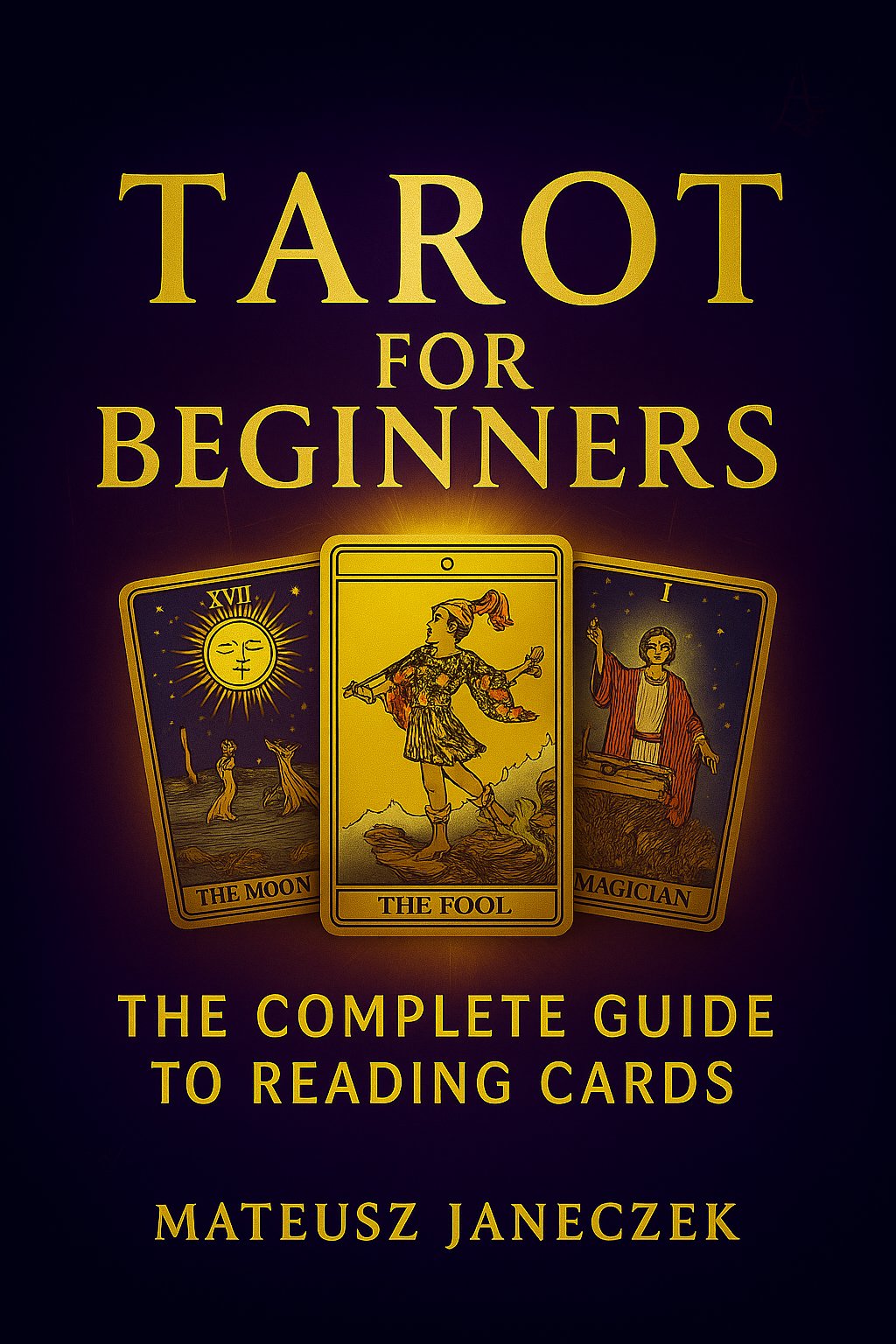
Tarot for Beginners – The Complete Guide to Card Reading - ebook

Tarot for Beginners – The Complete Guide to Card Reading - ebook
Ready to read Tarot with confidence? Tarot for Beginners – The Complete Guide to Reading Cards teaches you how to understand card meanings, symbols, spreads and intuition without memorizing hundreds of definitions. Learn to read for yourself and others, explore the Major and Minor Arcana, and use Tarot for relationships, decisions and self-discovery. Clear, practical and designed for complete beginners. Open your deck, trust your intuition and let the cards speak.
Ta publikacja spełnia wymagania dostępności zgodnie z dyrektywą EAA.
| Kategoria: | Ezoteryka |
| Język: | Angielski |
| Zabezpieczenie: |
Watermark
|
| ISBN: | 9788368686098 |
| Rozmiar pliku: | 2,8 MB |
FRAGMENT KSIĄŻKI
Chapter 1 – The Magic of Tarot: What It Is and
Why It Fascinates
8
Chapter 2 – How to Use This Book – A Guide
for Beginners
12
Chapter 3 – The History of Tarot – From Card
Game to Spiritual Tool
16
Chapter 4 – Tarot as a Mirror of the Soul –
Introspection and the Development of Intuition
20
Chapter 5 – Structure of the Deck – Major and
Minor Arcana in Brief
24
Chapter 6 – The Language of Tarot – Colors,
Numbers, and Images
28
Chapter 7 – Elements and Symbols – Fire,
Water, Air, Earth, and Astrological Archetypes
32
Chapter 8 – The Fool’s Journey – The
Beginning of Adventure and Exploring the
Unknown
36Chapter 9 – Creation and Intuition – The
Magician, The High Priestess, The Empress
41
Chapter 10 – Structure, Choices, and
Relationships – The Emperor, The Hierophant,
The Lovers
47
Chapter 11 – Will, Balance, and Introspection –
The Chariot, Justice, The Hermit
53
Chapter 12 – Transformation and the Shadow –
The Wheel of Fortune, Strength, The Hanged
Man, Death, Temperance
58
Chapter 13 – Enlightenment and Full
Consciousness – The Devil, The Tower, The
Star, The Moon, The Sun, Judgment, The World
65
Chapter 14 – Wands: Fire, Passion, Action, and
Creativity
70
Chapter 15 – Cups: Water, Emotions, Intuition,
and Relationships
76
Chapter 16 – Swords: Air, Mind, Truth, and
Conflicts83
Chapter 17 – Pentacles: Earth, Matter, Stability,
and Manifestation
89
Chapter 18 – Court Cards and Numerology:
Daily Guides and the Hidden Power of
Numbers
94
Chapter 19 – Principles of Interpretation: How
to Read the Messages of the Cards
99
Chapter 20 – Card Connections: Reading in the
Context of Questions and Relationships
Between Cards
104
Chapter 21 – Spreads and the Meaning of
Positions: From a Single Card to the Celtic
Cross
109
Chapter 22 – Reversed Cards: Uncovering
Hidden Truths
114
Chapter 23 – Examples of Interpretation:
Scenarios, Reflections, and Stories
118Chapter 24. Creating Your Own Language of
Tarot – Building a Cohesive System of
Interpretation
122
Chapter 25. Rituals, Deck Cleansing, and
Working with Energy
126
Chapter 26. Tarot in Daily Life – Meditation,
Reflection, and Spiritual Growth
130
Chapter 27. Developing Intuition and Self-
Awareness – How to Trust Your Inner Feeling
134
Chapter 28. The Most Common Mistakes
Beginners Make – and How to Avoid Them
140
Chapter 29. The Next Steps – From Learning to
Mastery and Full Integration
147
Chapter 30. Your First Practice and the Tarot as
a Map of Consciousness – The Return to the
Source and the Wholeness of Experience
156CHAPTER 1 – THE MAGIC
of Tarot: What It Is
and Why It Fascinates
Tarot has fascinated humanity for centuries with its
mystery, depth, and the ability to peer into the hidden
corners of human consciousness. Its cards are more
than mere symbols or illustrations—they serve as
mirrors of the soul, maps of archetypes, and guides on
the journey of self-discovery. The history of Tarot is as
colorful and enigmatic as its imagery: although its
origins trace back to 15th-century Italy, when the first
playing card decks were created, it quickly evolved
into a tool for spiritual reflection and hidden
knowledge, opening the way to symbolic exploration
of life, destiny, and the human psyche. Born from the
need for entertainment and social games, Tarot
gradually became a system rich in meaning, blending
philosophy, mysticism, psychology, and intuition. Each
card, from the Fool to the World, tells a story of
human existence, emotions, choices, transformation,and spiritual growth. The magic of Tarot lies
primarily in its universal language of symbols. Colors,
numbers, figures, and images are not arbitrary—
every detail carries a message, whose interpretation
depends on both knowledge and intuition of the
reader. The deep fascination with Tarot stems from
the way it allows one to merge rational understanding
of life with subtle observation of emotions and the
subconscious. At first encounter, the deck may evoke
both a sense of wonder and gentle apprehension—
the cards seem to speak their own mysterious
language, inviting reflection and prompting questions
that often remain unspoken within us. In daily life,
Tarot can serve as a guide and support in difficult
decisions, as a mirror for introspection, and as a tool
for developing intuition. Even a simple three-card
daily spread can offer a new perspective: the first
card indicates the dominant energy of the day, the
second reveals challenges, and the third suggests
possibilities and directions for action. In this way,
Tarot becomes not only a tool for divination but also
practical support for conscious living.The spiritual dimension of Tarot makes it truly
unique. Cards can serve as a focal point for
meditation, as guides in rituals of cleansing and
energy harmonization, and as instruments for
working with one’s archetypes and emotions. A deep
understanding of Tarot requires openness to its
language, patience, and a willingness to observe
oneself. Each card carries a story that resonates on
psychological, energetic, and spiritual levels, allowing
the discovery of unknown aspects of personality and
the subconscious. Tarot also captivates because it
connects past, present, and future within a single
image. Its symbols reference both ancient wisdom
and universal human experiences. From timeless
archetypes to modern psychological interpretations,
Tarot offers a dialogue with one’s inner self and the
forces shaping our lives. It does not provide simple
answers; rather, it invites independent exploration,
attentive listening to intuition, and conscious choice
of one’s path. In daily practice, even a few minutes
spent observing a single card can become a moment
of reflection and inspiration. One might begin with
selecting a card of the day to serve as a guide and
source of insight, or pose a simple question: “What do
I need today to better understand myself?” Tarot thenbecomes not only a mirror of the soul but also a
teacher, leading one through life with wisdom,
patience, and a subtle lesson in openness to change.
The magic of Tarot lies in the integration of
knowledge, intuition, and openness to experience. It
is not merely a deck of cards but an invitation to a
journey that allows deep, transformative discovery of
oneself and the surrounding world. In this book, the
reader will not only learn the history and structure of
Tarot but, more importantly, how to harness its
power in daily life—how to develop intuition, observe
emotions, and make conscious decisions, guided by
the archetypes and symbols. Tarot becomes a bridge
between consciousness and intuition, knowledge and
experience, humanity and its spiritual potential.CHAPTER 2 – HOW TO
Use This Book – A
Guide for Beginners
Entering the world of Tarot, many may initially feel a
mix of fascination and uncertainty, arising from the
vast array of symbols, meanings, and interpretive
possibilities that each card carries. This book is
designed to guide the reader step by step, like a
companion on a mystical journey, where each stage
builds understanding, confidence, and intuitive
wisdom. The most important aspect of learning Tarot
is recognizing that there is no single “correct” path –
each individual develops their own language of the
cards, tailored to intuition, experience, and sensitivity.
It is therefore recommended to start by reading the
chapters sequentially, gradually introducing practice,
and combining theory with personal observation and
experience.The first step is understanding the structure of the
book. Part I presents the foundations – the history of
Tarot, its functions and role in self-discovery, the
structure of the deck, and basic symbolism. It is worth
spending time to thoroughly study these chapters,
without rushing, to establish a solid knowledge base
that will later allow for intuitive card reading. Part II
introduces the Major Arcana as a map of spiritual and
psychological development, showing the stages of
human journey from the beginner Fool to the full
awareness represented by the World. In this section,
the reader learns to recognize archetypes, their
significance in daily and spiritual life, and to find their
own experiences and lessons within the cards. Part III
focuses on the Minor Arcana, which reflects everyday
situations, emotions, decisions, and challenges.
Through these cards, we learn to observe subtle, often
overlooked aspects of life, understand the dynamics
of relationships, emotions, and thoughts, and notice
recurring patterns. Part IV is practical – it presents
rules for interpretation, card combinations, various
spreads, the role of reversed cards, as well as
guidance for working with the deck’s energy, rituals,
and developing one’s own Tarot language. It is
important to note that practice is as essential astheory; every observation, mini-spread, and reflection
brings one closer to a fuller understanding of oneself
and the cards. For beginners, an excellent starting
point is a simple three-card spread. The first card
symbolizes the past or context of the situation, the
second reveals the present, and the third suggests
possible directions or lessons to be learned. Even this
simple layout helps cultivate observation, connections
between cards, and intuitive interpretation of
meanings. It is vital not to rush interpretation or seek
“ready-made answers” – Tarot calls for reflection and
dialogue with one’s own consciousness, and its
wisdom emerges in silence, focus, and openness.
Gradually introducing knowledge into practice is the
key to mastery. Initially, one might choose a single
card daily, observing its image, colors, symbols, and
the feelings it evokes. Keeping a Tarot journal to
record reflections, emotions, and insights allows
subtle changes, connections, and personal growth to
become visible.
As confidence grows, more complex spreads and card
combinations can be explored, introducing personalquestions, scenarios, and intentions. Equally
important in learning Tarot is a conscious approach
to intuition. While this book provides knowledge,
meanings, and interpretive structures, it is one’s own
feelings, sensitivity, and discernment that give each
reading its unique character. Learning involves
harmoniously combining theory, observation, and
practice – so that the cards become an extension of
the inner voice, a tool for self-discovery, and a guide
in daily life. Thus, this book is not merely a manual –
it is an invitation to a journey that develops intuition,
awareness, and the ability to read the subtle signals of
the world and one’s own soul. Each chapter leads step
by step, but the reader decides how deeply they wish
to enter the world of Tarot, how much time to
dedicate to observing the cards, reflecting, and
practicing. The book allows learning to be combined
with practice, theory with intuition, symbolism with
personal experience, creating a coherent system in
which Tarot becomes a guide, a mirror, and a teacher
opening the path to self-knowledge, harmony, and
conscious living.CHAPTER 3 – THE
History of Tarot –
From Card Game to
Spiritual Tool
The history of Tarot is a journey through time,
culture, and human consciousness, where each stage
of the cards’ evolution reveals fragments of mystery,
symbolism, and spiritual potential. The origins of
Tarot trace back to the 14th and 15th centuries in
Europe, when the first playing card decks appeared,
used primarily for games and entertainment. Their
artistic designs reflected both the aesthetic ideals of
the time and symbols of power, religion, and morality.
The Italian Visconti and Sforza decks, richly
illustrated, contained cards depicting figures,
religious scenes, and allegories that later became
known as the Major Arcana – originally called
tarocchi, distinct from standard playing cards. While
their initial purpose was recreational, even then theimages contained a hidden layer of meanings,
accessible only to those who could perceive subtle
connections between symbols and human experience.
Over time, Tarot began to serve a purpose far deeper
than mere gameplay. In Renaissance Europe,
particularly in Italy and France, the cards started
being used for exercises in reflection on life, morality,
and human fate. Mystics, philosophers, and
alchemists recognized their symbolic potential,
seeing in the Major Arcana a map of consciousness,
and in the Minor Arcana a mirror of everyday
experiences and human choices. Tarot became a tool
for exploring the nature of the soul, introspection, and
developing intuition, acting as a bridge between
matter and spirit, the external world and the inner
self. In the 17th and 18th centuries, Tarot was
increasingly studied by occultists and esotericists,
who assigned the cards a coherent symbolism based
on astrology, numerology, Kabbalah, and alchemy.
Each card ceased to be merely an illustration of a
scene or figure – it became a bearer of archetypes
reflecting universal truths about humans, their
emotions, desires, fears, and creative potential.
During this period, various schools of Tarot
interpretation emerged: French, Italian, and laterEnglish and German traditions, each with its own
system of meanings and methods of reading the
cards. Some focused on psychology and inner
transformation, others emphasized magical or ritual
applications, and still others treated Tarot as a
spiritual guide for personal growth and intuitive
development. In the 19th century, with the rise of
esoteric movements, Tarot gained new popularity as a
tool for self-discovery and divination. The works of
authors such as Etteilla and Papus defined the first
structured systems of interpretation, combining
elements of astrology, numerology, and Kabbalistic
symbolism, giving the cards a framework for
conscious reading of messages. The cards were no
longer merely artistic objects – they became mirrors
in which one could observe one’s own consciousness,
intuition, mental and emotional processes, as well as
the path of spiritual growth. Modern Tarot combines
all these traditions – historical, artistic, symbolic, and
psychological – allowing both beginners and
advanced practitioners to use it as a tool for
reflection, learning, and guidance. The diversity of
interpretive schools is also its greatest strength. Some
emphasize intuition and emotion, others analyze the
cards through the lens of numerology, astrology, oralchemy, while still others view them as a form of
dialogue with the subconscious and the inner guide.
Tarot remains flexible – adapting to what a person is
ready to see and understand. The history of Tarot
demonstrates that while its form has evolved, its
purpose has remained constant: to guide the
individual inward, revealing the mysteries of the soul
and teaching that every choice, every decision, and
every emotion is reflected in the universal order that
the cards help recognize and understand. Tarot is
thus not merely a historical artifact or a card game – it
is a mirror of consciousness, a tool that has evolved
over centuries from simple illustrations to a full-
fledged map of the human spiritual journey, reflecting
both the mystery of life and the individual path of
self-discovery. Every deck, regardless of tradition,
holds layers of symbols waiting to be uncovered by
those willing to listen to their wisdom, learning
simultaneously to hear their own inner voice and
cultivate intuition, whose power transcends the limits
of words and logical explanation.
Why It Fascinates
8
Chapter 2 – How to Use This Book – A Guide
for Beginners
12
Chapter 3 – The History of Tarot – From Card
Game to Spiritual Tool
16
Chapter 4 – Tarot as a Mirror of the Soul –
Introspection and the Development of Intuition
20
Chapter 5 – Structure of the Deck – Major and
Minor Arcana in Brief
24
Chapter 6 – The Language of Tarot – Colors,
Numbers, and Images
28
Chapter 7 – Elements and Symbols – Fire,
Water, Air, Earth, and Astrological Archetypes
32
Chapter 8 – The Fool’s Journey – The
Beginning of Adventure and Exploring the
Unknown
36Chapter 9 – Creation and Intuition – The
Magician, The High Priestess, The Empress
41
Chapter 10 – Structure, Choices, and
Relationships – The Emperor, The Hierophant,
The Lovers
47
Chapter 11 – Will, Balance, and Introspection –
The Chariot, Justice, The Hermit
53
Chapter 12 – Transformation and the Shadow –
The Wheel of Fortune, Strength, The Hanged
Man, Death, Temperance
58
Chapter 13 – Enlightenment and Full
Consciousness – The Devil, The Tower, The
Star, The Moon, The Sun, Judgment, The World
65
Chapter 14 – Wands: Fire, Passion, Action, and
Creativity
70
Chapter 15 – Cups: Water, Emotions, Intuition,
and Relationships
76
Chapter 16 – Swords: Air, Mind, Truth, and
Conflicts83
Chapter 17 – Pentacles: Earth, Matter, Stability,
and Manifestation
89
Chapter 18 – Court Cards and Numerology:
Daily Guides and the Hidden Power of
Numbers
94
Chapter 19 – Principles of Interpretation: How
to Read the Messages of the Cards
99
Chapter 20 – Card Connections: Reading in the
Context of Questions and Relationships
Between Cards
104
Chapter 21 – Spreads and the Meaning of
Positions: From a Single Card to the Celtic
Cross
109
Chapter 22 – Reversed Cards: Uncovering
Hidden Truths
114
Chapter 23 – Examples of Interpretation:
Scenarios, Reflections, and Stories
118Chapter 24. Creating Your Own Language of
Tarot – Building a Cohesive System of
Interpretation
122
Chapter 25. Rituals, Deck Cleansing, and
Working with Energy
126
Chapter 26. Tarot in Daily Life – Meditation,
Reflection, and Spiritual Growth
130
Chapter 27. Developing Intuition and Self-
Awareness – How to Trust Your Inner Feeling
134
Chapter 28. The Most Common Mistakes
Beginners Make – and How to Avoid Them
140
Chapter 29. The Next Steps – From Learning to
Mastery and Full Integration
147
Chapter 30. Your First Practice and the Tarot as
a Map of Consciousness – The Return to the
Source and the Wholeness of Experience
156CHAPTER 1 – THE MAGIC
of Tarot: What It Is
and Why It Fascinates
Tarot has fascinated humanity for centuries with its
mystery, depth, and the ability to peer into the hidden
corners of human consciousness. Its cards are more
than mere symbols or illustrations—they serve as
mirrors of the soul, maps of archetypes, and guides on
the journey of self-discovery. The history of Tarot is as
colorful and enigmatic as its imagery: although its
origins trace back to 15th-century Italy, when the first
playing card decks were created, it quickly evolved
into a tool for spiritual reflection and hidden
knowledge, opening the way to symbolic exploration
of life, destiny, and the human psyche. Born from the
need for entertainment and social games, Tarot
gradually became a system rich in meaning, blending
philosophy, mysticism, psychology, and intuition. Each
card, from the Fool to the World, tells a story of
human existence, emotions, choices, transformation,and spiritual growth. The magic of Tarot lies
primarily in its universal language of symbols. Colors,
numbers, figures, and images are not arbitrary—
every detail carries a message, whose interpretation
depends on both knowledge and intuition of the
reader. The deep fascination with Tarot stems from
the way it allows one to merge rational understanding
of life with subtle observation of emotions and the
subconscious. At first encounter, the deck may evoke
both a sense of wonder and gentle apprehension—
the cards seem to speak their own mysterious
language, inviting reflection and prompting questions
that often remain unspoken within us. In daily life,
Tarot can serve as a guide and support in difficult
decisions, as a mirror for introspection, and as a tool
for developing intuition. Even a simple three-card
daily spread can offer a new perspective: the first
card indicates the dominant energy of the day, the
second reveals challenges, and the third suggests
possibilities and directions for action. In this way,
Tarot becomes not only a tool for divination but also
practical support for conscious living.The spiritual dimension of Tarot makes it truly
unique. Cards can serve as a focal point for
meditation, as guides in rituals of cleansing and
energy harmonization, and as instruments for
working with one’s archetypes and emotions. A deep
understanding of Tarot requires openness to its
language, patience, and a willingness to observe
oneself. Each card carries a story that resonates on
psychological, energetic, and spiritual levels, allowing
the discovery of unknown aspects of personality and
the subconscious. Tarot also captivates because it
connects past, present, and future within a single
image. Its symbols reference both ancient wisdom
and universal human experiences. From timeless
archetypes to modern psychological interpretations,
Tarot offers a dialogue with one’s inner self and the
forces shaping our lives. It does not provide simple
answers; rather, it invites independent exploration,
attentive listening to intuition, and conscious choice
of one’s path. In daily practice, even a few minutes
spent observing a single card can become a moment
of reflection and inspiration. One might begin with
selecting a card of the day to serve as a guide and
source of insight, or pose a simple question: “What do
I need today to better understand myself?” Tarot thenbecomes not only a mirror of the soul but also a
teacher, leading one through life with wisdom,
patience, and a subtle lesson in openness to change.
The magic of Tarot lies in the integration of
knowledge, intuition, and openness to experience. It
is not merely a deck of cards but an invitation to a
journey that allows deep, transformative discovery of
oneself and the surrounding world. In this book, the
reader will not only learn the history and structure of
Tarot but, more importantly, how to harness its
power in daily life—how to develop intuition, observe
emotions, and make conscious decisions, guided by
the archetypes and symbols. Tarot becomes a bridge
between consciousness and intuition, knowledge and
experience, humanity and its spiritual potential.CHAPTER 2 – HOW TO
Use This Book – A
Guide for Beginners
Entering the world of Tarot, many may initially feel a
mix of fascination and uncertainty, arising from the
vast array of symbols, meanings, and interpretive
possibilities that each card carries. This book is
designed to guide the reader step by step, like a
companion on a mystical journey, where each stage
builds understanding, confidence, and intuitive
wisdom. The most important aspect of learning Tarot
is recognizing that there is no single “correct” path –
each individual develops their own language of the
cards, tailored to intuition, experience, and sensitivity.
It is therefore recommended to start by reading the
chapters sequentially, gradually introducing practice,
and combining theory with personal observation and
experience.The first step is understanding the structure of the
book. Part I presents the foundations – the history of
Tarot, its functions and role in self-discovery, the
structure of the deck, and basic symbolism. It is worth
spending time to thoroughly study these chapters,
without rushing, to establish a solid knowledge base
that will later allow for intuitive card reading. Part II
introduces the Major Arcana as a map of spiritual and
psychological development, showing the stages of
human journey from the beginner Fool to the full
awareness represented by the World. In this section,
the reader learns to recognize archetypes, their
significance in daily and spiritual life, and to find their
own experiences and lessons within the cards. Part III
focuses on the Minor Arcana, which reflects everyday
situations, emotions, decisions, and challenges.
Through these cards, we learn to observe subtle, often
overlooked aspects of life, understand the dynamics
of relationships, emotions, and thoughts, and notice
recurring patterns. Part IV is practical – it presents
rules for interpretation, card combinations, various
spreads, the role of reversed cards, as well as
guidance for working with the deck’s energy, rituals,
and developing one’s own Tarot language. It is
important to note that practice is as essential astheory; every observation, mini-spread, and reflection
brings one closer to a fuller understanding of oneself
and the cards. For beginners, an excellent starting
point is a simple three-card spread. The first card
symbolizes the past or context of the situation, the
second reveals the present, and the third suggests
possible directions or lessons to be learned. Even this
simple layout helps cultivate observation, connections
between cards, and intuitive interpretation of
meanings. It is vital not to rush interpretation or seek
“ready-made answers” – Tarot calls for reflection and
dialogue with one’s own consciousness, and its
wisdom emerges in silence, focus, and openness.
Gradually introducing knowledge into practice is the
key to mastery. Initially, one might choose a single
card daily, observing its image, colors, symbols, and
the feelings it evokes. Keeping a Tarot journal to
record reflections, emotions, and insights allows
subtle changes, connections, and personal growth to
become visible.
As confidence grows, more complex spreads and card
combinations can be explored, introducing personalquestions, scenarios, and intentions. Equally
important in learning Tarot is a conscious approach
to intuition. While this book provides knowledge,
meanings, and interpretive structures, it is one’s own
feelings, sensitivity, and discernment that give each
reading its unique character. Learning involves
harmoniously combining theory, observation, and
practice – so that the cards become an extension of
the inner voice, a tool for self-discovery, and a guide
in daily life. Thus, this book is not merely a manual –
it is an invitation to a journey that develops intuition,
awareness, and the ability to read the subtle signals of
the world and one’s own soul. Each chapter leads step
by step, but the reader decides how deeply they wish
to enter the world of Tarot, how much time to
dedicate to observing the cards, reflecting, and
practicing. The book allows learning to be combined
with practice, theory with intuition, symbolism with
personal experience, creating a coherent system in
which Tarot becomes a guide, a mirror, and a teacher
opening the path to self-knowledge, harmony, and
conscious living.CHAPTER 3 – THE
History of Tarot –
From Card Game to
Spiritual Tool
The history of Tarot is a journey through time,
culture, and human consciousness, where each stage
of the cards’ evolution reveals fragments of mystery,
symbolism, and spiritual potential. The origins of
Tarot trace back to the 14th and 15th centuries in
Europe, when the first playing card decks appeared,
used primarily for games and entertainment. Their
artistic designs reflected both the aesthetic ideals of
the time and symbols of power, religion, and morality.
The Italian Visconti and Sforza decks, richly
illustrated, contained cards depicting figures,
religious scenes, and allegories that later became
known as the Major Arcana – originally called
tarocchi, distinct from standard playing cards. While
their initial purpose was recreational, even then theimages contained a hidden layer of meanings,
accessible only to those who could perceive subtle
connections between symbols and human experience.
Over time, Tarot began to serve a purpose far deeper
than mere gameplay. In Renaissance Europe,
particularly in Italy and France, the cards started
being used for exercises in reflection on life, morality,
and human fate. Mystics, philosophers, and
alchemists recognized their symbolic potential,
seeing in the Major Arcana a map of consciousness,
and in the Minor Arcana a mirror of everyday
experiences and human choices. Tarot became a tool
for exploring the nature of the soul, introspection, and
developing intuition, acting as a bridge between
matter and spirit, the external world and the inner
self. In the 17th and 18th centuries, Tarot was
increasingly studied by occultists and esotericists,
who assigned the cards a coherent symbolism based
on astrology, numerology, Kabbalah, and alchemy.
Each card ceased to be merely an illustration of a
scene or figure – it became a bearer of archetypes
reflecting universal truths about humans, their
emotions, desires, fears, and creative potential.
During this period, various schools of Tarot
interpretation emerged: French, Italian, and laterEnglish and German traditions, each with its own
system of meanings and methods of reading the
cards. Some focused on psychology and inner
transformation, others emphasized magical or ritual
applications, and still others treated Tarot as a
spiritual guide for personal growth and intuitive
development. In the 19th century, with the rise of
esoteric movements, Tarot gained new popularity as a
tool for self-discovery and divination. The works of
authors such as Etteilla and Papus defined the first
structured systems of interpretation, combining
elements of astrology, numerology, and Kabbalistic
symbolism, giving the cards a framework for
conscious reading of messages. The cards were no
longer merely artistic objects – they became mirrors
in which one could observe one’s own consciousness,
intuition, mental and emotional processes, as well as
the path of spiritual growth. Modern Tarot combines
all these traditions – historical, artistic, symbolic, and
psychological – allowing both beginners and
advanced practitioners to use it as a tool for
reflection, learning, and guidance. The diversity of
interpretive schools is also its greatest strength. Some
emphasize intuition and emotion, others analyze the
cards through the lens of numerology, astrology, oralchemy, while still others view them as a form of
dialogue with the subconscious and the inner guide.
Tarot remains flexible – adapting to what a person is
ready to see and understand. The history of Tarot
demonstrates that while its form has evolved, its
purpose has remained constant: to guide the
individual inward, revealing the mysteries of the soul
and teaching that every choice, every decision, and
every emotion is reflected in the universal order that
the cards help recognize and understand. Tarot is
thus not merely a historical artifact or a card game – it
is a mirror of consciousness, a tool that has evolved
over centuries from simple illustrations to a full-
fledged map of the human spiritual journey, reflecting
both the mystery of life and the individual path of
self-discovery. Every deck, regardless of tradition,
holds layers of symbols waiting to be uncovered by
those willing to listen to their wisdom, learning
simultaneously to hear their own inner voice and
cultivate intuition, whose power transcends the limits
of words and logical explanation.
więcej..