MENU
MENU
 Nasze ceny

 Przeczytaj fragment on-line

-
 nowość
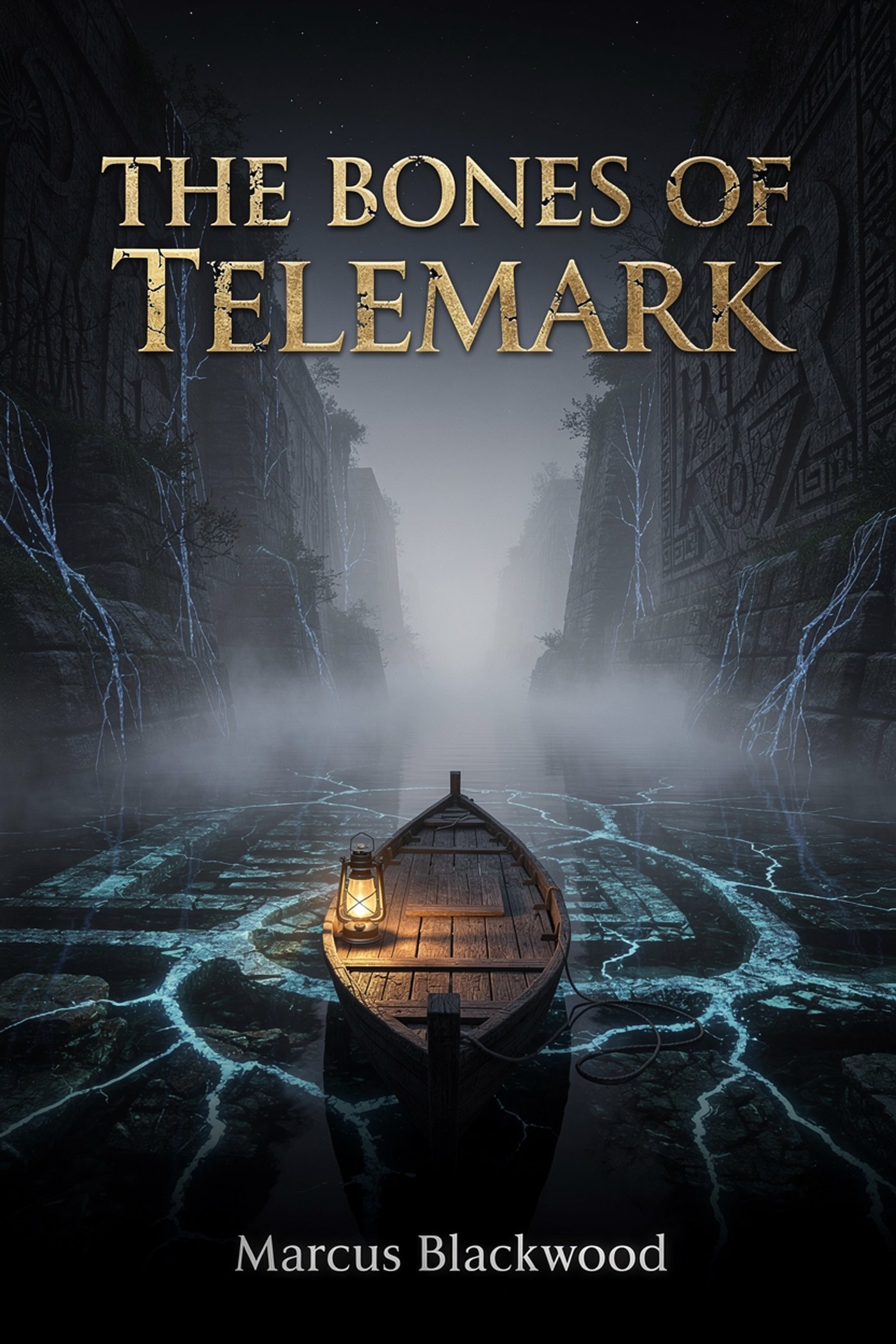
The Bones of Telemark - ebook
The Bones of Telemark - ebook
A canal trader with a forbidden gift. An ancient treaty unraveling beneath a mountain lake. The cost of saving the world is everything. Arnold Haugen smuggles Elder relics and maps ruins no one else can sense—until a ruthless councillor kidnaps his sister and forces him into a flooded labyrinth where the old gods are waking. Deep beneath Lake Norsjø, Arnold must choose between escape and sacrifice—between the life he has and the world that needs him to become something else entirely. Begin the descent. Some doors only open from the inside.
Ta publikacja spełnia wymagania dostępności zgodnie z dyrektywą EAA.
| Kategoria: | Fantasy |
| Język: | Angielski |
| Zabezpieczenie: |
Watermark
|
| ISBN: | 9788384330395 |
| Rozmiar pliku: | 862 KB |
FRAGMENT KSIĄŻKI
BLACK WATER, WARM PALMS
The mist came up to Arnold Haugen's knees, though calling it mist was generous. What pooled above the canal's surface was thicker than autumn fog, a permanent fixture of the lower channel between the Narrows and Skagen Lock. Cold exhalation from black water, dense enough that the flatboat seemed to travel through cloud rather than along a stone-banked canal. In the predawn dark, with only a stub of lantern hung from the bow-post, the world ended a boat-length ahead and a boat-length behind.
Arnold had worked this stretch for twenty years. He no longer found it strange.
A long, measured push of the pole, and the far bank's distance-stones glided past in the dimness. Pine resin, old iron, and faintly, the salt from three barrels of cod stacked under oilcloth in the bow. Good salt, the kind Marta's chandlery in Vaagholm's Underdock would move inside a week. That circuit had been his since before his beard came in properly. He could calculate Marta's offer within two copper bits without thinking about it.
The false planking beneath the forward deck held something absent from his licensed trade manifest. A bronze torc, pulled from a collapsed culvert three days ago while clearing debris. His palms had gone warm the moment his fingers closed around it — low, steady warmth, the kind the Bone-Sight produced when an artifact was old but quiet. No active resonance, just the residual signature of Elder craftsmanship settling into a new hand.
That was the First Rule of the Sight: warmth meant history, heat meant power. The torc was warm, and he could work with warm.
He'd wrapped it in oilcloth, cached it below the false planking, and gone home to eat a meal he didn't taste.
Dag Rensvik in the Underdock would know what it was — careful, discreet, fair in his prices. That was the end of the thought. Arnold had told himself so three times now, and each time it had ended a little less convincingly than the time before.
Another push. The flatboat moved through the mist with its bow displacing fog in a slow curl that closed behind it. Gray light was arriving without warmth — autumn in the Narrows, where dawn came thin and reluctant. The canal wall showed itself in slabs, distance-stones emerging one by one, the pine scrub on the ridge leaning toward the water like it wanted to drink.
Warmth at resting temperature in both palms. The Bone-Sight reading stone around him the way other men read wind or weather.
------------------------------------------------------------------------
The eruption came without warning.
Heat through both palms simultaneously — not gentle residual warmth but something total and sudden, like plunging his hands into near-boiling water. Arnold's grip on the pole went wrong, and some instinct deeper than thought loosened his fingers before his arms registered why. The current caught the pole's blade and pulled, and for a long second the canal was trying to take it from him while his hands burned like he'd grabbed forge-iron.
He wrenched the pole back, but the flatboat had drifted a full meter off course, the bow swinging toward the cut bank before a hard correcting shove sent a wake curling against the stone.
Three heartbeats holding position. Then three more, breathing through his teeth.
The pulse was coming from below. Not from the banks, not from a surface carving missed in the dark, but from somewhere deep beneath the canal floor. Every visible ruin between the Narrows and Skagen Lock had been mapped over the better part of a decade. Seventeen marked Elder-stone formations along this cut, and none of them had ever produced anything remotely like this.
Not residual warmth from dead Elder-stone. A heartbeat.
The Second Rule of the Sight: heat meant power, but rhythm meant something alive.
The cycling came through his palms in a slow, regular pattern — warmth building and receding with a precision too even to be geological, too deep to be anything currently mapped. Not through touch alone but through the pressure behind his eyes, the crude spatial sense the Sight gave when something large was close. The thing below was large. The thing below was active.
Then the pulse changed.
A variation in the rhythm — a slight intensification at each cycle's crest, like a sleeping animal shifting position under a blanket of stone. He'd felt that kind of spike before with smaller artifacts, the warmth jumping when he made full contact, as though the object recognized the presence of a Sighted hand. Proximity, he'd always told himself. An interaction between his own field and the residual one.
Standing above the black water with the mist pooling around his legs, the explanation didn't hold.
The pole went down. The flatboat moved forward at an easy pace — not quickly, because haste looked wrong to anyone watching from the lock ahead. He kept his face angled toward the far bank, his posture unchanged, a trader making his morning run. Behind him the pulse diminished in slow degrees, falling from that total heat back toward background warmth and then toward resting temperature. But it stayed at the edge of awareness like a sound in another room that wouldn't quite stop.
He moored and went through his routine checks, hands moving without instruction, while his mind turned over what he'd felt.
The journal opened to the front section, where bird sketches and current observations filled page after careful page — legitimate notes from a licensed trader who kept careful records. Past those pages to the back section, where the handwriting was smaller and the content would end his career if anyone saw it.
No dates there, only coordinates, depth estimates, and observations in compressed shorthand developed over years of recording things he shouldn't have been able to sense. A blank space, and into it: position against the Narrows cut, estimated depth, *large, active, possible primary node.*
Journal closed and stowed in the waterproof pouch at his belt. Pole in hand. A buyer in Vaagholm's lower docks, and contraband that couldn't survive inspection.
------------------------------------------------------------------------
Lock-keeper Asmund came around the Narrows bend twenty minutes later, poling a maintenance skiff upcanal with the unhurried rhythm of someone who'd worked this stretch longer than Arnold had been alive.
They greeted with the open palm — fingers together, no hidden cargo.
Asmund brought his skiff alongside and held water with his pole. Arnold matched him so the two craft drifted together in the slow current.
"Haugen."
"Asmund."
"Early run."
"Marta wants the cod before midday. You know how she gets."
Asmund nodded, his broad weathered face unsurprised. He adjusted his grip on the pole and let a moment pass before he said what he'd clearly been building toward.
"Thermal variance near the Narrows ruins again. Gauge reads two degrees above seasonal norm, third week running." He glanced at Arnold. "Same reading I had last spring before it settled. Could be the usual drift."
"Could be," Arnold said.
"Could be something else." Asmund watched him steadily. "You run this cut more than anyone. Felt anything unusual?"
The canal between their boats was black and still. Cold enough that the mist above it had a particular density where the temperature differential was sharpest. The pulse still lingered at the back of Arnold's palms, faint but present, like a bruise that hadn't finished forming.
"Water seems cold to me," Arnold said.
"It does seem cold," Asmund said, in a tone that acknowledged the answer while rejecting it entirely.
A silence opened between them. Arnold could have filled it. The words sat behind his teeth like stones, and he kept them there.
"You'll let me know if it changes?" Asmund said.
"Course I will."
"Safe run, Haugen."
"Safe run."
Asmund let the current carry him upcanal. Arnold pushed on alone.
------------------------------------------------------------------------
The canal-wren appeared as he rounded the last bend before Skagen Lock.
A flicker of movement against the iron bracket on the lock-gate's upper timber — right where he'd been tracking her for three weeks. A female, building late in the season and in a location that would strike most birders as absurd: the bracket jutting from the gate's upper timber, sheltered by the overhang, in a structure that moved twice daily when the mechanism operated.
The nest was nearly complete, accumulated fiber visible even at this distance against the dark iron.
Arnold let the flatboat drift forward on momentum and stood still as it settled, opening the journal to the front section to check his previous sketches. Wing-bar configuration, nest position, construction progress over fourteen days. The bird returned to the bracket, glanced at him with a single sharp movement, and stayed. Three weeks of slow approaches had earned that.
He estimated the nest dimensions and checked his earlier calculations on completion percentage and laying date. The number of gate operations between now and likely hatch came out the same both times, and it was not encouraging.
The gate couldn't be stopped, and the nest couldn't be moved at this stage. But he could try something.
*Journey before destination.* His grandmother's voice, emerging unbidden from wherever old voices lived. *You won't always arrive, but the walking matters.*
The wren settled deeper into her construction. Arnold marked the page and pushed toward the lock.
Petter Lund was waiting at the lock-gate with his manifest board and the gray wool of Council-registry staff. Petter Lund was always waiting at that gate.
"Haugen. Single manifest?"
"Three barrels salt cod, solo run." Arnold pulled alongside the stone lip and handed up his papers.
Petter reviewed them without hurrying, made a small notation, and looked up.
"New Council tariff schedule — independent traders, canal-class C licensing, effective ten days ago. Retroactive application." The figure he named was triple the standard rate.
Arnold had tracked the tariff proposals for four months through every public posting in the Underdock. The number was expected, even if the sting of it wasn't. Silver came from the purse at his belt in measured movements, exact to the mark.
Petter took the coins and counted them himself, then recorded the amount on his board.
"Retroactive," Arnold said. "Ten days."
"As written."
"How many independents have pulled their licenses since posting?"
Petter's expression didn't change. "I record tariffs, Haugen. Not license status."
"Right." Arnold let it go. The silver had changed hands, and the canal economy would continue to consolidate whether he commented on it or not. "Petter. The iron bracket on the upper gate has a canal-wren nesting on it."
Petter waited.
"I'm asking for ten minutes before you operate the upper mechanism. I'll take the delay on my schedule."
The younger crew member — Kaare — stared openly from the stone lip. "A bird?"
"A nesting bird," Arnold said. "Ten minutes."
"That's what you're spending your delay on," Kaare said. "A bird on a bracket."
"Kaare," Petter said, and the name carried enough weight to close the conversation. Something crossed Petter's face — not amusement exactly, but a kind of recognition. He studied Arnold for a moment, then shrugged.
"Ten minutes," Petter said.
They waited.
The wren made four trips in that time, each one a quick drop to the sedge grass at the canal's edge and a climb back up to the bracket with materials woven into the structure with precise efficiency. Arnold counted each trip and noted the materials — pine fiber and sedge grass together, unusual this late in the season when sedge was drying out and most birds had stopped building. Individual behavior, or an adaptation to the iron substrate? He'd need more observations to tell.
After the fourth trip, when she settled and her movements slowed to the stillness of a bird deciding she was finished, Arnold looked up at Petter and nodded.
Petter signaled his crew, and the mechanism engaged with its familiar grinding of iron on stone.
The wren flushed with a sharp call — a single startled protest that echoed off the lock walls — and vanished below the canal's edge. Arnold watched the bracket. Within two minutes she returned, circled the ironwork once, and settled onto the nest with the competence of an animal for whom interruption was simply a thing that happened between tasks.
Good. The nest had held.
Arnold pushed into the lock chamber.
Water came in controlled and fast once the upper valves opened — a rushing surge that raised the flatboat by degrees, the lock walls scrolling downward as the boat climbed. The pole went vertical, one hand on the stone wall when turbulence required steadying. The cod barrels shifted slightly under their oilcloth, but the lashing held.
He felt the weight change before he understood it.
The bow lifting fractionally — a subtle redistribution communicated through the pole and through his boot soles. Canal water was forcing through the bilge under increased pressure, reaching the false compartment in the forward section and filling it. Twenty years on a flatboat made the shift as obvious as a shout.
Petter's crew members were on the stone lip twenty feet away, handling gate ropes and not watching him.
Arnold dropped to one knee on the pretense of checking a mooring tie. Right hand on the rope, left hand under the planking, finding the panel by touch in the lock chamber's dim lantern-light.
"Consortium dispute's been running since what, last year?" he said, because Petter was looking in his direction.
"March," Petter said. "Before my jurisdiction — I've only seen the filings."
"Legal strategy seems self-defeating." Two fingers around the torc where it had caught on the inner lip. Millimeters of movement while keeping his shoulders still.
"The consortium's position has problems," Petter agreed, leaning against the lock wall with his board under one arm. "I read the third submission — they're arguing prior appropriation on a channel they don't have survey rights for."
"Which means someone told them to file anyway." Lateral pressure against the inner lip, changing the angle. The torc shifted half a millimeter and stopped.
"Survey rights question would be the first thing any judge addresses. They must know that."
"Maybe they don't have a surveyor on retainer." The torc came free. His left hand pressed the panel home, feeling for the seal as lock water continued rising and pressure equalized against the compartment. The seal caught and held.
Kaare glanced across the chamber.
Arnold straightened in the same motion that brushed canal water from his wet knee. He continued about the consortium's surveying problems as though he hadn't paused, and Petter nodded along. Kaare turned back to his rope.
The lock completed with a final surge that settled the flatboat at upper-canal level. Petter called from the gate lip as Arnold pushed clear into the morning light.
"Tariff schedule applies at Vaagholm's outer stations too — Council-wide as of last week. Expect it all day."
Arnold raised one hand without turning.
The upper channel stretched before him in the early morning, mist thinning ahead where the first real light hit the water. The faint smear of Vaagholm's refineries and forges sent up columns on the elevated horizon, merging into a haze over the rooftops.
When the lock had been out of sight long enough that the gate mechanism's sound had faded entirely, the journal came out.
Beneath the wren sketch: *Nest held during lock operation. Four construction trips in ten minutes. Pine fiber and sedge grass — unusual combination this late in season. Will check on return.* Dated and marked.
Then the back section.
The coordinates were there, along with the depth estimate and the phrase *large, active, possible primary node.* His handwriting in the back section was smaller, more compressed — a hand that knew these pages could cost him his license and possibly his freedom. The word *possible* sat on the page like something pretending to be smaller than it was.
He thought about crossing it out and writing *confirmed.* He thought about the Second Rule — heat meant power, and rhythm meant something alive. There weren't supposed to be exceptions to the Second Rule.
He closed the journal.
The flatboat drifted under him, carried by the upper channel's gentle current. The ridgeline above had gone from black to dark green as dawn found its way through. Somewhere in the sedge, a wren was calling — different individual, different location, same high carrying note the species used when asserting territory.
Beneath the false planking, the torc rested in its oilcloth. Getting it through the lock had cost triple tariff, performed interest in a consortium's legal troubles, and a seized panel worked one-handed while discussing survey rights. Dag Rensvik would give a fair price, and the silver would cover margins for this run and the next.
But the thing beneath the Narrows — the heartbeat in the deep — that wouldn't go to anyone. That would stay in the journal's back pages, because warm things turned hot, and the Second Rule didn't have exceptions.
The journal closed. The pole came up.
Black water ahead, still between the mist-patches. The canal floor was solid and familiar beneath the pole's blade, and Arnold pushed forward. Marta would count her coppers twice before paying for the cod. Petter's ledger would note the retroactive tariff in ink that wouldn't wash. The wren would make her trips to the bracket, building in a place that tried to shake her loose twice daily, until the eggs hatched or they didn't.
And somewhere beneath the Narrows, something large was breathing.
Arnold pushed forward into the light.WHAT THE WATER CARRIES
The outer toll-station at Vaagholm sat where the upper canal narrowed beneath the ridge gate, its stone booth wedged into the rock like something the city had grown around rather than built. Arnold tied his flatboat to the inspection ring, handed across his papers, and counted out the triple levy in silence.
He placed each stack of three coins on the worn stone counter with deliberate care, the way his mother had taught him to handle money — respectfully, because you never knew when it would be the last you had. Nine coins in all, three times the standard rate. The toll-collector, a thin fellow named Egil, counted twice, noted the amount in his ledger, and slid the papers back without meeting Arnold's eyes.
That was the part Arnold hadn't prepared for. He had tracked every public posting since autumn, watched the retroactive clause take shape through three revisions, and run the numbers until they stopped surprising him. The tariff itself he could absorb — barely, if his salvage trade held and the fish kept moving. But Egil's averted gaze carried something the numbers hadn't predicted. Even the people collecting the levy knew what it was doing to the canal trade, and knowing didn't change what they had to do.
Arnold untied the mooring line, shoved off from the inspection ring, and let the mist swallow the toll-station behind him as he poled south.
The Underdock opened below the ridge gate in layers of noise and smell. Canvas awnings hung between timber frames overhead, and the mixed scent of pine-tar and salt-brine settled on everything beneath them. Voices called prices and insults in roughly equal measure across the crowded water-lane. Arnold poled toward Marta's chandlery, reading the current by habit, noting where it ran thin near the eastern wall. Silt had been building there since last season, and nobody had dredged it — another sign of a district that was losing the resources to maintain itself.
Marta was outside, pressing her thumb against wax seals on a previous delivery with the practiced rhythm of someone who had done this ten thousand times. His barrels came before his greeting. She examined each one with her nose close enough to fog the wood.
"Three days old," he said.
"I can smell what they are." She lifted the lid on the nearest barrel, bent close, and straightened with a noncommittal expression. The second passed without comment. The third she tilted against the rim, checking the brine level with a careful eye. "These'll do. Barely."
She counted copper bits into his palm, paused, frowned, and started over from the beginning.
"Sven Koster moved upstream to Kleiv last month," she said while she counted. "And the Brandt boys are thinking about it."
"I heard something about that."
"Three independent sellers in six weeks. Canal-licenses aren't worth the paper once the tariffs eat the margin." She finished counting and folded her arms. "Used to be you could make an honest living on this stretch without apologizing for it."
"What do the Brandts plan to do when the tariffs follow them north?"
"Same thing we all do."
"Which is?"
"Figure it out until we can't." She turned toward her shop door, then paused with her hand on the frame. "Talk to Dag Rensvik while you're down here. He's been asking about you."
"I know where his shop is."
"I know you do. That's why I'm telling you to go there."
------------------------------------------------------------------------
Four gray coats moved through the alley ahead — Council enforcement, the wheel-mark stitched at their collars in dark thread. Between them walked Bram, the antiquities dealer from the rented stall near the fish-market. Arnold had sold him three pieces over as many years without exchanging surnames. Bram's hands were wrapped in suppression cloth, his wrists bound at the small of his back with the particular tightness that meant someone expected him to try something with his fingers.
Bram was not trying anything. He walked with the stillness of a man who had run every calculation and found the same answer from every direction.
Arnold reversed before the patrol's rear officer finished sweeping the alley. The fish-merchant's stall offered cover — smoked herring stacked in rows, the smell thick enough to serve as a wall — and he took the stairway behind it toward the upper lane. Halfway up, a barrel delivery blocked the landing. Two workers cursed the angle of the turn while they maneuvered a rolling cart through a gap that clearly hadn't been designed for rolling carts. Arnold pressed flat against cold stone and slid through.
"Afternoon," he said to the worker who glanced up.
A grunt, and back to the cart.
Below, the patrol's footsteps echoed through the stone corridor — not closer, not fading, just present. Arnold kept his pace steady through the fish-market's upper section until the sound dropped away behind him. His pulse settled a beat later, and he took a breath that tasted like smoked fish and damp limestone.
Dag's upper-lane entrance smelled of old vellum and wet stone. Arnold straightened his coat and knocked twice.
------------------------------------------------------------------------
Dag Rensvik's back room operated according to organizational principles that only Dag understood. Salvaged volumes filled the shelves in clusters that might have been alphabetical, chronological, or sorted by spine color — Arnold had never determined which. Coastal charts hung by region on the walls, and Elder artifacts sat between ordinary merchandise on the worktable, each positioned where Dag could reach it without looking.
Two oil lamps lit the workspace with warm, uneven light. Dag was already pulling back the oilcloth Arnold had placed before him.
Dag Rensvik was a large man who moved with the careful precision that came from decades spent among breakable things. He picked up the torc with both hands and held it toward the nearer lamp. His leather eye-patch sat on his face with the ease of a permanent feature.
"Bronze. Old casting technique — see how the spiral joins don't quite meet?" He tilted the torc, catching the light along the band's imperfections. "Elder smiths weren't aiming for beauty. They were building for function, the same way you'd build a lock mechanism or a canal gate. Form follows purpose." His lips moved as he read the runes etched along the inner band, and Arnold could see the genuine pleasure in his expression — the appreciation of a man who loved his subject the way Arnold loved the canal. "Second-tier craft. Spirit-binding focus, designed to anchor bound spirits to a specific location. Set this at a threshold or a boundary stone, and any spirit bound to it couldn't pass beyond the focus radius."
"Not rare," Arnold said.
"Not rare. And the binding channels are dormant without a living catalyst, so it's about as dangerous as a paperweight." Dag set the torc down, turning his head to compensate for the missing eye. "Where?"
"Collapsed culvert near the Skagen approaches. Three days ago."
"Any warmth when you found it?"
"Cold metal from cold water."
Dag weighed the torc on his small scale and scratched something on a scrap of paper. "Forty silver marks."
"That's fair. And we both know the markup will be substantial, so I appreciate the honesty."
Dag's mouth twitched in something that was almost a smile. "I have buyers who want exactly this kind of piece. Forty is honest." He counted the marks in careful stacks, slid them across, and began wrapping the torc in fresh oilcloth. Each fold was turned with the attention of a man who respected what he handled.
He poured tea from the corner brazier into two cups and pushed one toward Arnold without asking. It was bitter, with a faint pine-resin note that Arnold had never learned to enjoy but always drank anyway.
"Probable origin site?" Arnold asked.
"Three culverted sections near the Skagen approaches match the casting style. Second-tier binding foci turn up there every few years when old caches get flooded and canal-bed structures shift. These things migrate with the water." Dag sipped his tea. "They show up where the current deposits them, not where they were originally placed."
He set his cup down and put both hands flat on the worktable.
Arnold noticed, belatedly, that Dag had been handling the torc with bare fingers the entire time — running his thumb along the rune-band, touching the spiral joins where the bronze met imperfectly. Now his one working eye was fixed on Arnold with an expression that held no accusation, only the careful attention of a man choosing his next words the way he'd handle a cracked binding.
"When you handled the torc, I saw color in your palms. A warmth that rose on contact with the metal and faded when you pulled away." He paused, giving Arnold space to speak. Arnold didn't take it. "The Bone-Sight has markers, Arnold. The old texts describe them clearly — color in the hands when touching Elder craft, heat that scales with artifact strength. It's not something you fake, and it's not body heat alone."
Arnold kept his hands wrapped around the teacup. He had prepared for this possibility the way he prepared for every possibility — by having an answer ready that was true enough to hold weight. "You saw what two oil lamps in a dim room suggested. Three days of body heat conducted through cold metal produces exactly that kind of color shift, especially on canal-soaked bronze."
Dag listened to the full explanation. He nodded once.
"That makes sense. I accept that."
The words were courteous, careful, and absolutely transparent in what they concealed. Dag didn't believe a word of it, and he was offering Arnold the kindness of not pressing further. Arnold heard the question shelved rather than answered, and he respected Dag enough to feel the weight of it. He drank his tea.
"There's something else." Dag refilled both cups with the unhurried motion of a man settling into a longer conversation. "Past six months, Councillor Strand's people have been buying. Everything Elder-touched they can find — open market, black market, triple rates, no questions about origin or seller."
"How much is everything?"
"Enough that I see a pattern, not individual sales. I've turned down their business twice on principle." He wrapped both hands around his cup and looked at Arnold over the rim. "I'm reconsidering. Principles have a market price, and mine is becoming difficult to sustain."
"I don't deal with the Council."
"I know. That's admirable." A beat passed between them. "Admirable is getting harder to afford in Vaagholm. My advice, given freely — if you find something with more weight than that torc, Sight-weight, not physical weight, consider whether your usual routes still serve you. Strand's buyers don't ask questions. That's liability or convenience, depending on your circumstances."
"I'll keep that in mind."
Arnold stood, pocketed the silver, and retrieved his empty pack. Dag walked him to the upper-lane door, his large frame filling the narrow passage between shelves. At the threshold, he rested one hand on the doorframe and spoke with the lightness of someone delivering a warning disguised as casual observation.
"Whatever you pulled from that culvert — consider not pulling anything else for a while. The market is watching. And not just the artifact side of it."
The door closed behind Arnold with a quiet click. Forty silver marks sat heavy and real in his pocket, and the torc was Dag's problem now.
He turned north and started up the hill.
------------------------------------------------------------------------
The streets between the Underdock and the Upper Canal District climbed in steps, each level drier than the last, the mist thinning as elevation replaced it with actual air. Arnold's boots left dark prints on pale stone that dried behind him almost faster than he climbed.
Near the district boundary, a cluster of canal-workers stood around a fresh tariff posting nailed to a wall. One of them read the figures aloud, his finger tracking beneath each number, while the two beside him listened with crossed arms and the particular expression of people doing arithmetic they already knew the answer to. Arnold walked past without stopping. He'd done that arithmetic months ago, and the answer hadn't improved with time.
The Cartographers' Hall sat on the upper ridge like a building that had decided several centuries ago to stay exactly where it was and had not been given reason to reconsider. Stone walls, deep-set windows, and the smell of ink and parchment reached him before the door did.
Tomas Vesterås intercepted him in the lobby, carrying a folder of papers he'd clearly been reading until Arnold appeared. He had an open, pleasant face and the helpful manner of someone who positioned himself where information flowed.
"Arnold. I didn't know you were coming by."
"I'm here to see Kari."
"Of course. She's in the upper archive, been up there most of the morning. Had a commission inquiry from one of the eastern survey firms — seemed quite pleased about it." Tomas fell into step beside him without being invited. "I've actually been doing related work on the eastern channel surveys myself, if you're interested in—"
"I know the way, Tomas."
"Right. Of course." Tomas did not stop walking. He offered a remark about archive organization and followed it with a question about canal-traffic on the Skagen approaches, posed so casually that it had clearly been rehearsed. Arnold answered in as few words as he could manage without rudeness. By the time they reached the archive level, Tomas had settled at a shelf table in the adjacent room, positioned where the open doorway gave him clear sightlines into Kari's workspace. His lamp was already warm from previous use. He'd been stationed there for a while.
Arnold went through the doorway.
Survey charts covered the walls, pinned with brass tacks and annotated in four colors of ink. Reference volumes stood in stacks arranged according to an order that made sense only to Kari and possibly whatever god had been assigned to oversee cartography. She was bent over the center table, mid-conversation with the data, her pen moving in quick notation.
She looked up. "You smell like the Underdock."
"I came from there."
She pulled out the chair across the table and gestured with her chin. He sat, and she was already drawing the largest chart forward — Lake Norsjø and its approaches, dense with measurements and corrections layered over corrections in different-colored inks.
"I've been waiting weeks for someone to look at this properly." She pointed to a section where, instead of clean parallel depth-lines, the markings had been corrected, then corrected again, then marked with a small symbol he recognized as her shorthand for anomaly. "This structure, at depth. It doesn't match any catalogued Elder ruin in the registry. Not even close."
Arnold leaned over the table.
The warmth hit before he could brace for it. Not gradual — immediate, flaring from the center of both palms outward, stronger than anything the torc had produced, stronger than the morning's pulse beneath the Narrows. The Bone-Sight's rules were consistent, and Arnold knew them the way he knew current tables. Intensity scaled with proximity to active Elder work. Warmth meant active binding, not dormant stone. Whatever this map charted was not sleeping — it was channeling, drawing, pulling. The heat pushed through his fingers like current flowing the wrong direction through bone.
He pressed his hands flat on the table and held them still.
"What's the instrument error range on these passes?" he asked, keeping his voice level.
Kari's gaze dropped to his hands. She looked at them for two full seconds before answering.
"Plus or minus forty centimeters on depth." Her voice was careful, measured. "But that's not what you're really asking." She traced the anomaly marks without touching the chart surface, her finger hovering above the corrections. "It shifts position between passes. Not within error range — by meters, different directions. It's not instrument drift, and it's not current variation. I've run the corrections six times."
"Survey interval?"
"Two weeks." She straightened and reached beneath the chart to produce a sheaf of papers in different hands. "I have independent diver accounts as well. Physical sensations during dives near major Elder sites. Tonal frequencies underwater. Instruments behaving in ways their operators couldn't explain. Fourteen reports from divers who don't know each other."
She set the papers on the table and looked at his hands again, deliberately and without pretense.
"Have you experienced anything similar on your trade routes?"
Arnold scanned the accounts, keeping his hands flat on the table despite the heat pulsing steadily against the wood. Two workers had independently written the same phrase: *like the stone was breathing.* A third described a directional pull: *kept wanting to turn north, even at depth.* The Bone-Sight had given him identical signals that morning — warmth and direction, the two markers that the old texts said indicated active Elder craft drawing power.
"Were you running paired instruments on the position discrepancy," he said, "or single sonar-pass?"
"Paired. Both show the same discrepancy." She let a beat pass. "Arnold. I asked you a question."
Across the doorway, Tomas's pen had gone motionless.
"Have you decided on flowers or canal-stone for the grave marker?" Arnold said.
Silence filled the archive like water filling a lock chamber.
"What," Kari said.
"For Sigrid's memorial. It's next week."
She set down her papers, and the sound carried through the open doorway. "That's not what we're talking about."
"I'm asking what you've decided."
"I haven't decided anything because you haven't responded to three messages about it." Her voice dropped with the awareness that Tomas and his excellent hearing were only a doorway away. "You want to talk about flowers. Fine. What would Mother have wanted?"
"Canal-stone. She spent her life on the water."
"She would have wanted whatever caused you to stop treating her death like an invoice you're paying off in installments."
"I don't know what—"
"Yes you do."
The heat sat pinned between his palms and the survey table, rhythmic now, almost tidal in its pulse.
"I've been managing the expenses," he said. "The stone, the carver, the offering. I sent you the figures."
"I know you did. That's exactly what I mean." Her voice carried years behind it — not anger so much as accumulated exhaustion with a pattern she had watched for too long. "You organize grief like a ledger. Columns balanced, debits cleared, everything in its proper place."
"Someone has to manage the practical side."
"Someone has to choose to stop managing and start feeling it."
Across the doorway, Tomas gathered his papers with sudden urgency, and his footsteps receded quickly down the hall.
"She liked the junction stretch," Arnold said quietly. "Near the Narrows approach. She walked that towpath every morning before her lungs made it difficult." Something shifted behind his ribs — not the Bone-Sight's warmth but something older, something that had nothing to do with Elder craft. "Canal-stone from that stretch. If you can get it."
Something released in Kari's shoulders, a tension he hadn't even registered until it was gone.
"I can get it. I know someone at the survey depot."
"Good."
"Arnold."
"I know," he said.
"No, you don't."
"I know," he said again. Then, after a moment in which the map pulsed beneath his palms with its slow tidal rhythm: "I know that I don't. And I think that might be the problem."
They stood on opposite sides of the worktable with the Norsjø survey between them. She did not ask about the heat again, and he told her he needed to get back to the pier before the tide-change made docking difficult. She said nothing to that, which was an answer in itself.
They parted on the landing outside the archive. Arnold flexed his fingers as he descended, opening and closing his fists. The heat drained away by the second landing, leaving his palms tingling and cool.
------------------------------------------------------------------------
He took a different route down through the lower district, the afternoon mist thickening around him until the air tasted of iron and the mineral quality of canal-water that had sat in Elder-carved stone for centuries.
Near the bottom of the stepped lane, a woman was helping an older man walk — his arm over her shoulder, each breath a wet, labored pull that Arnold could hear from ten feet away. Canal-lung, advanced. The sound was specific and unmistakable, the sound of lungs that had spent decades breathing canal-mist and had finally decided to hold onto the water instead of letting it go. Her other hand held coins she was counting by touch.
Arnold kept walking.
Pier Eleven was quiet in the early evening, mist rolling off the canal thick enough to blur the far pier lights into yellow smears. His flatboat was where he'd left it, moored with his usual knot. He checked the lines by hand, running rope through his fingers, feeling for the fraying that canal-rope developed when the salt content changed between seasons.
Then he sat on the dock with his feet hanging over the dark water and opened his journal to the bird section.
The canal-wren sketch from that morning was still there — penciled in quick strokes that caught the angle of her head, the tension in her wings after the lock gate had fired. He had written beneath it: *nest held.* Two words that said everything he'd needed to say at the time.
He sat with it.
The canal moved beneath the dock in its slow, patient way. Arnold sat with the mist settling on his coat and thought about what the day had carried toward him, piece by piece. Dag's voice: *the market's watching.* Marta counting copper while she named the families who were leaving. Kari's question, asked while looking at his hands, still unanswered.
Deep in the Norsjø basin, something shifted between survey passes. Beneath the Narrows, something kept rhythm with the current. Two signals from different directions, carrying the same quality of heat, scaling the way the Bone-Sight's rules said they should — intensity proportional to proximity, warmth indicating active binding. Both signals were warm. Both were getting warmer with each passing week.
*Journey before destination,* his grandmother used to say. She'd picked it up from an old canal-prayer and turned it into her answer for everything — why she walked the towpath in winter, why she checked her lines twice, why she kept working the junction stretch long after her lungs started punishing her for it. She had believed it the way some people believed in tides: not as philosophy but as fact, something the world did whether you agreed with it or not.
He had watched her live that principle until it cost her everything. He still wasn't sure whether that made it true or tragic. He turned the journal's cover with one thumb and let the thought go the way canal-water went — not resolved, just moved on.
He closed the journal and checked the mooring lines one final time.
Then he went aboard.
The mist came up to Arnold Haugen's knees, though calling it mist was generous. What pooled above the canal's surface was thicker than autumn fog, a permanent fixture of the lower channel between the Narrows and Skagen Lock. Cold exhalation from black water, dense enough that the flatboat seemed to travel through cloud rather than along a stone-banked canal. In the predawn dark, with only a stub of lantern hung from the bow-post, the world ended a boat-length ahead and a boat-length behind.
Arnold had worked this stretch for twenty years. He no longer found it strange.
A long, measured push of the pole, and the far bank's distance-stones glided past in the dimness. Pine resin, old iron, and faintly, the salt from three barrels of cod stacked under oilcloth in the bow. Good salt, the kind Marta's chandlery in Vaagholm's Underdock would move inside a week. That circuit had been his since before his beard came in properly. He could calculate Marta's offer within two copper bits without thinking about it.
The false planking beneath the forward deck held something absent from his licensed trade manifest. A bronze torc, pulled from a collapsed culvert three days ago while clearing debris. His palms had gone warm the moment his fingers closed around it — low, steady warmth, the kind the Bone-Sight produced when an artifact was old but quiet. No active resonance, just the residual signature of Elder craftsmanship settling into a new hand.
That was the First Rule of the Sight: warmth meant history, heat meant power. The torc was warm, and he could work with warm.
He'd wrapped it in oilcloth, cached it below the false planking, and gone home to eat a meal he didn't taste.
Dag Rensvik in the Underdock would know what it was — careful, discreet, fair in his prices. That was the end of the thought. Arnold had told himself so three times now, and each time it had ended a little less convincingly than the time before.
Another push. The flatboat moved through the mist with its bow displacing fog in a slow curl that closed behind it. Gray light was arriving without warmth — autumn in the Narrows, where dawn came thin and reluctant. The canal wall showed itself in slabs, distance-stones emerging one by one, the pine scrub on the ridge leaning toward the water like it wanted to drink.
Warmth at resting temperature in both palms. The Bone-Sight reading stone around him the way other men read wind or weather.
------------------------------------------------------------------------
The eruption came without warning.
Heat through both palms simultaneously — not gentle residual warmth but something total and sudden, like plunging his hands into near-boiling water. Arnold's grip on the pole went wrong, and some instinct deeper than thought loosened his fingers before his arms registered why. The current caught the pole's blade and pulled, and for a long second the canal was trying to take it from him while his hands burned like he'd grabbed forge-iron.
He wrenched the pole back, but the flatboat had drifted a full meter off course, the bow swinging toward the cut bank before a hard correcting shove sent a wake curling against the stone.
Three heartbeats holding position. Then three more, breathing through his teeth.
The pulse was coming from below. Not from the banks, not from a surface carving missed in the dark, but from somewhere deep beneath the canal floor. Every visible ruin between the Narrows and Skagen Lock had been mapped over the better part of a decade. Seventeen marked Elder-stone formations along this cut, and none of them had ever produced anything remotely like this.
Not residual warmth from dead Elder-stone. A heartbeat.
The Second Rule of the Sight: heat meant power, but rhythm meant something alive.
The cycling came through his palms in a slow, regular pattern — warmth building and receding with a precision too even to be geological, too deep to be anything currently mapped. Not through touch alone but through the pressure behind his eyes, the crude spatial sense the Sight gave when something large was close. The thing below was large. The thing below was active.
Then the pulse changed.
A variation in the rhythm — a slight intensification at each cycle's crest, like a sleeping animal shifting position under a blanket of stone. He'd felt that kind of spike before with smaller artifacts, the warmth jumping when he made full contact, as though the object recognized the presence of a Sighted hand. Proximity, he'd always told himself. An interaction between his own field and the residual one.
Standing above the black water with the mist pooling around his legs, the explanation didn't hold.
The pole went down. The flatboat moved forward at an easy pace — not quickly, because haste looked wrong to anyone watching from the lock ahead. He kept his face angled toward the far bank, his posture unchanged, a trader making his morning run. Behind him the pulse diminished in slow degrees, falling from that total heat back toward background warmth and then toward resting temperature. But it stayed at the edge of awareness like a sound in another room that wouldn't quite stop.
He moored and went through his routine checks, hands moving without instruction, while his mind turned over what he'd felt.
The journal opened to the front section, where bird sketches and current observations filled page after careful page — legitimate notes from a licensed trader who kept careful records. Past those pages to the back section, where the handwriting was smaller and the content would end his career if anyone saw it.
No dates there, only coordinates, depth estimates, and observations in compressed shorthand developed over years of recording things he shouldn't have been able to sense. A blank space, and into it: position against the Narrows cut, estimated depth, *large, active, possible primary node.*
Journal closed and stowed in the waterproof pouch at his belt. Pole in hand. A buyer in Vaagholm's lower docks, and contraband that couldn't survive inspection.
------------------------------------------------------------------------
Lock-keeper Asmund came around the Narrows bend twenty minutes later, poling a maintenance skiff upcanal with the unhurried rhythm of someone who'd worked this stretch longer than Arnold had been alive.
They greeted with the open palm — fingers together, no hidden cargo.
Asmund brought his skiff alongside and held water with his pole. Arnold matched him so the two craft drifted together in the slow current.
"Haugen."
"Asmund."
"Early run."
"Marta wants the cod before midday. You know how she gets."
Asmund nodded, his broad weathered face unsurprised. He adjusted his grip on the pole and let a moment pass before he said what he'd clearly been building toward.
"Thermal variance near the Narrows ruins again. Gauge reads two degrees above seasonal norm, third week running." He glanced at Arnold. "Same reading I had last spring before it settled. Could be the usual drift."
"Could be," Arnold said.
"Could be something else." Asmund watched him steadily. "You run this cut more than anyone. Felt anything unusual?"
The canal between their boats was black and still. Cold enough that the mist above it had a particular density where the temperature differential was sharpest. The pulse still lingered at the back of Arnold's palms, faint but present, like a bruise that hadn't finished forming.
"Water seems cold to me," Arnold said.
"It does seem cold," Asmund said, in a tone that acknowledged the answer while rejecting it entirely.
A silence opened between them. Arnold could have filled it. The words sat behind his teeth like stones, and he kept them there.
"You'll let me know if it changes?" Asmund said.
"Course I will."
"Safe run, Haugen."
"Safe run."
Asmund let the current carry him upcanal. Arnold pushed on alone.
------------------------------------------------------------------------
The canal-wren appeared as he rounded the last bend before Skagen Lock.
A flicker of movement against the iron bracket on the lock-gate's upper timber — right where he'd been tracking her for three weeks. A female, building late in the season and in a location that would strike most birders as absurd: the bracket jutting from the gate's upper timber, sheltered by the overhang, in a structure that moved twice daily when the mechanism operated.
The nest was nearly complete, accumulated fiber visible even at this distance against the dark iron.
Arnold let the flatboat drift forward on momentum and stood still as it settled, opening the journal to the front section to check his previous sketches. Wing-bar configuration, nest position, construction progress over fourteen days. The bird returned to the bracket, glanced at him with a single sharp movement, and stayed. Three weeks of slow approaches had earned that.
He estimated the nest dimensions and checked his earlier calculations on completion percentage and laying date. The number of gate operations between now and likely hatch came out the same both times, and it was not encouraging.
The gate couldn't be stopped, and the nest couldn't be moved at this stage. But he could try something.
*Journey before destination.* His grandmother's voice, emerging unbidden from wherever old voices lived. *You won't always arrive, but the walking matters.*
The wren settled deeper into her construction. Arnold marked the page and pushed toward the lock.
Petter Lund was waiting at the lock-gate with his manifest board and the gray wool of Council-registry staff. Petter Lund was always waiting at that gate.
"Haugen. Single manifest?"
"Three barrels salt cod, solo run." Arnold pulled alongside the stone lip and handed up his papers.
Petter reviewed them without hurrying, made a small notation, and looked up.
"New Council tariff schedule — independent traders, canal-class C licensing, effective ten days ago. Retroactive application." The figure he named was triple the standard rate.
Arnold had tracked the tariff proposals for four months through every public posting in the Underdock. The number was expected, even if the sting of it wasn't. Silver came from the purse at his belt in measured movements, exact to the mark.
Petter took the coins and counted them himself, then recorded the amount on his board.
"Retroactive," Arnold said. "Ten days."
"As written."
"How many independents have pulled their licenses since posting?"
Petter's expression didn't change. "I record tariffs, Haugen. Not license status."
"Right." Arnold let it go. The silver had changed hands, and the canal economy would continue to consolidate whether he commented on it or not. "Petter. The iron bracket on the upper gate has a canal-wren nesting on it."
Petter waited.
"I'm asking for ten minutes before you operate the upper mechanism. I'll take the delay on my schedule."
The younger crew member — Kaare — stared openly from the stone lip. "A bird?"
"A nesting bird," Arnold said. "Ten minutes."
"That's what you're spending your delay on," Kaare said. "A bird on a bracket."
"Kaare," Petter said, and the name carried enough weight to close the conversation. Something crossed Petter's face — not amusement exactly, but a kind of recognition. He studied Arnold for a moment, then shrugged.
"Ten minutes," Petter said.
They waited.
The wren made four trips in that time, each one a quick drop to the sedge grass at the canal's edge and a climb back up to the bracket with materials woven into the structure with precise efficiency. Arnold counted each trip and noted the materials — pine fiber and sedge grass together, unusual this late in the season when sedge was drying out and most birds had stopped building. Individual behavior, or an adaptation to the iron substrate? He'd need more observations to tell.
After the fourth trip, when she settled and her movements slowed to the stillness of a bird deciding she was finished, Arnold looked up at Petter and nodded.
Petter signaled his crew, and the mechanism engaged with its familiar grinding of iron on stone.
The wren flushed with a sharp call — a single startled protest that echoed off the lock walls — and vanished below the canal's edge. Arnold watched the bracket. Within two minutes she returned, circled the ironwork once, and settled onto the nest with the competence of an animal for whom interruption was simply a thing that happened between tasks.
Good. The nest had held.
Arnold pushed into the lock chamber.
Water came in controlled and fast once the upper valves opened — a rushing surge that raised the flatboat by degrees, the lock walls scrolling downward as the boat climbed. The pole went vertical, one hand on the stone wall when turbulence required steadying. The cod barrels shifted slightly under their oilcloth, but the lashing held.
He felt the weight change before he understood it.
The bow lifting fractionally — a subtle redistribution communicated through the pole and through his boot soles. Canal water was forcing through the bilge under increased pressure, reaching the false compartment in the forward section and filling it. Twenty years on a flatboat made the shift as obvious as a shout.
Petter's crew members were on the stone lip twenty feet away, handling gate ropes and not watching him.
Arnold dropped to one knee on the pretense of checking a mooring tie. Right hand on the rope, left hand under the planking, finding the panel by touch in the lock chamber's dim lantern-light.
"Consortium dispute's been running since what, last year?" he said, because Petter was looking in his direction.
"March," Petter said. "Before my jurisdiction — I've only seen the filings."
"Legal strategy seems self-defeating." Two fingers around the torc where it had caught on the inner lip. Millimeters of movement while keeping his shoulders still.
"The consortium's position has problems," Petter agreed, leaning against the lock wall with his board under one arm. "I read the third submission — they're arguing prior appropriation on a channel they don't have survey rights for."
"Which means someone told them to file anyway." Lateral pressure against the inner lip, changing the angle. The torc shifted half a millimeter and stopped.
"Survey rights question would be the first thing any judge addresses. They must know that."
"Maybe they don't have a surveyor on retainer." The torc came free. His left hand pressed the panel home, feeling for the seal as lock water continued rising and pressure equalized against the compartment. The seal caught and held.
Kaare glanced across the chamber.
Arnold straightened in the same motion that brushed canal water from his wet knee. He continued about the consortium's surveying problems as though he hadn't paused, and Petter nodded along. Kaare turned back to his rope.
The lock completed with a final surge that settled the flatboat at upper-canal level. Petter called from the gate lip as Arnold pushed clear into the morning light.
"Tariff schedule applies at Vaagholm's outer stations too — Council-wide as of last week. Expect it all day."
Arnold raised one hand without turning.
The upper channel stretched before him in the early morning, mist thinning ahead where the first real light hit the water. The faint smear of Vaagholm's refineries and forges sent up columns on the elevated horizon, merging into a haze over the rooftops.
When the lock had been out of sight long enough that the gate mechanism's sound had faded entirely, the journal came out.
Beneath the wren sketch: *Nest held during lock operation. Four construction trips in ten minutes. Pine fiber and sedge grass — unusual combination this late in season. Will check on return.* Dated and marked.
Then the back section.
The coordinates were there, along with the depth estimate and the phrase *large, active, possible primary node.* His handwriting in the back section was smaller, more compressed — a hand that knew these pages could cost him his license and possibly his freedom. The word *possible* sat on the page like something pretending to be smaller than it was.
He thought about crossing it out and writing *confirmed.* He thought about the Second Rule — heat meant power, and rhythm meant something alive. There weren't supposed to be exceptions to the Second Rule.
He closed the journal.
The flatboat drifted under him, carried by the upper channel's gentle current. The ridgeline above had gone from black to dark green as dawn found its way through. Somewhere in the sedge, a wren was calling — different individual, different location, same high carrying note the species used when asserting territory.
Beneath the false planking, the torc rested in its oilcloth. Getting it through the lock had cost triple tariff, performed interest in a consortium's legal troubles, and a seized panel worked one-handed while discussing survey rights. Dag Rensvik would give a fair price, and the silver would cover margins for this run and the next.
But the thing beneath the Narrows — the heartbeat in the deep — that wouldn't go to anyone. That would stay in the journal's back pages, because warm things turned hot, and the Second Rule didn't have exceptions.
The journal closed. The pole came up.
Black water ahead, still between the mist-patches. The canal floor was solid and familiar beneath the pole's blade, and Arnold pushed forward. Marta would count her coppers twice before paying for the cod. Petter's ledger would note the retroactive tariff in ink that wouldn't wash. The wren would make her trips to the bracket, building in a place that tried to shake her loose twice daily, until the eggs hatched or they didn't.
And somewhere beneath the Narrows, something large was breathing.
Arnold pushed forward into the light.WHAT THE WATER CARRIES
The outer toll-station at Vaagholm sat where the upper canal narrowed beneath the ridge gate, its stone booth wedged into the rock like something the city had grown around rather than built. Arnold tied his flatboat to the inspection ring, handed across his papers, and counted out the triple levy in silence.
He placed each stack of three coins on the worn stone counter with deliberate care, the way his mother had taught him to handle money — respectfully, because you never knew when it would be the last you had. Nine coins in all, three times the standard rate. The toll-collector, a thin fellow named Egil, counted twice, noted the amount in his ledger, and slid the papers back without meeting Arnold's eyes.
That was the part Arnold hadn't prepared for. He had tracked every public posting since autumn, watched the retroactive clause take shape through three revisions, and run the numbers until they stopped surprising him. The tariff itself he could absorb — barely, if his salvage trade held and the fish kept moving. But Egil's averted gaze carried something the numbers hadn't predicted. Even the people collecting the levy knew what it was doing to the canal trade, and knowing didn't change what they had to do.
Arnold untied the mooring line, shoved off from the inspection ring, and let the mist swallow the toll-station behind him as he poled south.
The Underdock opened below the ridge gate in layers of noise and smell. Canvas awnings hung between timber frames overhead, and the mixed scent of pine-tar and salt-brine settled on everything beneath them. Voices called prices and insults in roughly equal measure across the crowded water-lane. Arnold poled toward Marta's chandlery, reading the current by habit, noting where it ran thin near the eastern wall. Silt had been building there since last season, and nobody had dredged it — another sign of a district that was losing the resources to maintain itself.
Marta was outside, pressing her thumb against wax seals on a previous delivery with the practiced rhythm of someone who had done this ten thousand times. His barrels came before his greeting. She examined each one with her nose close enough to fog the wood.
"Three days old," he said.
"I can smell what they are." She lifted the lid on the nearest barrel, bent close, and straightened with a noncommittal expression. The second passed without comment. The third she tilted against the rim, checking the brine level with a careful eye. "These'll do. Barely."
She counted copper bits into his palm, paused, frowned, and started over from the beginning.
"Sven Koster moved upstream to Kleiv last month," she said while she counted. "And the Brandt boys are thinking about it."
"I heard something about that."
"Three independent sellers in six weeks. Canal-licenses aren't worth the paper once the tariffs eat the margin." She finished counting and folded her arms. "Used to be you could make an honest living on this stretch without apologizing for it."
"What do the Brandts plan to do when the tariffs follow them north?"
"Same thing we all do."
"Which is?"
"Figure it out until we can't." She turned toward her shop door, then paused with her hand on the frame. "Talk to Dag Rensvik while you're down here. He's been asking about you."
"I know where his shop is."
"I know you do. That's why I'm telling you to go there."
------------------------------------------------------------------------
Four gray coats moved through the alley ahead — Council enforcement, the wheel-mark stitched at their collars in dark thread. Between them walked Bram, the antiquities dealer from the rented stall near the fish-market. Arnold had sold him three pieces over as many years without exchanging surnames. Bram's hands were wrapped in suppression cloth, his wrists bound at the small of his back with the particular tightness that meant someone expected him to try something with his fingers.
Bram was not trying anything. He walked with the stillness of a man who had run every calculation and found the same answer from every direction.
Arnold reversed before the patrol's rear officer finished sweeping the alley. The fish-merchant's stall offered cover — smoked herring stacked in rows, the smell thick enough to serve as a wall — and he took the stairway behind it toward the upper lane. Halfway up, a barrel delivery blocked the landing. Two workers cursed the angle of the turn while they maneuvered a rolling cart through a gap that clearly hadn't been designed for rolling carts. Arnold pressed flat against cold stone and slid through.
"Afternoon," he said to the worker who glanced up.
A grunt, and back to the cart.
Below, the patrol's footsteps echoed through the stone corridor — not closer, not fading, just present. Arnold kept his pace steady through the fish-market's upper section until the sound dropped away behind him. His pulse settled a beat later, and he took a breath that tasted like smoked fish and damp limestone.
Dag's upper-lane entrance smelled of old vellum and wet stone. Arnold straightened his coat and knocked twice.
------------------------------------------------------------------------
Dag Rensvik's back room operated according to organizational principles that only Dag understood. Salvaged volumes filled the shelves in clusters that might have been alphabetical, chronological, or sorted by spine color — Arnold had never determined which. Coastal charts hung by region on the walls, and Elder artifacts sat between ordinary merchandise on the worktable, each positioned where Dag could reach it without looking.
Two oil lamps lit the workspace with warm, uneven light. Dag was already pulling back the oilcloth Arnold had placed before him.
Dag Rensvik was a large man who moved with the careful precision that came from decades spent among breakable things. He picked up the torc with both hands and held it toward the nearer lamp. His leather eye-patch sat on his face with the ease of a permanent feature.
"Bronze. Old casting technique — see how the spiral joins don't quite meet?" He tilted the torc, catching the light along the band's imperfections. "Elder smiths weren't aiming for beauty. They were building for function, the same way you'd build a lock mechanism or a canal gate. Form follows purpose." His lips moved as he read the runes etched along the inner band, and Arnold could see the genuine pleasure in his expression — the appreciation of a man who loved his subject the way Arnold loved the canal. "Second-tier craft. Spirit-binding focus, designed to anchor bound spirits to a specific location. Set this at a threshold or a boundary stone, and any spirit bound to it couldn't pass beyond the focus radius."
"Not rare," Arnold said.
"Not rare. And the binding channels are dormant without a living catalyst, so it's about as dangerous as a paperweight." Dag set the torc down, turning his head to compensate for the missing eye. "Where?"
"Collapsed culvert near the Skagen approaches. Three days ago."
"Any warmth when you found it?"
"Cold metal from cold water."
Dag weighed the torc on his small scale and scratched something on a scrap of paper. "Forty silver marks."
"That's fair. And we both know the markup will be substantial, so I appreciate the honesty."
Dag's mouth twitched in something that was almost a smile. "I have buyers who want exactly this kind of piece. Forty is honest." He counted the marks in careful stacks, slid them across, and began wrapping the torc in fresh oilcloth. Each fold was turned with the attention of a man who respected what he handled.
He poured tea from the corner brazier into two cups and pushed one toward Arnold without asking. It was bitter, with a faint pine-resin note that Arnold had never learned to enjoy but always drank anyway.
"Probable origin site?" Arnold asked.
"Three culverted sections near the Skagen approaches match the casting style. Second-tier binding foci turn up there every few years when old caches get flooded and canal-bed structures shift. These things migrate with the water." Dag sipped his tea. "They show up where the current deposits them, not where they were originally placed."
He set his cup down and put both hands flat on the worktable.
Arnold noticed, belatedly, that Dag had been handling the torc with bare fingers the entire time — running his thumb along the rune-band, touching the spiral joins where the bronze met imperfectly. Now his one working eye was fixed on Arnold with an expression that held no accusation, only the careful attention of a man choosing his next words the way he'd handle a cracked binding.
"When you handled the torc, I saw color in your palms. A warmth that rose on contact with the metal and faded when you pulled away." He paused, giving Arnold space to speak. Arnold didn't take it. "The Bone-Sight has markers, Arnold. The old texts describe them clearly — color in the hands when touching Elder craft, heat that scales with artifact strength. It's not something you fake, and it's not body heat alone."
Arnold kept his hands wrapped around the teacup. He had prepared for this possibility the way he prepared for every possibility — by having an answer ready that was true enough to hold weight. "You saw what two oil lamps in a dim room suggested. Three days of body heat conducted through cold metal produces exactly that kind of color shift, especially on canal-soaked bronze."
Dag listened to the full explanation. He nodded once.
"That makes sense. I accept that."
The words were courteous, careful, and absolutely transparent in what they concealed. Dag didn't believe a word of it, and he was offering Arnold the kindness of not pressing further. Arnold heard the question shelved rather than answered, and he respected Dag enough to feel the weight of it. He drank his tea.
"There's something else." Dag refilled both cups with the unhurried motion of a man settling into a longer conversation. "Past six months, Councillor Strand's people have been buying. Everything Elder-touched they can find — open market, black market, triple rates, no questions about origin or seller."
"How much is everything?"
"Enough that I see a pattern, not individual sales. I've turned down their business twice on principle." He wrapped both hands around his cup and looked at Arnold over the rim. "I'm reconsidering. Principles have a market price, and mine is becoming difficult to sustain."
"I don't deal with the Council."
"I know. That's admirable." A beat passed between them. "Admirable is getting harder to afford in Vaagholm. My advice, given freely — if you find something with more weight than that torc, Sight-weight, not physical weight, consider whether your usual routes still serve you. Strand's buyers don't ask questions. That's liability or convenience, depending on your circumstances."
"I'll keep that in mind."
Arnold stood, pocketed the silver, and retrieved his empty pack. Dag walked him to the upper-lane door, his large frame filling the narrow passage between shelves. At the threshold, he rested one hand on the doorframe and spoke with the lightness of someone delivering a warning disguised as casual observation.
"Whatever you pulled from that culvert — consider not pulling anything else for a while. The market is watching. And not just the artifact side of it."
The door closed behind Arnold with a quiet click. Forty silver marks sat heavy and real in his pocket, and the torc was Dag's problem now.
He turned north and started up the hill.
------------------------------------------------------------------------
The streets between the Underdock and the Upper Canal District climbed in steps, each level drier than the last, the mist thinning as elevation replaced it with actual air. Arnold's boots left dark prints on pale stone that dried behind him almost faster than he climbed.
Near the district boundary, a cluster of canal-workers stood around a fresh tariff posting nailed to a wall. One of them read the figures aloud, his finger tracking beneath each number, while the two beside him listened with crossed arms and the particular expression of people doing arithmetic they already knew the answer to. Arnold walked past without stopping. He'd done that arithmetic months ago, and the answer hadn't improved with time.
The Cartographers' Hall sat on the upper ridge like a building that had decided several centuries ago to stay exactly where it was and had not been given reason to reconsider. Stone walls, deep-set windows, and the smell of ink and parchment reached him before the door did.
Tomas Vesterås intercepted him in the lobby, carrying a folder of papers he'd clearly been reading until Arnold appeared. He had an open, pleasant face and the helpful manner of someone who positioned himself where information flowed.
"Arnold. I didn't know you were coming by."
"I'm here to see Kari."
"Of course. She's in the upper archive, been up there most of the morning. Had a commission inquiry from one of the eastern survey firms — seemed quite pleased about it." Tomas fell into step beside him without being invited. "I've actually been doing related work on the eastern channel surveys myself, if you're interested in—"
"I know the way, Tomas."
"Right. Of course." Tomas did not stop walking. He offered a remark about archive organization and followed it with a question about canal-traffic on the Skagen approaches, posed so casually that it had clearly been rehearsed. Arnold answered in as few words as he could manage without rudeness. By the time they reached the archive level, Tomas had settled at a shelf table in the adjacent room, positioned where the open doorway gave him clear sightlines into Kari's workspace. His lamp was already warm from previous use. He'd been stationed there for a while.
Arnold went through the doorway.
Survey charts covered the walls, pinned with brass tacks and annotated in four colors of ink. Reference volumes stood in stacks arranged according to an order that made sense only to Kari and possibly whatever god had been assigned to oversee cartography. She was bent over the center table, mid-conversation with the data, her pen moving in quick notation.
She looked up. "You smell like the Underdock."
"I came from there."
She pulled out the chair across the table and gestured with her chin. He sat, and she was already drawing the largest chart forward — Lake Norsjø and its approaches, dense with measurements and corrections layered over corrections in different-colored inks.
"I've been waiting weeks for someone to look at this properly." She pointed to a section where, instead of clean parallel depth-lines, the markings had been corrected, then corrected again, then marked with a small symbol he recognized as her shorthand for anomaly. "This structure, at depth. It doesn't match any catalogued Elder ruin in the registry. Not even close."
Arnold leaned over the table.
The warmth hit before he could brace for it. Not gradual — immediate, flaring from the center of both palms outward, stronger than anything the torc had produced, stronger than the morning's pulse beneath the Narrows. The Bone-Sight's rules were consistent, and Arnold knew them the way he knew current tables. Intensity scaled with proximity to active Elder work. Warmth meant active binding, not dormant stone. Whatever this map charted was not sleeping — it was channeling, drawing, pulling. The heat pushed through his fingers like current flowing the wrong direction through bone.
He pressed his hands flat on the table and held them still.
"What's the instrument error range on these passes?" he asked, keeping his voice level.
Kari's gaze dropped to his hands. She looked at them for two full seconds before answering.
"Plus or minus forty centimeters on depth." Her voice was careful, measured. "But that's not what you're really asking." She traced the anomaly marks without touching the chart surface, her finger hovering above the corrections. "It shifts position between passes. Not within error range — by meters, different directions. It's not instrument drift, and it's not current variation. I've run the corrections six times."
"Survey interval?"
"Two weeks." She straightened and reached beneath the chart to produce a sheaf of papers in different hands. "I have independent diver accounts as well. Physical sensations during dives near major Elder sites. Tonal frequencies underwater. Instruments behaving in ways their operators couldn't explain. Fourteen reports from divers who don't know each other."
She set the papers on the table and looked at his hands again, deliberately and without pretense.
"Have you experienced anything similar on your trade routes?"
Arnold scanned the accounts, keeping his hands flat on the table despite the heat pulsing steadily against the wood. Two workers had independently written the same phrase: *like the stone was breathing.* A third described a directional pull: *kept wanting to turn north, even at depth.* The Bone-Sight had given him identical signals that morning — warmth and direction, the two markers that the old texts said indicated active Elder craft drawing power.
"Were you running paired instruments on the position discrepancy," he said, "or single sonar-pass?"
"Paired. Both show the same discrepancy." She let a beat pass. "Arnold. I asked you a question."
Across the doorway, Tomas's pen had gone motionless.
"Have you decided on flowers or canal-stone for the grave marker?" Arnold said.
Silence filled the archive like water filling a lock chamber.
"What," Kari said.
"For Sigrid's memorial. It's next week."
She set down her papers, and the sound carried through the open doorway. "That's not what we're talking about."
"I'm asking what you've decided."
"I haven't decided anything because you haven't responded to three messages about it." Her voice dropped with the awareness that Tomas and his excellent hearing were only a doorway away. "You want to talk about flowers. Fine. What would Mother have wanted?"
"Canal-stone. She spent her life on the water."
"She would have wanted whatever caused you to stop treating her death like an invoice you're paying off in installments."
"I don't know what—"
"Yes you do."
The heat sat pinned between his palms and the survey table, rhythmic now, almost tidal in its pulse.
"I've been managing the expenses," he said. "The stone, the carver, the offering. I sent you the figures."
"I know you did. That's exactly what I mean." Her voice carried years behind it — not anger so much as accumulated exhaustion with a pattern she had watched for too long. "You organize grief like a ledger. Columns balanced, debits cleared, everything in its proper place."
"Someone has to manage the practical side."
"Someone has to choose to stop managing and start feeling it."
Across the doorway, Tomas gathered his papers with sudden urgency, and his footsteps receded quickly down the hall.
"She liked the junction stretch," Arnold said quietly. "Near the Narrows approach. She walked that towpath every morning before her lungs made it difficult." Something shifted behind his ribs — not the Bone-Sight's warmth but something older, something that had nothing to do with Elder craft. "Canal-stone from that stretch. If you can get it."
Something released in Kari's shoulders, a tension he hadn't even registered until it was gone.
"I can get it. I know someone at the survey depot."
"Good."
"Arnold."
"I know," he said.
"No, you don't."
"I know," he said again. Then, after a moment in which the map pulsed beneath his palms with its slow tidal rhythm: "I know that I don't. And I think that might be the problem."
They stood on opposite sides of the worktable with the Norsjø survey between them. She did not ask about the heat again, and he told her he needed to get back to the pier before the tide-change made docking difficult. She said nothing to that, which was an answer in itself.
They parted on the landing outside the archive. Arnold flexed his fingers as he descended, opening and closing his fists. The heat drained away by the second landing, leaving his palms tingling and cool.
------------------------------------------------------------------------
He took a different route down through the lower district, the afternoon mist thickening around him until the air tasted of iron and the mineral quality of canal-water that had sat in Elder-carved stone for centuries.
Near the bottom of the stepped lane, a woman was helping an older man walk — his arm over her shoulder, each breath a wet, labored pull that Arnold could hear from ten feet away. Canal-lung, advanced. The sound was specific and unmistakable, the sound of lungs that had spent decades breathing canal-mist and had finally decided to hold onto the water instead of letting it go. Her other hand held coins she was counting by touch.
Arnold kept walking.
Pier Eleven was quiet in the early evening, mist rolling off the canal thick enough to blur the far pier lights into yellow smears. His flatboat was where he'd left it, moored with his usual knot. He checked the lines by hand, running rope through his fingers, feeling for the fraying that canal-rope developed when the salt content changed between seasons.
Then he sat on the dock with his feet hanging over the dark water and opened his journal to the bird section.
The canal-wren sketch from that morning was still there — penciled in quick strokes that caught the angle of her head, the tension in her wings after the lock gate had fired. He had written beneath it: *nest held.* Two words that said everything he'd needed to say at the time.
He sat with it.
The canal moved beneath the dock in its slow, patient way. Arnold sat with the mist settling on his coat and thought about what the day had carried toward him, piece by piece. Dag's voice: *the market's watching.* Marta counting copper while she named the families who were leaving. Kari's question, asked while looking at his hands, still unanswered.
Deep in the Norsjø basin, something shifted between survey passes. Beneath the Narrows, something kept rhythm with the current. Two signals from different directions, carrying the same quality of heat, scaling the way the Bone-Sight's rules said they should — intensity proportional to proximity, warmth indicating active binding. Both signals were warm. Both were getting warmer with each passing week.
*Journey before destination,* his grandmother used to say. She'd picked it up from an old canal-prayer and turned it into her answer for everything — why she walked the towpath in winter, why she checked her lines twice, why she kept working the junction stretch long after her lungs started punishing her for it. She had believed it the way some people believed in tides: not as philosophy but as fact, something the world did whether you agreed with it or not.
He had watched her live that principle until it cost her everything. He still wasn't sure whether that made it true or tragic. He turned the journal's cover with one thumb and let the thought go the way canal-water went — not resolved, just moved on.
He closed the journal and checked the mooring lines one final time.
Then he went aboard.
więcej..