MENU
MENU
 Nasze ceny

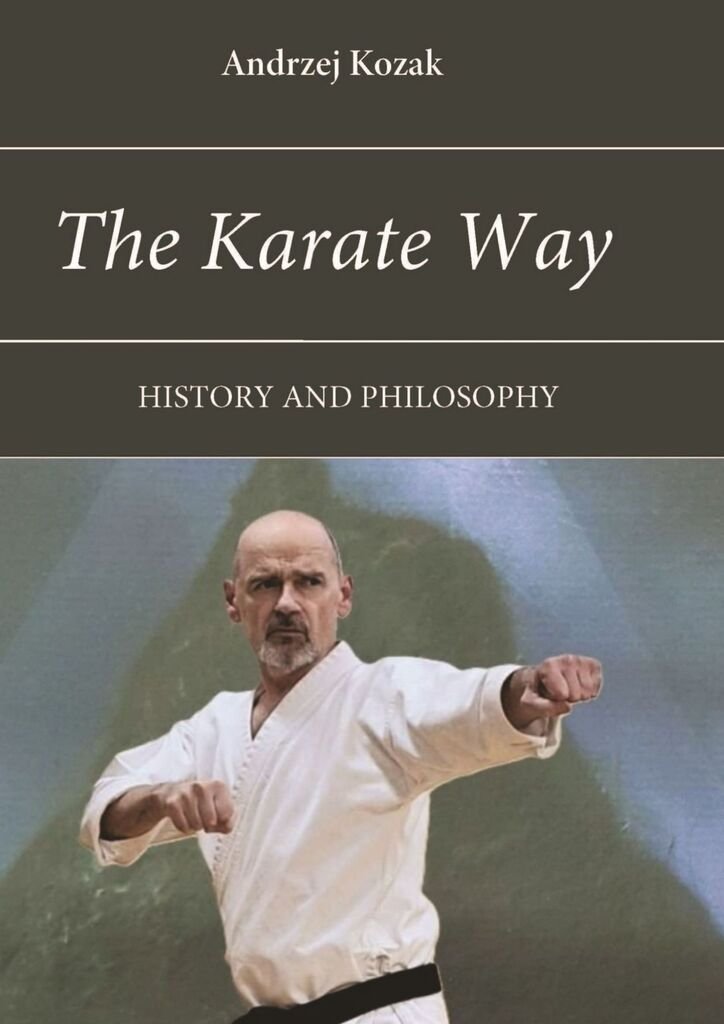
 Przeczytaj fragment on-line

The Karate Way - ebook
What is karate-dō? It is a martial art and a path to self-improvement. We will define this Path by analyzing the ideological foundations and goals of the practice. This book concisely presents the history of karate — the martial art from the island of Okinawa — and the philosophical foundations of its practice. It does not claim to be a scholarly work. Rather, it is the fruit of the author’s many years of studying karate.
Ta publikacja spełnia wymagania dostępności zgodnie z dyrektywą EAA.
| Kategoria: | Outdoor Recreation |
| Język: | Angielski |
| Zabezpieczenie: |
Watermark
|
| ISBN: | 978-83-8467-240-2 |
| Rozmiar pliku: | 3,7 MB |
FRAGMENT KSIĄŻKI
INTRODUCTION
Uncovering the history of karate is very difficult. For many years, historians did not engage with the history of martial arts; perhaps they did not consider this field significant enough, or perhaps they were deterred by the lack of documentation. This applies to both Chinese styles and the Okinawan art of “te.” Reliable texts from before the 1930s that describe the history and evolution of karate are practically nonexistent. Moreover, even the later ones, written by masters from Okinawa, are very few in number. And before that? The list is short:
— a note dated 1683 written by Tei Junsoku — an advisor to the King of Okinawa;
— an excerpt from “Notes from Oshima” (_Oshima Hikki_) from 1761;
— very general notes by several European and American visitors from the 19th century;
— two mid-19th-century illustrations depicting makiwara training in “Tales of the Southern Kingdom” by Nagoya Sagenta;
— a copy of the program for the farewell ceremony for the Chinese delegation in 1867, during which a martial arts demonstration was held in Shuri;
— a letter written in 1882 by Sokon Matsumura to one of his students, Ryosei Kuwae;
— a short text by the later-famous publisher Noma Seiji from 1904;
— two pages from the brochure “Karate Kumite” written in 1905 by instructor Chomo Hanashiro;
— the ten principles of karate practice that Anko Itosu included in a letter to the Ministry of Education in 1908;
— the article “Shihan Gakkō To-de Taikai” (To-de/Karate Meeting at the Teachers’ College) by Seiboku Tomikawa in the _Ryūkyū Shinpō_ from 1911;
— a series of articles by Gichin Funakoshi (written under the pseudonym Shoto) titled “Okinawa no Bugei” in the January 1914 issue of _Ryūkyū Shinpō_.
In 1922, Gichin Funakoshi published “To-de Ryukyu Kenpo”, and in the 1930s, books by Kenwa Mabuni, Chokkei Motobu, and Chojun Miyagi appeared. However, these were not detailed historical studies, but rather pamphlets outlining the basics of karate’s philosophy and training. Later, however, the students of these masters promoted karate, wrote articles and books — so the sources grew in number.
A historian searching for sources on the continent faces similar difficulties. Bodhidharma’s famous treatises on physical and spiritual perfection, supposedly written around 520 CE at the Shaolin Monastery, turned out to be apocryphal. The monastery’s documents were destroyed by fire. We are not even certain of the location of the “second Shaolin” in Fujian Province. Martial arts masters wrote nothing down; they strongly preferred the oral teacher-student tradition. In this situation, the text “Bubishi,” which traveled from China to Okinawa and circulated in copies, is one of the few valuable documents. No wonder it has earned the title “the Bible of karate.”
History has been obscured by dust; accounts passed down orally from generation to generation are often ambiguous, even contradictory. The language barrier adds to the difficulty. But that is not all. Over the centuries, certain stereotypes, legends, and even false information have become entrenched, which now need to be “debunked.” These errors stemmed from poor selection of sources, misunderstandings, a lack of historical expertise among those seeking the roots of karate, as well as simple confabulation by the authors of texts that often did not even aspire to be scholarly. Fortunately, this has changed in recent years.
Historians and organizations have taken an interest in martial arts. We know more and more, though we are still often groping in the dark. For this reason, this book does not claim to be a historical work. Not every fact cited is accompanied by a footnote citing its source. Moreover, sources are often unreliable and contradictory. Some statements are based on speculation.
When telling a story, we should start at the beginning. But where is the beginning? “Deep is the well of the past. Should we not call it bottomless?” asked Thomas Mann in his book *Joseph and His Brothers*. Every event has a cause. How far back in time should we go to begin the history of karate?
People have been fighting one another since the dawn of time, but combat training for military or security purposes is one thing, while martial arts practiced to refine the body and mind is quite another. The former has immediate goals — to win a fight, to defend a specific value. If drinking a poison that shortens life and destroys one’s personality were necessary to achieve this, it would be used. And indeed, this is sometimes the case — pragmatism above all else, the practice of cruelty, “brainwashing.” Sport serves as an intermediate stage. Its advocates speak of noble competition and breaking down barriers, but unfortunately, often only the result matters, even at the expense of health or through cheating. The goals of practicing martial arts are entirely different. It is a “way of life,” a means of realizing one’s own humanity. Moreover, as Sokon Matsumura pointed out in the 19th century, without philosophy, without deeply rooted moral standards, combat training is dangerous. Whoever stops at the stage of technique and physical exercises, may become aggressive, lose control, and pose a threat to those around him and to himself. Thanks to the philosophy of the “budo path,” the practitioner is calm, balanced, and loyal, and does nothing that goes against nature or moral principles.
In the person of SOKON MATSUMURA, three genealogical lines of karate from three countries converge: China, Okinawa, and Japan. We will return to this figure shortly, but for now, let us look far back into the past.
_I apologize for any errors in the translation. Some passages may have been translated too literally. The text has not been professionally edited by a native speaker._The second expanded edition of this book in 1925 was titled “Rentan go-shin to-de jutsu”
It should be noted, however, that these masters’ books typically focused on technique and general principles of practice. The history of karate was presented in them very succinctly.
Kenei Mabuni’s work — _The Empty Hand: The Essence of Budo Karate_. The Fozhou Wushu Association gathers all knowledge about the quan fa schools active there. Patrick McCarthy has made great contributions to the field of historical research — he is the author, among other works, of a translation with commentary of the famous _Bubishi._ He founded the International Ryukyu Research Society, an organization bringing together researchers of karate history.SHAOLIN
Shaolin Monastery, ca. 1890 (photographer unknown)
Some claim that the SHAOLIN Monastery in China (_Shaolin_, meaning “young forest”; in Japanese, _shorin_) is the birthplace of martial arts. It was built in 495, and its first abbot was Buddhabhadra, who came from India and was known in China as Batuo. There are records suggesting that two of his disciples — Huiguang (487–536) and Sengchou (480–560) — possessed exceptional martial skills. In 527 a famous Buddhist monk, the 28th patriarch of Mahayana Buddhism, with the Sanskrit name BODHIDHARMA (Chinese: Puti Damo, Japanese: Bodai Daruma), settled there. He promoted inner self-improvement through ZAZEN meditation. There are also speculations that, as a descendant of royal lineage, he knew the Hindu martial art „diamond fist” and recommended physical training to the monks — for hormonious spiritual, mental and physical improvement. Legend has it that it was Bodhidharma who taught the monks eighteen exercises, which later evolved into the first form/style known as “The 18 Hands of the Enlightened Buddhist (luohan) — _shi ba luohan shou_. Apparently, there was a disciple of Bodhidharma in the monastery at that time, a monk skilled in hand-to-hand combat named HUIKE (487–594), who served as a “bodyguard” and taught self-defense to his companions.
In the years that followed, various martial arts masters visited the monastery and taught the monks. There was also always an expert responsible for security. This fact seems quite reasonable. Since the Sui Dynasty (6th/7th century), the monastery had been awash in wealth (it owned over 100 hectares of fertile land), which is why it was a target for bandit raids. According to legend, 13 monks from Shaolin helped Prince Qin (whose given name was Li Shimin) defeat General Wang Shizhong, who was threatening the Tang Dynasty. Later, the prince, now Emperor Taizong, is said to have sent a letter of thanks to the monastery and granted it additional lands. Another legend states that the same emperor sent a group of monks south to Fujian Province to fight rampant pirates, which would explain the development of martial arts in that region.
It is believed that the martial art practiced at Shaolin was most heavily influenced by the PAO CHUI (“exploding hammer”) style, attributed to the three mythological emperors: Fuxi, Shennong, and Gonggong, and, from the 10th century onward, by the CHANGQUAN (“long fist”) developed by Emperor Taizu (founder of the Song Dynasty). The “Shaolin Five Animals System” (dragon, tiger, leopard, snake, crane) was developed here, as described by Pai Yu Feng in the book “The Essence of the Five Fists.” Years later, this martial art — unlike military training — came to be known AS “SHAOLIN TEMPLE FIST ART” (Chinese: shaolin quan fa; Japanese: shorin-ji kenpo). Hundreds of schools were established, and the term KUNG FU (gongfu) — meaning the time spent practicing — also emerged. The essence of the martial art, however, should always remain THE WAY (Chinese: tao; Japanese: dō) — the never-ending path of human self-improvement in physical, mental, and moral aspects. Perhaps the “Shaolin legend” is a stereotype that emerged during the discovery of the “spirit of the Orient” at the turn of the 19th and 20th centuries, a sort of “romanticization of reality.” But even if so, this legend influenced the development of martial arts philosophy in China and Okinawa.
Of course, martial arts did not develop exclusively at Shaolin. The monastery serves as a kind of symbol here. Historians claim that as early as the 5th century BCE, martial arts began to be practiced among Taoists and others. The „Spring and Autumn Chronicles” from that period mention „hard and soft techniques,” and the „Book of Rites (_Liji_)” refers to the _jiǎolì_ („wrestling,” “angular force”) involving strikes, throws, joint locks, and pressure on pressure points. In contrast, the art of TAI CHI CHUAN (taijiquan, lit. “great stillness fist”) sought to control the energy of chi (Japanese: ki) in its fighting techniques, and its masters also taught moral principles. The influence of tai chi on the emergence of karate in Okinawa is usually downplayed, but recently there have been proponents of the theory that it was precisely a master of early tai chi who was the teacher of the “fathers of karate” in the mid-18th century.
It is worth mentioning the famous physician HUA TUO, who, toward the end of the 2nd century, laid the foundation for later styles by developing the “FIVE ANIMALS EXERCISES” (_wuqinxi_) based on observations of the movements of the tiger, deer, bear, monkey, and crane. Alongside Shaolin Quan Fa, other “external styles” also developed, such as the aforementioned “Long Fist” or the “EAGLE CLAW FIST” attributed to General YUE FEI (1103–1141), as well as internal styles like XING YI QUAN (Hsing-i-chuan, “fist of the form of intention”) and BAGUA ZHANG (pakua chang, “hand of the eight trigrams”), which is related to taijiquan. The influence of the aforementioned internal styles on the development of karate, as I mentioned in the previous paragraph, is often underestimated. Meanwhile, there are accounts that masters of xing yi quan and baguazhang resided in Okinawa — both at the dawn of tode’s history and later.
When we first encounter XING-YI-QUAN (hsing-i-chuan), the associations with Okinawan karate are particularly strong. The roots of this art are lost in the mists of time. Perhaps it was developed by the aforementioned General Yue Fei, or perhaps by a man named Ji Long Feng toward the end of the Ming Dynasty. As an internal style (nei-jia), it emphasizes the cultivation of qi energy (Japanese: ki), harmonious development, and coordination of the entire body. Simple, powerful techniques, often serving as both defense and attack. Imitation of animal movements. A system of five elements of techniques corresponding to the elements of nature (earth, fire, water, wood, metal). Kenei Mabuni (son of the founder of the Shito-ryu karate-do style) writes:
„Martial arts developed particularly in monasteries, as these were home to art treasures and other valuables that the monks had to defend in times of danger. The term _Shaolin kempō_ encompasses all the martial arts techniques practiced within the monastery itself or in the surrounding area. Some of them have disappeared over time, such as the “crushing fist” (tsūhai ken), the “revitalizing fist” (shin i ken), or the “cosmic fist” (rikugō ken)”.
“The Sword Dancer” — a postcard from 1910.
Modern historians often cast doubt on the great skills of the monks from the Shaolin Monastery in Henan Province on the Yellow River. All that remains are accounts of their proficiency in staff fighting and folk legends. In any case, the glory of the former “first monastery in the empire” came to an end with the rise of the Manchu Qing Dynasty (1644). THE SO-CALLED SOUTHERN SHAOLIN — a monastery said to have existed (?) in Fujian Province — may have had a greater influence on the development of martial arts. It was there, reportedly, that warriors received their training, who later opened schools in the port city OF FUZHOU. It was from there (southeastern China) that the Chinese who arrived in Okinawa came.
While the existence of martial arts schools in Fuzhou, where styles such as tiger and crane, white crane, monk, and dragon were taught, is undisputed, the story of the “Southern Shaolin Monastery” is disputed. There are several stories passed down by word of mouth and very few documents.
We have already mentioned the first legend (from the 7th century). It bears a striking resemblance to another. In the first half of the 16th century, pirates (_wako_) were raiding coastal towns. General Qi Jiguang convened a meeting of martial arts experts to develop combat training. It turned out that the Shaolin monks possessed the highest skills. From that time on, the emperors of the Ming Dynasty sought the monks’ help on several occasions, rewarding them very generously. This also explains the hostility of the subsequent dynasty toward Shaolin. Legend has it that after the monastery was burned down by the imperial armies of the Qing Dynasty, the surviving monks fled south. There, to earn a living, they began teaching martial arts. There is also a theory that one of the surviving monks, named Ji Sin (Mandarin: Zhi Shan), built a small monastery in a remote location atop a mountain. This legend is connected to the tale of THE “FIVE ANCESTORS OF SHAOLIN” (Shaolin Wu Zu). According to this legend, only five masters came from the north and built a temple in Fujian Province (there are several possible locations). These five were the aforementioned Ji Sin, Wu Mei (the progenitor of the Dragon, White Crane, Hung Gar, and Wing Chun styles), Bai Mei (Mand. Pai Mei — White Eyebrow, a character used by Quentin Tarantino in “Kill Bill”), Fung Dou Dak, and Miu Hin. There are other “fives” in other legends. Recently, a new theory has emerged that this is not about five people, nor even monks, but five families who came from the Yellow River to Fujian Province and, facing economic hardship, began teaching their family styles of kung fu.
The legend of the Five from Shaolin is also intertwined with tales of secret societies fighting against the Qing Dynasty. The Five surviving martial arts masters formed the FAN QING FU MING pact, meaning “overthrow the Qing, restore the Ming.” Reportedly, they joined the network of secret societies known as the Tiandihui (Brotherhood of Heaven and Earth). Perhaps this alliance with the monks was intended to lend prestige to the brotherhoods, which were often merely self-help groups or sects, and some of which would later even evolve into criminal groups. On the other hand, many kung fu schools trace their roots precisely to the Five Masters of Southern Shaolin. But why are there so few historical sources? Even the legends were not written down until the mid-19th century.
So is the beautiful tale of the Shaolin monks who miraculously survived just a fiction? Not necessarily. Researchers do not rule out the existence of several monasteries bearing the name Shaolin. The word means “young forest.” The first monastery likely stood among the trees. It’s an interesting name (trees grow slowly, just as self-improvement is a slow process). It was known throughout China, as the emperors of the Tang and Ming dynasties held this temple in exceptional esteem. Perhaps it’s like the Jion temples in Japan (there are many of them). Historians point to as many as nine plausible locations for Southern Shaolin. Three of them are the most interesting, partly because monasteries were rebuilt there in the 1990s and these places are still promoted today as the cradles of martial arts: Putian, Quanzhou, and Fuqing.
Today, in Putian, an inscription above the entrance reads “Southern Shaolin Monastery.” The contemporary official version accepted by the Chinese authorities refers to the first legend cited at the beginning and points to the original location. According to this account, in the year 557, a group of monks from Shaolin arrived in the town of Putian in Fujian Province and founded a martial arts school on the summit of Mount Chulien. It was not a typical monastery, although Chan Buddhism (Japanese: Zen) was practiced there; it was also known as the “Temple of the Nine Lotuses.” Around 1644, monks from the north arrived here; they supported the Ming dynasty and had fled persecution by the new Qing rulers. On the one hand, this gave a new impetus to the development of martial arts, but on the other, it led to the monastery’s destruction by imperial troops. But when? Sources suggest several dates; perhaps the temple was burned down several times and rebuilt? Over 200 years later, Kanryo Higaonna’s alleged teacher, RYU RYU KO (probably LIU LONG GONG, 1793–1882), is said to have claimed that he learned the martial arts “in a mountain monastery.” This would confirm the theory that the final destruction of “Southern Shaolin” did not occur until the mid-The 19th century, a period of social unrest. However, the “Shaolin Temple fist art” had been taught in Fujian Province earlier. From the 17th century onward, the indigenous Okinawan martial art “te” began to blend with Chinese influences. In the town of Shuri, a style initially called shuri-te took shape, and in the early 20th century — shorin-ryu, or the “young forest” style. Shorin is the Japanese translation of the word Shaolin; the characters are the same.
The existence of “Southern Shaolin” thus seems indisputable, but is the officially recognized “Temple of the Nine Lotuses” “that” Shaolin? The site is indeed inaccessible, and that is likely why it failed economically as a tourist attraction (the authorities opened it to visitors in 1998). But many researchers, including contemporary kung fu practitioners, point to a different location. In Guangzhou, at the foot of Qingyuan Mountain, there is a restored “Temple of the Nine Dragons.” Several dozen monks practice there, including the style of the Five Ancestors (Five Elders) — wu zu shaolin. The door bears the inscription “Young Forest (Shaolin) Buddhist Temple.” This site was also home to a Buddhist monastery that was burned down several times over the centuries. Is this the “true” southern Shaolin monastery, or merely its more tourist-oriented location?
Finally, Fuqing — once a village, now a city of half a million people south of Fuzhou. Here, too, the characters the Southern Shaolin Temple appear on doors and on a stone obelisk. The oldest archaeological artifacts from this site date back to the 7th century. And this location has its supporters. Its proximity to Fuzhou, a multitude of various artifacts. But hard evidence and records in the chronicles are still lacking.
Katsushika Hokusai — _Daruma _(Metropolitan Museum of Art)
Conclusions. What is the truth? It is difficult to determine. Perhaps there was one monastery in the south, perhaps several, or perhaps there were none at all. The chronicles confirm that Shaolin monks protected emperors and fought bandits, and also that they traveled throughout the country. Perhaps the monasteries that hosted them were referred to as Shaolin? It seems, however, that tracing their origins back to the 6th century is somewhat far-fetched. This is an attempt at mythologization. Maintaining 1,500 years of continuity commands respect, but it is hardly realistic. More plausible is the theory that supporters of the defeated Ming dynasty migrated south in the 17th century and cultivated martial arts for self-defense. The establishment of a Buddhist temple and school also seems convincing. The masters who later taught the Okinawans arriving in Fuzhou must have learned their art somewhere. In a mountain monastery? Why not?
To conclude these reflections — as a point of interest — I quote a passage from the initiation ceremony for new members of the Heaven and Earth Brotherhood. The master of ceremonies asks: “How did you learn martial arts?” The initiates reply: “I learned at the Shaolin Monastery.”Sources give various dates for Bodhidharma’s arrival at Shaolin—512, 516, 520, 527—or simply the first half of the 6th century. Bodhidharma likely wandered the region for several decades.
In Buddhism, a luohan (Skt. Arhat) is someone who has gained insight into the true nature of existence and attained nirvana, but also a person advanced on the path to enlightenment.
Some sources attribute to Huike the role of Bodhidharma’s most important disciple and successor.
“Long fist” is essentially a group of external styles from which various kung fu styles and modern wushu derive.
The concept of harmonious development was attributed to Bodhidharma based on accounts that he was the author of two treatises: “On Physical Perfection” and “On Mental Perfection.” These texts were supposedly “discovered” in the early 20th century. Unfortunately, they turned out to be apocryphal. Nevertheless, as the “father of Zen Buddhism,” Bodhidharma could have espoused such a thesis.
The simplest distinction between external styles (Shaolin) and internal styles (Wudang) is that the latter place greater emphasis on the internal energy chi (ki).
At the turn of the 1930s and 1940s, Master Tung Gee (1900–1955) was staying in Okinawa, where he reportedly proposed “comparative studies” to Choki Motobu. Both men thus enriched their art.
Mabuni Kenei, _Empty Hand: The Essence of Budo Karate._ Palisander Verlag, Chemnitz 2009
Fuzhou — a city in eastern China, near the mouth of the Min River Yang to the East China Sea, the capital of Fujian Province. It was the Chinese port city closest to Okinawa (approx. 840 km as the crow flies).
There is much doubt regarding the identity of Master Ryu Ryu Ko, so one of the subsequent chapters is devoted to this topic.MASTERS FROM THE FUZHOU
We will write about the Chinese arriving in Okinawa in the next section. Now let’s take a look at other places (besides the Shaolin Monastery) in Fujian Province and in the city of Fuzhou where martial arts were practiced and which hosted visitors from Okinawa. Information is, of course, extremely scarce, and sometimes facts are mixed with legend.
FUJIAN Province is a large region in southeastern China, bordering the Taiwan Strait, with its capital, Fuzhou, located on its eastern edge, on the East China Sea. The southern Shaolin monastery, which I wrote about in the previous chapter, was said to be located in this area, and it was here that the masters of the styles that had the greatest influence on the development of karate lived. THE CRANE STYLE (he quan) deserves special attention, or more precisely, the White Crane style (bai he quan), and even more precisely — the Crying Crane style (ming he quan).
The crane is a special bird. It is one of the oldest species on Earth. In East Asia, it is a symbol of longevity, wisdom and life experience, fidelity, happiness, and good fortune. For a long time, it has been among the animals observed by kung fu masters to learn defense and attack techniques. It is present in both in Hua Tuo’s “Five Animal Exercises” and in the “Shaolin Five Animal System” (here: alongside the dragon, tiger, leopard, and snake) described by Pai Yu Feng in his book *The Essence of the Five Fists*. In the 17th century, facing persecution by Qing dynasty officials, the monks migrated south. The Five Animals System was refined by the monk Miu Hin and the nun Ng Mui. In the section devoted to the crane, they emphasized fighting techniques and tactics.
Fang Qiniang and Zeng Cishu (illustration from the Bubishi)
But in Fujian Province, we find a completely separate origin of the Crane style. Physical aspects intertwine with mental and moral ones, which we will later find in karate-do. There are many versions of this story; let us present the one contained in the famous book Bubishi.
In the 16th century, Fang Zhong lived in Yongchun; he knew the Shaolin monk’s Quan Fa style and taught it to his daughter, FANG QINIANG. Despite his skills, he was robbed and beaten to death by a group of bandits. The daughter dreamed of revenge, but she knew she stood no chance against the bandits. One day, Fang Qiniang saw two huge cranes fighting each other. With amazement and admiration, she watched their lightning-fast leaps, dodges, feints, and strikes with their beaks and claws. She grabbed a bamboo pole and tried to chase the birds away. However, they easily dodged the stick and eventually flew off. “If someone could fight like cranes, they would be invincible,” the girl thought. And for three years, she developed a fighting system that combined the Shaolin monk’s fist style with her observations of the fighting cranes. The system was named YONGCHUN HE QUAN — the Yongchun Crane Fist. Fang achieved mastery and a reputation as an undefeated warrior; among her students was the famous boxer ZENG CISHU. She also developed the philosophy of martial arts that her father had instilled in her. Dangerous techniques should only be used as a last resort in self-defense. Without inner peace and harmony, one cannot truly master martial arts or find one’s path in life. By discovering and then mastering your inner strength, you can develop it in harmony with nature and use it to defeat any opponent. Power and wisdom come from within. The mind controls the body. In this way, one can transcend physical limitations and achieve more than just through physical training. People who understand martial arts are never arrogant, heartless, or unjust.
Some see the collaboration between a woman (Fang Qiniang) and a man (Zeng Cishu) as a SYNTHESIS OF SOFTNESS AND HARDNESS that laid the foundation for later styles from Fujian and Okinawan to-de. Soon, the students of Fang Qiniang and Zeng Cishu began teaching on their own in other parts of Fujian Province, outside the town of Yongchen. Thus, the name FUJIAN BAI HE QUAN (Fujian White Crane Fist) came into use. The style developed into five similar “substyles”: MING HE QUAN (Crying Crane Fist), SU HE QUAN (Sleeping Crane Fist), SHI HE QUAN (Eating Crane Fist ), FEI HE QUAN (flying crane fist), and ZONG HE QUAN (dancing crane fist). However, it is doubtful that there is a single specific source for Bai He Quan. The fact is that this style was taught in Fujian Province when martial arts practitioners from Okinawa, such as Matsumura, Aragaki, Nakaima, and Higaonna, visited the province in the 19th century. Another expert in White Crane was the tea merchant WU XIANGUI, known in Okinawa as GO KENKI, who settled on the island in 1912 and had a significant influence on many karate masters.
A 19th-century photograph of Chinese martial arts practitioners
A special place in Fuzhou was so-called KOJO DOJO. The Chinese Cai family (Okinawan: Kogusuku, Japanese: Kojo) lived in Okinawa and practiced martial arts, but had strong ties to the kung fu school in Fuzhou. It was there that the mysterious master RYU RYU KO was said to be the head instructor, with WAI XINXIAN (Shinzan) as his assistant. It was there that in 1828 “Umare Bushi” Kojo and “Bushi” Matsumura appeared. Ten years later, Kitoku Sakiyama arrived there, and in 1870, Sakiyama’s student — Seisho Aragaki. And it was likely there, in the port city, that martial arts-trained bodyguards for diplomats and merchants — such as Iwa and Ason — also resided. And since the Ryukyu Kingdom (Okinawa) was a vassal of the emperor, it was able to maintain lucrative diplomatic, cultural, and commercial ties with China. Even in the 20th century, Fuzhou was a kung fu mecca to which later style founders such as Chojun Miyagi (Goju-ryu) and Kanbun Uechi (Uechi-ryu).
Of course, the Okinawans who arrived over the course of a century could not have been taught by the same instructors. The similarity of names sometimes leads to confusion. Thus, Matsumura’s teacher in the 1820s and 1830s was likely the baihe-quan master WANG DAXING (1798–1894).
It is also worth mentioning the semi-legendary figure of Master WONG CHUNG-YO, who lived in Fuzhou in the 17th century and taught the XING YI QUAN style (“fist of the will”), which belongs to the group of styles from the Wudang Mountains. Wong was born around 1630; the date of his death is unknown. One of Wong’s students is said to have been the famous Chatan Yara — Takahara’s teacher, that is, an expert in the art. Some researchers link this figure to the mysterious Kosokun.
Chinese masters of kung fu also traveled to Japan. It is known that in the 17th century, they served as teachers to the founders of the Kito-ryu and Yoshin-ju-jutsu styles. But there are no significant technical similarities between these styles and karate. So this is not the path to follow in the search for the roots of karate. These are undoubtedly found in Okinawa. And that is why, when writing about the history of karate, it is essential to mention the history of the Ryukyu Kingdom.Here, historical doubts are joined by ornithological ones. Some authors identify the ming he as the “whooping crane” (_Grus americana_) — a species very similar to the white crane inhabiting eastern China. However, it seems that in Chinese and Japanese culture, we are most often dealing with the Manchurian crane, also known as the Japanese crane (_Grus japonensis_). It is a beautiful white bird with a black neck and black wing tips, as well as a red patch on its head. It is not, therefore, the whooping crane, but the crying crane.
_The Bubishi_ is a book that has been copied by hand many times. It was originally classified as secret. It had a significant influence on the development of martial arts in Okinawa. Due to its vague, poetic language (Old Chinese) and the laconic descriptions of the illustrations, it is incomprehensible to those who are not martial arts experts. The Bubishi contains descriptions of techniques, pressure points, the history of the White Crane style, and information on herbal medicine. See the chapter — Bubishi — the Bible of Karate
Some sources state that the “White Crane of Fuzhou” incorporated elements of Shaolin quan fa and the “Fist of the Ancestors”The figure of Minamoto no Tametomo is shrouded in many legends, so his stay in Okinawa seems unlikely, but the Taira samurai were likely hiding in the Ryukyu Islands.
In the Fujian dialect, 36 can simply be understood to mean “many.”
Satsuma is the name of the domain comprising the provinces of Satsuma, Osumi, and Hyuga. Also known as Kagoshima. Today, Kagoshima Prefecture
These words are quoted by S. Nagamine based on an account of Basil Chamberlain Hall’s conversation with the emperor in 1816. S. Nagamine, _*The Essence of Okinawan Karate-do*,_ Tuttle Publishing, 1976
Quoted from: Nagamine Shoshin, _*The Essence of Okinawan Karate-do_*. Tuttle Publishing, 1976. The author claims that this poem was written in 1663
According to Naoki Motobu’s blog (translated by Andreas Quast), which cites Nobuo Harada, _*Mindai Ryūkyū Shiryō Shūsei* _(_A Collection of Ryūkyū Materials from the Ming Dynasty_)
There is a legend about 36 families who arrived in 1393 at the invitation of King Satto, followed by 100 households living behind a clay wall. Modern historians are uncertain about these facts. It is likely that the Chinese arrived in successive waves
Education began at age 5; at age 15, students were summoned to an official audience with the king at Shuri Castle. They also had to spend several years on the mainland to further their education.
Samure is the Okinawan pronunciation of the word samurai, but the two terms do not mean the same thing. The Japanese samurai was first and foremost a warrior. In some sources — particularly Japanese ones — the Ryukyuan nobility is referred to as samurai, and the princes as daimyo, which is also misleading, as Japanese daimyo were feudal lords with vast estates.
In 1670, the nobility was ordered to keep “genealogical records”
Nagamine S., _The Essence of Okinawan Karate-do_, p. 21
It is possible that all three names refer to a single person — the instructor Chotoku Kyan, to whom he passed down an expanded version of the Ku-shanku kata, known today as Chatan Yara Kushanku.
Giordano Emanuel, _“Kusanku — Chinese or Japanese kata?”,_ article https:// karate-shorin-ryu-piemonte.webnode.it
In his book, Kenei Mabuni explicitly writes about Master Shungo Sakugawa (1733–1815), who combined Okinawan te with Chinese martial arts. Mabuni, _op. cit._
The author of this hypothesis is karate practitioner and historian Simon Keegan.
This theory can be found in the article “Kusanku: Chinese or Japanese kata?” by Emanuel Giordano
Shoshine Nagamine was a student of Chotoku Kyan, who in turn was taught by Master Yara. According to _Nagamine, op. cit._
Dates are highly uncertain. Sources mention several figures named Tachimura (Takemura) from Tobaru. The son of a student of Sakugawa was reportedly sent to Kagoshima to train in jujutsu. G. Funakoshi wrote about this in a newspaper article in 1914.
In some sources, Kishimoto’s year of birth is also given as 1866 or 1868.
K. Mabuni, _*Empty Hand: The Essence of Budo Karate*,_ Chemnitz 2009„BUCHO” MATSUMURA
SOKON MATSUMURA (May 30, 1809 — August 8, 1899) was born in Yamagawa into a noble family — the Kiyo clan. On his father’s side, it was the Bu clan, descended from the first Chinese settlers in Kumemura. On his mother’s side, it was the ancient Ryukyuan Mo clan. Both clans had martial arts experts in their ranks. He trained from childhood. We do not know exactly from whom he learned martial arts at that time. His first teacher was likely his father, Sofuku, who instilled in him the principle of balance between physical and spiritual training. The next was someone from the Sakugawa family, or perhaps he trained under the guidance of Kanga Sakugawa’s student, MATSUMOTO. Some sources suggest that Sokon was also taught by Chatan Yara, but of course it could not have been Li Dao — Takahara’s alleged teacher — but rather someone younger from the family. Nevertheless, it is certain that Sokon learned TE.
Sokon „Bushi” Matsumura
In 1826, Sokon entered the service of King Sho Ko. According to the tradition of the court guards, he then abandoned his family name and adopted a new one — Matsumura — and was also granted the title of chikudun pechin. He began training with the king’s current bodyguard, whom he would soon replace — CHINPE KOJO, also known as Umare Bushi of Kume. In 1828, the king sent a diplomatic mission to the mainland to explore the possibility of greater support for Ryukyu from China. Sokon Matsumura and Chinpe Kojo also joined the diplomats, but their goal was also to train in martial arts under Chinese masters. During his stay in China, Matsumura studied martial arts under the guidance of several different instructors. Some of them later visited Okinawa as part of the delegation’s security guard, such as IWA (Iwaa, Yáo Wéi Bó), WANG DAXING, and ASON.
It is said that Matsumura also ended up in “Southern Shaolin,” where he encountered training based on the practice of forms. Many years later, Chojun Miyagi, the founder of the Goju-ryu style, would refer to this training as the origin of Naha-te and “orthodox Goju-ryu.” It is also worth noting that Matsumura visited China (Fuzhou, Beijing) several times and spent a significant amount of time there (various estimates range from 10 to 15 years). He studied various styles. Iwaa was most likely an expert in xing-yi-quan (the fist of form and will), Wang Daxing — Baihe-quan, and Ason — Shaolin-quan-fa,
Diplomacy in China proved fruitless; King Sho Ko was forced to abdicate, and his successor opted to come to terms with the Japanese. He also wanted his bodyguard to be skilled in the art of the sword. In 1832, Matsumura traveled to Satsuma on Kyushu and stayed there for about two years. There, he also trained at the Jigen-ryu sword school. This last point is very interesting, as Kenei Mabuni was the first to note. The Satsuma samurai of the Jigen-ryu commanded widespread respect for their art, which was based on a single, extremely fast, and maximally effective strike. They also taught their families how to fight with various objects (kobujutsu) for self-defense in the absence of the head of the household. It is said that it was while in Japan that Matsumura developed his style. Its essence was speed, power, and striking a vital point. This is where the saying comes from: ichigeki hissatsu — “One strike — one opponent.” Furthermore, Matsumura was inspired by tachi-ki-uchi training (striking a standing tree) and introduced makiwara (striking a board). It follows that — as already mentioned in the introduction — Matsumura embodies the convergence of three sources of karate: Okinawan te, Chinese Shaolin quan fa, and the economical, pragmatic martial art of the Satsuma samurai.
We know quite a bit about Matsumura’s advanced education in literature. As a court official, he even passed special examinations. In 1838, he married a young woman named Tsuru (also referred to in sources as Chiru or Ume) Yonamine, who had practiced martial arts since childhood. There is an anecdote associated with this. Apparently, Tsuru was tall, strong, and very beautiful, but she rejected suitors because they could not match her in combat. Sokon therefore had to literally fight for her favor. One version of the anecdote even claims that he was defeated, while another says that he underestimated his opponent, lost the first bout, and only won in the rematch.
From 1838 to 1860, Sokon Matsumura served as an advisor to King Sho Iku and the personal instructor of the young King Sho Tai. He developed his his martial arts skills by training with the most outstanding masters of the time, as discussed in the next chapter. He wrote literary works. Then he left for Fuzhou for a few years for the second time. After the fall of the kingdom, he received a low-stress position as a guard of the Royal Gardens (Uban) and taught karate to locals who were interested in the old ways of fighting.
During this time, Matsumura wrote several letters, most of which were signed with the name “Bucho”. One of them is particularly noteworthy. In a letter to his student Ryosei Kuwae (fortunately preserved by the family), he articulated HIS PHILOSOPHY OF PRACTICING MARTIAL ARTS. This concept, known as “Matsumura’s Triple Path,” demonstrates that karate was, from the very beginning, a path to human perfection, one that placed very high moral demands.
Matsumura was the most renowned martial arts expert of his time. He is considered the founder of the original style of SHURI-TE (later known as Shorin-ryu) and the creator of many kata, including the fundamental Passai. This style was fast and hard. It formed the basis for the later development of karate and was closest to the traditional martial art of Okinawa. The old karate masters used to say: _“_The only true _‘te’_ is Shuri-te.” It is believed that Matsumura’s shuri-te kata repertoire initially included: KUSHANKU (learned from the Yara and Sakugawa families), the now-lost CHANNAN (pra Pinan/Heian?), and those brought from Fuzhou: SEISAN (13), USEISHI (54), JUTTE (Jitte, 10 hands). Matsumura then developed PASSAI (Matsumura Bassai) and PASSAI GWA (Bassai Sho), and upon his return from Japan — JION. Later, sifu ASON arrived in Okinawa, and it was from him that Matsumura learned the NAIHANCHI (Naifanchin) form. Finally, from the mysterious Annan — CHINTO. Among the 10 forms mentioned, the fast, dynamic Naihanchi (now divided into 3 kata) is considered fundamental to the Shuri-te style. According to Matsumura’s grandson — Hohana Soken — he also brought the Sanchin and Hakutsuru (White Crane) forms from China.
As can be seen, Matsumura’s Shuri-te had many sources. Little known and underappreciated is the influence of the Five Elements Fist, the Five Animals of Shaolin, and internal styles such as XING YI QUAN (hsing-i-chu-an, “fist of the will”) and BAGUA ZHANG (pakua chang, “hand of the eight trigrams”).
During his stay in Fuzhou and Beijing, Matsumura gained a deeper understanding of the Chinese concepts of xing and taolu — as training in a specific martial art style — which he combined with the Japanese concept of kata. Xing (形, also transcribed as hsing, literally “shape” or “form”) is a set of techniques specific to a given style and the method of performing them — a distinct concept of combat encapsulated in a form. _TAOLU_, on the other hand, is also known as _LIAN_ — training, practice, a set sequence of movements in training. Superficial practice of martial arts usually boils down to taolu, but great masters recommend understanding xing. And so it remains to this day. Whoever disregards kata cannot claim to practice karate.
It is commonly believed that the master-student lineages in early karate were straightforward. In reality, they were complex. The greatest masters often had several teachers, even during the same period. It was customary that if a master wished to teach a student a technique or kata for which another master was famous, he would send his student to study under that other master. Matsumura’s most famous students were: KOSAKU MATSUMORA (1829–1898) from Tomari, and ANKO (Yasutsune) AZATO (1827–1906) and ANKO (Yasutsune) ITOSU (1832–1915) from Shuri. Also worth mentioning are his grandson NABE MATSUMURA (1860–1930), the sai-jutsu master SHINBUKU TAWADA (1851–1920 ), the tall, slender ISHIMINE (1835–1889), SAKIHARA (1833–1918), KIYUNA (1845–1920), and the previously mentioned RYOSEI KUWAE (1858–1939), CHOTOKU KYAN (1870–1945). He also shared his knowledge with SEISHO ARAGAKI (1840–1918), the MOTOBU brothers, and the students of Azato and Itosu — GICHIN FUNAKOSHI (1868–1957), KENTSU YABU (1866–1937), and CHOMO HANASHIRO (1869–1945). There are, however, indications that Matsumura did not pass on the entirety of his art to anyone. He taught techniques, he taught forms, but the essence of his fast and effective karate remains shrouded in mystery. This does not change the fact that all the roots of karate converge in the person of Matsumura: the indigenous Okinawan roots, Chinese kenpo, Japanese ji-gen-ryu tactics, and the philosophy of self-improvement through the practice of martial arts. This is why it is Sokon Matsumura whom we can rightly call the “father of karate.”There are many different accounts regarding Matsumura’s age. The above is based on a document stating that Matsumura’s 88th birthday was celebrated in 1896. These dates are also inscribed on Matsumura’s grave. Kenei Mabuni, in his book, gives the dates 1800–1896, but there is also evidence that Matsumura was born in 1797.
The figure of Ason appears quite frequently in the history of to-de. Gichin Funakoshi (under the pseudonym Shoto) published an article titled “Okinawa no Bugei” in the _Ryūkyū Shinpō _magazine in 1914. In it, he recounts stories from his teacher Anko Azato, who claimed that Ason was an officer, represented Shōrei-ryū (Naha-te), and taught Sakiyama of Izumizaki, Nagahama, Tomoyose, and Gushi. Sakiyama later taught Tomigusuku and Kuniyoshi; Nagahama was Itosu’s teacher; and Gushi taught Ishimine (according to Naoki Motobu’s blog). Others identify Ason as Liu Long Gong, who in turn appears to be the famous master Ryu Ryu Ko.
Other sources mention five years of sword training under the legendary master Ijuin Yashichiro
K. Mabuni, op. cit.
Bucho is a so-called personal name (nanui, nanori) initially given only upon reaching adulthood, used in Okinawa since the 17th century, consisting of one clan character (nanori-gashira) and one distinguishing character.
The full text of this letter can be found in the chapter on the philosophy of karate
The concept of style in martial arts is extremely broad and ambiguous. Typically, a given style is distinguished by the way techniques are performed, the emphasis placed on specific aspects of training, and the selection of forms.
In some sources, Tawada’s date of death is given as 1907, and other names appear as well, which stems from different interpretations of the ideogramsProbably a student or training partner of Sakugawa; according to some sources (Kanazawa), Makabe taught a version of the Wanshu kata that later became the model for the Enpi kata in Shotokan
In a 1914 article titled “Ryukyu Kenpo To-de” (part of the “Okinawa no Bugei” series in _Ryūkyū Shinpō_). In his opinion, Chinto also taught the forms Chinte, Jitte, and Jiin, which seems unlikely. Perhaps not one, but several sailors named Annan/Chinto earned a living by teaching a large group in Tomari.
This name is interpreted as a proper name or as “protect the head”
The origins of the kata are not the main focus here, so let us examine other developments in Tomari during the second half of the 19th century.
There are significant discrepancies in the sources regarding both Annan himself and the years of his stay — ranging from 1850 to 1873 (Sakagami).The term _Shōrei ryū _is known primarily from the writings of Gichin Funakoshi, who echoed the words of his teacher, Anko Azato. The main purpose was to distinguish shorin-ryu (shuri-te) from shorei-ryu (na-ha-te). The name likely refers to the Shorei Temple in China. Some interpret the characters as “style of inspiration,” suggesting that this was the style from which Goju-ryu originated.
The year 1920 also appears in the sources.
This program, along with explanations, is cited by many budo historians, including Kinjo Akio, _Karate Den Shinroku_, 1999
The figure of the Kojo-Dojo instructor named Wai Shinzan (Xinxian) appears in connection with nearly every visit by Okinawan martial arts practitioners to Fuzhou. However, we know very little about him. We do not know the dates of his life, though since he taught in the 1930s, 1970s, and 1980s, he must have lived a long life. An interesting fact is that when, around 1968, the Kojo family finally opened a public dojo in Naha, the style was first named Shinzan-ryu, and only later Kojo-ryu. Perhaps Wai Xinxian is being confused with an older instructor named Wang Daxing (1798–1894).Some sources give April 4 (Gregorian calendar)
An article in Chinese written by the IOGKF representative in China, https://tieba.baidu.com/p/1307549295. It states that information about Higaonna was passed on by Miyagi Chojun (Gong Cheng Zhang Shun) to Mr. Miyagi Anichi (Gong Cheng An Yi), who in turn passed it on to Mr. Lin Shifan. A similar account is found in the booklet “History of Goju Ryu Karate-Do” by Higaonna Morio.
It is unclear whether Higaonna taught Suparinpei (108) or Pechurin (100 steps). Both forms share common roots, and some schools even equate them.
The previously cited article from a Chinese website
Uncovering the history of karate is very difficult. For many years, historians did not engage with the history of martial arts; perhaps they did not consider this field significant enough, or perhaps they were deterred by the lack of documentation. This applies to both Chinese styles and the Okinawan art of “te.” Reliable texts from before the 1930s that describe the history and evolution of karate are practically nonexistent. Moreover, even the later ones, written by masters from Okinawa, are very few in number. And before that? The list is short:
— a note dated 1683 written by Tei Junsoku — an advisor to the King of Okinawa;
— an excerpt from “Notes from Oshima” (_Oshima Hikki_) from 1761;
— very general notes by several European and American visitors from the 19th century;
— two mid-19th-century illustrations depicting makiwara training in “Tales of the Southern Kingdom” by Nagoya Sagenta;
— a copy of the program for the farewell ceremony for the Chinese delegation in 1867, during which a martial arts demonstration was held in Shuri;
— a letter written in 1882 by Sokon Matsumura to one of his students, Ryosei Kuwae;
— a short text by the later-famous publisher Noma Seiji from 1904;
— two pages from the brochure “Karate Kumite” written in 1905 by instructor Chomo Hanashiro;
— the ten principles of karate practice that Anko Itosu included in a letter to the Ministry of Education in 1908;
— the article “Shihan Gakkō To-de Taikai” (To-de/Karate Meeting at the Teachers’ College) by Seiboku Tomikawa in the _Ryūkyū Shinpō_ from 1911;
— a series of articles by Gichin Funakoshi (written under the pseudonym Shoto) titled “Okinawa no Bugei” in the January 1914 issue of _Ryūkyū Shinpō_.
In 1922, Gichin Funakoshi published “To-de Ryukyu Kenpo”, and in the 1930s, books by Kenwa Mabuni, Chokkei Motobu, and Chojun Miyagi appeared. However, these were not detailed historical studies, but rather pamphlets outlining the basics of karate’s philosophy and training. Later, however, the students of these masters promoted karate, wrote articles and books — so the sources grew in number.
A historian searching for sources on the continent faces similar difficulties. Bodhidharma’s famous treatises on physical and spiritual perfection, supposedly written around 520 CE at the Shaolin Monastery, turned out to be apocryphal. The monastery’s documents were destroyed by fire. We are not even certain of the location of the “second Shaolin” in Fujian Province. Martial arts masters wrote nothing down; they strongly preferred the oral teacher-student tradition. In this situation, the text “Bubishi,” which traveled from China to Okinawa and circulated in copies, is one of the few valuable documents. No wonder it has earned the title “the Bible of karate.”
History has been obscured by dust; accounts passed down orally from generation to generation are often ambiguous, even contradictory. The language barrier adds to the difficulty. But that is not all. Over the centuries, certain stereotypes, legends, and even false information have become entrenched, which now need to be “debunked.” These errors stemmed from poor selection of sources, misunderstandings, a lack of historical expertise among those seeking the roots of karate, as well as simple confabulation by the authors of texts that often did not even aspire to be scholarly. Fortunately, this has changed in recent years.
Historians and organizations have taken an interest in martial arts. We know more and more, though we are still often groping in the dark. For this reason, this book does not claim to be a historical work. Not every fact cited is accompanied by a footnote citing its source. Moreover, sources are often unreliable and contradictory. Some statements are based on speculation.
When telling a story, we should start at the beginning. But where is the beginning? “Deep is the well of the past. Should we not call it bottomless?” asked Thomas Mann in his book *Joseph and His Brothers*. Every event has a cause. How far back in time should we go to begin the history of karate?
People have been fighting one another since the dawn of time, but combat training for military or security purposes is one thing, while martial arts practiced to refine the body and mind is quite another. The former has immediate goals — to win a fight, to defend a specific value. If drinking a poison that shortens life and destroys one’s personality were necessary to achieve this, it would be used. And indeed, this is sometimes the case — pragmatism above all else, the practice of cruelty, “brainwashing.” Sport serves as an intermediate stage. Its advocates speak of noble competition and breaking down barriers, but unfortunately, often only the result matters, even at the expense of health or through cheating. The goals of practicing martial arts are entirely different. It is a “way of life,” a means of realizing one’s own humanity. Moreover, as Sokon Matsumura pointed out in the 19th century, without philosophy, without deeply rooted moral standards, combat training is dangerous. Whoever stops at the stage of technique and physical exercises, may become aggressive, lose control, and pose a threat to those around him and to himself. Thanks to the philosophy of the “budo path,” the practitioner is calm, balanced, and loyal, and does nothing that goes against nature or moral principles.
In the person of SOKON MATSUMURA, three genealogical lines of karate from three countries converge: China, Okinawa, and Japan. We will return to this figure shortly, but for now, let us look far back into the past.
_I apologize for any errors in the translation. Some passages may have been translated too literally. The text has not been professionally edited by a native speaker._The second expanded edition of this book in 1925 was titled “Rentan go-shin to-de jutsu”
It should be noted, however, that these masters’ books typically focused on technique and general principles of practice. The history of karate was presented in them very succinctly.
Kenei Mabuni’s work — _The Empty Hand: The Essence of Budo Karate_. The Fozhou Wushu Association gathers all knowledge about the quan fa schools active there. Patrick McCarthy has made great contributions to the field of historical research — he is the author, among other works, of a translation with commentary of the famous _Bubishi._ He founded the International Ryukyu Research Society, an organization bringing together researchers of karate history.SHAOLIN
Shaolin Monastery, ca. 1890 (photographer unknown)
Some claim that the SHAOLIN Monastery in China (_Shaolin_, meaning “young forest”; in Japanese, _shorin_) is the birthplace of martial arts. It was built in 495, and its first abbot was Buddhabhadra, who came from India and was known in China as Batuo. There are records suggesting that two of his disciples — Huiguang (487–536) and Sengchou (480–560) — possessed exceptional martial skills. In 527 a famous Buddhist monk, the 28th patriarch of Mahayana Buddhism, with the Sanskrit name BODHIDHARMA (Chinese: Puti Damo, Japanese: Bodai Daruma), settled there. He promoted inner self-improvement through ZAZEN meditation. There are also speculations that, as a descendant of royal lineage, he knew the Hindu martial art „diamond fist” and recommended physical training to the monks — for hormonious spiritual, mental and physical improvement. Legend has it that it was Bodhidharma who taught the monks eighteen exercises, which later evolved into the first form/style known as “The 18 Hands of the Enlightened Buddhist (luohan) — _shi ba luohan shou_. Apparently, there was a disciple of Bodhidharma in the monastery at that time, a monk skilled in hand-to-hand combat named HUIKE (487–594), who served as a “bodyguard” and taught self-defense to his companions.
In the years that followed, various martial arts masters visited the monastery and taught the monks. There was also always an expert responsible for security. This fact seems quite reasonable. Since the Sui Dynasty (6th/7th century), the monastery had been awash in wealth (it owned over 100 hectares of fertile land), which is why it was a target for bandit raids. According to legend, 13 monks from Shaolin helped Prince Qin (whose given name was Li Shimin) defeat General Wang Shizhong, who was threatening the Tang Dynasty. Later, the prince, now Emperor Taizong, is said to have sent a letter of thanks to the monastery and granted it additional lands. Another legend states that the same emperor sent a group of monks south to Fujian Province to fight rampant pirates, which would explain the development of martial arts in that region.
It is believed that the martial art practiced at Shaolin was most heavily influenced by the PAO CHUI (“exploding hammer”) style, attributed to the three mythological emperors: Fuxi, Shennong, and Gonggong, and, from the 10th century onward, by the CHANGQUAN (“long fist”) developed by Emperor Taizu (founder of the Song Dynasty). The “Shaolin Five Animals System” (dragon, tiger, leopard, snake, crane) was developed here, as described by Pai Yu Feng in the book “The Essence of the Five Fists.” Years later, this martial art — unlike military training — came to be known AS “SHAOLIN TEMPLE FIST ART” (Chinese: shaolin quan fa; Japanese: shorin-ji kenpo). Hundreds of schools were established, and the term KUNG FU (gongfu) — meaning the time spent practicing — also emerged. The essence of the martial art, however, should always remain THE WAY (Chinese: tao; Japanese: dō) — the never-ending path of human self-improvement in physical, mental, and moral aspects. Perhaps the “Shaolin legend” is a stereotype that emerged during the discovery of the “spirit of the Orient” at the turn of the 19th and 20th centuries, a sort of “romanticization of reality.” But even if so, this legend influenced the development of martial arts philosophy in China and Okinawa.
Of course, martial arts did not develop exclusively at Shaolin. The monastery serves as a kind of symbol here. Historians claim that as early as the 5th century BCE, martial arts began to be practiced among Taoists and others. The „Spring and Autumn Chronicles” from that period mention „hard and soft techniques,” and the „Book of Rites (_Liji_)” refers to the _jiǎolì_ („wrestling,” “angular force”) involving strikes, throws, joint locks, and pressure on pressure points. In contrast, the art of TAI CHI CHUAN (taijiquan, lit. “great stillness fist”) sought to control the energy of chi (Japanese: ki) in its fighting techniques, and its masters also taught moral principles. The influence of tai chi on the emergence of karate in Okinawa is usually downplayed, but recently there have been proponents of the theory that it was precisely a master of early tai chi who was the teacher of the “fathers of karate” in the mid-18th century.
It is worth mentioning the famous physician HUA TUO, who, toward the end of the 2nd century, laid the foundation for later styles by developing the “FIVE ANIMALS EXERCISES” (_wuqinxi_) based on observations of the movements of the tiger, deer, bear, monkey, and crane. Alongside Shaolin Quan Fa, other “external styles” also developed, such as the aforementioned “Long Fist” or the “EAGLE CLAW FIST” attributed to General YUE FEI (1103–1141), as well as internal styles like XING YI QUAN (Hsing-i-chuan, “fist of the form of intention”) and BAGUA ZHANG (pakua chang, “hand of the eight trigrams”), which is related to taijiquan. The influence of the aforementioned internal styles on the development of karate, as I mentioned in the previous paragraph, is often underestimated. Meanwhile, there are accounts that masters of xing yi quan and baguazhang resided in Okinawa — both at the dawn of tode’s history and later.
When we first encounter XING-YI-QUAN (hsing-i-chuan), the associations with Okinawan karate are particularly strong. The roots of this art are lost in the mists of time. Perhaps it was developed by the aforementioned General Yue Fei, or perhaps by a man named Ji Long Feng toward the end of the Ming Dynasty. As an internal style (nei-jia), it emphasizes the cultivation of qi energy (Japanese: ki), harmonious development, and coordination of the entire body. Simple, powerful techniques, often serving as both defense and attack. Imitation of animal movements. A system of five elements of techniques corresponding to the elements of nature (earth, fire, water, wood, metal). Kenei Mabuni (son of the founder of the Shito-ryu karate-do style) writes:
„Martial arts developed particularly in monasteries, as these were home to art treasures and other valuables that the monks had to defend in times of danger. The term _Shaolin kempō_ encompasses all the martial arts techniques practiced within the monastery itself or in the surrounding area. Some of them have disappeared over time, such as the “crushing fist” (tsūhai ken), the “revitalizing fist” (shin i ken), or the “cosmic fist” (rikugō ken)”.
“The Sword Dancer” — a postcard from 1910.
Modern historians often cast doubt on the great skills of the monks from the Shaolin Monastery in Henan Province on the Yellow River. All that remains are accounts of their proficiency in staff fighting and folk legends. In any case, the glory of the former “first monastery in the empire” came to an end with the rise of the Manchu Qing Dynasty (1644). THE SO-CALLED SOUTHERN SHAOLIN — a monastery said to have existed (?) in Fujian Province — may have had a greater influence on the development of martial arts. It was there, reportedly, that warriors received their training, who later opened schools in the port city OF FUZHOU. It was from there (southeastern China) that the Chinese who arrived in Okinawa came.
While the existence of martial arts schools in Fuzhou, where styles such as tiger and crane, white crane, monk, and dragon were taught, is undisputed, the story of the “Southern Shaolin Monastery” is disputed. There are several stories passed down by word of mouth and very few documents.
We have already mentioned the first legend (from the 7th century). It bears a striking resemblance to another. In the first half of the 16th century, pirates (_wako_) were raiding coastal towns. General Qi Jiguang convened a meeting of martial arts experts to develop combat training. It turned out that the Shaolin monks possessed the highest skills. From that time on, the emperors of the Ming Dynasty sought the monks’ help on several occasions, rewarding them very generously. This also explains the hostility of the subsequent dynasty toward Shaolin. Legend has it that after the monastery was burned down by the imperial armies of the Qing Dynasty, the surviving monks fled south. There, to earn a living, they began teaching martial arts. There is also a theory that one of the surviving monks, named Ji Sin (Mandarin: Zhi Shan), built a small monastery in a remote location atop a mountain. This legend is connected to the tale of THE “FIVE ANCESTORS OF SHAOLIN” (Shaolin Wu Zu). According to this legend, only five masters came from the north and built a temple in Fujian Province (there are several possible locations). These five were the aforementioned Ji Sin, Wu Mei (the progenitor of the Dragon, White Crane, Hung Gar, and Wing Chun styles), Bai Mei (Mand. Pai Mei — White Eyebrow, a character used by Quentin Tarantino in “Kill Bill”), Fung Dou Dak, and Miu Hin. There are other “fives” in other legends. Recently, a new theory has emerged that this is not about five people, nor even monks, but five families who came from the Yellow River to Fujian Province and, facing economic hardship, began teaching their family styles of kung fu.
The legend of the Five from Shaolin is also intertwined with tales of secret societies fighting against the Qing Dynasty. The Five surviving martial arts masters formed the FAN QING FU MING pact, meaning “overthrow the Qing, restore the Ming.” Reportedly, they joined the network of secret societies known as the Tiandihui (Brotherhood of Heaven and Earth). Perhaps this alliance with the monks was intended to lend prestige to the brotherhoods, which were often merely self-help groups or sects, and some of which would later even evolve into criminal groups. On the other hand, many kung fu schools trace their roots precisely to the Five Masters of Southern Shaolin. But why are there so few historical sources? Even the legends were not written down until the mid-19th century.
So is the beautiful tale of the Shaolin monks who miraculously survived just a fiction? Not necessarily. Researchers do not rule out the existence of several monasteries bearing the name Shaolin. The word means “young forest.” The first monastery likely stood among the trees. It’s an interesting name (trees grow slowly, just as self-improvement is a slow process). It was known throughout China, as the emperors of the Tang and Ming dynasties held this temple in exceptional esteem. Perhaps it’s like the Jion temples in Japan (there are many of them). Historians point to as many as nine plausible locations for Southern Shaolin. Three of them are the most interesting, partly because monasteries were rebuilt there in the 1990s and these places are still promoted today as the cradles of martial arts: Putian, Quanzhou, and Fuqing.
Today, in Putian, an inscription above the entrance reads “Southern Shaolin Monastery.” The contemporary official version accepted by the Chinese authorities refers to the first legend cited at the beginning and points to the original location. According to this account, in the year 557, a group of monks from Shaolin arrived in the town of Putian in Fujian Province and founded a martial arts school on the summit of Mount Chulien. It was not a typical monastery, although Chan Buddhism (Japanese: Zen) was practiced there; it was also known as the “Temple of the Nine Lotuses.” Around 1644, monks from the north arrived here; they supported the Ming dynasty and had fled persecution by the new Qing rulers. On the one hand, this gave a new impetus to the development of martial arts, but on the other, it led to the monastery’s destruction by imperial troops. But when? Sources suggest several dates; perhaps the temple was burned down several times and rebuilt? Over 200 years later, Kanryo Higaonna’s alleged teacher, RYU RYU KO (probably LIU LONG GONG, 1793–1882), is said to have claimed that he learned the martial arts “in a mountain monastery.” This would confirm the theory that the final destruction of “Southern Shaolin” did not occur until the mid-The 19th century, a period of social unrest. However, the “Shaolin Temple fist art” had been taught in Fujian Province earlier. From the 17th century onward, the indigenous Okinawan martial art “te” began to blend with Chinese influences. In the town of Shuri, a style initially called shuri-te took shape, and in the early 20th century — shorin-ryu, or the “young forest” style. Shorin is the Japanese translation of the word Shaolin; the characters are the same.
The existence of “Southern Shaolin” thus seems indisputable, but is the officially recognized “Temple of the Nine Lotuses” “that” Shaolin? The site is indeed inaccessible, and that is likely why it failed economically as a tourist attraction (the authorities opened it to visitors in 1998). But many researchers, including contemporary kung fu practitioners, point to a different location. In Guangzhou, at the foot of Qingyuan Mountain, there is a restored “Temple of the Nine Dragons.” Several dozen monks practice there, including the style of the Five Ancestors (Five Elders) — wu zu shaolin. The door bears the inscription “Young Forest (Shaolin) Buddhist Temple.” This site was also home to a Buddhist monastery that was burned down several times over the centuries. Is this the “true” southern Shaolin monastery, or merely its more tourist-oriented location?
Finally, Fuqing — once a village, now a city of half a million people south of Fuzhou. Here, too, the characters the Southern Shaolin Temple appear on doors and on a stone obelisk. The oldest archaeological artifacts from this site date back to the 7th century. And this location has its supporters. Its proximity to Fuzhou, a multitude of various artifacts. But hard evidence and records in the chronicles are still lacking.
Katsushika Hokusai — _Daruma _(Metropolitan Museum of Art)
Conclusions. What is the truth? It is difficult to determine. Perhaps there was one monastery in the south, perhaps several, or perhaps there were none at all. The chronicles confirm that Shaolin monks protected emperors and fought bandits, and also that they traveled throughout the country. Perhaps the monasteries that hosted them were referred to as Shaolin? It seems, however, that tracing their origins back to the 6th century is somewhat far-fetched. This is an attempt at mythologization. Maintaining 1,500 years of continuity commands respect, but it is hardly realistic. More plausible is the theory that supporters of the defeated Ming dynasty migrated south in the 17th century and cultivated martial arts for self-defense. The establishment of a Buddhist temple and school also seems convincing. The masters who later taught the Okinawans arriving in Fuzhou must have learned their art somewhere. In a mountain monastery? Why not?
To conclude these reflections — as a point of interest — I quote a passage from the initiation ceremony for new members of the Heaven and Earth Brotherhood. The master of ceremonies asks: “How did you learn martial arts?” The initiates reply: “I learned at the Shaolin Monastery.”Sources give various dates for Bodhidharma’s arrival at Shaolin—512, 516, 520, 527—or simply the first half of the 6th century. Bodhidharma likely wandered the region for several decades.
In Buddhism, a luohan (Skt. Arhat) is someone who has gained insight into the true nature of existence and attained nirvana, but also a person advanced on the path to enlightenment.
Some sources attribute to Huike the role of Bodhidharma’s most important disciple and successor.
“Long fist” is essentially a group of external styles from which various kung fu styles and modern wushu derive.
The concept of harmonious development was attributed to Bodhidharma based on accounts that he was the author of two treatises: “On Physical Perfection” and “On Mental Perfection.” These texts were supposedly “discovered” in the early 20th century. Unfortunately, they turned out to be apocryphal. Nevertheless, as the “father of Zen Buddhism,” Bodhidharma could have espoused such a thesis.
The simplest distinction between external styles (Shaolin) and internal styles (Wudang) is that the latter place greater emphasis on the internal energy chi (ki).
At the turn of the 1930s and 1940s, Master Tung Gee (1900–1955) was staying in Okinawa, where he reportedly proposed “comparative studies” to Choki Motobu. Both men thus enriched their art.
Mabuni Kenei, _Empty Hand: The Essence of Budo Karate._ Palisander Verlag, Chemnitz 2009
Fuzhou — a city in eastern China, near the mouth of the Min River Yang to the East China Sea, the capital of Fujian Province. It was the Chinese port city closest to Okinawa (approx. 840 km as the crow flies).
There is much doubt regarding the identity of Master Ryu Ryu Ko, so one of the subsequent chapters is devoted to this topic.MASTERS FROM THE FUZHOU
We will write about the Chinese arriving in Okinawa in the next section. Now let’s take a look at other places (besides the Shaolin Monastery) in Fujian Province and in the city of Fuzhou where martial arts were practiced and which hosted visitors from Okinawa. Information is, of course, extremely scarce, and sometimes facts are mixed with legend.
FUJIAN Province is a large region in southeastern China, bordering the Taiwan Strait, with its capital, Fuzhou, located on its eastern edge, on the East China Sea. The southern Shaolin monastery, which I wrote about in the previous chapter, was said to be located in this area, and it was here that the masters of the styles that had the greatest influence on the development of karate lived. THE CRANE STYLE (he quan) deserves special attention, or more precisely, the White Crane style (bai he quan), and even more precisely — the Crying Crane style (ming he quan).
The crane is a special bird. It is one of the oldest species on Earth. In East Asia, it is a symbol of longevity, wisdom and life experience, fidelity, happiness, and good fortune. For a long time, it has been among the animals observed by kung fu masters to learn defense and attack techniques. It is present in both in Hua Tuo’s “Five Animal Exercises” and in the “Shaolin Five Animal System” (here: alongside the dragon, tiger, leopard, and snake) described by Pai Yu Feng in his book *The Essence of the Five Fists*. In the 17th century, facing persecution by Qing dynasty officials, the monks migrated south. The Five Animals System was refined by the monk Miu Hin and the nun Ng Mui. In the section devoted to the crane, they emphasized fighting techniques and tactics.
Fang Qiniang and Zeng Cishu (illustration from the Bubishi)
But in Fujian Province, we find a completely separate origin of the Crane style. Physical aspects intertwine with mental and moral ones, which we will later find in karate-do. There are many versions of this story; let us present the one contained in the famous book Bubishi.
In the 16th century, Fang Zhong lived in Yongchun; he knew the Shaolin monk’s Quan Fa style and taught it to his daughter, FANG QINIANG. Despite his skills, he was robbed and beaten to death by a group of bandits. The daughter dreamed of revenge, but she knew she stood no chance against the bandits. One day, Fang Qiniang saw two huge cranes fighting each other. With amazement and admiration, she watched their lightning-fast leaps, dodges, feints, and strikes with their beaks and claws. She grabbed a bamboo pole and tried to chase the birds away. However, they easily dodged the stick and eventually flew off. “If someone could fight like cranes, they would be invincible,” the girl thought. And for three years, she developed a fighting system that combined the Shaolin monk’s fist style with her observations of the fighting cranes. The system was named YONGCHUN HE QUAN — the Yongchun Crane Fist. Fang achieved mastery and a reputation as an undefeated warrior; among her students was the famous boxer ZENG CISHU. She also developed the philosophy of martial arts that her father had instilled in her. Dangerous techniques should only be used as a last resort in self-defense. Without inner peace and harmony, one cannot truly master martial arts or find one’s path in life. By discovering and then mastering your inner strength, you can develop it in harmony with nature and use it to defeat any opponent. Power and wisdom come from within. The mind controls the body. In this way, one can transcend physical limitations and achieve more than just through physical training. People who understand martial arts are never arrogant, heartless, or unjust.
Some see the collaboration between a woman (Fang Qiniang) and a man (Zeng Cishu) as a SYNTHESIS OF SOFTNESS AND HARDNESS that laid the foundation for later styles from Fujian and Okinawan to-de. Soon, the students of Fang Qiniang and Zeng Cishu began teaching on their own in other parts of Fujian Province, outside the town of Yongchen. Thus, the name FUJIAN BAI HE QUAN (Fujian White Crane Fist) came into use. The style developed into five similar “substyles”: MING HE QUAN (Crying Crane Fist), SU HE QUAN (Sleeping Crane Fist), SHI HE QUAN (Eating Crane Fist ), FEI HE QUAN (flying crane fist), and ZONG HE QUAN (dancing crane fist). However, it is doubtful that there is a single specific source for Bai He Quan. The fact is that this style was taught in Fujian Province when martial arts practitioners from Okinawa, such as Matsumura, Aragaki, Nakaima, and Higaonna, visited the province in the 19th century. Another expert in White Crane was the tea merchant WU XIANGUI, known in Okinawa as GO KENKI, who settled on the island in 1912 and had a significant influence on many karate masters.
A 19th-century photograph of Chinese martial arts practitioners
A special place in Fuzhou was so-called KOJO DOJO. The Chinese Cai family (Okinawan: Kogusuku, Japanese: Kojo) lived in Okinawa and practiced martial arts, but had strong ties to the kung fu school in Fuzhou. It was there that the mysterious master RYU RYU KO was said to be the head instructor, with WAI XINXIAN (Shinzan) as his assistant. It was there that in 1828 “Umare Bushi” Kojo and “Bushi” Matsumura appeared. Ten years later, Kitoku Sakiyama arrived there, and in 1870, Sakiyama’s student — Seisho Aragaki. And it was likely there, in the port city, that martial arts-trained bodyguards for diplomats and merchants — such as Iwa and Ason — also resided. And since the Ryukyu Kingdom (Okinawa) was a vassal of the emperor, it was able to maintain lucrative diplomatic, cultural, and commercial ties with China. Even in the 20th century, Fuzhou was a kung fu mecca to which later style founders such as Chojun Miyagi (Goju-ryu) and Kanbun Uechi (Uechi-ryu).
Of course, the Okinawans who arrived over the course of a century could not have been taught by the same instructors. The similarity of names sometimes leads to confusion. Thus, Matsumura’s teacher in the 1820s and 1830s was likely the baihe-quan master WANG DAXING (1798–1894).
It is also worth mentioning the semi-legendary figure of Master WONG CHUNG-YO, who lived in Fuzhou in the 17th century and taught the XING YI QUAN style (“fist of the will”), which belongs to the group of styles from the Wudang Mountains. Wong was born around 1630; the date of his death is unknown. One of Wong’s students is said to have been the famous Chatan Yara — Takahara’s teacher, that is, an expert in the art. Some researchers link this figure to the mysterious Kosokun.
Chinese masters of kung fu also traveled to Japan. It is known that in the 17th century, they served as teachers to the founders of the Kito-ryu and Yoshin-ju-jutsu styles. But there are no significant technical similarities between these styles and karate. So this is not the path to follow in the search for the roots of karate. These are undoubtedly found in Okinawa. And that is why, when writing about the history of karate, it is essential to mention the history of the Ryukyu Kingdom.Here, historical doubts are joined by ornithological ones. Some authors identify the ming he as the “whooping crane” (_Grus americana_) — a species very similar to the white crane inhabiting eastern China. However, it seems that in Chinese and Japanese culture, we are most often dealing with the Manchurian crane, also known as the Japanese crane (_Grus japonensis_). It is a beautiful white bird with a black neck and black wing tips, as well as a red patch on its head. It is not, therefore, the whooping crane, but the crying crane.
_The Bubishi_ is a book that has been copied by hand many times. It was originally classified as secret. It had a significant influence on the development of martial arts in Okinawa. Due to its vague, poetic language (Old Chinese) and the laconic descriptions of the illustrations, it is incomprehensible to those who are not martial arts experts. The Bubishi contains descriptions of techniques, pressure points, the history of the White Crane style, and information on herbal medicine. See the chapter — Bubishi — the Bible of Karate
Some sources state that the “White Crane of Fuzhou” incorporated elements of Shaolin quan fa and the “Fist of the Ancestors”The figure of Minamoto no Tametomo is shrouded in many legends, so his stay in Okinawa seems unlikely, but the Taira samurai were likely hiding in the Ryukyu Islands.
In the Fujian dialect, 36 can simply be understood to mean “many.”
Satsuma is the name of the domain comprising the provinces of Satsuma, Osumi, and Hyuga. Also known as Kagoshima. Today, Kagoshima Prefecture
These words are quoted by S. Nagamine based on an account of Basil Chamberlain Hall’s conversation with the emperor in 1816. S. Nagamine, _*The Essence of Okinawan Karate-do*,_ Tuttle Publishing, 1976
Quoted from: Nagamine Shoshin, _*The Essence of Okinawan Karate-do_*. Tuttle Publishing, 1976. The author claims that this poem was written in 1663
According to Naoki Motobu’s blog (translated by Andreas Quast), which cites Nobuo Harada, _*Mindai Ryūkyū Shiryō Shūsei* _(_A Collection of Ryūkyū Materials from the Ming Dynasty_)
There is a legend about 36 families who arrived in 1393 at the invitation of King Satto, followed by 100 households living behind a clay wall. Modern historians are uncertain about these facts. It is likely that the Chinese arrived in successive waves
Education began at age 5; at age 15, students were summoned to an official audience with the king at Shuri Castle. They also had to spend several years on the mainland to further their education.
Samure is the Okinawan pronunciation of the word samurai, but the two terms do not mean the same thing. The Japanese samurai was first and foremost a warrior. In some sources — particularly Japanese ones — the Ryukyuan nobility is referred to as samurai, and the princes as daimyo, which is also misleading, as Japanese daimyo were feudal lords with vast estates.
In 1670, the nobility was ordered to keep “genealogical records”
Nagamine S., _The Essence of Okinawan Karate-do_, p. 21
It is possible that all three names refer to a single person — the instructor Chotoku Kyan, to whom he passed down an expanded version of the Ku-shanku kata, known today as Chatan Yara Kushanku.
Giordano Emanuel, _“Kusanku — Chinese or Japanese kata?”,_ article https:// karate-shorin-ryu-piemonte.webnode.it
In his book, Kenei Mabuni explicitly writes about Master Shungo Sakugawa (1733–1815), who combined Okinawan te with Chinese martial arts. Mabuni, _op. cit._
The author of this hypothesis is karate practitioner and historian Simon Keegan.
This theory can be found in the article “Kusanku: Chinese or Japanese kata?” by Emanuel Giordano
Shoshine Nagamine was a student of Chotoku Kyan, who in turn was taught by Master Yara. According to _Nagamine, op. cit._
Dates are highly uncertain. Sources mention several figures named Tachimura (Takemura) from Tobaru. The son of a student of Sakugawa was reportedly sent to Kagoshima to train in jujutsu. G. Funakoshi wrote about this in a newspaper article in 1914.
In some sources, Kishimoto’s year of birth is also given as 1866 or 1868.
K. Mabuni, _*Empty Hand: The Essence of Budo Karate*,_ Chemnitz 2009„BUCHO” MATSUMURA
SOKON MATSUMURA (May 30, 1809 — August 8, 1899) was born in Yamagawa into a noble family — the Kiyo clan. On his father’s side, it was the Bu clan, descended from the first Chinese settlers in Kumemura. On his mother’s side, it was the ancient Ryukyuan Mo clan. Both clans had martial arts experts in their ranks. He trained from childhood. We do not know exactly from whom he learned martial arts at that time. His first teacher was likely his father, Sofuku, who instilled in him the principle of balance between physical and spiritual training. The next was someone from the Sakugawa family, or perhaps he trained under the guidance of Kanga Sakugawa’s student, MATSUMOTO. Some sources suggest that Sokon was also taught by Chatan Yara, but of course it could not have been Li Dao — Takahara’s alleged teacher — but rather someone younger from the family. Nevertheless, it is certain that Sokon learned TE.
Sokon „Bushi” Matsumura
In 1826, Sokon entered the service of King Sho Ko. According to the tradition of the court guards, he then abandoned his family name and adopted a new one — Matsumura — and was also granted the title of chikudun pechin. He began training with the king’s current bodyguard, whom he would soon replace — CHINPE KOJO, also known as Umare Bushi of Kume. In 1828, the king sent a diplomatic mission to the mainland to explore the possibility of greater support for Ryukyu from China. Sokon Matsumura and Chinpe Kojo also joined the diplomats, but their goal was also to train in martial arts under Chinese masters. During his stay in China, Matsumura studied martial arts under the guidance of several different instructors. Some of them later visited Okinawa as part of the delegation’s security guard, such as IWA (Iwaa, Yáo Wéi Bó), WANG DAXING, and ASON.
It is said that Matsumura also ended up in “Southern Shaolin,” where he encountered training based on the practice of forms. Many years later, Chojun Miyagi, the founder of the Goju-ryu style, would refer to this training as the origin of Naha-te and “orthodox Goju-ryu.” It is also worth noting that Matsumura visited China (Fuzhou, Beijing) several times and spent a significant amount of time there (various estimates range from 10 to 15 years). He studied various styles. Iwaa was most likely an expert in xing-yi-quan (the fist of form and will), Wang Daxing — Baihe-quan, and Ason — Shaolin-quan-fa,
Diplomacy in China proved fruitless; King Sho Ko was forced to abdicate, and his successor opted to come to terms with the Japanese. He also wanted his bodyguard to be skilled in the art of the sword. In 1832, Matsumura traveled to Satsuma on Kyushu and stayed there for about two years. There, he also trained at the Jigen-ryu sword school. This last point is very interesting, as Kenei Mabuni was the first to note. The Satsuma samurai of the Jigen-ryu commanded widespread respect for their art, which was based on a single, extremely fast, and maximally effective strike. They also taught their families how to fight with various objects (kobujutsu) for self-defense in the absence of the head of the household. It is said that it was while in Japan that Matsumura developed his style. Its essence was speed, power, and striking a vital point. This is where the saying comes from: ichigeki hissatsu — “One strike — one opponent.” Furthermore, Matsumura was inspired by tachi-ki-uchi training (striking a standing tree) and introduced makiwara (striking a board). It follows that — as already mentioned in the introduction — Matsumura embodies the convergence of three sources of karate: Okinawan te, Chinese Shaolin quan fa, and the economical, pragmatic martial art of the Satsuma samurai.
We know quite a bit about Matsumura’s advanced education in literature. As a court official, he even passed special examinations. In 1838, he married a young woman named Tsuru (also referred to in sources as Chiru or Ume) Yonamine, who had practiced martial arts since childhood. There is an anecdote associated with this. Apparently, Tsuru was tall, strong, and very beautiful, but she rejected suitors because they could not match her in combat. Sokon therefore had to literally fight for her favor. One version of the anecdote even claims that he was defeated, while another says that he underestimated his opponent, lost the first bout, and only won in the rematch.
From 1838 to 1860, Sokon Matsumura served as an advisor to King Sho Iku and the personal instructor of the young King Sho Tai. He developed his his martial arts skills by training with the most outstanding masters of the time, as discussed in the next chapter. He wrote literary works. Then he left for Fuzhou for a few years for the second time. After the fall of the kingdom, he received a low-stress position as a guard of the Royal Gardens (Uban) and taught karate to locals who were interested in the old ways of fighting.
During this time, Matsumura wrote several letters, most of which were signed with the name “Bucho”. One of them is particularly noteworthy. In a letter to his student Ryosei Kuwae (fortunately preserved by the family), he articulated HIS PHILOSOPHY OF PRACTICING MARTIAL ARTS. This concept, known as “Matsumura’s Triple Path,” demonstrates that karate was, from the very beginning, a path to human perfection, one that placed very high moral demands.
Matsumura was the most renowned martial arts expert of his time. He is considered the founder of the original style of SHURI-TE (later known as Shorin-ryu) and the creator of many kata, including the fundamental Passai. This style was fast and hard. It formed the basis for the later development of karate and was closest to the traditional martial art of Okinawa. The old karate masters used to say: _“_The only true _‘te’_ is Shuri-te.” It is believed that Matsumura’s shuri-te kata repertoire initially included: KUSHANKU (learned from the Yara and Sakugawa families), the now-lost CHANNAN (pra Pinan/Heian?), and those brought from Fuzhou: SEISAN (13), USEISHI (54), JUTTE (Jitte, 10 hands). Matsumura then developed PASSAI (Matsumura Bassai) and PASSAI GWA (Bassai Sho), and upon his return from Japan — JION. Later, sifu ASON arrived in Okinawa, and it was from him that Matsumura learned the NAIHANCHI (Naifanchin) form. Finally, from the mysterious Annan — CHINTO. Among the 10 forms mentioned, the fast, dynamic Naihanchi (now divided into 3 kata) is considered fundamental to the Shuri-te style. According to Matsumura’s grandson — Hohana Soken — he also brought the Sanchin and Hakutsuru (White Crane) forms from China.
As can be seen, Matsumura’s Shuri-te had many sources. Little known and underappreciated is the influence of the Five Elements Fist, the Five Animals of Shaolin, and internal styles such as XING YI QUAN (hsing-i-chu-an, “fist of the will”) and BAGUA ZHANG (pakua chang, “hand of the eight trigrams”).
During his stay in Fuzhou and Beijing, Matsumura gained a deeper understanding of the Chinese concepts of xing and taolu — as training in a specific martial art style — which he combined with the Japanese concept of kata. Xing (形, also transcribed as hsing, literally “shape” or “form”) is a set of techniques specific to a given style and the method of performing them — a distinct concept of combat encapsulated in a form. _TAOLU_, on the other hand, is also known as _LIAN_ — training, practice, a set sequence of movements in training. Superficial practice of martial arts usually boils down to taolu, but great masters recommend understanding xing. And so it remains to this day. Whoever disregards kata cannot claim to practice karate.
It is commonly believed that the master-student lineages in early karate were straightforward. In reality, they were complex. The greatest masters often had several teachers, even during the same period. It was customary that if a master wished to teach a student a technique or kata for which another master was famous, he would send his student to study under that other master. Matsumura’s most famous students were: KOSAKU MATSUMORA (1829–1898) from Tomari, and ANKO (Yasutsune) AZATO (1827–1906) and ANKO (Yasutsune) ITOSU (1832–1915) from Shuri. Also worth mentioning are his grandson NABE MATSUMURA (1860–1930), the sai-jutsu master SHINBUKU TAWADA (1851–1920 ), the tall, slender ISHIMINE (1835–1889), SAKIHARA (1833–1918), KIYUNA (1845–1920), and the previously mentioned RYOSEI KUWAE (1858–1939), CHOTOKU KYAN (1870–1945). He also shared his knowledge with SEISHO ARAGAKI (1840–1918), the MOTOBU brothers, and the students of Azato and Itosu — GICHIN FUNAKOSHI (1868–1957), KENTSU YABU (1866–1937), and CHOMO HANASHIRO (1869–1945). There are, however, indications that Matsumura did not pass on the entirety of his art to anyone. He taught techniques, he taught forms, but the essence of his fast and effective karate remains shrouded in mystery. This does not change the fact that all the roots of karate converge in the person of Matsumura: the indigenous Okinawan roots, Chinese kenpo, Japanese ji-gen-ryu tactics, and the philosophy of self-improvement through the practice of martial arts. This is why it is Sokon Matsumura whom we can rightly call the “father of karate.”There are many different accounts regarding Matsumura’s age. The above is based on a document stating that Matsumura’s 88th birthday was celebrated in 1896. These dates are also inscribed on Matsumura’s grave. Kenei Mabuni, in his book, gives the dates 1800–1896, but there is also evidence that Matsumura was born in 1797.
The figure of Ason appears quite frequently in the history of to-de. Gichin Funakoshi (under the pseudonym Shoto) published an article titled “Okinawa no Bugei” in the _Ryūkyū Shinpō _magazine in 1914. In it, he recounts stories from his teacher Anko Azato, who claimed that Ason was an officer, represented Shōrei-ryū (Naha-te), and taught Sakiyama of Izumizaki, Nagahama, Tomoyose, and Gushi. Sakiyama later taught Tomigusuku and Kuniyoshi; Nagahama was Itosu’s teacher; and Gushi taught Ishimine (according to Naoki Motobu’s blog). Others identify Ason as Liu Long Gong, who in turn appears to be the famous master Ryu Ryu Ko.
Other sources mention five years of sword training under the legendary master Ijuin Yashichiro
K. Mabuni, op. cit.
Bucho is a so-called personal name (nanui, nanori) initially given only upon reaching adulthood, used in Okinawa since the 17th century, consisting of one clan character (nanori-gashira) and one distinguishing character.
The full text of this letter can be found in the chapter on the philosophy of karate
The concept of style in martial arts is extremely broad and ambiguous. Typically, a given style is distinguished by the way techniques are performed, the emphasis placed on specific aspects of training, and the selection of forms.
In some sources, Tawada’s date of death is given as 1907, and other names appear as well, which stems from different interpretations of the ideogramsProbably a student or training partner of Sakugawa; according to some sources (Kanazawa), Makabe taught a version of the Wanshu kata that later became the model for the Enpi kata in Shotokan
In a 1914 article titled “Ryukyu Kenpo To-de” (part of the “Okinawa no Bugei” series in _Ryūkyū Shinpō_). In his opinion, Chinto also taught the forms Chinte, Jitte, and Jiin, which seems unlikely. Perhaps not one, but several sailors named Annan/Chinto earned a living by teaching a large group in Tomari.
This name is interpreted as a proper name or as “protect the head”
The origins of the kata are not the main focus here, so let us examine other developments in Tomari during the second half of the 19th century.
There are significant discrepancies in the sources regarding both Annan himself and the years of his stay — ranging from 1850 to 1873 (Sakagami).The term _Shōrei ryū _is known primarily from the writings of Gichin Funakoshi, who echoed the words of his teacher, Anko Azato. The main purpose was to distinguish shorin-ryu (shuri-te) from shorei-ryu (na-ha-te). The name likely refers to the Shorei Temple in China. Some interpret the characters as “style of inspiration,” suggesting that this was the style from which Goju-ryu originated.
The year 1920 also appears in the sources.
This program, along with explanations, is cited by many budo historians, including Kinjo Akio, _Karate Den Shinroku_, 1999
The figure of the Kojo-Dojo instructor named Wai Shinzan (Xinxian) appears in connection with nearly every visit by Okinawan martial arts practitioners to Fuzhou. However, we know very little about him. We do not know the dates of his life, though since he taught in the 1930s, 1970s, and 1980s, he must have lived a long life. An interesting fact is that when, around 1968, the Kojo family finally opened a public dojo in Naha, the style was first named Shinzan-ryu, and only later Kojo-ryu. Perhaps Wai Xinxian is being confused with an older instructor named Wang Daxing (1798–1894).Some sources give April 4 (Gregorian calendar)
An article in Chinese written by the IOGKF representative in China, https://tieba.baidu.com/p/1307549295. It states that information about Higaonna was passed on by Miyagi Chojun (Gong Cheng Zhang Shun) to Mr. Miyagi Anichi (Gong Cheng An Yi), who in turn passed it on to Mr. Lin Shifan. A similar account is found in the booklet “History of Goju Ryu Karate-Do” by Higaonna Morio.
It is unclear whether Higaonna taught Suparinpei (108) or Pechurin (100 steps). Both forms share common roots, and some schools even equate them.
The previously cited article from a Chinese website
więcej..