MENU
MENU
 Nasze ceny

 Przeczytaj fragment on-line

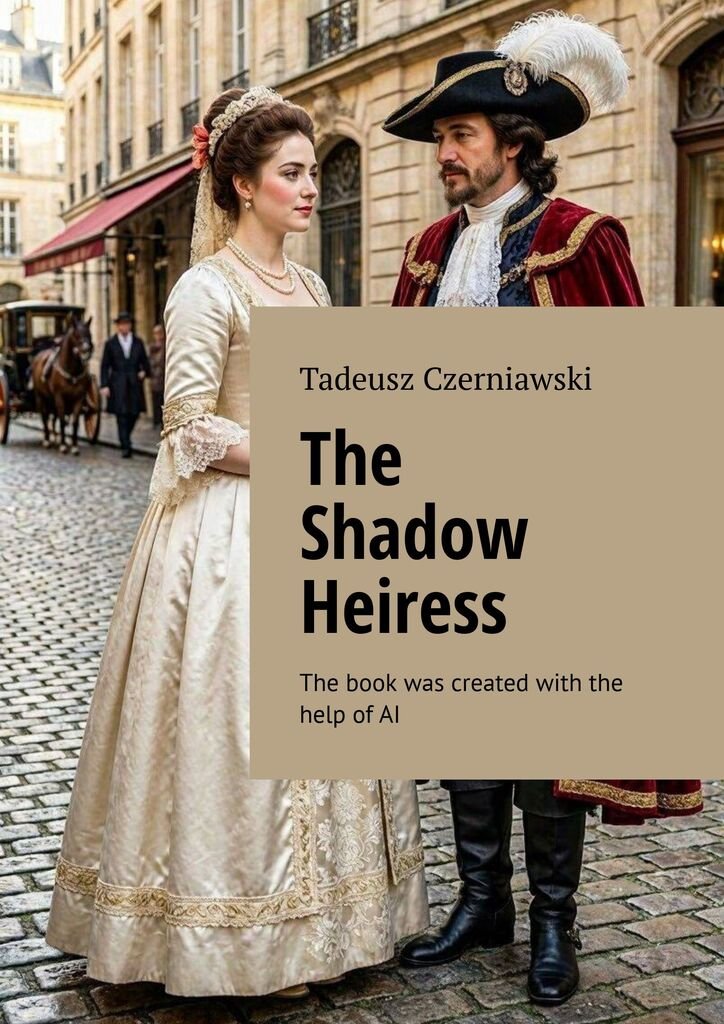
The Shadow Heiress - ebook
In a magical Versailles, Camille de Lacroix arrives as a royal bride candidate hiding a deadly secret: she has no true Shadow. When a king’s advisor is murdered and her family’s mark is found at the scene, Camille is thrust into a court conspiracy where stolen magic, dangerous desire, and betrayal could save the crown — or burn France to ash. The book was created with the help of AI
Ta publikacja spełnia wymagania dostępności zgodnie z dyrektywą EAA.
| Kategoria: | Proza |
| Zabezpieczenie: |
Watermark
|
| ISBN: | 978-83-8455-834-8 |
| Rozmiar pliku: | 1,2 MB |
FRAGMENT KSIĄŻKI
Preface
There are books that entertain, books that enchant, and books that seem to slip a hand beneath your ribs and remind you that fear, longing, ambition, and love have always lived in the same dark chamber of the human heart. _The Shadow Heiress_ belongs to that rare third category. It is a novel of masks and power, of glittering halls and hidden wounds, of magic used not only to dazzle but to dominate. Yet for all its splendor, what lingers after the final page is not merely the grandeur of its world, but the emotional truth beating at its center.
At first glance, this story offers everything a reader of historical fantasy could hope for: a reimagined Versailles steeped in ceremony and danger, a court where secrets travel faster than footsteps, and a magic system so elegant and sinister that it feels both original and inevitable. Here, Shadows are not metaphors alone. They are living instruments of surveillance, seduction, memory, and death. They obey bloodlines, expose weakness, and make power visible. It is a brilliant conceit, and one that allows the novel to do what the best fantasy always does: translate invisible human structures into forms we can feel, fear, and understand.
But what makes this book exceptional is not simply the invention of its world. It is the woman who must survive it.
Camille de Lacroix enters the story with one of the richest and most compelling contradictions in recent fantasy: she is surrounded by magic, judged by magic, summoned because of magic, and yet the central truth of her life is the absence of it. She is not merely an outsider at court; she is a young woman forced to perform belonging in a system built to detect and punish those who do not belong. That tension gives the novel its pulse. Camille’s intelligence, restraint, and emotional discipline are not decorative character traits. They are survival tools. She does not move through Versailles because she is fearless. She moves through it because she has learned that fear can be mastered, redirected, sharpened into perception.
That perception is one of the novel’s great pleasures. Camille is a heroine who watches before she speaks, who understands that the body often confesses what the mouth denies, and who reads rooms with an acuity bordering on the supernatural. In a palace crowded with noble Shadows, she sees what others miss: the tremor beneath a smile, the silence that means more than a declaration, the tiny fracture in a person’s carefully arranged composure. This gives the story a psychological intelligence that elevates every scene. Court intrigue can so easily become costume and choreography. Here, it becomes anatomy. Every glance matters. Every pause carries risk. Every performance has a cost.
And what performances they are. This novel understands something essential about aristocratic worlds, both historical and invented: that etiquette is warfare in lace cuffs, that politeness is often only violence slowed to a socially acceptable speed, and that the most dangerous rooms are not always those where swords are drawn, but those where everyone is smiling. The book captures this with rare confidence. It gives us rivalry sharpened by vulnerability, flirtation complicated by strategy, and ambition that is never simple because it is never free of consequence.
The emotional architecture of the story is equally strong. Camille’s journey is not just about proving her innocence or exposing a conspiracy, though both threads propel the plot with admirable force. It is also about identity — about the exhausting burden of pretending, the loneliness of being unseen, and the aching human need to be recognized without disguise. This is where the novel’s psychological depth and its romance intertwine so beautifully. The central romantic tension is not merely a matter of choosing between two men. It is a matter of who sees Camille most clearly, and what it means to be loved once you are truly known.
The prince is rendered with great sensitivity. He is not a simple fairy-tale reward, nor a hollow symbol of status. He is thoughtful, burdened, morally restless, and quietly tragic in the way many heirs are tragic: shaped by expectations he did not choose and watched by a world that mistakes duty for destiny. His connection with Camille carries tenderness, intellectual affinity, and the haunting sadness of two people meeting at the wrong angle of truth. Their scenes together are luminous because they are built not on spectacle, but on recognition.
And then there is the captain. He enters the novel carrying danger, skepticism, and a gaze sharp enough to cut through pretense in a heartbeat. The dynamic between him and Camille hums from the beginning with tension of the best kind: not merely attraction, but friction between two people who understand survival in ways that others around them do not. Their relationship unfolds with admirable control. It is not rushed. It is earned. It grows through mistrust, leverage, reluctant respect, and the kind of emotional honesty that only becomes possible once every easier option has failed. This gives the romance not only heat, but gravity.
What I particularly admire is the novel’s refusal to reduce its characters to roles. The rivals are not only rivals. The rulers are not only rulers. Even the antagonists are granted coherence of motive. The story understands that people justify themselves with frightening eloquence, especially when power is involved. This does not make cruelty less cruel, but it makes the conflict more unsettling, and therefore more memorable. Evil here is not random. It is structured, rationalized, elegant. That is always the most dangerous kind.
Thematically, _The Shadow Heiress_ is far richer than its shimmering surface first suggests. It is, among other things, a meditation on inherited power and inherited damage. Bloodlines in this novel confer privilege, yes, but they also transmit decay, expectation, and violence. The book asks what it costs to be born into power, what it costs to be excluded from it, and whether systems built on ancient bargains can ever be made humane. These are large questions, but they are never handled abstractly. They are embedded in bodies, families, illnesses, loyalties, and betrayals. They hurt. That is why they matter.
The prose carries the right kind of duality for such a tale: atmospheric without becoming heavy, vivid without losing clarity, romantic without sentimentality. There is a sensual intelligence to the descriptions of candlelight, silk, blood, stone, gardens, mirrors, and shadow that makes the world feel tactile and lived-in. At the same time, the storytelling never forgets momentum. It knows when to linger and when to strike. It knows how to build dread. It knows how to let revelation bloom at exactly the right moment.
Readers who come for the glamour of court fantasy will find it in abundance. Readers who come for mystery will find a conspiracy that deepens with satisfying complexity. Readers who come for romance will find not one easy fantasy, but several hard truths about love, trust, and the terrible vulnerability of being seen. And readers who come for character will find, in Camille de Lacroix, a heroine worthy of fierce devotion: clever without coldness, frightened without passivity, wounded without fragility, and brave in the way that matters most — brave enough to keep choosing truth even when truth threatens to take everything from her.
This is a novel that understands its readers. It knows the intoxicating appeal of dark corridors, forbidden gardens, dangerous men, secret pacts, and royal intrigue. But it also knows that spectacle alone is never enough. What remains with us, always, is the emotional truth under the glitter. Who are we when the mask breaks? What part of ourselves survives performance? What kind of power do we seek when all inherited power has failed us? And who, if anyone, will stand beside us when the world learns what we have hidden?
_The Shadow Heiress_ answers these questions with intelligence, elegance, and heart. It is thrilling, romantic, politically sharp, and emotionally resonant. More importantly, it is the kind of fantasy that reminds us why stories of shadows endure: because they are never only about darkness. They are about what the darkness reveals when false light finally falls away.
Enter this book as you would enter Versailles in the half-light — carefully, curiously, alert to beauty and danger in equal measure. Once inside, you may find it difficult to leave.Chapter 1: The last light of the de Lacroix
The blood never fell the same way twice.
Camille de Lacroix had learned this over seventeen months of practice — seventeen months of pricking her finger in the dark, of watching the droplet swell on her fingertip like a tiny garnet, of holding her breath as it fell into the waiting mouth of something that should not exist. Some nights the blood dropped clean and fast, a single crimson bead that the Fragment absorbed with a shudder of gratitude. Other nights it clung to her skin, reluctant, as if her body knew what her mind refused to accept: that she was feeding a lie with pieces of herself, and the lie was always hungry.
Tonight, the blood clung.
She sat cross-legged on the floor of her bedchamber in the Château de Lacroix, her back against the cold stone wall, her left hand extended over a shallow copper bowl that had once belonged to her grandmother. The bowl was engraved with the family crest — a falcon in flight, talons extended, above the motto Nous Voyons Dans L’Ombre. We See in Shadow. A fine motto for a family that could no longer see anything at all.
The Fragment waited in the bowl like a pool of living ink. It was roughly the size of a man’s fist when compressed, though it could stretch and reshape itself into something that approximated a proper Shadow — a dark, semi-humanoid presence that hovered at its master’s shoulder, dense enough to cast its own faint anti-light, animate enough to turn its featureless head as if surveying a room. From a distance, in dim light, it could pass for the real thing. Camille had spent months refining its movements, learning to puppet it with micro-gestures of her fingers, training it to respond to subtle shifts in her posture so that it appeared to move with independent will.
But it was not a Shadow. It was a Fragment — a piece of dead magic, harvested from a noble bloodline that had ended without heirs, preserved through alchemical processes that were technically illegal in fourteen of France’s twenty provinces. It had no awareness, no hunger, no loyalty. It could not whisper through keyholes or steal memories from sleeping minds. It could not wrap itself around a man’s heart and squeeze until the beating stopped. It was a costume. A puppet. A remarkably convincing nothing.
And it needed to eat.
„Come on,” Camille murmured, squeezing her fingertip until the blood finally released and dropped into the Fragment with a soft, wet sound, like a stone falling into a still pond. The Fragment rippled. Darkened. Expanded slightly, its edges firming up, its texture shifting from translucent to opaque. She watched it with the clinical attention of a physician monitoring a patient’s pulse, cataloging each response: absorption rate, three seconds — slower than last week. Expansion coefficient, adequate but not robust. Color density, perhaps eighty percent of what a true Shadow would present. At court, where Shadows were displayed like jewels and judged with the same exacting eye, eighty percent might not be enough.
She fed it a second drop, then a third. The Fragment shuddered with something that, if she were being generous, she might call satisfaction. It rose from the bowl and drifted to its customary position at her left shoulder, hovering just above the fabric of her dress, a dark smudge against the candlelit room. Camille turned her head and regarded it.
„You look terrible,” she told it.
The Fragment, possessing neither ears nor opinions, said nothing.
Camille cleaned the copper bowl with a rag, wrapped her pricked finger in a strip of linen, and stood. The room swam for a moment — she had been lightheaded more often lately, and she suspected the blood-feeding was partly to blame, though she refused to calculate exactly how much blood she had given the Fragment over seventeen months. Some arithmetic was better left undone.
Her bedchamber was the finest room in the château, which was rather like being the tallest blade of grass in a mown field. The tapestries on the walls were genuine Flemish work, but they were faded and moth-eaten, their once-vivid hunting scenes reduced to ghostly suggestions of hounds and horses. The bed was massive, carved from oak in the previous century, but two of its four posts were cracked and the canopy drooped on one side like a wilting flower. The window overlooked what had once been a formal garden and was now a wilderness of unpruned roses and ambitious weeds. The Château de Lacroix was a monument to the specific French art of dignified decay — everything grand, everything broken, everything maintained just enough to suggest that someone still cared, even when caring had become a kind of performance in itself.
There was a proverb in Provence that Camille’s old nurse had been fond of repeating: „A château without a Shadow is just a pile of expensive stones.” The nurse had meant it as a general truth about the aristocracy — that magic was the mortar that held noble houses together — but she could not have known how literally it would apply to the de Lacroix family. When the Shadow left, everything else followed. The money. The influence. The invitations. The marriages. The health.
The health especially.
Camille crossed the corridor to Théo’s room, her Fragment gliding silently behind her. She knocked softly, though she knew he would be awake. Théo was always awake at this hour. The illness that was consuming him — slowly, patiently, like a river wearing away a stone — had stolen his ability to sleep through the night. He dozed in fragments, waking and sleeping in unpredictable cycles that left him perpetually exhausted and perpetually alert, a combination that had made him, at sixteen, the most observant person Camille had ever known. Théo saw everything. This was partly because he had nothing to do but watch, and partly because whatever the family had lost when their Shadow departed, it had not taken Théo’s mind. If anything, the boy’s intellect burned brighter as his body dimmed, as if his consciousness were compensating for the failure of his flesh.
„Enter, sister, and bring your puppet with you,” Théo called from within, his voice carrying the particular mix of warmth and mischief that Camille associated with her brother the way other people associated certain melodies with certain memories — instantly, viscerally, with a pang.
She opened the door. Théo was propped up in bed against a fortress of pillows, a book open on his lap, a candle guttering on the bedside table. He was thin — thinner than last month, she noted with a stab of worry — and his skin had the translucent quality of fine porcelain, blue veins visible at his temples and wrists. His dark hair, the same near-black as Camille’s, fell across his forehead in untidy waves. His eyes, though, were bright and sharp and full of the particular delight he took in making his sister uncomfortable.
„You heard the feeding?” Camille asked, settling into the chair beside his bed.
„I heard you talking to it. »You look terrible,« you said. As critiques go, it lacked nuance.” He peered past her at the Fragment, which hovered in the doorway as if uncertain of its welcome. „Although you weren’t wrong. It does look terrible. It’s listing to the left.”
Camille glanced over her shoulder. The Fragment was, indeed, listing slightly — a flaw in its cohesion that she hadn’t noticed. She made a subtle corrective gesture with her left hand, and it straightened. Théo watched this with undisguised fascination.
„How do you do that?” he asked. „The puppetry. You never explain it properly.”
„Because explaining it properly would require admitting that I’ve spent a year and a half learning to manipulate a blob of dead magic with my fingers, and I prefer to maintain at least the illusion of dignity.”
„Dignity,” Théo repeated, savoring the word. „You’re about to walk into the most powerful court in Europe with a counterfeit Shadow and a dress that Maman wore in 1635. Dignity left this family around the same time the Shadow did.”
He said it lightly, but Camille heard the edge beneath the humor. Théo had been fourteen when their father had finally admitted the truth that the household had been circling for years: the de Lacroix Shadow was gone. Not weakened, not dormant, but gone — severed from the bloodline by some mechanism that Gérard de Lacroix either could not or would not explain. The Fading, the old texts called it. A slow dissolution of the blood-bond between a noble family and its Shadow, ending in the Shadow’s departure. It was the aristocratic equivalent of a death sentence — not sudden, but certain, and carrying with it a shame so profound that most Faded families simply disappeared from public life, retreating to their estates to decay in private.
The de Lacroix family had decayed on schedule. But Marquis Gérard, despite his many failings as a manager of money, land, and truth, had refused to disappear. When the royal summons arrived — an invitation for Camille to present herself at Versailles as a candidate for the hand of Prince Étienne — Gérard had seized upon it with the desperate energy of a drowning man reaching for driftwood. The summons was genuine; the de Lacroix name, however tarnished, still appeared in the rolls of ancient nobility, and the Crown’s selection process cast a wide net. But to accept the summons, Camille would need a Shadow. And so Gérard had spent the last of the family’s reserves — the silver candlesticks, the remaining good horses, a small Caravaggio that had been in the family for sixty years — to purchase the Fragment from an alchemist in Marseille whose name he refused to share and whose methods he preferred not to contemplate.
„The Fragment will hold,” Camille said, more firmly than she felt. „It only needs to last long enough for me to make an impression.”
„An impression,” Théo echoed. He had a habit of repeating her words back to her, testing them for structural integrity like an engineer tapping a bridge. „And what sort of impression are you planning to make? The mysterious provincial noblewoman with the unusually quiet Shadow? The modest ingénue who prefers restraint over display? Because I’ve been thinking about this, Camille, and I believe your strategy has a significant flaw.”
„Only one?”
„The flaw is that Versailles is a place where Shadows are currency. Every interaction, every dinner, every dance is an opportunity for display. You will be expected to demonstrate your Shadow’s abilities — not immediately, perhaps, but soon. And when that moment comes, your charming puppet will be revealed as exactly what it is: a dead thing pretending to be alive.”
Camille looked at her brother, at his wasted frame and his ferocious mind, and felt the familiar compound of love and heartbreak that defined their relationship. He was right, of course. He was nearly always right. But being right was a luxury that only people with choices could afford, and the de Lacroix family had run out of choices approximately the same time they had run out of Caravaggio paintings.
„The physician says you need the new medicines from Paris,” Camille said quietly. „The ones derived from Mediterranean herbs. They cost more than this house is worth.”
Théo’s expression shifted. The mischief dimmed, replaced by something older and more complicated. „So this is about me.”
„This is about all of us. But yes. Mostly you.”
A silence settled between them, filled with the things they never quite said: that Théo’s illness was getting worse, that the local physician had exhausted his knowledge, that the expensive medicines from Paris represented not a cure but a delay, a purchased extension of time that might or might not be enough. Camille did not tell her brother about the other possibility — the one she had begun to suspect and could not yet confirm — that his illness was connected to the Fading itself, that the Shadow’s departure had left a wound in the family bloodline and Théo, born after the Fading began, was the one paying the price. She did not tell him because the theory was unproven, because it would frighten him, and because there was nothing either of them could do about it from a crumbling château in Provence.
But at Versailles, surrounded by the most powerful Shadows in France, surrounded by libraries and scholars and centuries of accumulated magical knowledge — at Versailles, perhaps, she could find answers.
„I brought you something,” Camille said, changing the subject with the gracelessness that Théo always forgave. She produced a small package wrapped in cloth: a new candle, beeswax rather than tallow, purchased in the village with coins she had scraped together from various hiding places around the château. It was a trivial gift. It was also the best she could manage.
Théo unwrapped it with the ceremony of a priest unveiling a relic. „Beeswax,” he said, inhaling its honey scent. „You spoil me, Camille. Next you’ll be bringing me actual food.”
„There’s bread and cheese in the kitchen. Father forgot to eat again.”
„Father forgets most things. It’s his primary talent.” Théo set the candle aside and reached under his pillow, producing a small, worn book. „My turn to give a gift. Take this with you.”
Camille took the book. It was a collection of poetry — Ronsard, well-thumbed, with annotations in Théo’s precise hand filling every margin. She recognized it as his most treasured possession, the book he returned to when the pain was bad and the nights were long.
„I can’t take this,” she said.
„You can and you will. Consider it tactical equipment. I’ve been told that princes appreciate women who read. And if the prince turns out to be an idiot, you can at least comfort yourself with good verse while you pretend to find him fascinating.”
Camille pressed the book to her chest. „I will bring it back.”
„You will bring it back,” Théo agreed. Then, with the careful precision of someone managing limited energy: „And you will bring yourself back, Camille. Whatever happens at Versailles — whatever they offer you, whatever they threaten you with — you come home. Promise me.”
„I promise.”
„Say it properly. Say: »I, Camille de Lacroix, promise my brother Théodore that I will return from Versailles alive, intact, and preferably with a rich husband, but the husband is optional.«”
Despite everything — despite the fear, the exhaustion, the impossible task ahead — Camille laughed. It was a real laugh, full and unguarded, and it filled the small, shabby room like sunlight. Théo grinned at her, and for a moment he looked like the boy he had been before the illness, the boy who had chased her through these corridors, who had hidden frogs in her shoes, who had once convinced the cook that he was dying of a rare disease that could only be cured by chocolate pastries.
„I, Camille de Lacroix,” she began.
„With appropriate solemnity, please.”
„I, Camille de Lacroix,” she repeated, lowering her voice to a mock-grave register, „promise my brother Théodore — who is the most irritating person in Provence and possibly in all of France — that I will return from Versailles alive, intact, and with a husband who is at minimum not actively repulsive.”
„Acceptable,” Théo said. „You may go and conquer the court. I will remain here and conquer this book. We shall see which of us faces the greater challenge.”
Camille kissed his forehead, felt the fever-warmth of his skin against her lips, and left before he could see her eyes fill.
Her father was waiting in the entrance hall, which was the grandest room in the château and therefore the most painful evidence of the family’s decline. The hall was two stories high, with a vaulted ceiling painted with scenes from classical mythology — Odysseus and the Sirens, Perseus and Medusa, other tales of heroes navigating impossible dangers through cleverness rather than strength. The paintings were masterful but water-stained, the ceiling leaking in three places despite repeated repairs. A grand staircase swept upward to a gallery that had once held portraits of twelve generations of de Lacroix ancestors. The portraits were gone — sold, one by one, over the past five years — and the gallery wall was now a patchwork of bright rectangles where the paintings had protected the wallpaper from fading, surrounded by the ghostly outlines of frames, a gallery of absences.
Marquis Gérard de Lacroix stood at the center of this diminished grandeur like the last actor on a dismantled stage. He was fifty-two but looked older — a tall man who had once been imposing and was now merely large, his frame thinned by worry and poor nutrition, his dark hair gone to grey, his face carrying the particular expression of someone who has spent years managing catastrophe and has forgotten what calm feels like. He wore his best coat, which was twenty years out of fashion, and he held a leather traveling case in both hands as if it were a holy object.
„The carriage is ready,” he said. „Such as it is.”
The carriage was a rented affair from the village — functional, unglamorous, drawn by two horses of no particular quality. It would take Camille as far as Lyon, where she would transfer to a public coach for the journey north to Paris and then west to Versailles. It was not the arrival that a bridal candidate for the Crown Prince of France would typically make, but Gérard had devised a cover story: Camille would claim that she had dismissed her private carriage in Lyon, preferring to travel modestly as a reflection of her family’s values. Humility as performance. Poverty as virtue. It was the kind of reframing at which the de Lacroix family had become expert.
Gérard handed her the traveling case. Inside, carefully wrapped in tissue, were the essentials of deception: a forged letter of introduction supplementing the genuine royal summons, a vial of her own blood preserved with salt and herbs for emergency Fragment feedings during the journey, a small pouch of coins — barely enough for two weeks of modest expenses — and a sealed envelope containing detailed instructions that Gérard had spent weeks composing.
„The instructions,” Gérard began.
„I’ve memorized them, Father.”
„Nonetheless. The critical points: never allow your Shadow — your Fragment — to be isolated for examination. At court, Shadows are regularly assessed by the Garde des Ombres, the Shadow Guard. If you are asked to present your Shadow for formal inspection, you must find a way to defer. Illness, fatigue, religious objection — any excuse will do, but use each excuse only once. You will have perhaps three or four opportunities to deflect before suspicion becomes certainty.”
Camille nodded. They had been over this a dozen times.
„Second: the blood-feeding must be performed every three days without exception. Miss a feeding, and the Fragment will begin to lose cohesion within hours. You will know it is failing when it becomes translucent at the edges. At that point, you have perhaps six hours before it dissolves entirely.”
„Every three days. Yes.”
„Third, and most important.” Gérard paused, and Camille saw something shift in his face — the manager of catastrophe giving way, briefly, to the father. „Do not trust anyone. Not the other candidates, not the courtiers, not the servants. Versailles is a machine designed to extract secrets. Every conversation is an interrogation, every kindness is a transaction, every smile is a mask. You are walking into a nest of people who have spent their entire lives wielding power that you do not possess. Your only advantages are your intelligence and their assumption that you are what you appear to be. The moment that assumption fails, you are finished.”
He held her gaze, and Camille saw in his eyes the thing he would never say aloud: the guilt. It was Gérard who had lost the family’s fortune through a series of ill-advised investments. It was Gérard who had failed to secure advantageous marriages for himself or his daughter when the family still had leverage. It was Gérard who had watched the Shadow weaken year by year and done nothing — or nothing effective — to halt the Fading. And it was Gérard who was now sending his twenty-one-year-old daughter into the most dangerous court in Europe armed with a fraud and a prayer.
He knew what he was doing. He knew it was wrong. He was doing it anyway, because the alternative was watching Théo die in a crumbling house while the de Lacroix name dissolved into the kind of historical footnote that scholars glanced at and forgot. The de Lacroix family: a minor noble house of Provence, attested from the twelfth century, extinct by the seventeenth. Notable for nothing in particular.
There was a saying among the old families of France, one that Camille had found in a book of aristocratic proverbs so ancient that its leather binding had turned to powder: „A name without a Shadow is a ghost that has not yet learned it is dead.” The de Lacroix family was not yet dead. But it was haunting its own house, drifting through rooms that no longer belonged to it in any meaningful sense, performing the rituals of nobility — the meals, the manners, the morning prayers — for an audience of no one.
Unless Camille could change the ending.
„I understand, Father,” she said. She took the traveling case and kissed his cheek. His skin was rough, improperly shaved. He smelled of old books and worry. „I will be careful.”
„Be more than careful,” Gérard said. „Be invisible. The safest person at court is the one nobody is looking at.”
Camille thought of the Fragment hovering at her shoulder — a visible, constant, scrutinizable declaration of magical identity — and reflected that invisibility was unlikely to be an option. But she said nothing. She had learned, in twenty-one years as Gérard de Lacroix’s daughter, that her father’s advice was often sound in principle and disastrous in application. She would take the principle and improvise the application.
She climbed into the rented carriage. The driver, a taciturn man from the village who had been paid in advance and asked no questions, clicked his tongue at the horses. The carriage lurched into motion, its wheels grinding on the gravel drive, and the Château de Lacroix began to recede behind her — its stone walls golden in the early morning light, its broken shutters and overgrown gardens and empty portrait gallery all compressed by distance into a single, coherent image that looked, from far enough away, like a proper noble estate. Like a home that still mattered.
Camille watched it until the road curved and the château disappeared behind a stand of poplars. Then she turned forward and opened Théo’s book of poetry. The pages fell open to a passage her brother had underlined twice and annotated in his cramped, precise hand:
„I go to seek a grand perhaps.”
In the margin, Théo had written: „Rabelais said this on his deathbed. You are not dying, sister. You are beginning. But the perhaps is still grand.”
The journey north took eight days. Eight days of rattling roads, indifferent inns, and the constant, low-level anxiety of maintaining the Fragment through irregular feedings performed in rented rooms with unreliable locks. Camille developed a routine: arrive at the inn, secure her room, wedge a chair against the door, feed the Fragment, sleep with one hand on the copper bowl and the other on the small knife she carried in her bodice. She spoke to no one beyond the minimum required for commerce. She read Théo’s poetry. She practiced her story — the narrative of Camille de Lacroix, daughter of the Marquis, bearer of an ancient Shadow, modest in manner, gentle in temperament, suitable in every way for the hand of a prince.
The story was mostly true, which was the most dangerous kind of lie. Everything about Camille was genuine except the one thing that mattered most.
She transferred to the public coach in Lyon and found herself sharing the compartment with a merchant’s wife heading to Paris and a young priest who slept with his mouth open. The merchant’s wife was chatty and curious, peppering Camille with questions about her destination and her family. Camille deflected with practiced ease, turning the conversation back to the woman’s own affairs — a technique she had learned from observation rather than instruction. People who felt listened to rarely noticed that they had learned nothing about the listener.
The landscape changed as they moved north: the dry gold of Provence giving way to the greener, softer countryside of the Île-de-France, the air thickening with moisture, the sky lowering from the infinite Provençal blue to a more tentative, pearl-grey vault. Camille watched the transformation with a feeling she could not quite name — something between anticipation and dread, seasoned with a strange, inappropriate excitement that she did not entirely trust. She was heading toward danger. She was also heading toward the most extraordinary place in Europe, and some part of her — the part that was twenty-one years old and had never been farther than Aix-en-Provence — wanted to see it.
On the final morning, the coach crested a low hill and Versailles appeared.
Camille had seen engravings. She had read descriptions. She had listened to her father’s stories of the court he had attended as a young man, when the de Lacroix Shadow was strong and the family name opened doors. None of it had prepared her for the reality.
The palace spread across the landscape like something that had grown rather than been built — a vast, pale organism of stone and glass, its wings extending outward in geometrical embraces, its gardens stretching to the horizon in patterns so precise they seemed to impose human will on the earth itself. The scale was not merely large; it was argumentative. It insisted on its own importance with a vehemence that bordered on aggression. The morning sun caught the windows and turned them to sheets of gold, and the light seemed to emanate from the building rather than reflecting off it, as if Versailles were the source of illumination and the sun merely its accomplice.
But it was not the architecture that made Camille’s breath catch. It was the Shadows.
Even from this distance, she could feel them. Not with her eyes — Shadows were not visible in daylight except to those with specialized training — but with something deeper, something in the blood. The Fragment at her shoulder trembled, and Camille placed a steadying hand against it, a gesture that would have looked, to anyone watching, like a woman adjusting her collar. The Fragment was responding to the proximity of true Shadows — hundreds of them, perhaps thousands, concentrated within the palace and its grounds. The magical density was extraordinary. The air tasted the way it tasted before a storm: metallic, electric, heavy with potential.
Camille looked at the palace. The palace, in its way, looked back.
„Behave,” she whispered to the Fragment, too softly for the merchant’s wife or the sleeping priest to hear. „We are going to lie to a king.”
The Fragment shuddered once, as if in acknowledgment, and went still.
The coach rolled on, and the shadow of Versailles fell over them like a closing hand.
There are books that entertain, books that enchant, and books that seem to slip a hand beneath your ribs and remind you that fear, longing, ambition, and love have always lived in the same dark chamber of the human heart. _The Shadow Heiress_ belongs to that rare third category. It is a novel of masks and power, of glittering halls and hidden wounds, of magic used not only to dazzle but to dominate. Yet for all its splendor, what lingers after the final page is not merely the grandeur of its world, but the emotional truth beating at its center.
At first glance, this story offers everything a reader of historical fantasy could hope for: a reimagined Versailles steeped in ceremony and danger, a court where secrets travel faster than footsteps, and a magic system so elegant and sinister that it feels both original and inevitable. Here, Shadows are not metaphors alone. They are living instruments of surveillance, seduction, memory, and death. They obey bloodlines, expose weakness, and make power visible. It is a brilliant conceit, and one that allows the novel to do what the best fantasy always does: translate invisible human structures into forms we can feel, fear, and understand.
But what makes this book exceptional is not simply the invention of its world. It is the woman who must survive it.
Camille de Lacroix enters the story with one of the richest and most compelling contradictions in recent fantasy: she is surrounded by magic, judged by magic, summoned because of magic, and yet the central truth of her life is the absence of it. She is not merely an outsider at court; she is a young woman forced to perform belonging in a system built to detect and punish those who do not belong. That tension gives the novel its pulse. Camille’s intelligence, restraint, and emotional discipline are not decorative character traits. They are survival tools. She does not move through Versailles because she is fearless. She moves through it because she has learned that fear can be mastered, redirected, sharpened into perception.
That perception is one of the novel’s great pleasures. Camille is a heroine who watches before she speaks, who understands that the body often confesses what the mouth denies, and who reads rooms with an acuity bordering on the supernatural. In a palace crowded with noble Shadows, she sees what others miss: the tremor beneath a smile, the silence that means more than a declaration, the tiny fracture in a person’s carefully arranged composure. This gives the story a psychological intelligence that elevates every scene. Court intrigue can so easily become costume and choreography. Here, it becomes anatomy. Every glance matters. Every pause carries risk. Every performance has a cost.
And what performances they are. This novel understands something essential about aristocratic worlds, both historical and invented: that etiquette is warfare in lace cuffs, that politeness is often only violence slowed to a socially acceptable speed, and that the most dangerous rooms are not always those where swords are drawn, but those where everyone is smiling. The book captures this with rare confidence. It gives us rivalry sharpened by vulnerability, flirtation complicated by strategy, and ambition that is never simple because it is never free of consequence.
The emotional architecture of the story is equally strong. Camille’s journey is not just about proving her innocence or exposing a conspiracy, though both threads propel the plot with admirable force. It is also about identity — about the exhausting burden of pretending, the loneliness of being unseen, and the aching human need to be recognized without disguise. This is where the novel’s psychological depth and its romance intertwine so beautifully. The central romantic tension is not merely a matter of choosing between two men. It is a matter of who sees Camille most clearly, and what it means to be loved once you are truly known.
The prince is rendered with great sensitivity. He is not a simple fairy-tale reward, nor a hollow symbol of status. He is thoughtful, burdened, morally restless, and quietly tragic in the way many heirs are tragic: shaped by expectations he did not choose and watched by a world that mistakes duty for destiny. His connection with Camille carries tenderness, intellectual affinity, and the haunting sadness of two people meeting at the wrong angle of truth. Their scenes together are luminous because they are built not on spectacle, but on recognition.
And then there is the captain. He enters the novel carrying danger, skepticism, and a gaze sharp enough to cut through pretense in a heartbeat. The dynamic between him and Camille hums from the beginning with tension of the best kind: not merely attraction, but friction between two people who understand survival in ways that others around them do not. Their relationship unfolds with admirable control. It is not rushed. It is earned. It grows through mistrust, leverage, reluctant respect, and the kind of emotional honesty that only becomes possible once every easier option has failed. This gives the romance not only heat, but gravity.
What I particularly admire is the novel’s refusal to reduce its characters to roles. The rivals are not only rivals. The rulers are not only rulers. Even the antagonists are granted coherence of motive. The story understands that people justify themselves with frightening eloquence, especially when power is involved. This does not make cruelty less cruel, but it makes the conflict more unsettling, and therefore more memorable. Evil here is not random. It is structured, rationalized, elegant. That is always the most dangerous kind.
Thematically, _The Shadow Heiress_ is far richer than its shimmering surface first suggests. It is, among other things, a meditation on inherited power and inherited damage. Bloodlines in this novel confer privilege, yes, but they also transmit decay, expectation, and violence. The book asks what it costs to be born into power, what it costs to be excluded from it, and whether systems built on ancient bargains can ever be made humane. These are large questions, but they are never handled abstractly. They are embedded in bodies, families, illnesses, loyalties, and betrayals. They hurt. That is why they matter.
The prose carries the right kind of duality for such a tale: atmospheric without becoming heavy, vivid without losing clarity, romantic without sentimentality. There is a sensual intelligence to the descriptions of candlelight, silk, blood, stone, gardens, mirrors, and shadow that makes the world feel tactile and lived-in. At the same time, the storytelling never forgets momentum. It knows when to linger and when to strike. It knows how to build dread. It knows how to let revelation bloom at exactly the right moment.
Readers who come for the glamour of court fantasy will find it in abundance. Readers who come for mystery will find a conspiracy that deepens with satisfying complexity. Readers who come for romance will find not one easy fantasy, but several hard truths about love, trust, and the terrible vulnerability of being seen. And readers who come for character will find, in Camille de Lacroix, a heroine worthy of fierce devotion: clever without coldness, frightened without passivity, wounded without fragility, and brave in the way that matters most — brave enough to keep choosing truth even when truth threatens to take everything from her.
This is a novel that understands its readers. It knows the intoxicating appeal of dark corridors, forbidden gardens, dangerous men, secret pacts, and royal intrigue. But it also knows that spectacle alone is never enough. What remains with us, always, is the emotional truth under the glitter. Who are we when the mask breaks? What part of ourselves survives performance? What kind of power do we seek when all inherited power has failed us? And who, if anyone, will stand beside us when the world learns what we have hidden?
_The Shadow Heiress_ answers these questions with intelligence, elegance, and heart. It is thrilling, romantic, politically sharp, and emotionally resonant. More importantly, it is the kind of fantasy that reminds us why stories of shadows endure: because they are never only about darkness. They are about what the darkness reveals when false light finally falls away.
Enter this book as you would enter Versailles in the half-light — carefully, curiously, alert to beauty and danger in equal measure. Once inside, you may find it difficult to leave.Chapter 1: The last light of the de Lacroix
The blood never fell the same way twice.
Camille de Lacroix had learned this over seventeen months of practice — seventeen months of pricking her finger in the dark, of watching the droplet swell on her fingertip like a tiny garnet, of holding her breath as it fell into the waiting mouth of something that should not exist. Some nights the blood dropped clean and fast, a single crimson bead that the Fragment absorbed with a shudder of gratitude. Other nights it clung to her skin, reluctant, as if her body knew what her mind refused to accept: that she was feeding a lie with pieces of herself, and the lie was always hungry.
Tonight, the blood clung.
She sat cross-legged on the floor of her bedchamber in the Château de Lacroix, her back against the cold stone wall, her left hand extended over a shallow copper bowl that had once belonged to her grandmother. The bowl was engraved with the family crest — a falcon in flight, talons extended, above the motto Nous Voyons Dans L’Ombre. We See in Shadow. A fine motto for a family that could no longer see anything at all.
The Fragment waited in the bowl like a pool of living ink. It was roughly the size of a man’s fist when compressed, though it could stretch and reshape itself into something that approximated a proper Shadow — a dark, semi-humanoid presence that hovered at its master’s shoulder, dense enough to cast its own faint anti-light, animate enough to turn its featureless head as if surveying a room. From a distance, in dim light, it could pass for the real thing. Camille had spent months refining its movements, learning to puppet it with micro-gestures of her fingers, training it to respond to subtle shifts in her posture so that it appeared to move with independent will.
But it was not a Shadow. It was a Fragment — a piece of dead magic, harvested from a noble bloodline that had ended without heirs, preserved through alchemical processes that were technically illegal in fourteen of France’s twenty provinces. It had no awareness, no hunger, no loyalty. It could not whisper through keyholes or steal memories from sleeping minds. It could not wrap itself around a man’s heart and squeeze until the beating stopped. It was a costume. A puppet. A remarkably convincing nothing.
And it needed to eat.
„Come on,” Camille murmured, squeezing her fingertip until the blood finally released and dropped into the Fragment with a soft, wet sound, like a stone falling into a still pond. The Fragment rippled. Darkened. Expanded slightly, its edges firming up, its texture shifting from translucent to opaque. She watched it with the clinical attention of a physician monitoring a patient’s pulse, cataloging each response: absorption rate, three seconds — slower than last week. Expansion coefficient, adequate but not robust. Color density, perhaps eighty percent of what a true Shadow would present. At court, where Shadows were displayed like jewels and judged with the same exacting eye, eighty percent might not be enough.
She fed it a second drop, then a third. The Fragment shuddered with something that, if she were being generous, she might call satisfaction. It rose from the bowl and drifted to its customary position at her left shoulder, hovering just above the fabric of her dress, a dark smudge against the candlelit room. Camille turned her head and regarded it.
„You look terrible,” she told it.
The Fragment, possessing neither ears nor opinions, said nothing.
Camille cleaned the copper bowl with a rag, wrapped her pricked finger in a strip of linen, and stood. The room swam for a moment — she had been lightheaded more often lately, and she suspected the blood-feeding was partly to blame, though she refused to calculate exactly how much blood she had given the Fragment over seventeen months. Some arithmetic was better left undone.
Her bedchamber was the finest room in the château, which was rather like being the tallest blade of grass in a mown field. The tapestries on the walls were genuine Flemish work, but they were faded and moth-eaten, their once-vivid hunting scenes reduced to ghostly suggestions of hounds and horses. The bed was massive, carved from oak in the previous century, but two of its four posts were cracked and the canopy drooped on one side like a wilting flower. The window overlooked what had once been a formal garden and was now a wilderness of unpruned roses and ambitious weeds. The Château de Lacroix was a monument to the specific French art of dignified decay — everything grand, everything broken, everything maintained just enough to suggest that someone still cared, even when caring had become a kind of performance in itself.
There was a proverb in Provence that Camille’s old nurse had been fond of repeating: „A château without a Shadow is just a pile of expensive stones.” The nurse had meant it as a general truth about the aristocracy — that magic was the mortar that held noble houses together — but she could not have known how literally it would apply to the de Lacroix family. When the Shadow left, everything else followed. The money. The influence. The invitations. The marriages. The health.
The health especially.
Camille crossed the corridor to Théo’s room, her Fragment gliding silently behind her. She knocked softly, though she knew he would be awake. Théo was always awake at this hour. The illness that was consuming him — slowly, patiently, like a river wearing away a stone — had stolen his ability to sleep through the night. He dozed in fragments, waking and sleeping in unpredictable cycles that left him perpetually exhausted and perpetually alert, a combination that had made him, at sixteen, the most observant person Camille had ever known. Théo saw everything. This was partly because he had nothing to do but watch, and partly because whatever the family had lost when their Shadow departed, it had not taken Théo’s mind. If anything, the boy’s intellect burned brighter as his body dimmed, as if his consciousness were compensating for the failure of his flesh.
„Enter, sister, and bring your puppet with you,” Théo called from within, his voice carrying the particular mix of warmth and mischief that Camille associated with her brother the way other people associated certain melodies with certain memories — instantly, viscerally, with a pang.
She opened the door. Théo was propped up in bed against a fortress of pillows, a book open on his lap, a candle guttering on the bedside table. He was thin — thinner than last month, she noted with a stab of worry — and his skin had the translucent quality of fine porcelain, blue veins visible at his temples and wrists. His dark hair, the same near-black as Camille’s, fell across his forehead in untidy waves. His eyes, though, were bright and sharp and full of the particular delight he took in making his sister uncomfortable.
„You heard the feeding?” Camille asked, settling into the chair beside his bed.
„I heard you talking to it. »You look terrible,« you said. As critiques go, it lacked nuance.” He peered past her at the Fragment, which hovered in the doorway as if uncertain of its welcome. „Although you weren’t wrong. It does look terrible. It’s listing to the left.”
Camille glanced over her shoulder. The Fragment was, indeed, listing slightly — a flaw in its cohesion that she hadn’t noticed. She made a subtle corrective gesture with her left hand, and it straightened. Théo watched this with undisguised fascination.
„How do you do that?” he asked. „The puppetry. You never explain it properly.”
„Because explaining it properly would require admitting that I’ve spent a year and a half learning to manipulate a blob of dead magic with my fingers, and I prefer to maintain at least the illusion of dignity.”
„Dignity,” Théo repeated, savoring the word. „You’re about to walk into the most powerful court in Europe with a counterfeit Shadow and a dress that Maman wore in 1635. Dignity left this family around the same time the Shadow did.”
He said it lightly, but Camille heard the edge beneath the humor. Théo had been fourteen when their father had finally admitted the truth that the household had been circling for years: the de Lacroix Shadow was gone. Not weakened, not dormant, but gone — severed from the bloodline by some mechanism that Gérard de Lacroix either could not or would not explain. The Fading, the old texts called it. A slow dissolution of the blood-bond between a noble family and its Shadow, ending in the Shadow’s departure. It was the aristocratic equivalent of a death sentence — not sudden, but certain, and carrying with it a shame so profound that most Faded families simply disappeared from public life, retreating to their estates to decay in private.
The de Lacroix family had decayed on schedule. But Marquis Gérard, despite his many failings as a manager of money, land, and truth, had refused to disappear. When the royal summons arrived — an invitation for Camille to present herself at Versailles as a candidate for the hand of Prince Étienne — Gérard had seized upon it with the desperate energy of a drowning man reaching for driftwood. The summons was genuine; the de Lacroix name, however tarnished, still appeared in the rolls of ancient nobility, and the Crown’s selection process cast a wide net. But to accept the summons, Camille would need a Shadow. And so Gérard had spent the last of the family’s reserves — the silver candlesticks, the remaining good horses, a small Caravaggio that had been in the family for sixty years — to purchase the Fragment from an alchemist in Marseille whose name he refused to share and whose methods he preferred not to contemplate.
„The Fragment will hold,” Camille said, more firmly than she felt. „It only needs to last long enough for me to make an impression.”
„An impression,” Théo echoed. He had a habit of repeating her words back to her, testing them for structural integrity like an engineer tapping a bridge. „And what sort of impression are you planning to make? The mysterious provincial noblewoman with the unusually quiet Shadow? The modest ingénue who prefers restraint over display? Because I’ve been thinking about this, Camille, and I believe your strategy has a significant flaw.”
„Only one?”
„The flaw is that Versailles is a place where Shadows are currency. Every interaction, every dinner, every dance is an opportunity for display. You will be expected to demonstrate your Shadow’s abilities — not immediately, perhaps, but soon. And when that moment comes, your charming puppet will be revealed as exactly what it is: a dead thing pretending to be alive.”
Camille looked at her brother, at his wasted frame and his ferocious mind, and felt the familiar compound of love and heartbreak that defined their relationship. He was right, of course. He was nearly always right. But being right was a luxury that only people with choices could afford, and the de Lacroix family had run out of choices approximately the same time they had run out of Caravaggio paintings.
„The physician says you need the new medicines from Paris,” Camille said quietly. „The ones derived from Mediterranean herbs. They cost more than this house is worth.”
Théo’s expression shifted. The mischief dimmed, replaced by something older and more complicated. „So this is about me.”
„This is about all of us. But yes. Mostly you.”
A silence settled between them, filled with the things they never quite said: that Théo’s illness was getting worse, that the local physician had exhausted his knowledge, that the expensive medicines from Paris represented not a cure but a delay, a purchased extension of time that might or might not be enough. Camille did not tell her brother about the other possibility — the one she had begun to suspect and could not yet confirm — that his illness was connected to the Fading itself, that the Shadow’s departure had left a wound in the family bloodline and Théo, born after the Fading began, was the one paying the price. She did not tell him because the theory was unproven, because it would frighten him, and because there was nothing either of them could do about it from a crumbling château in Provence.
But at Versailles, surrounded by the most powerful Shadows in France, surrounded by libraries and scholars and centuries of accumulated magical knowledge — at Versailles, perhaps, she could find answers.
„I brought you something,” Camille said, changing the subject with the gracelessness that Théo always forgave. She produced a small package wrapped in cloth: a new candle, beeswax rather than tallow, purchased in the village with coins she had scraped together from various hiding places around the château. It was a trivial gift. It was also the best she could manage.
Théo unwrapped it with the ceremony of a priest unveiling a relic. „Beeswax,” he said, inhaling its honey scent. „You spoil me, Camille. Next you’ll be bringing me actual food.”
„There’s bread and cheese in the kitchen. Father forgot to eat again.”
„Father forgets most things. It’s his primary talent.” Théo set the candle aside and reached under his pillow, producing a small, worn book. „My turn to give a gift. Take this with you.”
Camille took the book. It was a collection of poetry — Ronsard, well-thumbed, with annotations in Théo’s precise hand filling every margin. She recognized it as his most treasured possession, the book he returned to when the pain was bad and the nights were long.
„I can’t take this,” she said.
„You can and you will. Consider it tactical equipment. I’ve been told that princes appreciate women who read. And if the prince turns out to be an idiot, you can at least comfort yourself with good verse while you pretend to find him fascinating.”
Camille pressed the book to her chest. „I will bring it back.”
„You will bring it back,” Théo agreed. Then, with the careful precision of someone managing limited energy: „And you will bring yourself back, Camille. Whatever happens at Versailles — whatever they offer you, whatever they threaten you with — you come home. Promise me.”
„I promise.”
„Say it properly. Say: »I, Camille de Lacroix, promise my brother Théodore that I will return from Versailles alive, intact, and preferably with a rich husband, but the husband is optional.«”
Despite everything — despite the fear, the exhaustion, the impossible task ahead — Camille laughed. It was a real laugh, full and unguarded, and it filled the small, shabby room like sunlight. Théo grinned at her, and for a moment he looked like the boy he had been before the illness, the boy who had chased her through these corridors, who had hidden frogs in her shoes, who had once convinced the cook that he was dying of a rare disease that could only be cured by chocolate pastries.
„I, Camille de Lacroix,” she began.
„With appropriate solemnity, please.”
„I, Camille de Lacroix,” she repeated, lowering her voice to a mock-grave register, „promise my brother Théodore — who is the most irritating person in Provence and possibly in all of France — that I will return from Versailles alive, intact, and with a husband who is at minimum not actively repulsive.”
„Acceptable,” Théo said. „You may go and conquer the court. I will remain here and conquer this book. We shall see which of us faces the greater challenge.”
Camille kissed his forehead, felt the fever-warmth of his skin against her lips, and left before he could see her eyes fill.
Her father was waiting in the entrance hall, which was the grandest room in the château and therefore the most painful evidence of the family’s decline. The hall was two stories high, with a vaulted ceiling painted with scenes from classical mythology — Odysseus and the Sirens, Perseus and Medusa, other tales of heroes navigating impossible dangers through cleverness rather than strength. The paintings were masterful but water-stained, the ceiling leaking in three places despite repeated repairs. A grand staircase swept upward to a gallery that had once held portraits of twelve generations of de Lacroix ancestors. The portraits were gone — sold, one by one, over the past five years — and the gallery wall was now a patchwork of bright rectangles where the paintings had protected the wallpaper from fading, surrounded by the ghostly outlines of frames, a gallery of absences.
Marquis Gérard de Lacroix stood at the center of this diminished grandeur like the last actor on a dismantled stage. He was fifty-two but looked older — a tall man who had once been imposing and was now merely large, his frame thinned by worry and poor nutrition, his dark hair gone to grey, his face carrying the particular expression of someone who has spent years managing catastrophe and has forgotten what calm feels like. He wore his best coat, which was twenty years out of fashion, and he held a leather traveling case in both hands as if it were a holy object.
„The carriage is ready,” he said. „Such as it is.”
The carriage was a rented affair from the village — functional, unglamorous, drawn by two horses of no particular quality. It would take Camille as far as Lyon, where she would transfer to a public coach for the journey north to Paris and then west to Versailles. It was not the arrival that a bridal candidate for the Crown Prince of France would typically make, but Gérard had devised a cover story: Camille would claim that she had dismissed her private carriage in Lyon, preferring to travel modestly as a reflection of her family’s values. Humility as performance. Poverty as virtue. It was the kind of reframing at which the de Lacroix family had become expert.
Gérard handed her the traveling case. Inside, carefully wrapped in tissue, were the essentials of deception: a forged letter of introduction supplementing the genuine royal summons, a vial of her own blood preserved with salt and herbs for emergency Fragment feedings during the journey, a small pouch of coins — barely enough for two weeks of modest expenses — and a sealed envelope containing detailed instructions that Gérard had spent weeks composing.
„The instructions,” Gérard began.
„I’ve memorized them, Father.”
„Nonetheless. The critical points: never allow your Shadow — your Fragment — to be isolated for examination. At court, Shadows are regularly assessed by the Garde des Ombres, the Shadow Guard. If you are asked to present your Shadow for formal inspection, you must find a way to defer. Illness, fatigue, religious objection — any excuse will do, but use each excuse only once. You will have perhaps three or four opportunities to deflect before suspicion becomes certainty.”
Camille nodded. They had been over this a dozen times.
„Second: the blood-feeding must be performed every three days without exception. Miss a feeding, and the Fragment will begin to lose cohesion within hours. You will know it is failing when it becomes translucent at the edges. At that point, you have perhaps six hours before it dissolves entirely.”
„Every three days. Yes.”
„Third, and most important.” Gérard paused, and Camille saw something shift in his face — the manager of catastrophe giving way, briefly, to the father. „Do not trust anyone. Not the other candidates, not the courtiers, not the servants. Versailles is a machine designed to extract secrets. Every conversation is an interrogation, every kindness is a transaction, every smile is a mask. You are walking into a nest of people who have spent their entire lives wielding power that you do not possess. Your only advantages are your intelligence and their assumption that you are what you appear to be. The moment that assumption fails, you are finished.”
He held her gaze, and Camille saw in his eyes the thing he would never say aloud: the guilt. It was Gérard who had lost the family’s fortune through a series of ill-advised investments. It was Gérard who had failed to secure advantageous marriages for himself or his daughter when the family still had leverage. It was Gérard who had watched the Shadow weaken year by year and done nothing — or nothing effective — to halt the Fading. And it was Gérard who was now sending his twenty-one-year-old daughter into the most dangerous court in Europe armed with a fraud and a prayer.
He knew what he was doing. He knew it was wrong. He was doing it anyway, because the alternative was watching Théo die in a crumbling house while the de Lacroix name dissolved into the kind of historical footnote that scholars glanced at and forgot. The de Lacroix family: a minor noble house of Provence, attested from the twelfth century, extinct by the seventeenth. Notable for nothing in particular.
There was a saying among the old families of France, one that Camille had found in a book of aristocratic proverbs so ancient that its leather binding had turned to powder: „A name without a Shadow is a ghost that has not yet learned it is dead.” The de Lacroix family was not yet dead. But it was haunting its own house, drifting through rooms that no longer belonged to it in any meaningful sense, performing the rituals of nobility — the meals, the manners, the morning prayers — for an audience of no one.
Unless Camille could change the ending.
„I understand, Father,” she said. She took the traveling case and kissed his cheek. His skin was rough, improperly shaved. He smelled of old books and worry. „I will be careful.”
„Be more than careful,” Gérard said. „Be invisible. The safest person at court is the one nobody is looking at.”
Camille thought of the Fragment hovering at her shoulder — a visible, constant, scrutinizable declaration of magical identity — and reflected that invisibility was unlikely to be an option. But she said nothing. She had learned, in twenty-one years as Gérard de Lacroix’s daughter, that her father’s advice was often sound in principle and disastrous in application. She would take the principle and improvise the application.
She climbed into the rented carriage. The driver, a taciturn man from the village who had been paid in advance and asked no questions, clicked his tongue at the horses. The carriage lurched into motion, its wheels grinding on the gravel drive, and the Château de Lacroix began to recede behind her — its stone walls golden in the early morning light, its broken shutters and overgrown gardens and empty portrait gallery all compressed by distance into a single, coherent image that looked, from far enough away, like a proper noble estate. Like a home that still mattered.
Camille watched it until the road curved and the château disappeared behind a stand of poplars. Then she turned forward and opened Théo’s book of poetry. The pages fell open to a passage her brother had underlined twice and annotated in his cramped, precise hand:
„I go to seek a grand perhaps.”
In the margin, Théo had written: „Rabelais said this on his deathbed. You are not dying, sister. You are beginning. But the perhaps is still grand.”
The journey north took eight days. Eight days of rattling roads, indifferent inns, and the constant, low-level anxiety of maintaining the Fragment through irregular feedings performed in rented rooms with unreliable locks. Camille developed a routine: arrive at the inn, secure her room, wedge a chair against the door, feed the Fragment, sleep with one hand on the copper bowl and the other on the small knife she carried in her bodice. She spoke to no one beyond the minimum required for commerce. She read Théo’s poetry. She practiced her story — the narrative of Camille de Lacroix, daughter of the Marquis, bearer of an ancient Shadow, modest in manner, gentle in temperament, suitable in every way for the hand of a prince.
The story was mostly true, which was the most dangerous kind of lie. Everything about Camille was genuine except the one thing that mattered most.
She transferred to the public coach in Lyon and found herself sharing the compartment with a merchant’s wife heading to Paris and a young priest who slept with his mouth open. The merchant’s wife was chatty and curious, peppering Camille with questions about her destination and her family. Camille deflected with practiced ease, turning the conversation back to the woman’s own affairs — a technique she had learned from observation rather than instruction. People who felt listened to rarely noticed that they had learned nothing about the listener.
The landscape changed as they moved north: the dry gold of Provence giving way to the greener, softer countryside of the Île-de-France, the air thickening with moisture, the sky lowering from the infinite Provençal blue to a more tentative, pearl-grey vault. Camille watched the transformation with a feeling she could not quite name — something between anticipation and dread, seasoned with a strange, inappropriate excitement that she did not entirely trust. She was heading toward danger. She was also heading toward the most extraordinary place in Europe, and some part of her — the part that was twenty-one years old and had never been farther than Aix-en-Provence — wanted to see it.
On the final morning, the coach crested a low hill and Versailles appeared.
Camille had seen engravings. She had read descriptions. She had listened to her father’s stories of the court he had attended as a young man, when the de Lacroix Shadow was strong and the family name opened doors. None of it had prepared her for the reality.
The palace spread across the landscape like something that had grown rather than been built — a vast, pale organism of stone and glass, its wings extending outward in geometrical embraces, its gardens stretching to the horizon in patterns so precise they seemed to impose human will on the earth itself. The scale was not merely large; it was argumentative. It insisted on its own importance with a vehemence that bordered on aggression. The morning sun caught the windows and turned them to sheets of gold, and the light seemed to emanate from the building rather than reflecting off it, as if Versailles were the source of illumination and the sun merely its accomplice.
But it was not the architecture that made Camille’s breath catch. It was the Shadows.
Even from this distance, she could feel them. Not with her eyes — Shadows were not visible in daylight except to those with specialized training — but with something deeper, something in the blood. The Fragment at her shoulder trembled, and Camille placed a steadying hand against it, a gesture that would have looked, to anyone watching, like a woman adjusting her collar. The Fragment was responding to the proximity of true Shadows — hundreds of them, perhaps thousands, concentrated within the palace and its grounds. The magical density was extraordinary. The air tasted the way it tasted before a storm: metallic, electric, heavy with potential.
Camille looked at the palace. The palace, in its way, looked back.
„Behave,” she whispered to the Fragment, too softly for the merchant’s wife or the sleeping priest to hear. „We are going to lie to a king.”
The Fragment shuddered once, as if in acknowledgment, and went still.
The coach rolled on, and the shadow of Versailles fell over them like a closing hand.
więcej..