MENU
MENU
 Nasze ceny

 Przeczytaj fragment on-line

-
 nowość
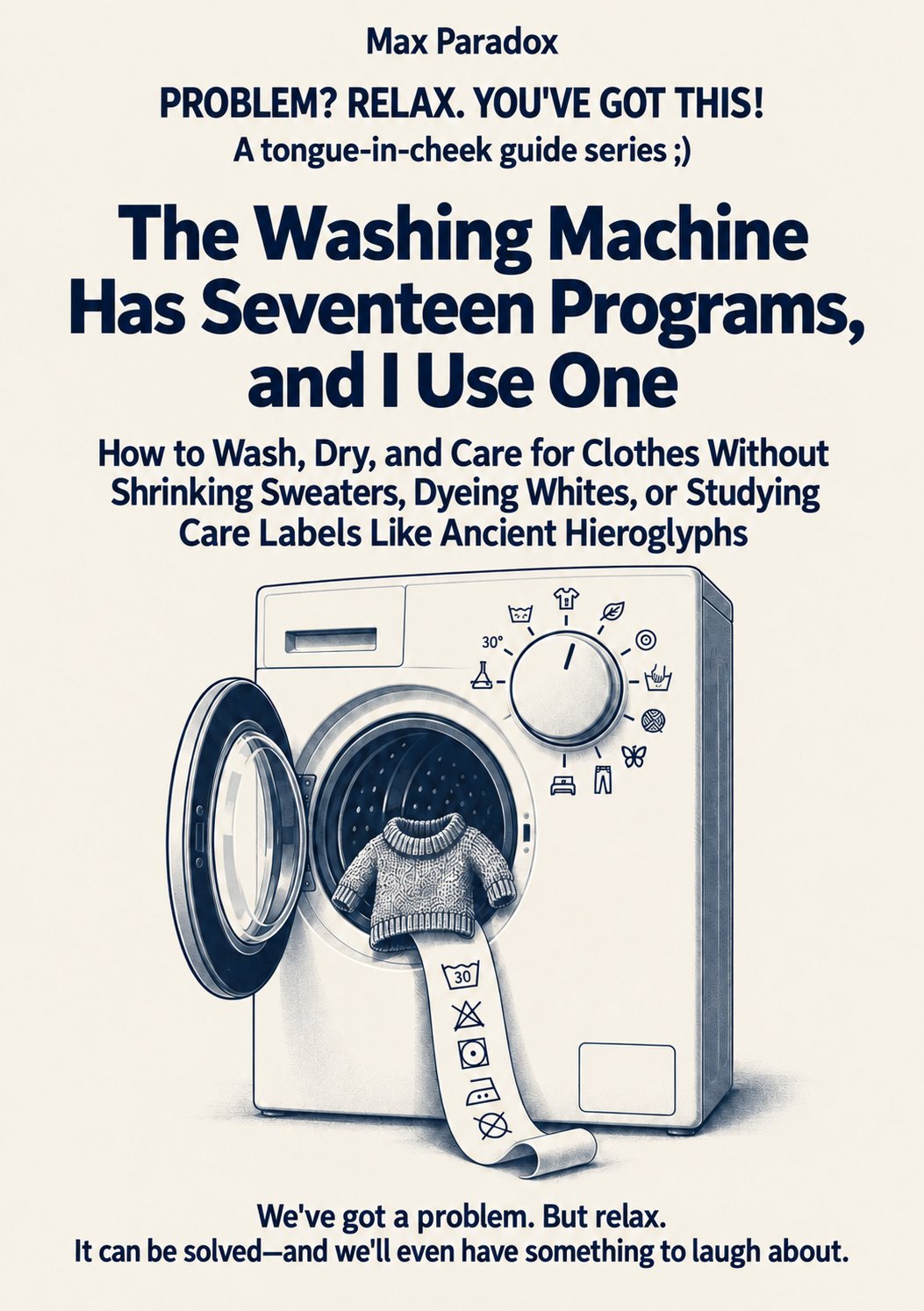
The Washing Machine Has Seventeen Programs, and I Use One - ebook

The Washing Machine Has Seventeen Programs, and I Use One - ebook
A clear and humorous guide to washing, drying and caring for clothes without shrinking sweaters, dyeing whites or treating care labels like ancient hieroglyphs. Through realistic examples and clear steps, Max Paradox shows how to make better everyday decisions, avoid common mistakes and build a simple system that still works when time, energy and patience are limited.
Ta publikacja spełnia wymagania dostępności zgodnie z dyrektywą EAA.
| Kategoria: | Poradniki |
| Język: | Angielski |
| Zabezpieczenie: |
Watermark
|
| Rozmiar pliku: | 1,8 MB |
FRAGMENT KSIĄŻKI
INTRO
You know the moment. The washer beeps, you open the door, and immediately something feels wrong. You reach in and pull out a sweater that went in as an adult medium and has returned as a confident children's size six. Next comes a white T-shirt with a faint pink glow, the sort of color nobody buys deliberately but laundry machines seem extremely proud to produce. Somewhere in the drum is one red sock looking completely innocent, which is bold considering the amount of evidence against it. You stand there holding your newly redesigned wardrobe and stare at the control panel, where seventeen programs wait patiently beneath symbols that appear to have been developed by an ancient civilization obsessed with cotton.
You use one of them.
You have used one of them for years.
It works. Usually. And "usually" is a remarkably powerful standard in domestic life. Usually the clothes come out cleaner. Usually they remain approximately the same size. Usually nobody has to search online for "can a sweater be unshrunk if it now fits a dachshund." That is enough to make one washing-machine setting feel less like a program and more like a trusted family tradition.
Laundry is strange because everybody is expected to know how to do it, yet very few people were ever properly taught. At some point somebody showed you where the detergent goes, mentioned something about separating whites, and released you into adulthood. From there, the knowledge was assembled from fragments. Your parents did one thing. A roommate insisted on another. Someone online swore that vinegar could solve everything short of international diplomacy. A detergent bottle introduced a dosage chart involving water hardness, kilograms and several tiny shirts. Eventually the safest response seemed obvious: pour in roughly the usual amount, select the familiar cycle and leave before the machine asks any follow-up questions.
Then clothes became more complicated. A basic cotton T-shirt is forgiving. A wool sweater has opinions. Sportswear arrives with technical fibers, elastic panels and care instructions written as if the shirt has a maintenance contract. Jackets may contain membranes, glued seams or fillings that turn a simple wash into an administrative procedure. Even towels, which look emotionally stable, suddenly come with debates about fabric softener, absorbency and whether they should be washed at a temperature normally associated with cooking vegetables.
And then there are care labels.
Care labels deserve some respect because they contain genuinely useful information. Unfortunately, they communicate it using a tiny bowl, a triangle, a square with a circle in it, several dots and occasionally a letter trapped inside another circle like it owes somebody money. You wanted to clean a shirt. The shirt has given you a puzzle.
So people improvise. We turn 30°C into a universal peace treaty. We assume "delicate" means safe for anything expensive. We use extra detergent because the clothes are extra dirty, then wonder why they feel coated. We cram the drum because running two loads feels inefficient, even though half the clothes can barely move and one pair of jeans has compressed itself into structural support. We dry everything together because wet is wet. Then one sweater emerges with the proportions of a decorative cushion and suddenly the appliance has betrayed us personally.
It has not, of course.
The machine did exactly what we told it to do.
That is the mildly irritating truth behind most laundry disasters. The problem is usually not that washing clothes is impossibly technical. It is that several small decisions are hiding inside a task we treat as one decision. "Do the laundry" sounds singular. In reality, you are deciding what can go together, how dirty it is, how delicate it is, what temperature makes sense, how much detergent is appropriate, how aggressively it should spin and what happens when the washing is finished. Skip enough of those decisions and you eventually create a pale gray shirt that was once expensive and white.
The good news is that you do not need to become interested in laundry.
This is important.
You are allowed to continue feeling completely neutral about rinse cycles.
You do not need to memorize every symbol, own eight detergents or start referring to your laundry room as "the textile care area." You certainly do not need seventeen favorite programs. What you need is a small set of reliable rules that help you notice when an ordinary load is no longer ordinary.
That is the real skill. Not knowing everything. Knowing when to stop guessing.
If you can look at a pile of clothes and spot the one item that needs different treatment, you have already prevented a surprising number of problems. If you can recognize that a full drum and an overstuffed drum are not the same thing, you have improved the odds again. If you understand that detergent has a useful dose rather than a moral requirement to fill the cap, even better. Add the ability to check a drying symbol before launching a sweater into an hour of heated tumbling, and suddenly laundry becomes less of a weekly experiment conducted on your own possessions.
This book is about building that kind of practical judgment.
We are going to treat laundry as a normal household skill, not a personality trait. The goal is not beautifully organized shelves photographed beside glass jars labelled POWDER and DELICATES in an elegant serif font. The goal is to get your clothes clean without shortening their lives unnecessarily, creating extra work or turning every unfamiliar fabric into a small domestic emergency.
That means understanding why some common shortcuts fail. More detergent does not automatically mean cleaner. Hotter does not automatically mean better. Washing everything after one brief wear is not always necessary. Leaving wet clothes in the machine until tomorrow is not a drying method. A tumble dryer is not simply a faster clothesline with electricity. And if a garment says it should not be tumble-dried, "just ten minutes" is not technically a different activity.
We will also deal with the part nobody enjoys admitting: sometimes you will still make mistakes.
A tissue will survive unnoticed in a pocket and distribute itself across every black garment you own. A new item may release more dye than expected. You may forget a load until the machine contains something that smells less like "fresh linen" and more like "closed gym bag with administrative responsibilities." That does not mean you have failed laundry forever. It means you need a sensible next move instead of panic, random chemistry and another aggressive wash cycle.
The useful question is rarely, "How do I become perfect at this?"
It is, "What do I do now?"
What do you do with the fresh stain? What do you check before washing the expensive sweater? What setting matters when a garment is delicate? What can wait until tomorrow? When is a professional cleaner genuinely the cheaper option? How do you build a routine that still works on a Wednesday night when you have no interest whatsoever in studying fabric technology?
Those are ordinary questions, which is exactly why they matter.
Laundry happens repeatedly. Tiny improvements get repeated too.
You do not need to transform yourself into the person who can identify every textile-care symbol from twenty feet away. You only need to become the person who sees something unfamiliar and checks before pressing Start.
So begin with one simple experiment. The next time you prepare a load, pick out the item you would be most annoyed to ruin. Find its care label. Look at the maximum wash temperature, the drying instruction and any obvious prohibition. Do not memorize the whole thing. Do not revise for an exam.
Just notice what the garment is asking you not to do.
That is enough for now.
The washing machine can keep its seventeen programs.
We are only going to make sure you are choosing one on purpose.CHAPTER 1 - THE ONE-CYCLE HOUSEHOLD
At 7:18 on a Saturday morning, the washing machine is presented with a load that makes no sense as a group. There are jeans, gym clothes, two cotton T-shirts, a bath towel, underwear, one shirt that definitely cost enough to deserve a better life, and a sweater that entered the basket because somebody decided "laundry is laundry." The door closes. You look at seventeen available programs, ignore sixteen of them, turn the dial to the same setting you have used since roughly the invention of streaming television, and press Start.
You do not know exactly what this program does.
You know that it has never called the police.
That counts as trust.
This is how most people end up with a favorite washing-machine cycle. Not because they carefully compared drum motion, rinse behavior and spin speed. They found one setting that produced acceptable clothes without triggering an error code, and the relationship became permanent. Cotton 40. Mixed Load. Daily Wash. Normal. Whatever your machine calls it, that program becomes the household government. Towels? Same program. Work shirts? Same program. Pajamas? Same program. Sportswear containing four kinds of synthetic fiber and a logo that becomes sticky near heat? Same program, but with optimism.
And for a surprisingly long time, this works.
That is what makes the habit so convincing.
If every incorrect laundry decision immediately turned a shirt purple and reduced your trousers to doll clothing, people would learn very quickly. Laundry mistakes are often quieter. Colors fade a little faster. Elastic loses resilience. A delicate knit slowly changes shape. A printed shirt becomes less sharp after twenty washes instead of exploding after one. Nothing dramatic happens on Tuesday, so Tuesday's method gets promoted to official policy.
The first useful thing to understand is that a washing program is not a personality. It is a preset combination of decisions.
Temperature is one decision. Drum movement is another. Spin speed matters. Cycle length matters. Water use and rinsing behavior may vary. Some programs allow a full load; others are designed for much less. When manufacturers label cycles Cotton, Synthetics, Delicates, Wool or similar names, they are giving you shortcuts for particular combinations of those variables.
You do not need to become emotionally attached to each shortcut.
You do need to understand what problem it is trying to solve.
Think of your washing machine less like a restaurant menu and more like a car with different driving modes. You probably do not need to use every option on every journey. But if you drive through snow, tow a trailer and crawl through city traffic using exactly the same assumptions, eventually one of those situations will make your favorite setting look less universal than you hoped.
Laundry is the same, except the trailer is a wool cardigan.
Temperature is the setting people notice first, partly because it is easy to understand. Thirty degrees is cooler than forty. Sixty sounds serious. Ninety sounds like you are planning to remove evidence. The mistake is assuming that hotter automatically means cleaner.
Temperature has to match the garment, the soil level, the detergent and the purpose of the wash. Higher temperatures may be useful in appropriate circumstances, but they can also be harder on certain fibers, dyes, prints, elastic components and finishes. A care label that gives a maximum washing temperature is setting a limit, not beginning a negotiation.
If the label says 30°C, the correct interpretation is not, "Thirty is probably conservative. Forty is only ten more."
Ten is occasionally a very important number.
The opposite mistake is treating cold water as a magical safe zone where every textile becomes immortal. Lower temperatures can be gentler on many garments, but they do not override care instructions, hygiene needs or detergent directions. There is no single temperature that solves every laundry decision. If there were, washing machines would have one button and appliance designers could all go home.
Spin speed is the next setting people often leave untouched because it feels technical and the machine has already chosen a number with great confidence. The basic trade-off is simple: faster spinning removes more water, which can reduce drying time, but aggressive spinning may be unsuitable for some delicate or easily distorted fabrics and can increase creasing.
A sturdy load of towels may tolerate a faster spin very happily. A loose knit may have a different opinion.
The machine does not know which item you would cry about.
That part is your job.
Mechanical action matters too. A delicate cycle is not simply a normal wash with better manners in the title. Depending on the machine, it may use gentler drum movement, different timing, different spin behavior or a lower recommended load. The goal is to reduce stress on fabrics that do not need the full nightclub experience of a standard cycle.
This is why choosing a program only by temperature misses half the story. Two cycles can both show 30°C while treating the clothing quite differently. One may be built for everyday synthetic garments, another for delicate items. The number on the display is useful, but it is not the entire plot.
Cycle length causes another very understandable misunderstanding. People see a three-hour eco cycle and think, "How can three hours possibly be economical? Is the machine knitting a new shirt in there?"
Longer does not automatically mean more energy-intensive. Some energy-saving cycles take more time while using lower temperatures or different wash patterns. Fast cycles, meanwhile, can be excellent for small loads of lightly soiled garments when used as intended, but they are not a time portal that turns fifteen minutes into a full heavy-duty wash.
A quick cycle should solve a quick-cycle problem.
It should not be punishment for the fact that you forgot to do laundry for nine days.
The simplest way to stop guessing is to spend ten minutes with the washing-machine manual. This sounds like exactly the sort of sentence people skip in books, so stay with me. You do not need to read the safety chapter, the installation diagram and the paragraph explaining that the plug must go into an electrical outlet. Find the program table.
That table is one of the most useful pages in the entire appliance manual.
Look for the maximum load for each cycle, the available temperatures, spin limits and the types of fabrics the manufacturer expects you to put there. You may discover that the "Delicates" program is designed for a fraction of the machine's advertised capacity. You may find that your favorite quick wash assumes a very small load. You may learn that the mysterious symbol you have ignored for four years is actually the most useful program on the machine.
You may also discover a program for curtains despite not owning curtains.
You are under no obligation to honor it.
The goal is not to use all seventeen programs. That would be like deliberately taking every possible route home because your navigation app technically offers alternatives. The goal is to identify the few programs that cover most of your actual wardrobe.
For many households, three or four familiar categories are enough to handle most ordinary laundry. You might have one reliable everyday cycle for sturdy clothes with similar requirements, one gentler cycle for more delicate items, one option for towels or bedding, and perhaps one shorter program for smaller, lightly soiled loads. If you regularly wear sportswear or wool, you may need another clearly defined option.
That is still nowhere near seventeen.
The appliance will cope with the rejection.
The more important shift is deciding based on what is inside the drum rather than based on what your hand usually does after closing the door.
Imagine a load containing seven ordinary cotton T-shirts and one lightweight blouse with more delicate instructions. Your old method says, "Mostly T-shirts, therefore normal cycle." A better method notices the blouse because it is the item with the smallest margin for error.
That does not automatically mean all eight pieces must now be washed as if they were rare museum fabric. You have choices. If the blouse can safely share a gentler cycle with the shirts, you can adjust the load. If it has substantially different requirements, remove it and wash it with suitable items later. If it is urgent and suitable for hand washing, that may be an option.
The important thing is that you noticed the conflict.
That single moment is more valuable than memorizing the names of every program.
This is also why labels such as "delicate" and "normal" need to stay practical rather than emotional. A garment is not delicate because it was expensive. A cheap lace top may need more careful washing than an expensive heavyweight cotton sweatshirt. Price can influence how upset you will be if you ruin something, but it does not determine fiber behavior.
Likewise, sturdy does not mean indestructible. Jeans can tolerate plenty, but dark denim may still lose color faster with unnecessary heat and aggressive washing. Towels are robust, but decorative borders or special fibers may have their own limits. Clothes are annoyingly specific that way.
They refuse to respect broad personality categories.
Another common mistake is assuming that if a cycle worked once, it has been permanently approved for that garment. Sometimes you get away with treatment that was harsher than recommended. A sweater survives. A printed shirt looks fine. You conclude that the label was being dramatic.
That is a dangerous little victory.
Textile damage can be cumulative. Color loss, fiber wear, loss of shape and degradation of elastic may become obvious only after repeated washing. "Nothing happened last time" is useful information, but it is not a replacement for the care instructions.
You can drive over a pothole once without breaking anything.
That does not turn the pothole into road maintenance.
The practical method, then, is to build your own tiny program map. Not a spreadsheet. Not a laminated flowchart. Just know what your machine does for the clothes you own most often.
Take your three most common laundry situations. For example:
1. Everyday sturdy clothes with similar care requirements.
2. Delicate, stretchy or easily distorted items.
3. Towels, sheets or other household textiles.
Now identify the machine program you will normally use for each one and check the manufacturer's load guidance. Add one special category only if your wardrobe genuinely needs it.
That is your working system.
The next time you wash, ask one question before pressing Start: "Is there anything in here that does not belong with this treatment?"
That question catches an astonishing number of bad decisions.
New sweater? Maybe.
Sports shirt with unusual instructions? Check.
Garment marked hand wash only? Definitely check.
Everything familiar and compatible? Fine. Start the machine and go do something more interesting.
Because there is a second trap here: overcorrection.
Once people learn that washing programs matter, some respond by treating every load as a high-stakes engineering project. Suddenly a beige sock cannot be washed until its fiber composition has been cross-referenced against humidity levels and the phase of the moon.
That is not the goal either.
Ordinary laundry should become easier because you understand it, not slower because you fear it.
Use the routine for routine things. Save attention for exceptions.
Your minimum version is almost embarrassingly simple: before the next wash, remove one item that clearly has different care requirements from the rest. Do not redesign your whole system. Just stop one obvious mismatch.
That is enough to improve the load.
Plan B is for the evening when you are exhausted and the basket has become a political problem. Use a conservative shared setting only for garments that genuinely have compatible instructions. Lower the spin if the more delicate items require it. Do not stuff the drum. Anything uncertain stays out.
Tomorrow is still legally available for laundry.
A sweater does not become urgent because it was lying near the basket.
The real victory is not finding a superior favorite cycle. You may still use one program more than all the others because it genuinely fits most of your clothes.
The difference is that it is no longer your favorite because your finger remembers the position.
It is your favorite because you know what it does.CHAPTER 2 - SORTING WITHOUT STARTING A TEXTILE CENSUS
The laundry basket has one major design flaw: everything inside it looks equally washable.
A white shirt lies next to dark jeans. Gym socks are developing international relations with a bath towel. A new red sweatshirt has settled at the bottom beside a pale pillowcase. Somewhere underneath everything is a dish towel that has had a difficult week and probably deserves legal representation.
From above, it is one pile.
That does not mean it should become one load.
Sorting is one of those tasks that becomes ridiculous very quickly. Tell somebody to separate laundry and within minutes they imagine seven baskets labeled WHITES, LIGHTS, DARKS, DELICATES, SPORTS, TOWELS and THINGS THAT HAVE BETRAYED ME BEFORE. The bathroom starts looking like a parcel distribution center. One lonely cream sock sits in a container waiting six business days for compatible colleagues.
No wonder people give up and wash everything together.
The better approach is not to sort more.
It is to sort for actual risk.
Color is the obvious place to begin because dye transfer creates the kind of laundry mistake that is immediately visible. New or strongly colored garments deserve particular attention, especially reds, dark blues, blacks and other saturated shades. Not every new garment will release enough dye to affect the rest of the load, but early washes are a sensible time to be cautious.
If you have a new burgundy sweatshirt and six expensive white shirts, do not use the shirts as unpaid laboratory equipment.
Wash the new item according to its care instructions with compatible colors, or wait until you have a suitable load. If the label allows hand washing and that makes sense for the garment, that may be another option.
What you do not need is a heroic attitude.
"It's probably fine" has created an impressive amount of pale pink underwear.
Color sorting is not only about preventing dramatic dye transfer, though. White and very pale garments can gradually become dull when repeatedly washed with darker items, loose dyes and dirt. The change can be slow enough that you barely notice until you place an older white T-shirt next to a new one and discover that the first shirt has quietly moved into the category of "historically white."
Keeping whites and very light clothes with similar colors can help preserve their appearance.
But color alone is not enough.
This is the mistake behind the famous "dark load" that contains black jeans, a delicate black blouse, a navy bath towel, a pair of running tights and a wool-blend sweater. Technically, everybody matches. If this were a paint chart, excellent work.
Unfortunately, the washing machine is not sorting by aesthetics.
Those items differ in weight, structure, fiber, required temperature, spin tolerance and how much friction they can handle. Dark color tells you one useful thing. It does not tell you everything.
The next filter is fabric behavior and weight.
Heavy jeans and thick towels move differently in the drum from lightweight tops, delicate underwear or fine knits. A fragile garment may suffer more mechanical stress when it shares a cycle with several heavy items, even if every piece happens to be navy blue.
You do not need to separate every T-shirt from every pair of trousers. That would turn laundry into customs control. You only need to notice obvious mismatches.
A thin lace camisole surrounded by four wet bath towels is an obvious mismatch.
So is a loose knit hiding among jeans.
When you are deciding whether things belong together, ask: can these items tolerate roughly the same temperature, movement and spin?
If yes, you probably have a practical group.
If one item immediately makes you hesitate, investigate that item rather than redesigning the entire load.
The third filter is lint.
Some fabrics give. Some fabrics collect. Pair them badly and you discover after washing that your favorite black shirt has acquired a soft white winter coat.
New towels are talented in this area. So are some fleece garments, fluffy blankets and other fabrics that release fibers. Smooth dark clothes are often excellent at displaying every single one.
If you know an item sheds heavily, wash it with things that can tolerate that rather than with garments that will become a lint exhibition. This problem often improves as an item is washed over time, but you do not need to discover the answer while wearing a black shirt to dinner.
Lint is rarely life-changing.
It is just astonishingly committed.
Then there is the question of soil level and use. A lightly worn office shirt is not doing the same job as a kitchen cloth that spent the evening encountering oil, sauce and whatever happened near the stove at 7:30. Likewise, towels, underwear, cleaning cloths and garments worn during illness may have different hygiene needs.
This does not mean every category automatically requires a particular high temperature. Fabric limits matter, and care instructions still apply. The point is to recognize when items have substantially different cleaning requirements.
If one cloth is genuinely filthy and the rest of the load is lightly worn everyday clothing, throwing everything together and increasing the detergent is not clever efficiency.
It is making nine garments participate in one cloth's personal crisis.
This is where sorting becomes much easier if you stop thinking in rigid categories and start thinking in conflicts.
There are four common conflicts to catch:
You know the moment. The washer beeps, you open the door, and immediately something feels wrong. You reach in and pull out a sweater that went in as an adult medium and has returned as a confident children's size six. Next comes a white T-shirt with a faint pink glow, the sort of color nobody buys deliberately but laundry machines seem extremely proud to produce. Somewhere in the drum is one red sock looking completely innocent, which is bold considering the amount of evidence against it. You stand there holding your newly redesigned wardrobe and stare at the control panel, where seventeen programs wait patiently beneath symbols that appear to have been developed by an ancient civilization obsessed with cotton.
You use one of them.
You have used one of them for years.
It works. Usually. And "usually" is a remarkably powerful standard in domestic life. Usually the clothes come out cleaner. Usually they remain approximately the same size. Usually nobody has to search online for "can a sweater be unshrunk if it now fits a dachshund." That is enough to make one washing-machine setting feel less like a program and more like a trusted family tradition.
Laundry is strange because everybody is expected to know how to do it, yet very few people were ever properly taught. At some point somebody showed you where the detergent goes, mentioned something about separating whites, and released you into adulthood. From there, the knowledge was assembled from fragments. Your parents did one thing. A roommate insisted on another. Someone online swore that vinegar could solve everything short of international diplomacy. A detergent bottle introduced a dosage chart involving water hardness, kilograms and several tiny shirts. Eventually the safest response seemed obvious: pour in roughly the usual amount, select the familiar cycle and leave before the machine asks any follow-up questions.
Then clothes became more complicated. A basic cotton T-shirt is forgiving. A wool sweater has opinions. Sportswear arrives with technical fibers, elastic panels and care instructions written as if the shirt has a maintenance contract. Jackets may contain membranes, glued seams or fillings that turn a simple wash into an administrative procedure. Even towels, which look emotionally stable, suddenly come with debates about fabric softener, absorbency and whether they should be washed at a temperature normally associated with cooking vegetables.
And then there are care labels.
Care labels deserve some respect because they contain genuinely useful information. Unfortunately, they communicate it using a tiny bowl, a triangle, a square with a circle in it, several dots and occasionally a letter trapped inside another circle like it owes somebody money. You wanted to clean a shirt. The shirt has given you a puzzle.
So people improvise. We turn 30°C into a universal peace treaty. We assume "delicate" means safe for anything expensive. We use extra detergent because the clothes are extra dirty, then wonder why they feel coated. We cram the drum because running two loads feels inefficient, even though half the clothes can barely move and one pair of jeans has compressed itself into structural support. We dry everything together because wet is wet. Then one sweater emerges with the proportions of a decorative cushion and suddenly the appliance has betrayed us personally.
It has not, of course.
The machine did exactly what we told it to do.
That is the mildly irritating truth behind most laundry disasters. The problem is usually not that washing clothes is impossibly technical. It is that several small decisions are hiding inside a task we treat as one decision. "Do the laundry" sounds singular. In reality, you are deciding what can go together, how dirty it is, how delicate it is, what temperature makes sense, how much detergent is appropriate, how aggressively it should spin and what happens when the washing is finished. Skip enough of those decisions and you eventually create a pale gray shirt that was once expensive and white.
The good news is that you do not need to become interested in laundry.
This is important.
You are allowed to continue feeling completely neutral about rinse cycles.
You do not need to memorize every symbol, own eight detergents or start referring to your laundry room as "the textile care area." You certainly do not need seventeen favorite programs. What you need is a small set of reliable rules that help you notice when an ordinary load is no longer ordinary.
That is the real skill. Not knowing everything. Knowing when to stop guessing.
If you can look at a pile of clothes and spot the one item that needs different treatment, you have already prevented a surprising number of problems. If you can recognize that a full drum and an overstuffed drum are not the same thing, you have improved the odds again. If you understand that detergent has a useful dose rather than a moral requirement to fill the cap, even better. Add the ability to check a drying symbol before launching a sweater into an hour of heated tumbling, and suddenly laundry becomes less of a weekly experiment conducted on your own possessions.
This book is about building that kind of practical judgment.
We are going to treat laundry as a normal household skill, not a personality trait. The goal is not beautifully organized shelves photographed beside glass jars labelled POWDER and DELICATES in an elegant serif font. The goal is to get your clothes clean without shortening their lives unnecessarily, creating extra work or turning every unfamiliar fabric into a small domestic emergency.
That means understanding why some common shortcuts fail. More detergent does not automatically mean cleaner. Hotter does not automatically mean better. Washing everything after one brief wear is not always necessary. Leaving wet clothes in the machine until tomorrow is not a drying method. A tumble dryer is not simply a faster clothesline with electricity. And if a garment says it should not be tumble-dried, "just ten minutes" is not technically a different activity.
We will also deal with the part nobody enjoys admitting: sometimes you will still make mistakes.
A tissue will survive unnoticed in a pocket and distribute itself across every black garment you own. A new item may release more dye than expected. You may forget a load until the machine contains something that smells less like "fresh linen" and more like "closed gym bag with administrative responsibilities." That does not mean you have failed laundry forever. It means you need a sensible next move instead of panic, random chemistry and another aggressive wash cycle.
The useful question is rarely, "How do I become perfect at this?"
It is, "What do I do now?"
What do you do with the fresh stain? What do you check before washing the expensive sweater? What setting matters when a garment is delicate? What can wait until tomorrow? When is a professional cleaner genuinely the cheaper option? How do you build a routine that still works on a Wednesday night when you have no interest whatsoever in studying fabric technology?
Those are ordinary questions, which is exactly why they matter.
Laundry happens repeatedly. Tiny improvements get repeated too.
You do not need to transform yourself into the person who can identify every textile-care symbol from twenty feet away. You only need to become the person who sees something unfamiliar and checks before pressing Start.
So begin with one simple experiment. The next time you prepare a load, pick out the item you would be most annoyed to ruin. Find its care label. Look at the maximum wash temperature, the drying instruction and any obvious prohibition. Do not memorize the whole thing. Do not revise for an exam.
Just notice what the garment is asking you not to do.
That is enough for now.
The washing machine can keep its seventeen programs.
We are only going to make sure you are choosing one on purpose.CHAPTER 1 - THE ONE-CYCLE HOUSEHOLD
At 7:18 on a Saturday morning, the washing machine is presented with a load that makes no sense as a group. There are jeans, gym clothes, two cotton T-shirts, a bath towel, underwear, one shirt that definitely cost enough to deserve a better life, and a sweater that entered the basket because somebody decided "laundry is laundry." The door closes. You look at seventeen available programs, ignore sixteen of them, turn the dial to the same setting you have used since roughly the invention of streaming television, and press Start.
You do not know exactly what this program does.
You know that it has never called the police.
That counts as trust.
This is how most people end up with a favorite washing-machine cycle. Not because they carefully compared drum motion, rinse behavior and spin speed. They found one setting that produced acceptable clothes without triggering an error code, and the relationship became permanent. Cotton 40. Mixed Load. Daily Wash. Normal. Whatever your machine calls it, that program becomes the household government. Towels? Same program. Work shirts? Same program. Pajamas? Same program. Sportswear containing four kinds of synthetic fiber and a logo that becomes sticky near heat? Same program, but with optimism.
And for a surprisingly long time, this works.
That is what makes the habit so convincing.
If every incorrect laundry decision immediately turned a shirt purple and reduced your trousers to doll clothing, people would learn very quickly. Laundry mistakes are often quieter. Colors fade a little faster. Elastic loses resilience. A delicate knit slowly changes shape. A printed shirt becomes less sharp after twenty washes instead of exploding after one. Nothing dramatic happens on Tuesday, so Tuesday's method gets promoted to official policy.
The first useful thing to understand is that a washing program is not a personality. It is a preset combination of decisions.
Temperature is one decision. Drum movement is another. Spin speed matters. Cycle length matters. Water use and rinsing behavior may vary. Some programs allow a full load; others are designed for much less. When manufacturers label cycles Cotton, Synthetics, Delicates, Wool or similar names, they are giving you shortcuts for particular combinations of those variables.
You do not need to become emotionally attached to each shortcut.
You do need to understand what problem it is trying to solve.
Think of your washing machine less like a restaurant menu and more like a car with different driving modes. You probably do not need to use every option on every journey. But if you drive through snow, tow a trailer and crawl through city traffic using exactly the same assumptions, eventually one of those situations will make your favorite setting look less universal than you hoped.
Laundry is the same, except the trailer is a wool cardigan.
Temperature is the setting people notice first, partly because it is easy to understand. Thirty degrees is cooler than forty. Sixty sounds serious. Ninety sounds like you are planning to remove evidence. The mistake is assuming that hotter automatically means cleaner.
Temperature has to match the garment, the soil level, the detergent and the purpose of the wash. Higher temperatures may be useful in appropriate circumstances, but they can also be harder on certain fibers, dyes, prints, elastic components and finishes. A care label that gives a maximum washing temperature is setting a limit, not beginning a negotiation.
If the label says 30°C, the correct interpretation is not, "Thirty is probably conservative. Forty is only ten more."
Ten is occasionally a very important number.
The opposite mistake is treating cold water as a magical safe zone where every textile becomes immortal. Lower temperatures can be gentler on many garments, but they do not override care instructions, hygiene needs or detergent directions. There is no single temperature that solves every laundry decision. If there were, washing machines would have one button and appliance designers could all go home.
Spin speed is the next setting people often leave untouched because it feels technical and the machine has already chosen a number with great confidence. The basic trade-off is simple: faster spinning removes more water, which can reduce drying time, but aggressive spinning may be unsuitable for some delicate or easily distorted fabrics and can increase creasing.
A sturdy load of towels may tolerate a faster spin very happily. A loose knit may have a different opinion.
The machine does not know which item you would cry about.
That part is your job.
Mechanical action matters too. A delicate cycle is not simply a normal wash with better manners in the title. Depending on the machine, it may use gentler drum movement, different timing, different spin behavior or a lower recommended load. The goal is to reduce stress on fabrics that do not need the full nightclub experience of a standard cycle.
This is why choosing a program only by temperature misses half the story. Two cycles can both show 30°C while treating the clothing quite differently. One may be built for everyday synthetic garments, another for delicate items. The number on the display is useful, but it is not the entire plot.
Cycle length causes another very understandable misunderstanding. People see a three-hour eco cycle and think, "How can three hours possibly be economical? Is the machine knitting a new shirt in there?"
Longer does not automatically mean more energy-intensive. Some energy-saving cycles take more time while using lower temperatures or different wash patterns. Fast cycles, meanwhile, can be excellent for small loads of lightly soiled garments when used as intended, but they are not a time portal that turns fifteen minutes into a full heavy-duty wash.
A quick cycle should solve a quick-cycle problem.
It should not be punishment for the fact that you forgot to do laundry for nine days.
The simplest way to stop guessing is to spend ten minutes with the washing-machine manual. This sounds like exactly the sort of sentence people skip in books, so stay with me. You do not need to read the safety chapter, the installation diagram and the paragraph explaining that the plug must go into an electrical outlet. Find the program table.
That table is one of the most useful pages in the entire appliance manual.
Look for the maximum load for each cycle, the available temperatures, spin limits and the types of fabrics the manufacturer expects you to put there. You may discover that the "Delicates" program is designed for a fraction of the machine's advertised capacity. You may find that your favorite quick wash assumes a very small load. You may learn that the mysterious symbol you have ignored for four years is actually the most useful program on the machine.
You may also discover a program for curtains despite not owning curtains.
You are under no obligation to honor it.
The goal is not to use all seventeen programs. That would be like deliberately taking every possible route home because your navigation app technically offers alternatives. The goal is to identify the few programs that cover most of your actual wardrobe.
For many households, three or four familiar categories are enough to handle most ordinary laundry. You might have one reliable everyday cycle for sturdy clothes with similar requirements, one gentler cycle for more delicate items, one option for towels or bedding, and perhaps one shorter program for smaller, lightly soiled loads. If you regularly wear sportswear or wool, you may need another clearly defined option.
That is still nowhere near seventeen.
The appliance will cope with the rejection.
The more important shift is deciding based on what is inside the drum rather than based on what your hand usually does after closing the door.
Imagine a load containing seven ordinary cotton T-shirts and one lightweight blouse with more delicate instructions. Your old method says, "Mostly T-shirts, therefore normal cycle." A better method notices the blouse because it is the item with the smallest margin for error.
That does not automatically mean all eight pieces must now be washed as if they were rare museum fabric. You have choices. If the blouse can safely share a gentler cycle with the shirts, you can adjust the load. If it has substantially different requirements, remove it and wash it with suitable items later. If it is urgent and suitable for hand washing, that may be an option.
The important thing is that you noticed the conflict.
That single moment is more valuable than memorizing the names of every program.
This is also why labels such as "delicate" and "normal" need to stay practical rather than emotional. A garment is not delicate because it was expensive. A cheap lace top may need more careful washing than an expensive heavyweight cotton sweatshirt. Price can influence how upset you will be if you ruin something, but it does not determine fiber behavior.
Likewise, sturdy does not mean indestructible. Jeans can tolerate plenty, but dark denim may still lose color faster with unnecessary heat and aggressive washing. Towels are robust, but decorative borders or special fibers may have their own limits. Clothes are annoyingly specific that way.
They refuse to respect broad personality categories.
Another common mistake is assuming that if a cycle worked once, it has been permanently approved for that garment. Sometimes you get away with treatment that was harsher than recommended. A sweater survives. A printed shirt looks fine. You conclude that the label was being dramatic.
That is a dangerous little victory.
Textile damage can be cumulative. Color loss, fiber wear, loss of shape and degradation of elastic may become obvious only after repeated washing. "Nothing happened last time" is useful information, but it is not a replacement for the care instructions.
You can drive over a pothole once without breaking anything.
That does not turn the pothole into road maintenance.
The practical method, then, is to build your own tiny program map. Not a spreadsheet. Not a laminated flowchart. Just know what your machine does for the clothes you own most often.
Take your three most common laundry situations. For example:
1. Everyday sturdy clothes with similar care requirements.
2. Delicate, stretchy or easily distorted items.
3. Towels, sheets or other household textiles.
Now identify the machine program you will normally use for each one and check the manufacturer's load guidance. Add one special category only if your wardrobe genuinely needs it.
That is your working system.
The next time you wash, ask one question before pressing Start: "Is there anything in here that does not belong with this treatment?"
That question catches an astonishing number of bad decisions.
New sweater? Maybe.
Sports shirt with unusual instructions? Check.
Garment marked hand wash only? Definitely check.
Everything familiar and compatible? Fine. Start the machine and go do something more interesting.
Because there is a second trap here: overcorrection.
Once people learn that washing programs matter, some respond by treating every load as a high-stakes engineering project. Suddenly a beige sock cannot be washed until its fiber composition has been cross-referenced against humidity levels and the phase of the moon.
That is not the goal either.
Ordinary laundry should become easier because you understand it, not slower because you fear it.
Use the routine for routine things. Save attention for exceptions.
Your minimum version is almost embarrassingly simple: before the next wash, remove one item that clearly has different care requirements from the rest. Do not redesign your whole system. Just stop one obvious mismatch.
That is enough to improve the load.
Plan B is for the evening when you are exhausted and the basket has become a political problem. Use a conservative shared setting only for garments that genuinely have compatible instructions. Lower the spin if the more delicate items require it. Do not stuff the drum. Anything uncertain stays out.
Tomorrow is still legally available for laundry.
A sweater does not become urgent because it was lying near the basket.
The real victory is not finding a superior favorite cycle. You may still use one program more than all the others because it genuinely fits most of your clothes.
The difference is that it is no longer your favorite because your finger remembers the position.
It is your favorite because you know what it does.CHAPTER 2 - SORTING WITHOUT STARTING A TEXTILE CENSUS
The laundry basket has one major design flaw: everything inside it looks equally washable.
A white shirt lies next to dark jeans. Gym socks are developing international relations with a bath towel. A new red sweatshirt has settled at the bottom beside a pale pillowcase. Somewhere underneath everything is a dish towel that has had a difficult week and probably deserves legal representation.
From above, it is one pile.
That does not mean it should become one load.
Sorting is one of those tasks that becomes ridiculous very quickly. Tell somebody to separate laundry and within minutes they imagine seven baskets labeled WHITES, LIGHTS, DARKS, DELICATES, SPORTS, TOWELS and THINGS THAT HAVE BETRAYED ME BEFORE. The bathroom starts looking like a parcel distribution center. One lonely cream sock sits in a container waiting six business days for compatible colleagues.
No wonder people give up and wash everything together.
The better approach is not to sort more.
It is to sort for actual risk.
Color is the obvious place to begin because dye transfer creates the kind of laundry mistake that is immediately visible. New or strongly colored garments deserve particular attention, especially reds, dark blues, blacks and other saturated shades. Not every new garment will release enough dye to affect the rest of the load, but early washes are a sensible time to be cautious.
If you have a new burgundy sweatshirt and six expensive white shirts, do not use the shirts as unpaid laboratory equipment.
Wash the new item according to its care instructions with compatible colors, or wait until you have a suitable load. If the label allows hand washing and that makes sense for the garment, that may be another option.
What you do not need is a heroic attitude.
"It's probably fine" has created an impressive amount of pale pink underwear.
Color sorting is not only about preventing dramatic dye transfer, though. White and very pale garments can gradually become dull when repeatedly washed with darker items, loose dyes and dirt. The change can be slow enough that you barely notice until you place an older white T-shirt next to a new one and discover that the first shirt has quietly moved into the category of "historically white."
Keeping whites and very light clothes with similar colors can help preserve their appearance.
But color alone is not enough.
This is the mistake behind the famous "dark load" that contains black jeans, a delicate black blouse, a navy bath towel, a pair of running tights and a wool-blend sweater. Technically, everybody matches. If this were a paint chart, excellent work.
Unfortunately, the washing machine is not sorting by aesthetics.
Those items differ in weight, structure, fiber, required temperature, spin tolerance and how much friction they can handle. Dark color tells you one useful thing. It does not tell you everything.
The next filter is fabric behavior and weight.
Heavy jeans and thick towels move differently in the drum from lightweight tops, delicate underwear or fine knits. A fragile garment may suffer more mechanical stress when it shares a cycle with several heavy items, even if every piece happens to be navy blue.
You do not need to separate every T-shirt from every pair of trousers. That would turn laundry into customs control. You only need to notice obvious mismatches.
A thin lace camisole surrounded by four wet bath towels is an obvious mismatch.
So is a loose knit hiding among jeans.
When you are deciding whether things belong together, ask: can these items tolerate roughly the same temperature, movement and spin?
If yes, you probably have a practical group.
If one item immediately makes you hesitate, investigate that item rather than redesigning the entire load.
The third filter is lint.
Some fabrics give. Some fabrics collect. Pair them badly and you discover after washing that your favorite black shirt has acquired a soft white winter coat.
New towels are talented in this area. So are some fleece garments, fluffy blankets and other fabrics that release fibers. Smooth dark clothes are often excellent at displaying every single one.
If you know an item sheds heavily, wash it with things that can tolerate that rather than with garments that will become a lint exhibition. This problem often improves as an item is washed over time, but you do not need to discover the answer while wearing a black shirt to dinner.
Lint is rarely life-changing.
It is just astonishingly committed.
Then there is the question of soil level and use. A lightly worn office shirt is not doing the same job as a kitchen cloth that spent the evening encountering oil, sauce and whatever happened near the stove at 7:30. Likewise, towels, underwear, cleaning cloths and garments worn during illness may have different hygiene needs.
This does not mean every category automatically requires a particular high temperature. Fabric limits matter, and care instructions still apply. The point is to recognize when items have substantially different cleaning requirements.
If one cloth is genuinely filthy and the rest of the load is lightly worn everyday clothing, throwing everything together and increasing the detergent is not clever efficiency.
It is making nine garments participate in one cloth's personal crisis.
This is where sorting becomes much easier if you stop thinking in rigid categories and start thinking in conflicts.
There are four common conflicts to catch:
więcej..