MENU
MENU
 Nasze ceny

 Przeczytaj fragment on-line

-
 nowość
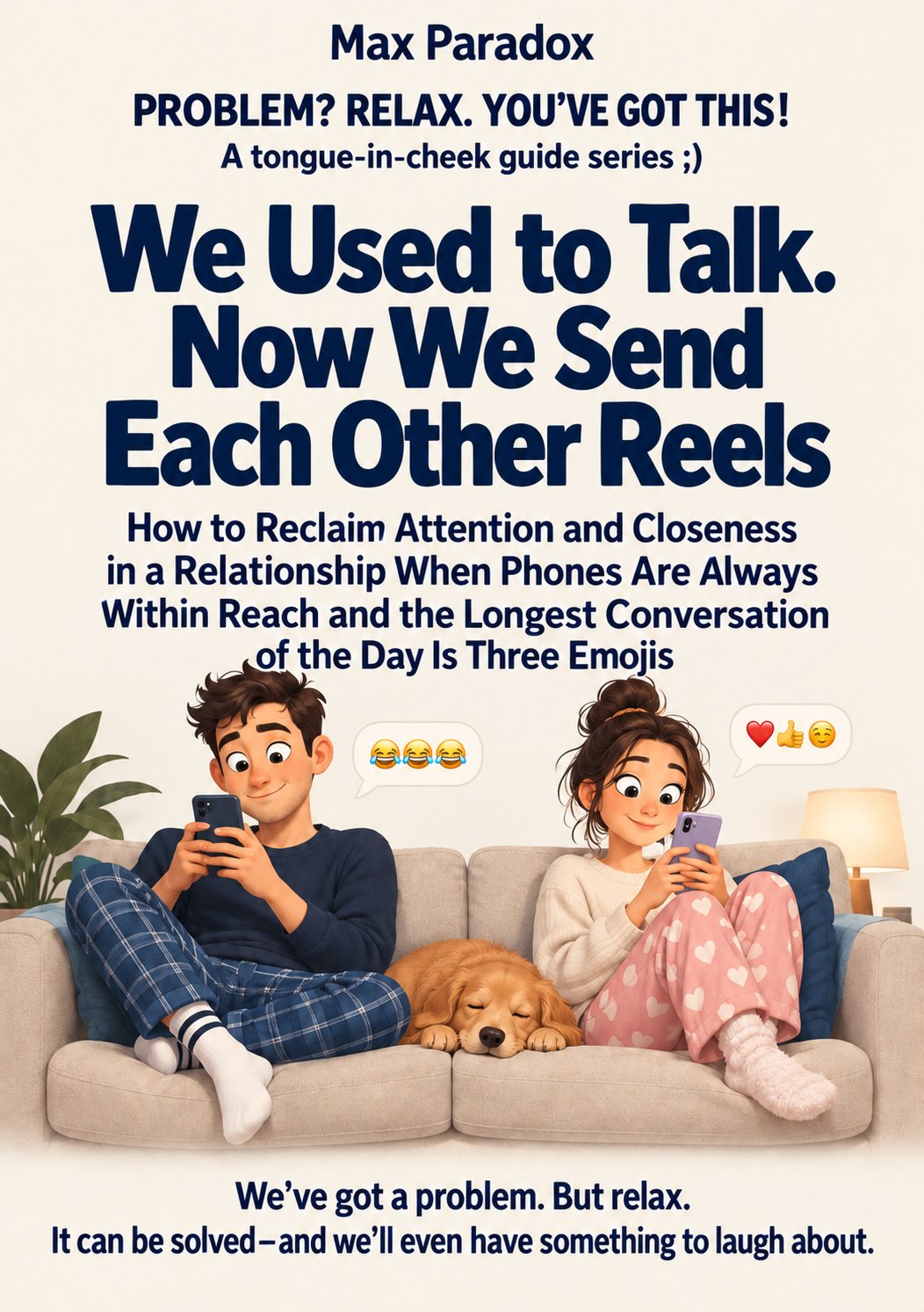
We Used to Talk. Now We Send Each Other Reels - ebook
We Used to Talk. Now We Send Each Other Reels - ebook
You love each other. You live together. You even send each other reels. So why does the longest conversation of the day sometimes end with three emojis? We Used to Talk. Now We Send Each Other Reels is a practical, funny guide to rebuilding attention and closeness without banning phones or pretending modern life is simple. Max Paradox shows how distraction, tiredness, text arguments, separate feeds and invisible expectations quietly replace real contact - and how to change that with realistic conversations, boundaries, affection, shared moments and small habits that work in ordinary life.
Ta publikacja spełnia wymagania dostępności zgodnie z dyrektywą EAA.
| Kategoria: | Poradniki |
| Język: | Angielski |
| Zabezpieczenie: |
Watermark
|
| Rozmiar pliku: | 1,9 MB |
FRAGMENT KSIĄŻKI
You are sitting next to each other on the couch. Not metaphorically next to each other, not emotionally adjacent in some complicated relationship diagram - physically next to each other, close enough that one of you could steal the blanket without even pretending it happened accidentally. One phone is in your hand. The other is in theirs. Suddenly your screen lights up with a message from the person sitting approximately sixteen inches away from you. It is a reel. You open it. A dog wearing tiny safety goggles is supervising a man badly repairing a fence. You laugh, send three laughing emojis, and for a brief moment there is genuine connection. Then both of you return to your separate screens. Twenty minutes later someone asks, "What are we doing tomorrow?" The answer is, "I don't know, we'll figure it out," followed by another stretch of scrolling during which you both become strangely invested in the kitchen renovation of a family you have never met. Their pantry now has excellent lighting. Your evening, meanwhile, has quietly left the building.
The confusing part is that nothing necessarily feels wrong. You may love each other, function well together, share responsibilities, remember birthdays, know who buys the coffee, and operate a household with the precision of a small logistics company that occasionally kisses. You talk every day. In fact, you may communicate constantly. There are messages about groceries, appointments, dinner, traffic, deliveries, work, family, and whether the mysterious container in the fridge is still edible or has begun developing its own political system. You send each other memes, reels, screenshots, photos, links, and highly sophisticated emotional statements such as "this is you 😂". From the outside, there is no shortage of contact. Yet if someone asked when you last had an actual conversation that wandered somewhere unexpected, revealed something new, or simply held both of your attention for more than four minutes, you might need a moment. Possibly several. Your relationship has not stopped communicating. It has become extremely efficient at communicating without always meeting.
Phones did not enter relationships wearing villain capes. They are useful, entertaining, comforting, practical, and sometimes genuinely intimate. A ridiculous video sent at the right moment can mean, "I thought of you." A photo can make someone feel included in a day they could not share. A message can offer support from another city, another office, or the other side of a terrible family gathering where leaving the table would cause diplomatic consequences. Technology has given couples countless ways to stay connected. The problem is not that these tools exist. The problem begins when connection becomes so easy, constant, and fragmented that it starts replacing the slower forms of attention that used to happen almost by accident. You no longer have to sit with a quiet moment long enough for a thought to appear. There is always something available. Something funny, urgent, interesting, horrifying, discounted, recommended, trending, or allegedly essential for people who own an air fryer. Silence used to have a chance. Now it has about two seconds before somebody checks something.
That matters because attention is not the same thing as physical proximity. Two people can spend an entire evening in the same room and barely occupy the same experience. One is reading comments about a restaurant scandal. The other is watching a woman reorganize a laundry room with transparent containers apparently manufactured for people whose detergent has a personal branding strategy. Every few minutes someone says, "Look at this," and the other performs a brief ceremonial glance before returning to their own feed. Nothing terrible happens. That is exactly why the pattern can last so long. There is no dramatic moment when a relationship officially announces, "We have replaced curiosity with parallel content consumption." There are simply hundreds of small moments in which something easier wins. The relationship does not explode. It gets quieter in places where nobody thought to measure the volume.
The obvious solution seems to be: use your phones less. Brilliant. Put it next to "sleep more," "stress less," and "stop leaving everything until the last minute" in the museum of advice that is completely correct and impressively unhelpful. Most couples already know that staring at separate screens for four hours is unlikely to win an award for intimate connection. Knowing is not the problem. The harder questions begin after you put the phone down. What do you talk about when your conversations have gradually become mostly administrative? What happens if one person wants more closeness and the other is exhausted after work? How do you say, "I miss us," without making it sound like the opening line of a relationship emergency meeting? What do you do when the phone is not really the problem at all, but the convenient place both of you go when conversation feels repetitive, uncomfortable, effortful, or simply less immediately rewarding than a video titled "You Won't Believe What This Raccoon Did Next"?
You also do not need to turn your home into a digital monastery. There will be evenings when both of you want to scroll nonsense in peace, and this is not evidence of emotional collapse. Sometimes lying beside someone you love while each of you does your own thing is comfortable intimacy, not avoidance. Sometimes sending a reel is genuinely affectionate. Sometimes neither person has the energy for a meaningful conversation and the highest available level of relationship excellence is sharing takeout and saying, "Move your leg, you're crushing the blanket." The goal is not to make every interaction profound. That would be exhausting. If every Tuesday night required emotional depth, active listening, intentional touch, reflective questions, and a closing statement about what you learned, most people would begin volunteering for overtime just to get some rest.
What matters is whether you still have a choice. Can you notice when you are both disappearing into separate streams and come back without making it a major event? Can you hear the difference between "I want some quiet tonight" and "we have not really connected in two weeks"? Can you send something funny and still sometimes add your own sentence? Can you recognize when your partner is making a small attempt to reach you, even if that attempt sounds less like "I need emotional closeness" and more like "You have to see what happened at the grocery store"? Relationships are built from surprisingly unimpressive raw material. A question followed by a real answer. A story that gets one extra follow-up instead of an automatic "wow." A moment when the screen can wait. A private joke that belongs to the two of you rather than to twelve million viewers and a recommendation algorithm.
This book is about rebuilding those choices in ordinary life. Not in an imaginary version of life where both partners are rested, patient, emotionally articulate, and somehow finished with work by 5:00 p.m. We are working with real evenings, real fatigue, different communication styles, conflicting needs, badly timed conversations, family obligations, jobs that occasionally behave like jealous third partners, and phones that are always close enough to become the default activity. You will learn how to create small openings for attention instead of waiting for the perfect date night, how to tell whether technology is actually causing a problem or merely revealing one, how to listen without immediately opening the Department of Solutions, and how to protect closeness without supervising each other's screen use like airport security officers checking suspicious luggage.
There will also be room for the less tidy parts. One of you may care about this problem more than the other. A good routine may work for three weeks and then disappear during a stressful month. A conversation may begin well and still end with somebody saying, "That is absolutely not what I meant." You may agree to spend more time together and then discover that what you actually needed first was more time alone. None of this means you have failed. Relationships are not habits performed in laboratory conditions. They are two moving people trying to stay in contact while life repeatedly throws laundry, deadlines, relatives, exhaustion, money, notifications, and questions about dinner into the same room. The useful skill is not perfect consistency. It is recognizing what is happening early enough to make a smaller correction.
So no, you do not need to defeat the phone. The internet will survive without your attention for fifteen minutes, and your relationship does not need to become an anti-technology campaign with matching T-shirts. What you need is something more realistic: the ability to notice when convenience is replacing connection, the language to ask for attention without starting a courtroom drama, and a few simple ways to keep curiosity alive after you already know how the other person takes their coffee, what they order at your usual restaurant, and exactly which cupboard they will fail to close for the six-hundredth time. You can keep the phones. You can keep the reels. You can even keep the three emojis. It would just be useful if, now and then, something came after them.
Something that is actually yours.CHAPTER 1 - TOGETHER, BUT SOMEWHERE ELSE
It happens on a perfectly ordinary evening, which is part of the problem. You are both home. Dinner happened, although describing it as "dinner together" would be generous because one person ate first while the other finished something, then the second reheated a plate while the first answered a message about tomorrow. Eventually you both land in the living room at roughly the same time. This feels promising. No one has to be anywhere. No crisis is unfolding. You sit down, one of you starts half-watching a show, the other picks up a phone "for a second," and within twenty minutes you are sharing a sofa but not an evening. One person is reading a thread about a neighbor dispute in a city neither of you has visited. The other is comparing hotel rooms for a trip you are not currently planning. Occasionally someone says, "Oh wow," with the confidence of a person providing valuable social interaction. By bedtime, you have spent nearly three hours beside each other and somehow know less about each other's day than you know about a stranger's kitchen backsplash.
This kind of distance is difficult to notice because it does not look like distance. You are physically close. You may touch feet under a blanket, pass each other a drink, ask whether the other wants tea, and perform all the tiny domestic movements that signal familiarity. If a visitor walked in, they might think, "Aw, cozy." The trouble is that proximity can create a very convincing imitation of connection. Sharing a room is not the same as sharing attention, just as sitting in a parked car does not mean you have traveled anywhere. There is nothing wrong with spending quiet time side by side, and there is nothing wrong with doing separate things. In fact, being able to coexist comfortably without constant conversation is one of the nicer parts of a long relationship. The question is whether you still move between "next to each other" and "with each other," or whether "next to each other" has quietly become the permanent setting.
That shift usually happens in tiny increments rather than one dramatic decision. Nobody announces, "From now on, I would like our evenings to be primarily parallel activities with occasional logistical updates." You simply reach for the easiest available option in a moment of fatigue, then do it again the next day, then again because it now feels normal. The phone fits perfectly into these gaps because it requires almost nothing from you. Starting a conversation takes a little energy. You have to think of something, respond to what comes back, perhaps tolerate a pause, perhaps hear something you did not expect. Opening an app requires a thumb. The contrast is unfair. One option asks you to be a person in a relationship; the other immediately offers a video, a headline, a message, a sale, a sports score, a recipe, and a man somewhere in Arizona explaining why his lawn mower has ruined his marriage. Your tired brain does not hold a committee meeting. It takes the cheaper door.
This is why "we spend loads of time together" can be technically true and emotionally misleading. Time is not a single substance. Twenty minutes of mutual attention can feel more connecting than four hours of parallel presence, while two people can also enjoy four peaceful hours doing their own things and feel perfectly close afterward. The useful distinction is not between screen time and non-screen time. It is between shared attention and separate attention. Shared attention means you are oriented toward the same experience and, crucially, toward each other's responses to it. You can have shared attention while using technology - watching something together, planning a trip, looking through photos, playing a game, laughing at something and actually talking about it. Separate attention means you are each inside a different stream, occasionally surfacing to exchange information like two submarines passing coordinates. Neither mode is morally superior. A healthy relationship simply needs access to both.
The first practical step is therefore not "put the phones away." It is to learn to identify what mode you are actually in. For a few days, notice the difference between intentional parallel time and accidental disconnection. Intentional parallel time sounds like, "I'm wiped out. Want to sit together and do our own thing for a while?" Everyone knows the deal. No one is expecting a conversation that never arrives. Accidental disconnection looks different: you sit down intending to spend time together, one person checks something, the other follows, and an hour disappears without anyone choosing that outcome. At the end, one person may even feel disappointed while the other honestly believes you had a nice evening together. That mismatch matters because resentment loves situations in which two people think they participated in two different events.
You do not need an app to track this. Please do not download a relationship-awareness dashboard that sends you a notification reminding you to stop looking at notifications. Once a day, ask yourself three quick questions: When today were we actually engaged with each other? When were we merely in the same place? Was there a moment when I wanted connection but defaulted to something easier instead? The answers do not need to be dramatic. "We talked for six minutes while making breakfast." "We sat together for an hour after dinner but barely interacted." "I almost asked about their meeting, then opened my phone because they were answering an email." That is useful information. You are not building a case against yourself or your partner. You are finding the places where attention tends to leak.
Once you can see those moments, the next move is to create one deliberate transition into shared attention. Not an entire phone-free evening. Not a new lifestyle identity. One transition. It could happen when you both get home, after the kitchen is cleaned, during a short walk, while having coffee, or before starting a show. The point is to mark the shift: "Give me ten minutes before we disappear into our own stuff." That sentence is wonderfully unromantic, which is one reason it works. It does not require anyone to feel inspired. It simply creates a small protected patch in which the relationship gets first access to your attention rather than whatever app happens to be most aggressively decorated in red circles.
What do you do in those ten minutes? Almost anything that involves actual exchange. You can talk about the day, but try not to turn it into a performance review. You can share one thing that was annoying, funny, strange, or unexpectedly good. You can make a small plan. You can sit with a drink and say nothing for thirty seconds until somebody remembers something. The content matters less than the fact that you are available to each other. If the first question is always "How was your day?" and the answer is always "Fine," change the shape. Try, "What took up the most space in your head today?" or "Was there a moment today when you wanted to walk out of the room and live under a different name?" You are not trying to excavate childhood wounds before dessert. You are simply giving conversation a better opening than the verbal equivalent of an automatic email reply.
A common objection appears quickly: "But we already talk." Probably. Most couples do. The question is what the conversations contain. If ninety percent of them concern errands, schedules, repairs, bills, appointments, and whether someone remembered to buy dishwasher tablets, communication is happening beautifully. The household may be functioning like a highly competent shipping company. But logistics tell you what the other person is doing, not necessarily what is happening inside them. You can know that your partner has a meeting at 2:00, needs gas, is picking up a package, and wants pasta for dinner while having no idea that they are quietly considering changing jobs. This is why "we talk all day" and "I miss talking to you" can both be true without either person being irrational.
It helps to separate functional conversation from relational conversation without insulting the functional kind. Logistics are not the enemy. In fact, if nobody discusses them, your relationship may become very emotionally open while also running out of toilet paper. The goal is not to replace practical coordination with endless introspection. It is to make sure practical coordination is not the only language left. A simple ratio is enough in your head: after dealing with what needs to happen, occasionally ask about what something means. "You've mentioned that project three times this week - is it exciting or just eating your life?" "You seemed quiet after dinner with your family. Was that just tiredness or did something get to you?" The difference between those questions and surveillance is tone. Curiosity invites. Interrogation corners.
Another useful move is to stop assuming that "quality time" must be impressive. People often sabotage reconnection by making it too expensive in energy. They think they need a date, a reservation, a babysitter, a good mood, decent clothes, and an evening long enough to justify leaving the house. Then none of it happens because Wednesday has no interest in cooperating. Shared attention can be embarrassingly small. Fifteen minutes on the porch. A walk around the block. Sitting on the kitchen counter while the other person makes lunch. Driving somewhere without each of you wearing your own private audio universe. The standard is not "Would this look romantic in a montage?" The standard is "Did we both actually show up for it?"
The minimum version is smaller still. Once a day, complete one interaction before returning to your screen. If your partner starts telling you something, give them the next sixty seconds instead of splitting attention. If you ask a question, listen to the answer you requested. If you come into the room after being apart for several hours, make eye contact before checking what your phone has been doing during your absence. One minute will not repair a relationship, obviously. But it creates a repeated message: when we reach for each other, there is still someone there.
Plan B is for evenings when neither of you has the energy for even ten minutes of interesting conversation. Do not force depth. Use a three-minute check-in with one sentence each: "The thing taking up most space in my head is..." That could be work, exhaustion, excitement, irritation, absolutely nothing, or "I genuinely cannot think because my brain has resigned." Accept the answer. Then decide together whether you want quiet, separate screen time, sleep, or something shared. The victory is not producing meaningful content. It is making the evening a choice instead of an accident.
At first, these changes may feel oddly deliberate. That is fine. People sometimes reject useful habits because they are not immediately spontaneous, as though every good part of a relationship must emerge naturally from the mist. Plenty of good things become natural after being intentional for a while. You once had to remember your partner's coffee order; now you know it automatically. You once had to learn how they react when stressed; now you can sometimes identify the storm before they have located the umbrella. Attention works the same way. You practice turning toward each other until the movement becomes easier.
So do not begin by measuring how much time you spend together. Begin by noticing what kind of time it is. Tonight, find one stretch when you would normally drift into separate streams and interrupt the drift before it becomes the entire evening. Ten minutes is enough. Three if that is what you have. The goal is not to become a couple who never disappears into their phones. The goal is to remain a couple who knows how to come back.CHAPTER 2 - "JUST CHECKING" HAS A VERY LONG TAIL
You are in the middle of telling your partner about something that happened at work. Not the most important story in human history, admittedly, but important enough that you started it with, "You won't believe what happened in that meeting." They are listening. Then their phone lights up. They glance down. "Sorry, just checking who that is." Fair enough. The glance becomes an unlock. The unlock becomes a reply. The reply reveals another message. Their thumb moves with the calm efficiency of someone defusing a bomb, except the bomb is apparently a group chat discussing where to have brunch. You continue talking for a few seconds, then stop because you have realized you are now providing background audio. Finally they look up and say, "Sorry - what did you say after the part about your manager?" You consider your options. One is to repeat the story. Another is to say, "Nothing," in the tone universally understood to mean quite a lot.
"Just checking" sounds harmless because it describes a tiny intention. You intend to look at one thing. The phone, however, is not arranged as one thing. It is a building with sixty doors, most of them open, some flashing, and at least one containing a video you did not ask for but will somehow watch twice. You check the message, notice an email, remember something you meant to search, see a headline, and suddenly the original reason for picking up the device has vanished. This is not evidence that you are uniquely weak. It is simply what happens when one tool contains communication, entertainment, work, shopping, news, navigation, banking, photos, notes, music, and a frankly unreasonable number of opinions about breakfast. The important part for a relationship is that the interruption often lasts longer emotionally than it lasts chronologically.