MENU
MENU
 Nasze ceny

 Przeczytaj fragment on-line

-
 nowość
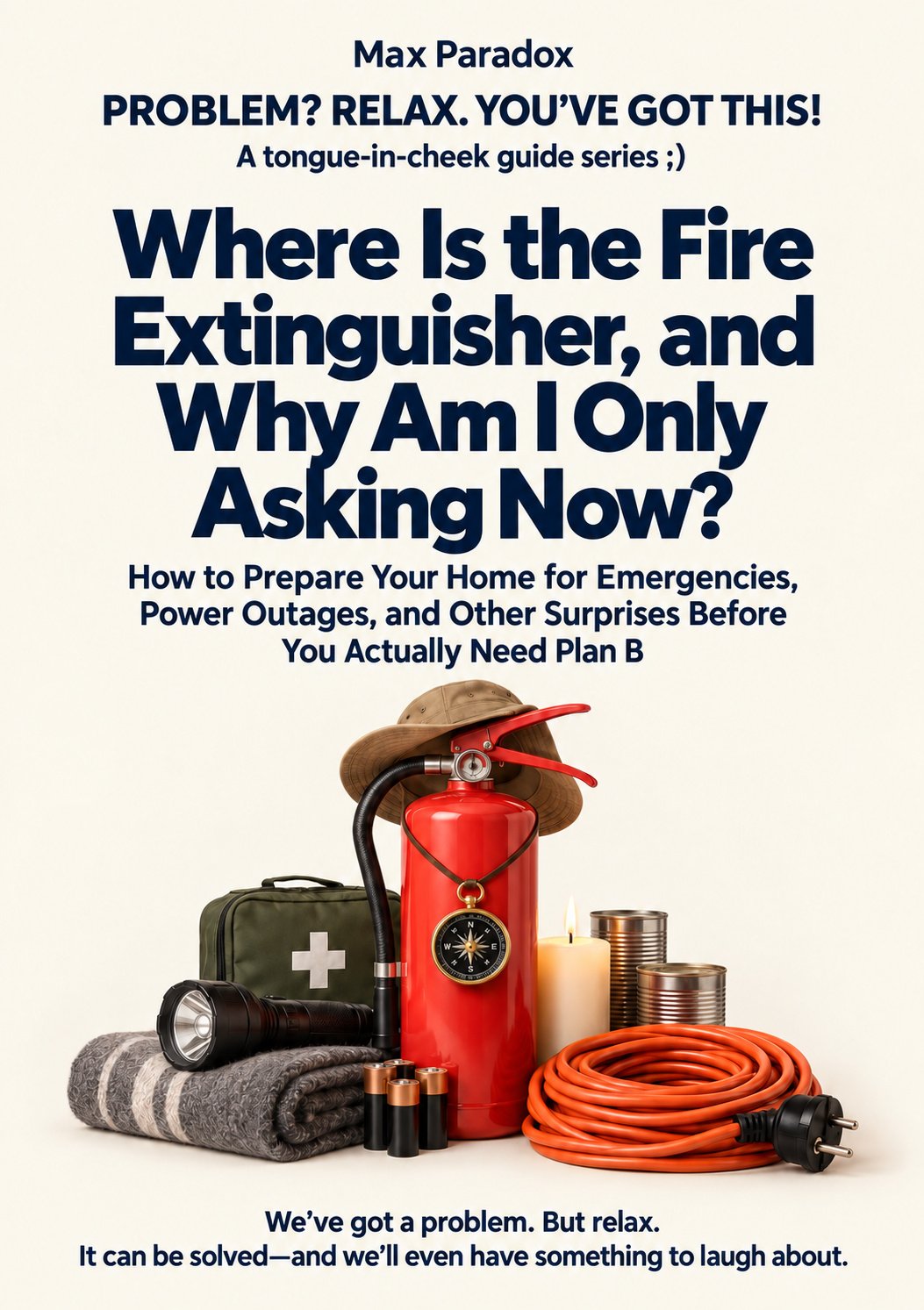
Where Is the Fire Extinguisher, and Why Am I Only Asking Now? - ebook

Where Is the Fire Extinguisher, and Why Am I Only Asking Now? - ebook
A practical guide to fire safety at home: where to keep an extinguisher, how to check it and what to do before a small emergency becomes a serious problem. Clear examples and simple steps help build habits that work even under pressure. It explains common mistakes, sensible preparation and a simple routine for keeping basic safety equipment visible, accessible and ready to use. The advice is practical, calm and designed for ordinary homes.
Ta publikacja spełnia wymagania dostępności zgodnie z dyrektywą EAA.
| Kategoria: | Poradniki |
| Język: | Angielski |
| Zabezpieczenie: |
Watermark
|
| Rozmiar pliku: | 1,7 MB |
FRAGMENT KSIĄŻKI
INTRO
It is 10:43 p.m. You are halfway through an episode you are only pretending to follow when the lights go out. Not flicker. Not dim. Out. The television disappears, the Wi-Fi router loses its tiny reassuring constellation of lights, and the refrigerator stops humming with the confidence of an appliance that has always assumed civilization would continue. For about three seconds, nobody says anything. Then someone asks, "Is it just us?" You look out the window, because apparently the first official diagnostic procedure for a power outage is checking whether the neighbors are suffering too. The building across the street is dark. Excellent. Shared inconvenience somehow feels more legitimate. You reach for your phone. Twenty-two percent. You reach for a flashlight. There is no flashlight where you thought the flashlight was. There is, however, a drawer containing seven charging cables for devices nobody owns anymore, a restaurant loyalty card from 2019, two mysterious keys, and a battery that may have been dead since the previous administration. The household emergency plan has officially begun.
The strange thing about home emergencies is that they spend most of their lives sounding slightly ridiculous. Where is the main water shutoff? When did you last test the smoke alarm? What happens to the garage door if the power fails? Where are the spare batteries? Does anyone except you know? These are not questions people normally raise over Saturday breakfast unless they are either extremely organized or trying to make everyone else leave the table. Most of us have more urgent matters. Laundry. Work. Dinner. A dripping faucet that has apparently entered a stable long-term relationship with the sink. We assume that when something goes wrong, we will deal with it then, using the remarkable emergency expertise we expect to download directly into our brains at the exact moment water begins spreading across the floor. Future You will know what to do. Future You is incredibly capable. Current You, meanwhile, has been meaning to find the fire extinguisher since February.
That is why ordinary households often have a peculiar mix of advanced technology and primitive emergency planning. You can adjust the thermostat from another country, see who is at the front door while sitting in a restaurant, and ask a speaker to play rain sounds because actual silence has somehow become too demanding. Yet when the power fails, the entire domestic ecosystem may discover that it was built on one electrical outlet and optimism. The smart lights are dark, the smart speaker has become an expensive cylinder, the router is contemplating mortality, and the app that controls the blinds would love to help if only it could contact the blinds. Convenience is wonderful. It is also very good at hiding dependency. Things work so reliably that we stop noticing what they need in order to work, which is fine right up until several of those needs take the evening off together.
Preparation tends to fail in the opposite direction too. One mildly alarming news story later, a perfectly normal person can find themselves online at 1:15 a.m. comparing emergency radios, water filters, solar chargers, tactical flashlights, folding shovels, and a device whose exact purpose is unclear but whose product photographs strongly suggest that civilization has collapsed somewhere just outside the frame. A week later, a large box arrives. Half of it goes into a closet. Nobody reads the manuals. The batteries are not installed. Three years pass. During an actual outage, someone opens that closet and discovers enough equipment to cross a mountain range, but no working light within easy reach. This is not preparedness. This is expensive clutter wearing cargo pants.
A useful Plan B is far less dramatic. It means that when something stops working, you do not have to invent your first five decisions while tired, scared, cold, wet, or standing in a hallway that smells suspiciously like burning plastic. You know where the important things are. You know which problems you can safely handle and which ones belong to qualified professionals or emergency services. You have enough basic supplies to avoid turning a short disruption into an immediate shopping expedition. The people you live with know at least the essentials instead of relying on one household wizard who understands every valve, breaker, password, key, warranty, and phone number. The goal is not independence from society. If anything, good preparation includes knowing when to stop improvising and use the people, services, systems, and expertise that exist precisely because some problems should not be solved by a determined amateur holding a screwdriver.
This matters because emergencies are rarely polite enough to arrive one at a time. A power outage can become a communication problem, a heating problem, a food-storage problem, a garage-door problem, and eventually a family problem involving the sentence, "Why did nobody charge the power bank?" A water outage affects drinking, cooking, hygiene, toilets, pets, and the sudden realization that every meal you planned requires three things to be washed afterward. A severe storm may interrupt electricity, block roads, damage property, and leave your phone full of messages from people forwarding information that begins with "Apparently..." By the time you establish that "apparently" is not an emergency management agency, you may already have spent an hour reacting to rumors instead of facts. Good preparation does not eliminate complexity, but it stops every new complication from feeling like the first surprise humanity has ever encountered.
There is another reason to prepare before you need to. Stress makes people wonderfully strange. A calm person who knows perfectly well that possessions can be replaced may suddenly decide to go back into a risky area because the laptop is still inside. Someone who normally reads instructions carefully may start pressing buttons at random because a machine is making an unfamiliar noise. Two adults who have successfully managed jobs, mortgages, children, taxes, and international travel can spend seven minutes arguing over whether the flashlight was "always kept in the kitchen" while standing in complete darkness. None of this means people are foolish. It means emergency conditions remove time, information, comfort, and certainty all at once. A good system assumes that you will be less elegant under pressure, not more. It puts important decisions in place while you are still wearing normal clothes and nobody is shouting from another room.
This book is not going to turn your home into a bunker, and it is not going to treat every inconvenience as the opening scene of a disaster movie. Most home disruptions are exactly that - disruptions. Annoying, inconvenient, occasionally expensive, sometimes genuinely dangerous, but usually made easier by a handful of sensible preparations. We will focus on realistic problems: losing power, water, heating, communications, access, or normal use of the home; dealing with alarms, smoke, leaks, severe weather, and situations where leaving is safer than staying; keeping useful supplies without becoming curator of the National Museum of Canned Beans; and making sure the plan still works when the one person who "knows all that stuff" is not available. Where there is real danger to life or health, the priority is safety and professional help, not heroic improvisation. A fire, electrical hazard, gas-related concern, medical emergency, or other serious threat is not improved by confidence unsupported by training.
You also do not need to solve everything in one weekend. That is how sensible preparation mutates into a lifestyle project involving storage bins, spreadsheets, labels, and a household that now fears the phrase "I had another idea." The useful question is smaller: if something important stopped working tonight, what would cause the most confusion in the first hour? Maybe nobody knows where the shutoff is. Maybe the flashlights are unreliable. Maybe every useful phone number lives online. Maybe there is no agreed plan for what happens if family members cannot reach one another. Maybe you have plenty of food but almost all of it expects an electric stove to participate. Find the first weak point. Fix that. Then another. Preparedness works much better as a series of boring improvements than as one glorious afternoon in which you attempt to become personally resistant to all known forms of misfortune.
The real promise here is not that nothing will catch you off guard. Something will. Houses are full of pipes, wires, appliances, people, animals, doors, weather, software, and occasionally a washing machine that chooses 2:00 a.m. to express itself creatively. The promise is that surprise does not have to become helplessness. You can know what matters first, what can wait, what you should keep available, what you should never improvise, and when the correct response is simply to leave, call someone qualified, or change the plan. That is enough. More than enough, actually, compared with standing in the dark holding a nearly dead phone and discovering that the only candle in the house smells aggressively of cinnamon.
So before we get clever, start with one question. Not "Am I prepared for every emergency?" Nobody is. Ask instead: if Plan A stopped working five minutes from now, would I know my first sensible move? If the answer is "probably," "I think so," or "I'd Google it," you are exactly where this book begins. The fire extinguisher can stay wherever it is for another few minutes. But by the time you really need Plan B, the goal is that "Where is it?" will no longer be the opening line.CHAPTER 1 - DON'T PREPARE FOR THE APOCALYPSE
You are standing in the emergency-preparedness aisle of a hardware store holding a flashlight powerful enough to signal passing aircraft. It has five brightness modes, a strobe setting, a metal body described as "tactical," and a price that suggests it may also know first aid. Beside it are water containers, emergency blankets, multitools, battery packs, radios, first-aid kits, and something called an emergency survival axe, which feels ambitious considering you live in a third-floor apartment and the last thing you chopped was a cucumber. Ten minutes earlier, you came in for batteries. Now your cart looks as though you have received confidential information about the collapse of civilization. This is one of the great traps of emergency preparation: buying serious-looking objects feels like action, while figuring out what can realistically go wrong in your actual home feels suspiciously like homework.
The imagination is terrible at sensible risk management because sensible risks are not very cinematic. A giant catastrophe is interesting. A failed washing-machine hose is not, right up until your hallway is becoming waterfront property. A major disaster makes us picture dramatic escapes, emergency broadcasts, and supplies stacked with military precision. A six-hour power outage sounds almost too ordinary to deserve preparation, even though it can affect lighting, charging, cooking, heating controls, garage access, refrigeration, and communication all at once. The boring problems are exactly the ones most likely to expose how little thought we have given to the house we use every day. Nobody makes a thriller called The Breaker Tripped Again, yet an ordinary household can produce remarkable levels of confusion around one electrical panel and a label reading "KITCHEN?".
The first useful shift is to stop preparing for "everything." Everything is an infinite category. You can spend all weekend imagining earthquakes, floods, fires, blackouts, extreme weather, water failures, internet outages, broken heating systems, supply disruptions, and the possibility that a raccoon somehow gains administrative control of the garage. The result is not resilience. The result is a shopping list, a headache, and a growing suspicion that your spare room should contain a generator, twelve crates of supplies, and a person named Frank who knows radio communications. A better question is smaller: which disruptions are realistic for this home, in this location, with these people? Preparedness begins when the abstract word "emergency" becomes a short list of concrete interruptions you can actually do something about.
Look at your home as a collection of functions rather than rooms. You need safe shelter, water, food, lighting, communication, temperature control, access in and out, basic hygiene, necessary medication or medical equipment, and a way to get reliable information. Now ask what could interrupt each one. Maybe your apartment relies entirely on electricity for cooking and heating controls. Maybe your home has a well pump, which means a power outage can become a water problem. Maybe a household member uses equipment that cannot simply wait until tomorrow. Maybe you live somewhere where severe storms, wildfire smoke, flooding, extreme heat, or winter outages deserve special attention. Maybe the most likely emergency is much less impressive: a burst pipe, a locked door, or one elderly heating system choosing January to explore early retirement.
This is where a simple risk screen helps. For each realistic disruption, consider three things: how likely is it, how serious would the consequences be in your household, and how much difference could one easy preparation make? You do not need a spreadsheet with seventeen risk categories and a heat map that makes your kitchen look like a defense ministry briefing. "Low, medium, high" is plenty. A short power outage might be mildly annoying for one household and medically significant for another. A leak may be uncommon, but knowing how to stop the water can make an enormous difference. A house fire may be relatively rare, but working smoke alarms and a practiced escape plan matter precisely because the consequences can be severe and time can be short. The American Red Cross recommends working smoke alarms and a practiced home fire escape plan, including knowing multiple ways out where possible. (source: Red Cross)
Notice what this approach does to shopping. It pushes equipment to the end of the process instead of the beginning. If your priority problem is a short blackout, perhaps you need reliable lighting, charged backup power, a way to receive information, and food that does not require an elaborate cooking setup. You probably do not need a folding shovel capable of surviving a polar expedition. If your concern is water leakage, the critical preparation may be knowing the shutoff location and keeping it accessible, not owning a wrench that looks impressive enough to have its own documentary series. Ready.gov explicitly recommends learning how to shut off utilities where you live, including water, electricity, and gas, while recognizing that the safe procedure depends on the utility and situation. (source: Ready.gov) The knowledge is less photogenic than the tool. It is also frequently more useful.
Another trap is focusing only on probability and forgetting consequence. Some things are worth preparing for even if you sincerely hope never to encounter them, because the preparation is easy and the downside of being unprepared is serious. Smoke alarms are an obvious example. You do not install one because you expect a fire next Thursday at 3:20 p.m. You install and maintain it because early warning matters if a fire happens at all. The same logic applies to knowing an exit route, having important medication reasonably available, or making sure a household member with mobility limitations is included in emergency planning. Preparedness is not predicting the future. It is making a few cheap bets against consequences you would rather not discover unprepared.
Then there are the problems that are neither dramatic nor especially dangerous but have astonishing power to ruin a day. The only spare key is inside the locked house. The property manager's emergency number exists solely in an email you cannot access because the internet is down. Every flashlight in the home uses a different battery. The manual release for the garage door is technically available, but nobody has ever used it and the instructions are somewhere in a folder named "HOUSE STUFF FINAL 2". These problems deserve attention because resilience is partly about keeping small failures small. A minor disruption becomes expensive, stressful, or unsafe when it triggers three additional problems that could have been prevented by ten minutes of preparation and one label.
Try a thought experiment using your real home. Imagine that the power is unavailable until tomorrow morning. What stops working besides the lights? Imagine that water service is interrupted for a day. What becomes difficult after drinking and cooking? Imagine that you need to leave the house quickly. Which necessary items would you spend the first five minutes searching for? Imagine that you cannot use your normal internet connection. Which phone numbers, documents, maps, or instructions disappear with it? Do not solve the scenarios yet. Just note every moment where the answer becomes "I'm not sure." Those are your preparedness gaps. "I'm not sure" is not a failure. It is useful information arriving at a pleasantly convenient time, rather than during the event while someone is asking why the garage door has become part of the architecture.
Your household also changes what deserves attention. A plan for a healthy adult living alone is not a plan for a family with an infant, an older relative, a person with disabilities, three pets, or someone who depends on refrigerated medication or powered medical equipment. Ready.gov preparedness guidance specifically emphasizes household communication, medical needs, transportation, service providers, pets, and other individual circumstances because generic plans become weak the moment real people are added. (source: Ready.gov) This is why copying a stranger's forty-item checklist can be strangely unhelpful. The stranger may own a basement, a truck, and a Labrador. You may own a studio apartment, a bicycle, and a cat who regards carriers as a violation of international law.
Money matters too. Emergency preparation can become expensive very quickly if you mistake "more equipment" for "more safety." Start with high-value, low-cost improvements. Learn a shutoff location. Move a flashlight. Write down important contacts. Check whether an existing battery pack works. Make sure everyone knows where the first-aid supplies are. Review the manufacturer's instructions for safety equipment already in your home. Replace an obviously missing or unreliable basic item before buying specialized gear. A household with a modest budget and five dependable basics may be better prepared than a household with thousands of dollars of equipment distributed across the garage like props from a survival convention.
You should also distinguish between inconvenience and genuine danger. Losing Wi-Fi during movie night is annoying. Smelling burning near electrical equipment is different. A dripping faucet can probably wait. Active smoke, a suspected gas leak, a serious electrical hazard, or a medical emergency requires a safety-first response and appropriate professional or emergency help rather than experimental repair. The goal of this book is not to make you confident enough to touch more things. Quite often, useful preparation makes you confident enough to leave something alone. There is an underrated skill in looking at a technical problem and saying, "I do not know enough to make this safer, so I am calling someone who does." That sentence has prevented far more trouble than "I watched a video about this once."
Now reduce your first risk list to three priorities. Not ten. Three. Pick the disruptions that combine meaningful consequences with realistic likelihood or easy preparation. One might be power loss. Another might be water leakage. A third might be fire warning and escape. Your choices may be entirely different. For each one, write a single first action: "Power out - confirm scope and switch to backup lighting." "Water leak - protect people and use the correct shutoff if it is safe and I know which one." "Smoke alarm - treat the alarm seriously and follow the household escape plan." You are not writing the complete procedure yet. You are giving Future You a starting block instead of an empty page.
The minimum version, if even this feels like too much, takes five minutes. Walk through your home and answer only three questions: What would I use for light if the electricity disappeared right now? Who would I contact if a serious building or utility problem developed? What is one important household function whose failure would genuinely create difficulty here? Fix one answer that is currently "I don't know." That might mean finding the flashlight, saving one phone number offline, or asking the landlord where the water shutoff is. Then stop. Preparedness works beautifully in small installments, especially because small installments do not require you to sacrifice an entire Saturday to become a person who suddenly owns six identical storage bins.
If your brain still refuses to cooperate with hypothetical emergencies, use Plan B: work backward from real annoyances you have already experienced. Think about the last three household disruptions. A brief outage. A leak. A lockout. A storm. A heating failure. A dead phone during a building problem. What made each event harder than it needed to be? Did you lack an item, a piece of information, a backup option, or simply a clear first step? Correct those specific weaknesses. This is an excellent strategy for people who dislike disaster planning because it is not really disaster planning. It is customer feedback from your own life, which has helpfully been beta-testing your household for years without sending formal reports.
The point of Chapter 1 is not to make the world look more dangerous. It is to make the word "emergency" smaller. Instead of one enormous cloud of things that might happen, you now have a few plausible disruptions, a few vulnerable functions, and a few improvements worth making. That is manageable. You do not need to be ready for the apocalypse, a meteor, the collapse of international trade, and a wolf pack taking over municipal services. You need to know what is most likely to make your home difficult or unsafe to use and what simple preparation would buy you time, clarity, or a safer first move.
So do not buy anything yet. Pick your three scenarios first. If the tactical flashlight still seems necessary afterward, fine. At least now it will have a job.CHAPTER 2 - YOUR HOME NEEDS AN OWNER'S MANUAL
You hear running water somewhere it absolutely should not be running. Not the pleasant, reassuring sound of a shower. More the expensive kind. You follow it to a utility area and discover water spreading across the floor with the calm confidence of something that pays no rent and recognizes no property boundaries. Someone says, "Turn off the water." Excellent suggestion. Everyone agrees immediately. Then the household enters phase two: four adults looking at one another while trying to remember where, exactly, the water turns off. There is a valve under something. Or beside something. Maybe in the basement. One person is fairly sure a red handle is involved, which is encouraging until you discover three red handles. Meanwhile, the leak continues performing the only part of the emergency procedure it fully understands.
We live inside complicated systems while knowing remarkably little about them. Electricity arrives. Water arrives. Heat appears. Locks open. Waste disappears. Internet emerges from a box with blinking lights. Most of the time, this arrangement is wonderful precisely because we do not have to understand every pipe, cable, pump, breaker, vent, and valve. The problem is that when one system fails, the house suddenly expects you to know information it has never previously required. You have effectively been driving a machine for seven years because the only control you needed was "make room warmer." Then one evening it presents a warning light, an error code, and a mechanical hum that sounds as though the appliance has recently learned resentment.
Your first defense against that moment is not technical expertise. It is orientation. You should know where the important control points are, how to reach them, and where your responsibility ends. Ready.gov recommends learning how to shut off household utilities, including water, electricity, and gas. (source: Ready.gov) That does not mean randomly operating valves and switches to see what happens. In some systems, especially gas and electrical systems, the correct procedure may depend on local infrastructure, equipment, utility guidance, and the specific emergency. If you are unsure, ask the utility, property manager, landlord, electrician, plumber, HVAC professional, or another qualified person while everything is normal. "Can you show me the correct emergency shutoff?" is an excellent question. It becomes noticeably less elegant when asked while something is already leaking.
It is 10:43 p.m. You are halfway through an episode you are only pretending to follow when the lights go out. Not flicker. Not dim. Out. The television disappears, the Wi-Fi router loses its tiny reassuring constellation of lights, and the refrigerator stops humming with the confidence of an appliance that has always assumed civilization would continue. For about three seconds, nobody says anything. Then someone asks, "Is it just us?" You look out the window, because apparently the first official diagnostic procedure for a power outage is checking whether the neighbors are suffering too. The building across the street is dark. Excellent. Shared inconvenience somehow feels more legitimate. You reach for your phone. Twenty-two percent. You reach for a flashlight. There is no flashlight where you thought the flashlight was. There is, however, a drawer containing seven charging cables for devices nobody owns anymore, a restaurant loyalty card from 2019, two mysterious keys, and a battery that may have been dead since the previous administration. The household emergency plan has officially begun.
The strange thing about home emergencies is that they spend most of their lives sounding slightly ridiculous. Where is the main water shutoff? When did you last test the smoke alarm? What happens to the garage door if the power fails? Where are the spare batteries? Does anyone except you know? These are not questions people normally raise over Saturday breakfast unless they are either extremely organized or trying to make everyone else leave the table. Most of us have more urgent matters. Laundry. Work. Dinner. A dripping faucet that has apparently entered a stable long-term relationship with the sink. We assume that when something goes wrong, we will deal with it then, using the remarkable emergency expertise we expect to download directly into our brains at the exact moment water begins spreading across the floor. Future You will know what to do. Future You is incredibly capable. Current You, meanwhile, has been meaning to find the fire extinguisher since February.
That is why ordinary households often have a peculiar mix of advanced technology and primitive emergency planning. You can adjust the thermostat from another country, see who is at the front door while sitting in a restaurant, and ask a speaker to play rain sounds because actual silence has somehow become too demanding. Yet when the power fails, the entire domestic ecosystem may discover that it was built on one electrical outlet and optimism. The smart lights are dark, the smart speaker has become an expensive cylinder, the router is contemplating mortality, and the app that controls the blinds would love to help if only it could contact the blinds. Convenience is wonderful. It is also very good at hiding dependency. Things work so reliably that we stop noticing what they need in order to work, which is fine right up until several of those needs take the evening off together.
Preparation tends to fail in the opposite direction too. One mildly alarming news story later, a perfectly normal person can find themselves online at 1:15 a.m. comparing emergency radios, water filters, solar chargers, tactical flashlights, folding shovels, and a device whose exact purpose is unclear but whose product photographs strongly suggest that civilization has collapsed somewhere just outside the frame. A week later, a large box arrives. Half of it goes into a closet. Nobody reads the manuals. The batteries are not installed. Three years pass. During an actual outage, someone opens that closet and discovers enough equipment to cross a mountain range, but no working light within easy reach. This is not preparedness. This is expensive clutter wearing cargo pants.
A useful Plan B is far less dramatic. It means that when something stops working, you do not have to invent your first five decisions while tired, scared, cold, wet, or standing in a hallway that smells suspiciously like burning plastic. You know where the important things are. You know which problems you can safely handle and which ones belong to qualified professionals or emergency services. You have enough basic supplies to avoid turning a short disruption into an immediate shopping expedition. The people you live with know at least the essentials instead of relying on one household wizard who understands every valve, breaker, password, key, warranty, and phone number. The goal is not independence from society. If anything, good preparation includes knowing when to stop improvising and use the people, services, systems, and expertise that exist precisely because some problems should not be solved by a determined amateur holding a screwdriver.
This matters because emergencies are rarely polite enough to arrive one at a time. A power outage can become a communication problem, a heating problem, a food-storage problem, a garage-door problem, and eventually a family problem involving the sentence, "Why did nobody charge the power bank?" A water outage affects drinking, cooking, hygiene, toilets, pets, and the sudden realization that every meal you planned requires three things to be washed afterward. A severe storm may interrupt electricity, block roads, damage property, and leave your phone full of messages from people forwarding information that begins with "Apparently..." By the time you establish that "apparently" is not an emergency management agency, you may already have spent an hour reacting to rumors instead of facts. Good preparation does not eliminate complexity, but it stops every new complication from feeling like the first surprise humanity has ever encountered.
There is another reason to prepare before you need to. Stress makes people wonderfully strange. A calm person who knows perfectly well that possessions can be replaced may suddenly decide to go back into a risky area because the laptop is still inside. Someone who normally reads instructions carefully may start pressing buttons at random because a machine is making an unfamiliar noise. Two adults who have successfully managed jobs, mortgages, children, taxes, and international travel can spend seven minutes arguing over whether the flashlight was "always kept in the kitchen" while standing in complete darkness. None of this means people are foolish. It means emergency conditions remove time, information, comfort, and certainty all at once. A good system assumes that you will be less elegant under pressure, not more. It puts important decisions in place while you are still wearing normal clothes and nobody is shouting from another room.
This book is not going to turn your home into a bunker, and it is not going to treat every inconvenience as the opening scene of a disaster movie. Most home disruptions are exactly that - disruptions. Annoying, inconvenient, occasionally expensive, sometimes genuinely dangerous, but usually made easier by a handful of sensible preparations. We will focus on realistic problems: losing power, water, heating, communications, access, or normal use of the home; dealing with alarms, smoke, leaks, severe weather, and situations where leaving is safer than staying; keeping useful supplies without becoming curator of the National Museum of Canned Beans; and making sure the plan still works when the one person who "knows all that stuff" is not available. Where there is real danger to life or health, the priority is safety and professional help, not heroic improvisation. A fire, electrical hazard, gas-related concern, medical emergency, or other serious threat is not improved by confidence unsupported by training.
You also do not need to solve everything in one weekend. That is how sensible preparation mutates into a lifestyle project involving storage bins, spreadsheets, labels, and a household that now fears the phrase "I had another idea." The useful question is smaller: if something important stopped working tonight, what would cause the most confusion in the first hour? Maybe nobody knows where the shutoff is. Maybe the flashlights are unreliable. Maybe every useful phone number lives online. Maybe there is no agreed plan for what happens if family members cannot reach one another. Maybe you have plenty of food but almost all of it expects an electric stove to participate. Find the first weak point. Fix that. Then another. Preparedness works much better as a series of boring improvements than as one glorious afternoon in which you attempt to become personally resistant to all known forms of misfortune.
The real promise here is not that nothing will catch you off guard. Something will. Houses are full of pipes, wires, appliances, people, animals, doors, weather, software, and occasionally a washing machine that chooses 2:00 a.m. to express itself creatively. The promise is that surprise does not have to become helplessness. You can know what matters first, what can wait, what you should keep available, what you should never improvise, and when the correct response is simply to leave, call someone qualified, or change the plan. That is enough. More than enough, actually, compared with standing in the dark holding a nearly dead phone and discovering that the only candle in the house smells aggressively of cinnamon.
So before we get clever, start with one question. Not "Am I prepared for every emergency?" Nobody is. Ask instead: if Plan A stopped working five minutes from now, would I know my first sensible move? If the answer is "probably," "I think so," or "I'd Google it," you are exactly where this book begins. The fire extinguisher can stay wherever it is for another few minutes. But by the time you really need Plan B, the goal is that "Where is it?" will no longer be the opening line.CHAPTER 1 - DON'T PREPARE FOR THE APOCALYPSE
You are standing in the emergency-preparedness aisle of a hardware store holding a flashlight powerful enough to signal passing aircraft. It has five brightness modes, a strobe setting, a metal body described as "tactical," and a price that suggests it may also know first aid. Beside it are water containers, emergency blankets, multitools, battery packs, radios, first-aid kits, and something called an emergency survival axe, which feels ambitious considering you live in a third-floor apartment and the last thing you chopped was a cucumber. Ten minutes earlier, you came in for batteries. Now your cart looks as though you have received confidential information about the collapse of civilization. This is one of the great traps of emergency preparation: buying serious-looking objects feels like action, while figuring out what can realistically go wrong in your actual home feels suspiciously like homework.
The imagination is terrible at sensible risk management because sensible risks are not very cinematic. A giant catastrophe is interesting. A failed washing-machine hose is not, right up until your hallway is becoming waterfront property. A major disaster makes us picture dramatic escapes, emergency broadcasts, and supplies stacked with military precision. A six-hour power outage sounds almost too ordinary to deserve preparation, even though it can affect lighting, charging, cooking, heating controls, garage access, refrigeration, and communication all at once. The boring problems are exactly the ones most likely to expose how little thought we have given to the house we use every day. Nobody makes a thriller called The Breaker Tripped Again, yet an ordinary household can produce remarkable levels of confusion around one electrical panel and a label reading "KITCHEN?".
The first useful shift is to stop preparing for "everything." Everything is an infinite category. You can spend all weekend imagining earthquakes, floods, fires, blackouts, extreme weather, water failures, internet outages, broken heating systems, supply disruptions, and the possibility that a raccoon somehow gains administrative control of the garage. The result is not resilience. The result is a shopping list, a headache, and a growing suspicion that your spare room should contain a generator, twelve crates of supplies, and a person named Frank who knows radio communications. A better question is smaller: which disruptions are realistic for this home, in this location, with these people? Preparedness begins when the abstract word "emergency" becomes a short list of concrete interruptions you can actually do something about.
Look at your home as a collection of functions rather than rooms. You need safe shelter, water, food, lighting, communication, temperature control, access in and out, basic hygiene, necessary medication or medical equipment, and a way to get reliable information. Now ask what could interrupt each one. Maybe your apartment relies entirely on electricity for cooking and heating controls. Maybe your home has a well pump, which means a power outage can become a water problem. Maybe a household member uses equipment that cannot simply wait until tomorrow. Maybe you live somewhere where severe storms, wildfire smoke, flooding, extreme heat, or winter outages deserve special attention. Maybe the most likely emergency is much less impressive: a burst pipe, a locked door, or one elderly heating system choosing January to explore early retirement.
This is where a simple risk screen helps. For each realistic disruption, consider three things: how likely is it, how serious would the consequences be in your household, and how much difference could one easy preparation make? You do not need a spreadsheet with seventeen risk categories and a heat map that makes your kitchen look like a defense ministry briefing. "Low, medium, high" is plenty. A short power outage might be mildly annoying for one household and medically significant for another. A leak may be uncommon, but knowing how to stop the water can make an enormous difference. A house fire may be relatively rare, but working smoke alarms and a practiced escape plan matter precisely because the consequences can be severe and time can be short. The American Red Cross recommends working smoke alarms and a practiced home fire escape plan, including knowing multiple ways out where possible. (source: Red Cross)
Notice what this approach does to shopping. It pushes equipment to the end of the process instead of the beginning. If your priority problem is a short blackout, perhaps you need reliable lighting, charged backup power, a way to receive information, and food that does not require an elaborate cooking setup. You probably do not need a folding shovel capable of surviving a polar expedition. If your concern is water leakage, the critical preparation may be knowing the shutoff location and keeping it accessible, not owning a wrench that looks impressive enough to have its own documentary series. Ready.gov explicitly recommends learning how to shut off utilities where you live, including water, electricity, and gas, while recognizing that the safe procedure depends on the utility and situation. (source: Ready.gov) The knowledge is less photogenic than the tool. It is also frequently more useful.
Another trap is focusing only on probability and forgetting consequence. Some things are worth preparing for even if you sincerely hope never to encounter them, because the preparation is easy and the downside of being unprepared is serious. Smoke alarms are an obvious example. You do not install one because you expect a fire next Thursday at 3:20 p.m. You install and maintain it because early warning matters if a fire happens at all. The same logic applies to knowing an exit route, having important medication reasonably available, or making sure a household member with mobility limitations is included in emergency planning. Preparedness is not predicting the future. It is making a few cheap bets against consequences you would rather not discover unprepared.
Then there are the problems that are neither dramatic nor especially dangerous but have astonishing power to ruin a day. The only spare key is inside the locked house. The property manager's emergency number exists solely in an email you cannot access because the internet is down. Every flashlight in the home uses a different battery. The manual release for the garage door is technically available, but nobody has ever used it and the instructions are somewhere in a folder named "HOUSE STUFF FINAL 2". These problems deserve attention because resilience is partly about keeping small failures small. A minor disruption becomes expensive, stressful, or unsafe when it triggers three additional problems that could have been prevented by ten minutes of preparation and one label.
Try a thought experiment using your real home. Imagine that the power is unavailable until tomorrow morning. What stops working besides the lights? Imagine that water service is interrupted for a day. What becomes difficult after drinking and cooking? Imagine that you need to leave the house quickly. Which necessary items would you spend the first five minutes searching for? Imagine that you cannot use your normal internet connection. Which phone numbers, documents, maps, or instructions disappear with it? Do not solve the scenarios yet. Just note every moment where the answer becomes "I'm not sure." Those are your preparedness gaps. "I'm not sure" is not a failure. It is useful information arriving at a pleasantly convenient time, rather than during the event while someone is asking why the garage door has become part of the architecture.
Your household also changes what deserves attention. A plan for a healthy adult living alone is not a plan for a family with an infant, an older relative, a person with disabilities, three pets, or someone who depends on refrigerated medication or powered medical equipment. Ready.gov preparedness guidance specifically emphasizes household communication, medical needs, transportation, service providers, pets, and other individual circumstances because generic plans become weak the moment real people are added. (source: Ready.gov) This is why copying a stranger's forty-item checklist can be strangely unhelpful. The stranger may own a basement, a truck, and a Labrador. You may own a studio apartment, a bicycle, and a cat who regards carriers as a violation of international law.
Money matters too. Emergency preparation can become expensive very quickly if you mistake "more equipment" for "more safety." Start with high-value, low-cost improvements. Learn a shutoff location. Move a flashlight. Write down important contacts. Check whether an existing battery pack works. Make sure everyone knows where the first-aid supplies are. Review the manufacturer's instructions for safety equipment already in your home. Replace an obviously missing or unreliable basic item before buying specialized gear. A household with a modest budget and five dependable basics may be better prepared than a household with thousands of dollars of equipment distributed across the garage like props from a survival convention.
You should also distinguish between inconvenience and genuine danger. Losing Wi-Fi during movie night is annoying. Smelling burning near electrical equipment is different. A dripping faucet can probably wait. Active smoke, a suspected gas leak, a serious electrical hazard, or a medical emergency requires a safety-first response and appropriate professional or emergency help rather than experimental repair. The goal of this book is not to make you confident enough to touch more things. Quite often, useful preparation makes you confident enough to leave something alone. There is an underrated skill in looking at a technical problem and saying, "I do not know enough to make this safer, so I am calling someone who does." That sentence has prevented far more trouble than "I watched a video about this once."
Now reduce your first risk list to three priorities. Not ten. Three. Pick the disruptions that combine meaningful consequences with realistic likelihood or easy preparation. One might be power loss. Another might be water leakage. A third might be fire warning and escape. Your choices may be entirely different. For each one, write a single first action: "Power out - confirm scope and switch to backup lighting." "Water leak - protect people and use the correct shutoff if it is safe and I know which one." "Smoke alarm - treat the alarm seriously and follow the household escape plan." You are not writing the complete procedure yet. You are giving Future You a starting block instead of an empty page.
The minimum version, if even this feels like too much, takes five minutes. Walk through your home and answer only three questions: What would I use for light if the electricity disappeared right now? Who would I contact if a serious building or utility problem developed? What is one important household function whose failure would genuinely create difficulty here? Fix one answer that is currently "I don't know." That might mean finding the flashlight, saving one phone number offline, or asking the landlord where the water shutoff is. Then stop. Preparedness works beautifully in small installments, especially because small installments do not require you to sacrifice an entire Saturday to become a person who suddenly owns six identical storage bins.
If your brain still refuses to cooperate with hypothetical emergencies, use Plan B: work backward from real annoyances you have already experienced. Think about the last three household disruptions. A brief outage. A leak. A lockout. A storm. A heating failure. A dead phone during a building problem. What made each event harder than it needed to be? Did you lack an item, a piece of information, a backup option, or simply a clear first step? Correct those specific weaknesses. This is an excellent strategy for people who dislike disaster planning because it is not really disaster planning. It is customer feedback from your own life, which has helpfully been beta-testing your household for years without sending formal reports.
The point of Chapter 1 is not to make the world look more dangerous. It is to make the word "emergency" smaller. Instead of one enormous cloud of things that might happen, you now have a few plausible disruptions, a few vulnerable functions, and a few improvements worth making. That is manageable. You do not need to be ready for the apocalypse, a meteor, the collapse of international trade, and a wolf pack taking over municipal services. You need to know what is most likely to make your home difficult or unsafe to use and what simple preparation would buy you time, clarity, or a safer first move.
So do not buy anything yet. Pick your three scenarios first. If the tactical flashlight still seems necessary afterward, fine. At least now it will have a job.CHAPTER 2 - YOUR HOME NEEDS AN OWNER'S MANUAL
You hear running water somewhere it absolutely should not be running. Not the pleasant, reassuring sound of a shower. More the expensive kind. You follow it to a utility area and discover water spreading across the floor with the calm confidence of something that pays no rent and recognizes no property boundaries. Someone says, "Turn off the water." Excellent suggestion. Everyone agrees immediately. Then the household enters phase two: four adults looking at one another while trying to remember where, exactly, the water turns off. There is a valve under something. Or beside something. Maybe in the basement. One person is fairly sure a red handle is involved, which is encouraging until you discover three red handles. Meanwhile, the leak continues performing the only part of the emergency procedure it fully understands.
We live inside complicated systems while knowing remarkably little about them. Electricity arrives. Water arrives. Heat appears. Locks open. Waste disappears. Internet emerges from a box with blinking lights. Most of the time, this arrangement is wonderful precisely because we do not have to understand every pipe, cable, pump, breaker, vent, and valve. The problem is that when one system fails, the house suddenly expects you to know information it has never previously required. You have effectively been driving a machine for seven years because the only control you needed was "make room warmer." Then one evening it presents a warning light, an error code, and a mechanical hum that sounds as though the appliance has recently learned resentment.
Your first defense against that moment is not technical expertise. It is orientation. You should know where the important control points are, how to reach them, and where your responsibility ends. Ready.gov recommends learning how to shut off household utilities, including water, electricity, and gas. (source: Ready.gov) That does not mean randomly operating valves and switches to see what happens. In some systems, especially gas and electrical systems, the correct procedure may depend on local infrastructure, equipment, utility guidance, and the specific emergency. If you are unsure, ask the utility, property manager, landlord, electrician, plumber, HVAC professional, or another qualified person while everything is normal. "Can you show me the correct emergency shutoff?" is an excellent question. It becomes noticeably less elegant when asked while something is already leaking.
więcej..